Few artists from the late nineteenth century remain as visually recognisable as Aubrey Beardsley. More than a century after his death, his black ink illustrations continue to influence fashion, publishing, theatre, graphic design and hospitality interiors. His work was elegant yet unsettling, highly decorative yet sharply satirical. At a time when Victorian Britain publicly projected restraint and morality, Beardsley produced imagery filled with sensuality, symbolism and theatrical excess.
Although his professional career lasted barely six years, his impact on visual culture was extraordinary. He became one of the defining artistic figures of the 1890s aesthetic movement and helped redefine illustration as a serious artistic medium rather than merely decorative publishing work. Today, his legacy extends far beyond galleries and rare books. His name has become associated with nightlife, performance, artistic rebellion and immersive visual storytelling.

Aubrey Beardsley was born on 21 August 1872 in Brighton, England. His father, Vincent Paul Beardsley, came from a family that had once enjoyed wealth and social standing before financial decline affected the household. His mother, Ellen Agnus Pitt, was musically trained and maintained strong artistic interests, encouraging both Aubrey and his sister, Mabel, to develop creatively from a young age. The Beardsley family lived modestly for much of Aubrey’s childhood, and financial instability remained a recurring part of their lives. Despite this, Beardsley quickly demonstrated exceptional artistic and musical talent. He and his sister regularly performed music together in public settings, and for a time music appeared just as important to him as drawing.
His childhood was also shaped by illness. At the age of seven, Beardsley contracted tuberculosis, the disease that would define much of his adult life and eventually lead to his death. Victorian medicine at the time had limited understanding of tuberculosis, and survival rates were poor. Throughout his career, Beardsley worked under the constant awareness that his health could collapse at any moment. This awareness of fragility and mortality later became deeply embedded in his work. Themes of beauty, decay, vanity, sensuality and death repeatedly surfaced throughout his illustrations.

During his teenage years, Beardsley moved to London and worked briefly in clerical positions, including employment at an insurance office. At the same time, he continued drawing obsessively, studying art independently and developing a style unlike anything being produced in Britain at the time. A major turning point came in 1891 when he met Edward Burne-Jones, one of the leading figures of the Pre-Raphaelite movement. Burne-Jones immediately recognised the originality of Beardsley’s work and encouraged him to pursue illustration professionally.

Although Beardsley later attended the Westminster School of Art, his education there was relatively short. Much of his development came instead through self study and immersion within London’s literary and artistic circles during the period often referred to as the “Yellow Nineties”, a decade associated with aestheticism, symbolism and decadent culture. Victorian London at the time was a city of contradiction. Public morality was strict and conservative, yet there was growing fascination with taboo subjects, exotic influences, erotic literature and alternative artistic movements. Beardsley’s work emerged directly from this atmosphere.
One of the strongest influences on Beardsley’s visual language came from Japanese woodblock prints, particularly ukiyo-e works that had entered Europe during the late nineteenth century. The wider artistic movement known as Japonisme had already influenced painters including James McNeill Whistler and Vincent van Gogh, but Beardsley absorbed Japanese aesthetics in a particularly graphic and theatrical way.
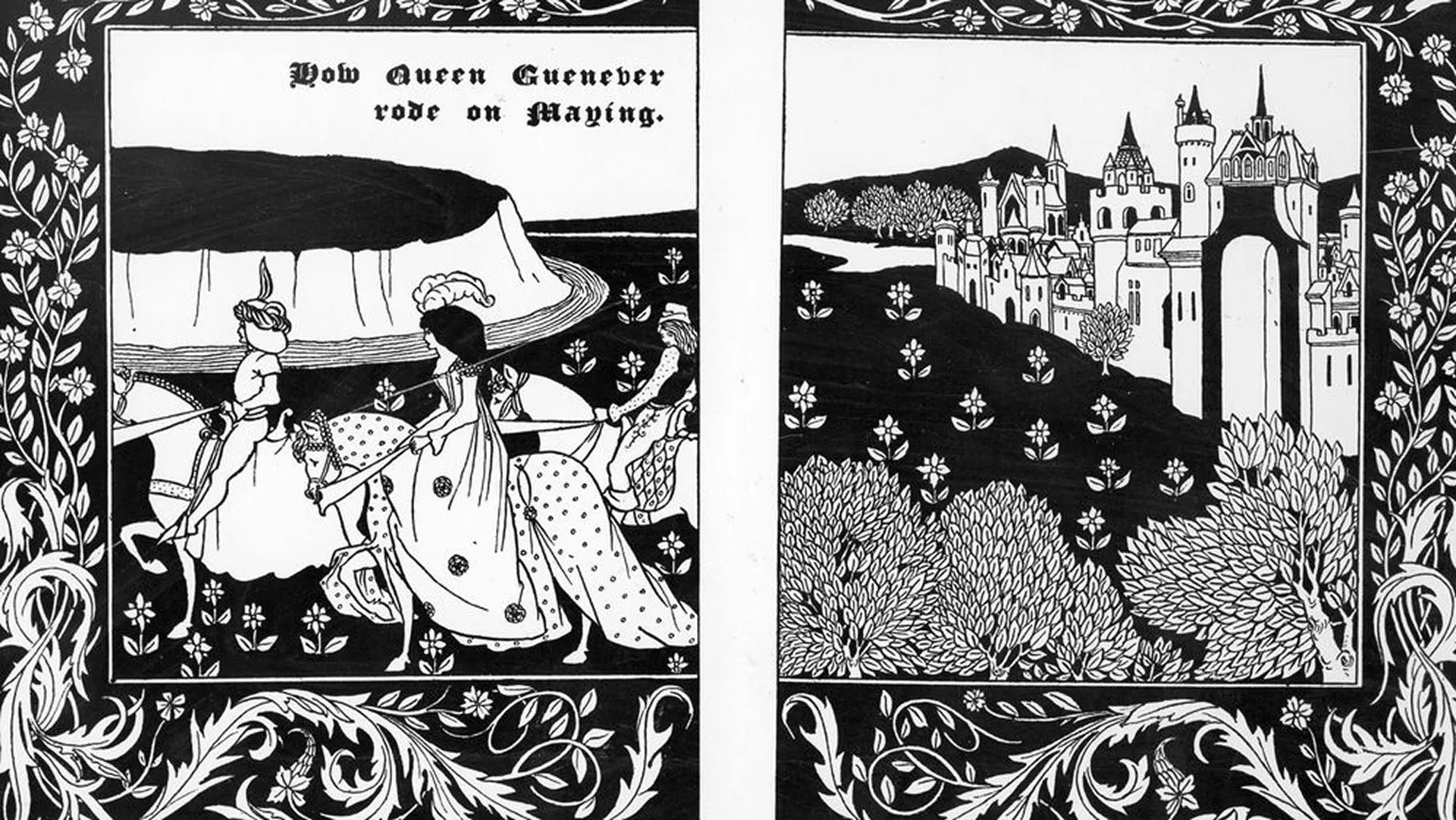
Rather than using traditional Western shading and realism, his illustrations relied on strong silhouette, flat black and white contrast, asymmetrical balance and carefully controlled negative space. His compositions often felt cropped or staged, creating dramatic tension within the page. Japanese influence could be seen in his flowing garments, elongated figures, decorative patterning and highly disciplined linework. Yet his work was never imitation. Instead, he fused these references with European symbolism, medieval imagery, Rococo ornamentation and contemporary satire to create something entirely individual. The result felt radically modern for its time.

Beardsley’s breakthrough came through his illustrations for Salomé by Oscar Wilde. Originally written in French in 1891, Wilde’s play retold the biblical story of Salome through themes of desire, obsession and death. When the English edition was published in 1894, it featured Beardsley’s illustrations, images that immediately generated controversy. The drawings were unlike traditional Victorian book illustration. They were sensual, grotesque, elegant and psychologically unsettling all at once. Beardsley combined oversized costumes, exaggerated anatomy and intricate decorative detail into compositions that often carried hidden symbolism and sexual undertones.
Some critics considered the work immoral. Others regarded it as revolutionary. Although Wilde himself reportedly had mixed feelings about the illustrations, the collaboration permanently linked the two men within cultural history. The publication also transformed Beardsley into an internationally recognised artist before the age of twenty two. Among Beardsley’s best known works from this period were The Peacock Skirt, The Climax, The Woman in the Moon and The Dancer’s Reward. These illustrations remain some of the defining images of fin de siècle art.

Following the success of Salomé, Beardsley became art editor of The Yellow Book, one of the most influential literary and artistic publications of the 1890s. The magazine became closely associated with avant garde London culture. Its bright yellow cover intentionally referenced controversial French novels that were traditionally wrapped in yellow paper when sold in Britain. Beardsley designed many of the covers and illustrations, helping shape a publication that felt visually radical compared to conventional Victorian publishing.
His work for The Yellow Book redefined magazine design by integrating typography, illustration and layout into a unified visual identity. Rather than treating illustration as secondary decoration, Beardsley made it central to the reading experience. However, scandal soon followed. In 1895, Oscar Wilde was arrested and later imprisoned following charges related to homosexuality, which was criminalised in Britain at the time. Because Wilde was carrying a yellow covered book during his arrest, public anger became irrationally connected to The Yellow Book, despite Wilde never contributing to the publication itself. Beardsley was dismissed from his editorial position shortly afterwards due to fears of reputational damage. The incident revealed how closely art, morality and public scandal were intertwined during the Victorian era.
Although Beardsley is often associated with Art Nouveau, his work moved fluidly across multiple influences and moods. Some illustrations were elegant and restrained, while others were deliberately excessive or grotesque. Throughout his career, several qualities remained consistent. His linework was extraordinarily precise. Rather than relying on heavy realism, he used black ink and negative space to create atmosphere and drama. This graphic clarity gave his work a timeless quality that still feels contemporary today.
His compositions also carried a strong sense of theatre. Many illustrations feel staged like scenes from a performance, framed by curtains, ornamental borders or exaggerated gestures. Characters appear posed, observed and intentionally artificial. At the same time, Beardsley frequently used humour and satire. Beneath the elegance of the drawings was often sharp social commentary aimed at Victorian vanity, aristocratic behaviour and cultural hypocrisy. This tension between refinement and provocation became central to his identity as an artist.

By the late 1890s, Beardsley’s tuberculosis had become increasingly severe. Despite recurring illness, internal bleeding and exhaustion, he continued producing work at remarkable speed whenever physically able. During his final years, he converted to Roman Catholicism and reportedly became uncomfortable with some of the more explicit elements of his earlier illustrations. He wrote to publishers asking for certain erotic works to be destroyed, although many survived.
Hoping that a warmer climate might improve his health, he relocated to the French Riviera. He died in Menton, France, on 16 March 1898 at just twenty five years old. His professional career had lasted little more than half a decade. Yet within that brief period, he permanently altered the direction of illustration, graphic composition and visual culture.
Beardsley’s influence expanded significantly during the twentieth century. His visual language appeared across poster design, fashion illustration, album artwork, theatre graphics and editorial publishing. During the 1960s psychedelic movement, many artists revisited his use of black and white contrast and flowing ornamental linework. What makes Beardsley endure is not simply the beauty of his drawings, but the atmosphere surrounding them. His work represented a world of performance, nightlife, artistic experimentation and social tension. It was sophisticated but dangerous, elegant but provocative.
That combination continues to resonate today because modern hospitality increasingly operates through similar ideas. Restaurants, bars and hotels are no longer designed purely as functional spaces. They are built around narrative, identity and atmosphere. This is partly why Beardsley’s legacy feels surprisingly contemporary.

At The Aubrey inside Mandarin Oriental Hong Kong, the influence of Aubrey Beardsley extends beyond the name itself. The venue draws upon the broader atmosphere associated with Beardsley’s world rather than attempting to recreate Victorian London literally. The restaurant combines Japanese dining culture, cocktail craftsmanship, music, art and layered interiors into an immersive social environment shaped around theatre and experience. This relationship feels especially fitting because Beardsley himself was heavily influenced by Japanese aesthetics throughout his career. His use of asymmetry, decorative linework and graphic contrast borrowed extensively from Japanese visual culture long before it became widely understood in Britain.
The Aubrey reflects many of these ideas spatially through layered composition, dramatic contrast, intimate lighting and a carefully staged sense of arrival and discovery. The space feels curated yet energetic, refined yet expressive, qualities closely associated with Beardsley’s illustrations and the decadent artistic culture surrounding the 1890s. Positioned within Hong Kong, a city shaped by the intersection of British heritage and Asian cultural influence, the connection becomes even more relevant. The venue does not treat Beardsley as a historical reference alone, but as a continuing symbol of artistic nightlife, visual storytelling and immersive cultural experience.
Many artists remain historically important while becoming visually distant from contemporary life. Beardsley remains unusual because his work still feels immediate. Part of this comes from the clarity of his compositions. His illustrations rely on silhouette, rhythm and contrast rather than highly period specific realism, allowing them to translate easily into modern visual culture. More importantly, Beardsley understood spectacle. His work was designed to provoke reaction, curiosity and conversation.
Whether appearing in books, galleries, fashion or hospitality spaces, it carried a strong sense of atmosphere and performance. More than a century after his death, that quality continues to influence how experiences are designed and remembered. His work survives not only because of its beauty, but because it created an entire world around itself, one that still feels compelling today.