
HOW HOTEL FUNCTION SPACE GREW FROM THE GILDED AGE BALLROOM TO DIVISIBLE HALLS, LOUNGES AND ROOFTOPS

Hotel event space design covers the rooms a hotel builds for gatherings: the ballroom, the corridors around it, divisible meeting rooms and, more recently, lounges, terraces and rooftops. The format took shape in New York in the 1890s, when the Waldorf (1893) and the Astoria (1897) took over the social role of the private Astor ballrooms on Fifth Avenue. By 1931 the new Waldorf-Astoria had a Grand Ballroom with a stage and balconies and a rooftop room whose roof rolled back on warm nights. Business events are now a measured industry: the Events Industry Council counted 1.65 billion participants in 2025 and US$1.3 trillion in direct spending.
WHERE DID THE HOTEL BALLROOM COME FROM?

In Gilded Age New York, the largest society gatherings took place in private houses. Caroline Schermerhorn Astor, who married William Astor in 1853, set out from the late 1860s to become the arbiter of society, and Britannica describes her annual January balls as central to that effort. She enlisted Ward McAllister, a Savannah-born lawyer turned socialite, who in the early 1870s had formed the Patriarchs, heads of old New York families who accepted or rejected aspirants to high society. According to the city's Landmarks Preservation Commission, the Astor houses on Fifth Avenue became a central meeting place of New York society and the setting for Mrs Astor's balls.
Those balls are linked to the phrase that came to stand for New York's elite. The Landmarks Preservation Commission, in its 1993 designation report on the Waldorf-Astoria, repeats the familiar story: McAllister coined "the four hundred" to describe the number of people who could fit into Mrs Astor's ballroom. Britannica gives a plainer account. In 1892, while shortening an invitation list for Mrs Astor, McAllister claimed that there were only about 400 people in New York society, and the phrase quickly became a popular idiom.
The hotel replaced the house within a few years. In 1890 William Waldorf Astor moved to England, a move Britannica attributes largely to her insistence on being addressed simply as Mrs Astor. On the site of his former Fifth Avenue house at 34th Street rose the 13-storey Waldorf, designed by Henry Janeway Hardenbergh in a German Renaissance style. It opened in 1893 with a benefit concert by the New York Symphony Orchestra. The 17-storey Astoria followed in 1897 on the adjoining Astor site; because the two branches of the family were on poor terms, it was built as a separate structure that could be sealed off.
PEACOCK ALLEY, THE SAVOY AND THE HOTEL AS A PUBLIC STAGE
Under its manager George Boldt, formerly of the Bellevue Hotel in Philadelphia, the Waldorf became a gathering place for the city's society, which the Landmarks Preservation Commission describes as a successor to the Astors' private homes. A corridor linking the Palm Room and the Empire Room became known as Peacock Alley, after the finery displayed by the guests and visitors who promenaded along it. The hotel also served public business: on 19 April 1912 the first hearings into the sinking of the Titanic were held at the original Waldorf, with 82 witnesses.
London followed a similar path. The Savoy opened in 1889, and Britannica's history of hotels records that it set a new standard with its own electricity and a range of services for guests. Richard D'Oyly Carte invited the hotelier César Ritz to manage the newly opened hotel; Ritz had worked with the chef Auguste Escoffier since 1887, when the two opened a restaurant in Baden-Baden. Britannica credits Ritz with converting London society to the practice of dining out, moving entertaining from private houses into hotel restaurants. Ritz went on to open the Ritz in Paris in 1898 and took a controlling interest in the Carlton in London.
HOW CONVENTIONS BECAME HOTEL BUSINESS

While New York society used hotels for balls, American cities were starting to treat conventions as trade. In February 1896 Milton J. Carmichael of the Detroit Evening Journal urged local leaders to promote Detroit as a convention destination, noting that manufacturers already held yearly meetings at the city's hotels. On 19 February 1896 business leaders met at the Cadillac Hotel and formed the Detroit Convention and Businessman's League, with hoteliers and railway agents on its founding committee. Destinations International, the association for convention bureaus, treats it as the start of the profession; its stated mission was hustling for conventions.
Hotels grew to meet that demand. Britannica describes the modern hotel as largely a product of the railway age, with a construction boom after the First World War. In 1908 Ellsworth Milton Statler opened a hotel in Buffalo, New York, aimed at business travellers; the Statler Company that grew from it became the first great hotel chain. Chicago's Stevens Hotel, later the Conrad Hilton, opened in 1927 with 3,000 rooms and remained the largest hotel in the world until the late 1960s. After the Second World War, hotels were built near major airports and chain operation became characteristic of the industry.
THE 1931 WALDORF-ASTORIA AND ITS GRAND BALLROOM

The original Waldorf-Astoria closed in 1929; its site became that of the Empire State Building. The replacement, designed by Schultze & Weaver with the design credited to Lloyd Morgan, was built from 1929 to 1931 on the Park Avenue block between East 49th and 50th Streets. At 625 feet it was one of the tallest buildings in the city, with two 20-storey hotel slabs flanking the 42-storey residential Towers. The plans described a city within a city, with restaurants, shops and exhibition halls, and at the opening a broadcast message from President Hoover was amplified in the grand ballroom.
The Landmarks Preservation Commission describes the Grand Ballroom as a traditionally theatrical space with a stage and balconies. A 1931 New York Times critic noted that its modernity was tempered by panels of classical figures in soft silver on the balcony fronts. On the 18th and 19th floors of the Park Avenue slab was the Starlight Roof, whose glass and metal roof rolled back to open the room to the sky on warm nights; the roof was inactive by 1993, but its machinery survived. Basildon Hall was furnished with pieces bought from an English country house.
The first Tony Awards were held in the Grand Ballroom on 6 April 1947, with more than 1,000 people attending on $7 tickets, and the Beatles were inducted into the Rock and Roll Hall of Fame there on 20 January 1988. Conrad Hilton bought the hotel in 1949. It closed in 2017 for a restoration led by Skidmore, Owings & Merrill and Pierre-Yves Rochon, with 375 hotel rooms and 372 residences. The Grand Ballroom, Jade Room, Astor Salon, Basildon Room and Silver Corridor were updated while keeping their Art Deco details.
HOW DO HOTELS DIVIDE A BALLROOM?
Hotels divide ballrooms with operable walls: rows of panels hung from tracks in the ceiling that can be pulled across a hall to divide it into smaller rooms and pushed back to reopen it. A 1997 United States patent granted to Wesley B. Dickson and assigned to Advanced Equipment Corporation describes operable wall systems as frequently used to divide large spaces such as convention centres, ballrooms, school classrooms and gymnasiums. In its design the panels hang from a ceiling guide track on trolleys.
The 1997 filing cites earlier inventions in the same field, including a portable partition patented by Hough Manufacturing, filed in 1970, and the Panelfold Doors patent titled Portable and Operable Wall Systems, filed in 1976 and published in 1981. The same 1997 patent sets out the main weakness of the system: operable walls are usually thinner than fixed walls and may not provide adequate sound insulation, which is why its stated aim was to improve impact resistance and reduce noise transmission between rooms.
HOW BIG IS THE MEETINGS INDUSTRY TODAY?
The Events Industry Council, working with Oxford Economics, defines a business event as a gathering of 10 or more participants for at least four hours in a contracted venue, a category that includes conventions, conferences, congresses, trade shows, exhibitions, incentive events and corporate meetings. Its 2026 study found that in 2025 business events drew 1.65 billion participants across more than 180 countries and generated US$1.3 trillion in direct spending. The sector contributed US$1.8 trillion to global GDP and supported 24.2 million jobs.
The study breaks the spending down by type and by region. Corporate and business events accounted for US$566 billion of direct spending, conventions, conferences and congresses for US$383.2 billion, trade shows for US$178.5 billion and incentive events for US$86.6 billion. North America was the largest market at US$487.7 billion, or 37.8 per cent of the global total, followed by Asia at US$352.8 billion and Western Europe at US$328 billion. The council forecasts direct spending of US$1.6 trillion by 2028, an average annual growth rate of 6.7 per cent from 2025.
BEYOND THE BALLROOM: LOUNGES, THEMED ROOMS AND OUTDOOR SPACE
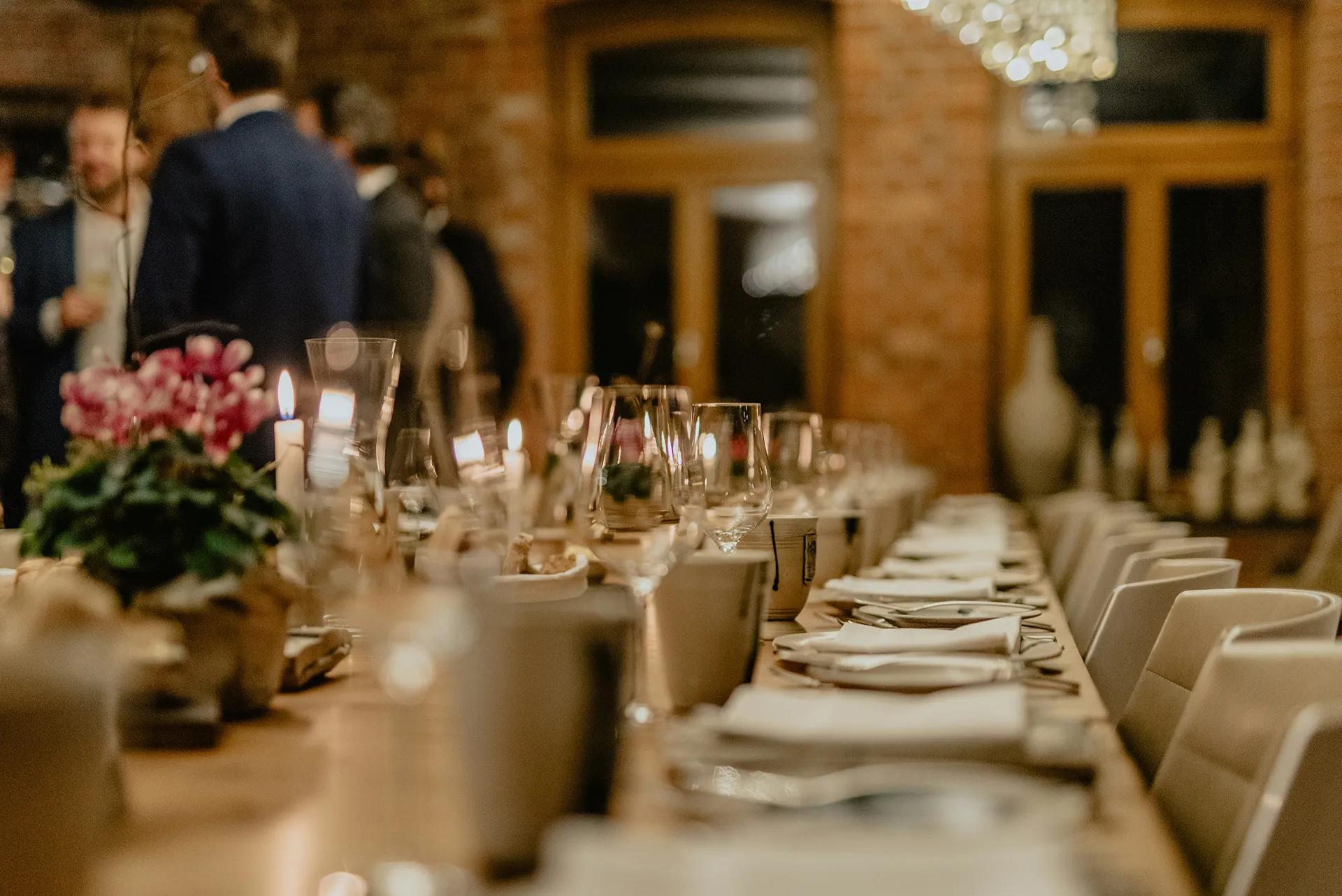
By 2017 hotels were redesigning meeting space to feel less like offices. Reporting in 2017, the trade magazine Meetings Today described hotels adding natural light, lounge seating, integrated technology, local themes and art to their meeting rooms, and rethinking the breaks between sessions. Grand Hyatt New York renovated 18 meeting rooms on its Conference Level with historic photographs of Grand Central Terminal and New York skyline artwork, and added Gallery on Lex, an informal lounge with touch-screen technology. Its general manager described the goal as a welcoming living room environment rather than a formal office atmosphere.
Other hotels took meetings outdoors or tied them to place. The Kimpton Donovan in Washington redesigned about 5,000 square feet of meeting space with a theme drawn from "Wild Bill" Donovan and the Washington Post Watergate reporting team, naming rooms after Woodward, Bernstein and Bradlee. Timber Cove Resort in Jenner, California, built in 1963, added meeting rooms in a renovation, including one with a deck over the Pacific. The idea of an event room open to the sky was not new: the Waldorf-Astoria's Starlight Roof had a retractable roof in 1931.
HYATT CENTRIC OCEANFRONT XIAMEN: A HOTEL PLANNED AS CONNECTED HOUSES

Hyatt Centric Oceanfront Xiamen, completed in 2025, is a full-scope hotel by Silverfox Studios on the Xiamen coast beside Ceng Cuo An (Zengcuo'an) Food Street. It is planned as a series of connected houses. The design draws on local street scenes and lanes, kiln-fired local bricks and local craftsmanship, as well as on music culture. Music culture is central to the ground floor. The House of Music is a focal point for live evening music, which carries across the ground floor beyond the house itself. The city's association with music extends offshore: Gulangyu, the island off Xiamen, is known as Piano Island.
SOURCES
- NYC Landmarks Preservation Commission Waldorf-Astoria Hotel, Designation Report (1993)
- Smithsonian Magazine Eight Historic Moments That Took Place at the Waldorf Astoria New York
- Britannica Caroline Webster Schermerhorn Astor
- Britannica Ward McAllister
- Britannica Hotel
- Britannica César Ritz
- Destinations International Industry Brief: Defining the 21st Century Destination Organization
- Google Patents US5603192A: Operable wall panel mounting apparatus
- Events Industry Council EIC Releases Full 2026 Global Economic Significance of Business Events Study
- Meetings Today Reworking the Room