

HOW A REGIONAL CUISINE FROM GUANGZHOU BECAME HONG KONG'S BANQUET TRADE, HOTEL DINING ROOMS AND FIRST THREE-STAR CANTONESE RESTAURANT

Cantonese fine dining in Hong Kong is the top end of Cantonese cuisine, the cooking of Guangdong province, as served in the city's banquet restaurants and luxury hotels. It rests on seasonal and often live ingredients, close control of heat, steaming, roasting and soups cooked for hours. Cantonese cooking was recognised as a distinct regional style only in the late Qing and early Republican periods, with Guangzhou as its centre. In 1949 and 1950 hundreds of thousands of people, mainly from Guangdong and Shanghai, arrived in Hong Kong, and Cantonese cooking flourished there while private catering declined on the mainland. The city's hotels opened Cantonese restaurants of their own, including Man Wah (1968), T'ang Court (1988) and Lung King Heen (2002). In 2009 the first MICHELIN Guide Hong Kong Macau gave Lung King Heen three stars, the first Cantonese restaurant to hold them.
WHERE DID CANTONESE FINE DINING COME FROM?

Cantonese cuisine became a named regional style relatively late. The food historian Zhou Songfang, interviewed by Sixth Tone in 2024, dates its recognition as a distinct style to the late Qing dynasty and the early Republic. Before that, dining in Guangzhou was dominated by cooks from the Yangtze River Delta, including Shanghai and Suzhou, whose food the city's officials and merchants preferred. He cites a remark attributed to Sun Yat-sen: for food, look to Guangzhou; for clothes, look to Suzhou. Cantonese restaurants in Shanghai pioneered private booths, hygiene standards and late opening hours; two of them, Xing Hua Lou and Guan Sheng Yuan, served late-night meals and reopened a few hours later for dim sum.
Private households also shaped the cuisine. The MICHELIN Guide's series on figures of Cantonese cuisine profiles Jiang Kong-yin, known as Jiang Taishi, one of the last candidates to pass the Qing metropolitan examination, which gave him the title taishi. His family had made its money in the tea trade, and he represented British and American tobacco companies in southern China. His household kitchen employed a chef, Western cooks, dim sum cooks and a separate cook for the vegetarian grandmothers, and most of its ingredients came from his own farm. Jiang was not a chef, but he is credited with dishes that passed into the Cantonese repertoire, including five-snake soup and deep-fried custard, and was nicknamed the first man of the hundred Cantonese foods.
HOW CANTONESE CHEFS AND DINERS CAME TO HONG KONG
Hong Kong's population fell to about 600,000 by August 1945. The Hong Kong government's yearbook records that, as the Nationalist forces faced defeat in 1948 and 1949, the territory received an influx it describes as unparalleled in its history. Hundreds of thousands of people, mainly from Guangdong, Shanghai and other commercial centres, arrived during 1949 and the spring of 1950, and by mid-1950 the population was an estimated 2.2 million. Lee Choi, the Jiang family's last household cook, also moved to Hong Kong to escape war. There he cooked for private households, worked at a private club and became a consultant to the Penthouse, the exclusive dining room of Hang Seng Bank.
On the mainland, Zhou notes, private catering declined under the planned economy, while Cantonese cooking flourished in Hong Kong because so many Cantonese chefs worked there. One Hong Kong restaurant, Lai Yuen, was known for training so many cooks that it was nicknamed the Whampoa Military Academy of Cantonese cooking. Training was by apprenticeship. Chan Yan-tak, later executive chef of Lung King Heen, entered a kitchen in 1964 at the age of 12 after his father's death, apprenticing at Dai Sam Yuen Restaurant in Wan Chai. He started at 4am, preparing dim sum and worked more than ten hours a day. In the 1960s and 1970s, the MICHELIN Guide notes, cooks had little status, whether they worked at a dai pai dong street stall or an upscale restaurant.
SEAFOOD TANKS, BANQUETS AND THE RISE OF HONG KONG'S CANTONESE RESTAURANTS

Hong Kong's Cantonese restaurants grew with the city's economy. The MICHELIN Guide's profile of Chan sets out the sequence: new public transport and public housing, then booming stock and property markets, and a restaurant trade that began to target the tycoons the economy produced. Live seafood became central in the same period. Zhou points out that Cantonese cooking had long used aquatic ingredients such as shark fin, but that live seafood became a defining part of the cuisine only after restaurants installed seafood tanks. The MICHELIN Guide links the emphasis on seafood to Guangdong's position on the South China Sea and notes that Cantonese restaurants still display live seafood tanks at their fronts to draw customers in.
Three independent restaurants founded in this period held MICHELIN stars in 2020. Sun Tung Lok opened in Causeway Bay in 1969 and is now run by the third generation of the founding Yuen family, with baked stuffed crab shell and roast suckling pig among its signatures. Fook Lam Moon began as the private catering business of its founder, Chui Fook Cheun, before he opened his first restaurant in Wan Chai in 1972. Known as the tycoons' canteen, its menu features dry-aged abalone, bird's nest and shark's fin. Lei Garden opened its first restaurant in Mong Kok in 1973 and runs its own 300-acre farm in nearby Zhanjiang for pork, poultry and vegetables.
HOTEL CHINESE RESTAURANTS: MAN WAH, T'ANG COURT AND LUNG KING HEEN

Hong Kong's luxury hotels opened Cantonese restaurants of their own. Man Wah, the Cantonese restaurant of Mandarin Oriental Hong Kong, has a history dating to 1968. Its current executive chef, Wong Wing Keung, is a third-generation Cantonese chef who joined as sous chef in 2011 and has led the kitchen since 2018, after running Yee Tung Heen at The Excelsior. T'ang Court at The Langham, Hong Kong, opened in 1988, and its Chinese master chef, Kwong Wai Keung, has been there since the opening. The restaurant's stir-fried lobster with spring onion, red onion and shallot won the Hong Kong Tourism Board's Best of the Best Culinary Award in 2002.
Lung King Heen opened at Four Seasons Hotel Hong Kong in 2002, with Chan Yan-tak as executive chef. The MICHELIN Guide reports that he was lured out of retirement to lead the kitchen, nearly four decades after his apprenticeship in Wan Chai, and that he cooks mostly traditional Cantonese dishes with occasional French touches. The restaurant serves a different slow-boiled soup every day alongside premium double-boiled soups. Mak Kwai Pui, owner of the one-star dim sum shop Tim Ho Wan, worked at Lung King Heen first, and the MICHELIN Guide credits that experience with helping him start his business.
THE MICHELIN GUIDE HONG KONG MACAU AND THE FIRST THREE-STAR CANTONESE RESTAURANT
The MICHELIN Guide Hong Kong Macau launched in 2009, and its first edition gave three stars to Lung King Heen, the only Chinese restaurant among that year's three-star selection. The MICHELIN Guide describes it as the first Cantonese restaurant to earn the rating. Before the stars, a table could be booked two days ahead. Afterwards, Lung King Heen was usually fully booked a month in advance on weekdays and three weeks ahead at weekends. The hotel invested more in the restaurant, and its team, 35 people at the opening, had grown to 45 by 2017. The rating also changed how cooks were seen: Chan observed that a chef from a three-star kitchen was viewed differently from one who was not.
Other Cantonese restaurants later followed Lung King Heen into the top category. In the 2011 edition, Sun Tung Lok became the first Chinese restaurant in the city outside a hotel to receive three stars. T'ang Court gained its third star in 2016, becoming only the third Chinese restaurant in the world to hold three. Chan told the MICHELIN Guide that presentation has become a big factor in gourmet Cantonese cuisine, and that some dishes are now served by designated staff.
WHAT TECHNIQUES DEFINE CANTONESE FINE DINING?
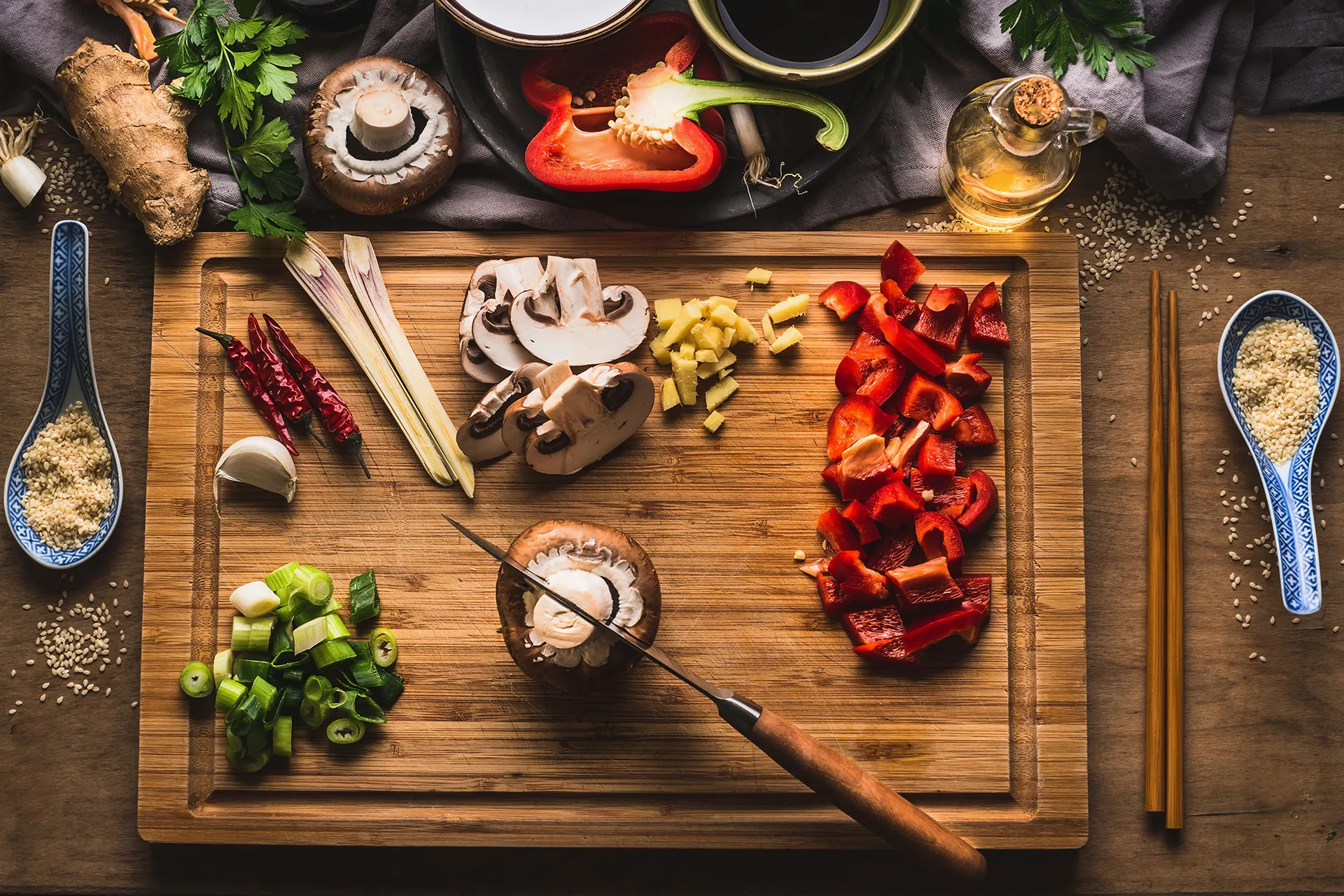
The MICHELIN Guide sums up the principles of the cuisine: produce chosen at its seasonal peak, fresh and often live seafood, and a range of techniques from stir-frying, pan-frying and deep-frying to steaming, braising and roasting, all aimed at bringing out each ingredient's own flavour. Central to all of them is huo hou, control of heat intensity and timing, which determines texture and flavour. Steaming is used on its own and in combination: pipa tofu, named after the pear-shaped lute it resembles, is steamed and then deep-fried for a crisp outside and a soft centre.
The MICHELIN Guide distinguishes three Cantonese soups: quick-boiled gwan tong, slow-boiled lou fo tong, which cooks for at least three hours, and double-boiled dan tong, which takes at least four. For a double-boiled soup, the ingredients and water are sealed in a ceramic pot that is set inside a larger pot of boiling water; Chef Tam Tung of Yat Tung Heen says this gives a clearer soup than slow boiling. Roast meats, or siu mei, are marinated, then spit-roasted over open flames or hung in charcoal ovens. For roast suckling pig, the skin is punctured during roasting and the pig is held open on a two-pronged spit and turned constantly so that the skin crisps.
SHARK FIN AND CONTEMPORARY CANTONESE COOKING
Shark fin, which Zhou counts among the long-established aquatic ingredients of Cantonese cooking, became the most visible point of change. In September 2013 the Hong Kong government announced that shark fin, bluefin tuna and black moss would no longer be served at official entertainment functions, citing international and local concern. NPR, reporting the decision, noted that Hong Kong handles about half of the world's shark fin trade and that mainland China had said it would ban shark fin soup at official banquets. The ingredient has not disappeared from private menus: in 2020 the MICHELIN Guide still listed shark's fin among the ingredients on Fook Lam Moon's menu.
Contemporary Cantonese cooking in Hong Kong combines the older techniques with imported ingredients and new dishes. Chan lists bitter melon from Okinawa, eggs from Japan and fresh Australian truffle in the Lung King Heen kitchen, while saying they are not the foundation of Cantonese cooking. When Man Wah reopened in February 2021 after a six-month renovation, Wong Wing Keung's menu, themed Taste Original Flavours, included a vegetarian version of guo ja, a Beijing street snack, made with Japanese matsutake mushroom, and a corn and blood bird's nest soup inspired by a sweet corn soup he had eaten in Japan.
MAN WAH AT MANDARIN ORIENTAL HONG KONG
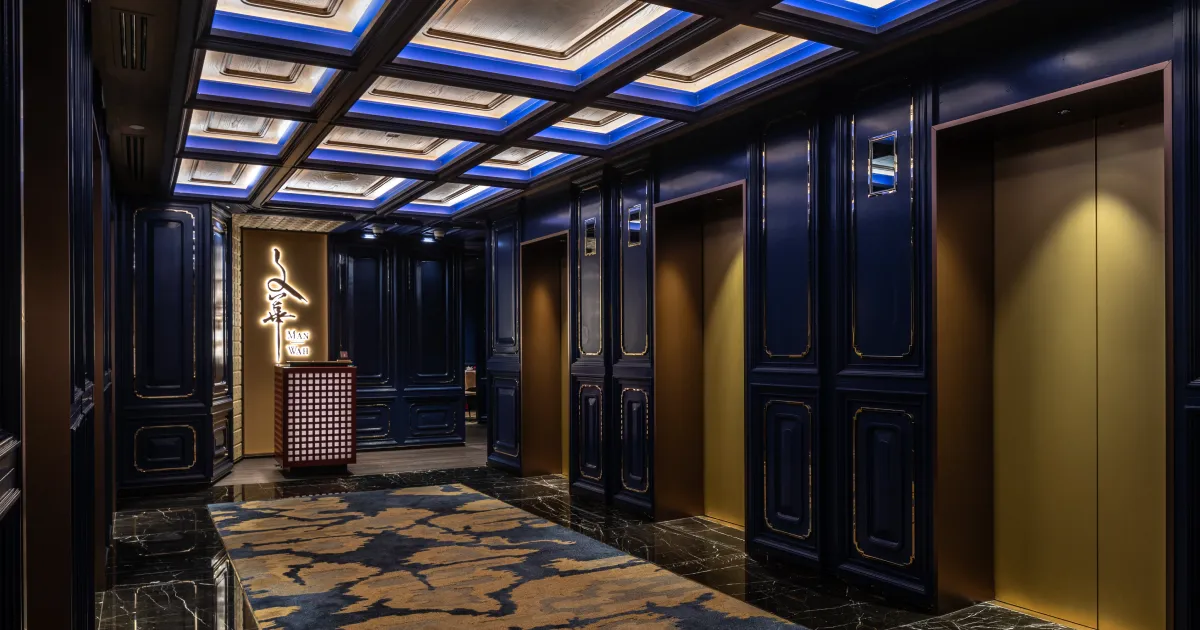
Man Wah is the Cantonese restaurant on the 25th floor of Mandarin Oriental Hong Kong, and it holds One MICHELIN Star. Silverfox Studios redesigned it in 2021. The design takes the Hong Kong skyline and Victoria Harbour, both seen from the restaurant's windows, as its subject and combines them with references to the hotel's heritage. The interior has navy panelling with gold trim, and a bespoke blue and gold carpet that mixes silk with hand-carved patterning to evoke light on the harbour.
The heritage references start with the restaurant's own past. The lanterns reinterpret the original Man Wah lanterns: clustered brass cage forms hold embroidered, pleated shades, so that the light fittings of the earlier dining room return in a new form. Embroidery appears again in an embroidered dragon and floral artwork set on a navy wall panel, the same navy used for the panelling with gold trim.
SOURCES
- Sixth Tone How China Fell in Love With Cantonese Cooking
- MICHELIN Guide Prominent Figures Of Cantonese Cuisine: Jiang Taishi
- Hong Kong Government, Hong Kong Yearbook 2004 History: The Post-war Years
- MICHELIN Guide Cantonese Cuisine: A Decade in Review
- MICHELIN Guide 5 Iconic MICHELIN Star Cantonese Restaurants in Hong Kong
- MICHELIN Guide The First Day I Got My MICHELIN Stars: Chan Yan-tak of Lung King Heen
- MICHELIN Guide Classic Cantonese Dishes in Hong Kong
- MICHELIN Guide Restore Your Yin and Yang: The Extraordinary Cantonese Soups
- NPR Hong Kong Bans Shark Fin At Official Functions
- MICHELIN Guide Man Wah To Reopen With A Focus On Time-Honoured Cantonese Dishes


