FROM A TENTH-CENTURY BANQUET SCROLL AND THE WINE HOUSES OF SONG DYNASTY KAIFENG AND HANGZHOU TO THE QING COURT

Private dining rooms are enclosed rooms in Chinese restaurants, usually arranged around a single round table, that a host books for family celebrations, banquets and business entertaining. Their history can be followed through paintings and written records. A 10th-century handscroll, The Night Revels of Han Xizai, shows a private banquet in a house divided by painted screens. Meng Yuanlao's Dongjing meng hua lu, a memoir of the Song capital Kaifeng, describes multi-storey wine houses lit from top to bottom at dusk, restaurants that kept rooms for a hundred or more parties, and hire services that supplied everything a household needed for a banquet. Wu Zimu's Mengliang lu of 1275 records a similar trade in Hangzhou. Later records cover the Qing court's Thousand Elders Banquets, the legend of the Manchu Han Imperial Feast and the seating rules that still govern the host's table.
A PRIVATE BANQUET IN PAINT: THE NIGHT REVELS OF HAN XIZAI

The most detailed early picture of a Chinese private banquet is a handscroll. The Night Revels of Han Xizai is attributed to Gu Hongzhong, a court painter of the Southern Tang, one of the kingdoms of the Five Dynasties period (907 to 960). According to Harvard Library, which exhibited a facsimile in 2018 and 2019, it shows an evening banquet held by Han Xizai, a Southern Tang minister; the original, a handscroll of 28.7 by 335.5 cm, is in the Palace Museum in Beijing. The scroll is divided into five scenes: listening to music, watching dancers, relaxing, playing string instruments and seeing the guests off. Gu painted a screen between each scene, so that the sections join into one continuous picture.
Smarthistory's account of the scroll describes the furnishings of the party. Guests sit on raised couch beds rather than on floor mats, a table in front of them holds small plates and drinks, and large screens painted with landscapes stand behind the seating. The scroll is read from right to left. In the first scene Han, seated among officials, watches a woman play the pipa; in later scenes he beats a drum beside a dancer, washes his hands at a basin, listens to women playing flutes and bids his guests farewell. Gu drew Han larger than the people around him and in a tall hat, which marks him as the host.
WINE HOUSES AND PRIVATE ROOMS IN SONG DYNASTY KAIFENG
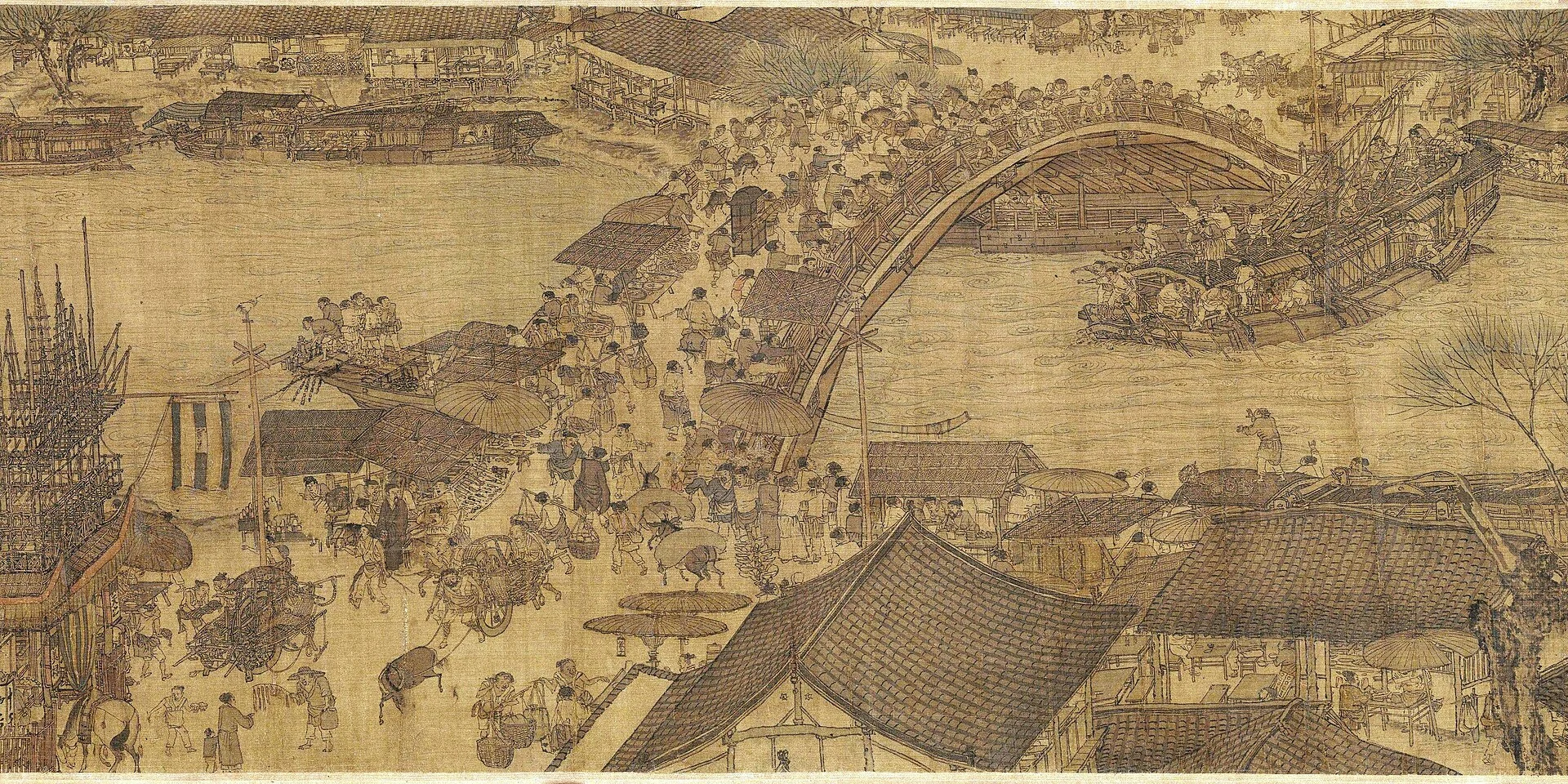
Kaifeng was the capital of the Northern Song dynasty. Meng Yuanlao (about 1090 to about 1150) recorded its daily life in the Dongjing meng hua lu. According to Meng, every wine house in the capital decorated its entrance with a coloured gateway. At one of them, the Ren Dian, a main corridor about a hundred paces long ran in from the door, with courtyards and side corridors to the north and south. At dusk, lamps and candles lit the upper and lower floors.
The largest house Meng describes is the Baifan Lou, later renamed the Fengle Lou. During the Xuanhe reign it was rebuilt to three storeys, as five buildings facing one another and linked by flying bridges with railings, hung with pearl curtains and embroidered signboards. Meng names more than a dozen other major wine houses and says the rest were called jiaodian. Writing in The World of Chinese, Hatty Liu notes that these wine mansions, or jiulou, were run both by the state and privately, were often the only multi-storey buildings in their neighbourhoods, and had dozens of private dining rooms on their upper floors.
Two houses, the Renhe Dian in the east of the city and the Huixian Lou inside the Xinmen gate, regularly kept rooms for a hundred or more parties, each fully supplied with dishes and utensils so that nothing was missing. For weddings and funerals, households could hire tables, chairs, displays, tableware and serving equipment from specialist tea and wine services; even for a hundred or more guests, Meng writes, the halls were kept in good order and the host only had to pay. In a passage translated by the sinologist Dorothee Schaab-Hanke, Meng also notes that market brokers did their eating and drinking in the market restaurants.
HANGZHOU RESTAURANTS IN THE MENGLIANG LU

When the Song court moved south, it settled at Hangzhou, which served as capital from about 1127 until 1279. The economist Nicholas Kiefer, writing in the Cornell Hotel and Restaurant Administration Quarterly, notes that before the Mongol invasions the city had about a million inhabitants, at a time when Paris had only tens of thousands. The Ducheng jisheng, a description of Hangzhou dated 1235, states that the city's restaurants were mostly run by people from the old capital, and Schaab-Hanke shows that it traced the decorated frontages of Hangzhou's wine houses back to a Kaifeng house called the Pan Lou.
Wu Zimu's Mengliang lu, completed in 1275, is the fullest account of the Hangzhou trade. Drawing on it through the historian Jacques Gernet, Kiefer describes large restaurants whose doors were archways decorated with flowers. A customer chose a seat and was then asked what he wanted, and several orders arrived together, hot and cold, cooked in different ways. Restaurants specialised by region, serving Kaifeng-style or Sichuan cooking, cheap noodle dishes with meat or fish, or, possibly for Muslim diners, menus without pork. Kiefer concludes that by 1275 the market was already finely segmented.
Private rooms formed part of this segmentation. Liu cites The Affairs of Wulin, a 13th-century memoir of Hangzhou, on the women who served guests in the private rooms of the city's wine houses, dressed in bright colours; those who knew their wines helped guests choose, while musicians and acrobats also performed for diners. The private room of a wine house also entered fiction: Liu notes that the 14th-century novel Outlaws of the Marsh uses one as the setting for a brawl.
QING COURT BANQUETS: THE THOUSAND ELDERS AND THE MANCHU HAN IMPERIAL FEAST
The largest and most lavish banquets of the Qing dynasty (1644 to 1912) were the Thousand Elders Banquets. According to the Baltimore Museum of Art, the first was held on 12 April 1713 to mark the 52nd year of the Kangxi emperor's reign and his 60th birthday, and more than 1,000 men over the age of 65 attended. Porcelain plates were made for the occasion, both for use at the banquet and as gifts for especially important guests. Several plates with naturalistic decoration and brocade-like borders, bearing the seal-script characters wanshou wu jiang, longevity without end, are associated with it.
The banquet most often linked with the Qing court in popular memory is the Manhan quanxi, the Manchu Han Imperial Feast. Popular lore holds that the feast ran to 108 dishes served over three days. Sun Xiaochun, head chef of the Cui Yuan restaurant in Beijing, told NPR that weeklong banquets were the norm, usually for occasions such as the emperor's birthday. Sun's training links him to the court: his teacher's teacher was a court chef at the Qing summer palace at Chengde, where the Qing emperors spent their summers.
Sun's own version of the feast had 268 dishes, not counting appetisers and desserts, cost just over US$54,000, and could take a client up to a year to eat through; one of its soups was described as a favourite of the Yongzheng emperor. Eileen Wen Mooney pointed out to NPR that nobody alive today has tasted a real imperial feast, so every modern Manchu Han banquet is a reconstruction. The three-day legend and the 108-dish count cannot be checked against a surviving meal.
WHERE DOES THE HOST SIT AT A CHINESE BANQUET?
Seating at a Chinese banquet table follows a fixed order. A table etiquette guide republished on the Shanghai government's English portal states that the seat facing the entrance is the most important and is usually reserved for the host or the guest of honour. The seat opposite is reserved for the co-host, who makes sure the ordering of food runs smoothly. Other guests are seated outward from the highest-ranking person according to their status, and the guide advises visitors to wait until they are told where to sit. When toasting the host, a guest stands, holds the cup with both hands and keeps it lower than the host's glass; the host normally insists on paying the bill.
How much depends on this arrangement is the subject of a 2026 INSEAD teaching case by Alex A. Sun and Guoli Chen. It follows a Shanghai managing director planning a dinner in the private dining room of a Shanghai restaurant, a task the authors describe as anything but administrative in a Chinese business context. The case teaches the basic spatial axis of the table, the back wall against the door side and the host's right against the host's left, and uses the buyer and seller relationship to decide who takes the guest of honour's seat and who sits second.
GRAND IMPERIAL COURT: GEMSTONE SUITES AT MGM MACAU

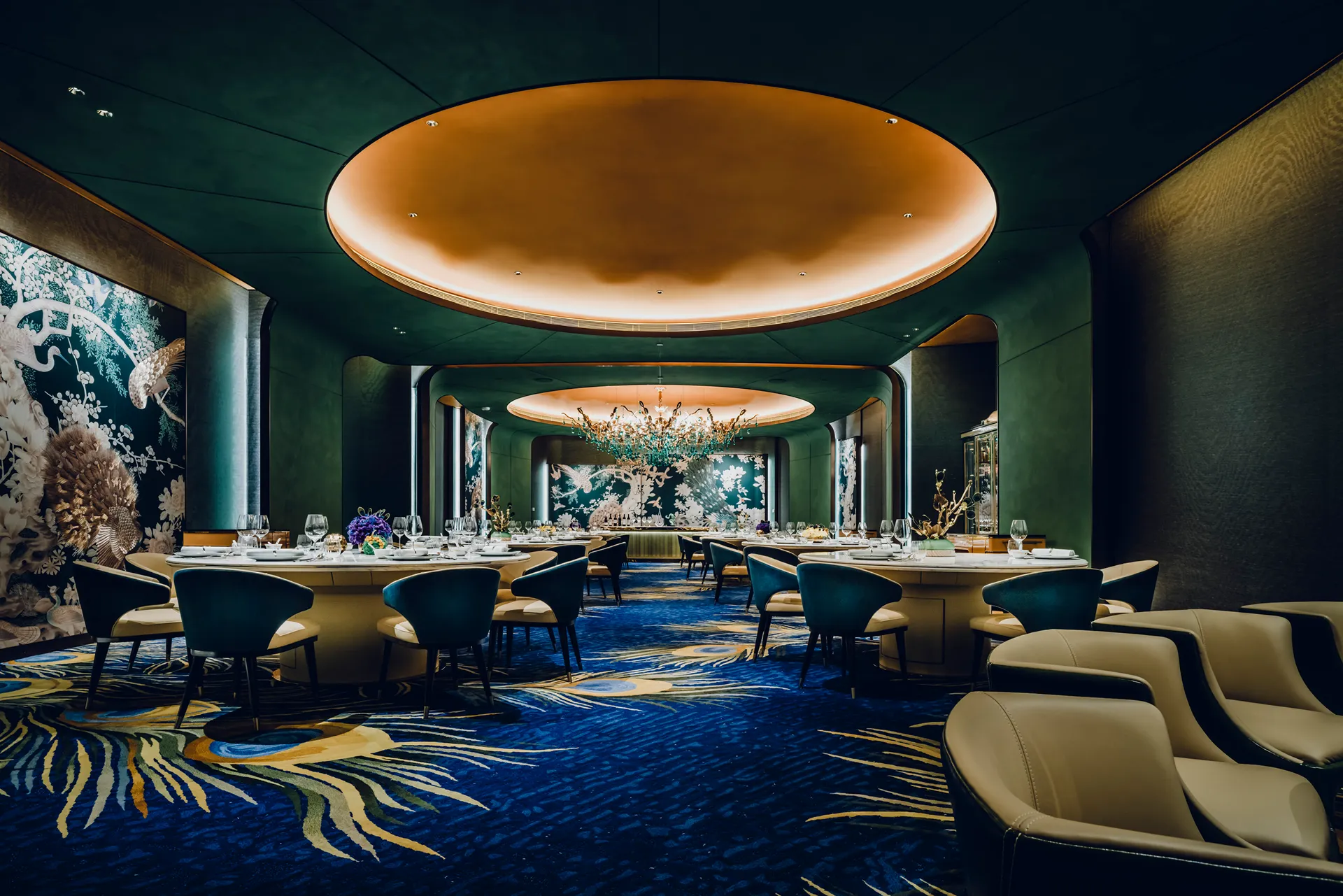
Grand Imperial Court at MGM Macau is a Chinese fine dining restaurant designed by Silverfox Studios and completed in 2024. Guests enter through an automated sliding entry that opens onto a display wall for Moutai: floating, individually lit jewel-box vitrines in red and gold holding rare vintage bottles of the baijiu. The wall serves as a brand statement and as a ceremonial introduction to the restaurant. Beyond the entrance, the restaurant's private suites are themed on gemstones: sapphire, emerald, ruby and gold. Each suite carries custom hand-crafted tapestries. The suites are separate rooms for hosted parties within a larger restaurant, the arrangement Meng Yuanlao recorded in 12th-century Kaifeng, where the Huixian Lou and the Renhe Dian kept rooms for a hundred or more parties at a time, each fully supplied with its own dishes and utensils, and which The Affairs of Wulin described in the wine houses of 13th-century Hangzhou.
SOURCES
- Project Gutenberg Meng Yuanlao, Dongjing meng hua lu (Chinese text)
- Oriens Extremus Dorothee Schaab-Hanke, The Capital Behind the Capital: Life in Kaifeng as Reflected in the Ducheng jisheng (2011)
- Cornell University Nicholas M. Kiefer, Economics and the Origin of the Restaurant, Cornell Hotel and Restaurant Administration Quarterly (2002)
- The World of Chinese Wine, Women and Song
- NPR A Chinese Imperial Feast: A Year In The Eating
- Shanghai Municipal People's Government Guide to table etiquette in China
- INSEAD The Dinner Table Before the Deal: Seating Protocol at a Chinese Business Banquet
- Harvard Library Night Revels of Han Xizai (Hanxizai Yeyantu)
- Smarthistory The Night Revels of Han Xizai
- Baltimore Museum of Art Segmented plate associated with the Qing Thousand Elders Banquet