HOW CHINA'S SILK TAPESTRY WAS WOVEN, WHO MADE IT AND HOW IT WAS USED IN IMPERIAL AND PRIVATE ROOMS

Chinese tapestry is best known through kesi, a silk tapestry weave whose name is usually translated as cut silk or carved silk. In kesi, each coloured weft thread is woven only within its own area of the design, so the image is built into the cloth on the loom rather than stitched onto it afterwards, and the finished piece is reversible. The technique came to China from Central Asia, where it was associated with Sogdian and Uyghur weavers, and the earliest surviving Chinese examples date from the Tang dynasty (618 to 907). Under the Song (960 to 1279), weavers such as Zhu Kerou and Shen Zifan used it to reproduce paintings; the Mongol Yuan court wove Buddhist icons more than two metres high; and in the Qianlong reign of the Qing dynasty most court kesi came from the imperial textile factory in Suzhou. It was hung on walls, mounted as scrolls and made into robes, and is still woven in Suzhou.
WHAT IS KESI? HOW CHINESE SILK TAPESTRY IS WOVEN
In an ordinary woven cloth, each weft thread runs across the full width of the warp. In tapestry, the weft is discontinuous: each colour is passed back and forth only across the section of warp where that colour is needed. A study in the Annals of the Náprstek Museum in Prague notes that, unlike brocade, kesi weft does not run from selvage to selvage. Where two colour areas meet along a vertical line, each weft turns back around its own neighbouring warp thread, leaving a small gap between them. The study calls these slits the distinctive characteristic of the kesi weave, and the Chinese name refers to them. Britannica adds that kesi is traditionally made entirely of silk, has a very fine texture and is finished on both sides.
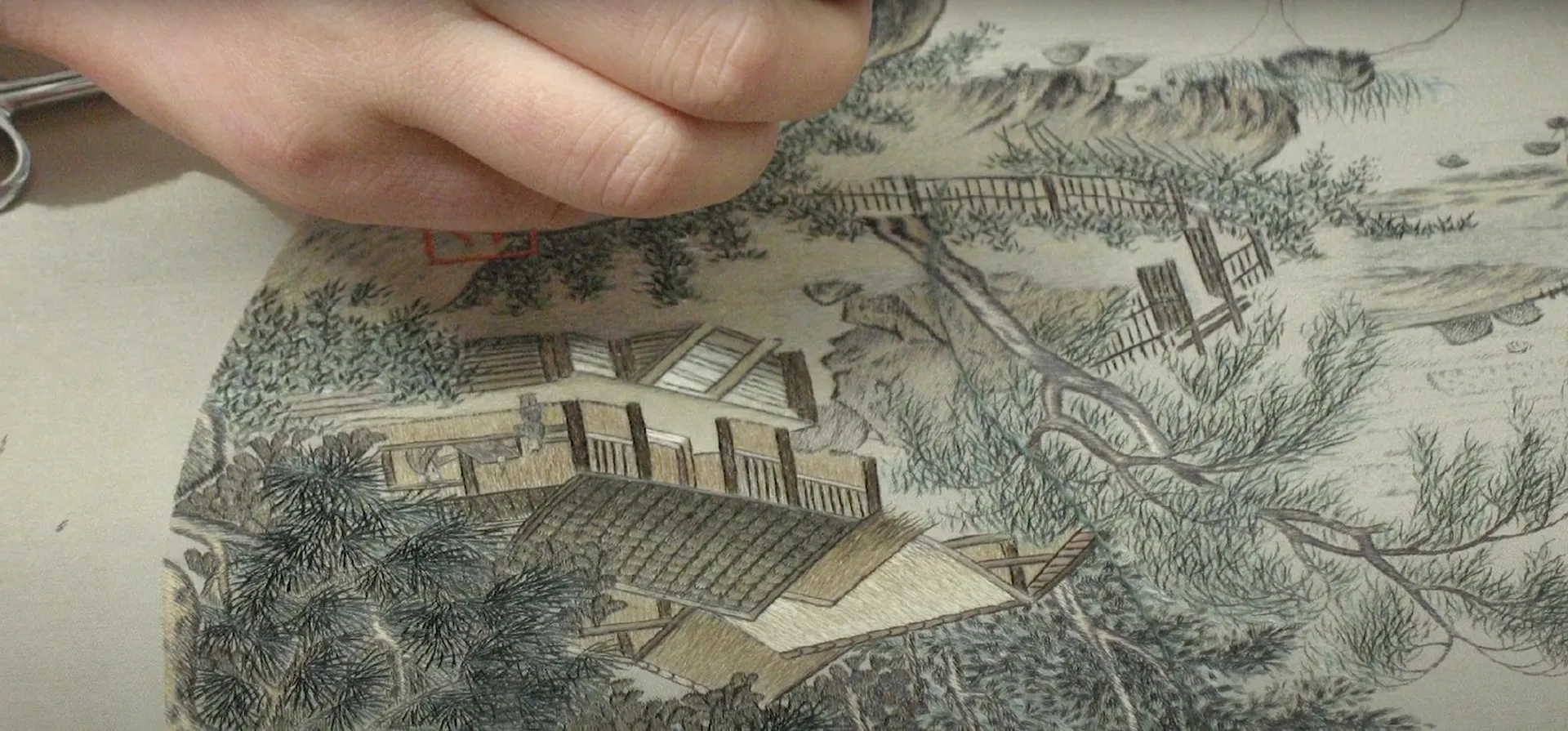
Separate colour areas allow detailed pictures. A Southern Song hanging scroll by Shen Zifan in the Palace Museum, Beijing, was woven with a small shuttle carrying silk in 15 to 16 colours. Weavers also developed shading methods: a kesi scroll at the University Museum and Art Gallery of the University of Hong Kong uses changduanqiang, long and short propping, for its magnolia petals and baoxinqiang, embracing propping, which shades colour from the edge towards the centre, for its orioles. Embroidery is a different craft. Britannica defines it as decorating material, primarily textile fabric, with a needle and thread, so the design is added to cloth that has already been woven; China's main regional schools are covered in the Four Great Embroideries of China. In kesi the woven image is the fabric.
WHERE DID KESI COME FROM? CENTRAL ASIA, THE UYGHURS AND THE TANG

The technique reached China from the west. The Rubin Museum's Project Himalayan Art states that kesi was originally associated with the Sogdian and Uyghur peoples and that silk tapestry was already woven in the Tarim Basin between the sixth and eighth centuries. The Náprstek study cites the scholar Cammann, who placed the origin of the technique in Central Asia or the Near East and dated its arrival in China to the first half of the tenth century. The same study says the Sogdians developed the weave and that the Uyghurs and Khitans knew it.
Surviving finds are earlier than Cammann's date. Britannica places the earliest surviving examples in the Tang dynasty: eighth-century fragments were found near Turfan, in today's Xinjiang Uygur Autonomous Region, and late Tang fragments at the Mogao Caves near Dunhuang, with simple repeating patterns of flowers, vines, ducks and lions. A larger and more sophisticated eighth-century kesi hangs in the Taima-dera temple near Nara in Japan. At about 4 square metres, Britannica describes it as the oldest known complete Chinese wall tapestry.
Central Asian production continued alongside Chinese work. The Metropolitan Museum of Art's Tapestry with Dragons and Flowers, woven in eastern Central Asia in the 11th or 12th century, sets a dragon against a ground of flowers, a pairing the museum considers most likely a Central Asian invention. Its long-snouted dragon follows a Tang convention that survived in Central Asia until at least the Yuan dynasty. The Met attributes pieces of this kind to Uyghur weavers, who were known for tapestry-woven clothing, and identifies brilliant colours and lively animals as regional characteristics.
SONG DYNASTY KESI: HOW WEAVERS COPIED PAINTINGS IN SILK

Britannica records that the imperial family, which encouraged painting, also supported tapestry, and identifies Dingzhou in Hebei province as an important weaving centre. Many kesi were woven after paintings and mounted as hanging scrolls and album leaves in the same way as the originals. The National Palace Museum in Taipei notes that during and after the Song kesi became both more decorative and more practical, and later developed into an art made purely for appreciation. Masterpieces of Song kesi later entered the Qing court collections.
Two Southern Song weavers are known by name from surviving works. Zhu Kerou was a woman weaver from the area of present-day Shanghai. Her kesi of ducks in a lotus pond, a flower-and-bird subject, has belonged to the Shanghai Museum since 1952; the journal Orientations reports that it stayed in storage except for a short exhibition in Japan in 1993, until the museum gave it a special exhibition in 2022. The journal notes that its design recalls the style of the Imperial Painting Academy.
Shen Zifan's Kesi Tapestry of Plum Blossoms and Magpies in Winter, in the Palace Museum, Beijing, is a hanging scroll 104 cm high and 36 cm wide, woven after a painting and combining several kesi techniques; it passed through the Qing imperial collection, and the museum counts it among the few surviving works by Shen. Song kesi were later copied. The National Palace Museum records that in the late Ming, artisans south of the Yangtze made imitations of ancient kesi and embroidery, and that some entered the Qing palace as tribute or birthday gifts and were accepted as Song originals.
YUAN AND MING KESI: IMPERIAL WORKSHOPS AND WALL HANGINGS

Under the Mongol Yuan dynasty, according to Britannica, a government factory for weaving kesi was established at Hangzhou, and its work was known for rich ornamental designs, often using gold and silver thread. The court also commissioned kesi on a monumental scale. The Vajrabhairava mandala in the Metropolitan Museum, woven in silk and gold around 1330 and probably made in Dadu (present-day Beijing), measures 245.5 by 209 cm. Yong Cho, writing for the Rubin Museum, explains that Mongol court workshops adapted Central Asian weaving techniques to make such silk icons.
The mandala carries portraits of its imperial donors, identified by Tibetan inscriptions: the emperor Tugh Temür (Wenzong) and his brother Qoshila (Mingzong) at lower left, and their wives Budashiri and Babusha at lower right. Under the Ming (1368 to 1644), Britannica describes surviving kesi as rare. Large pieces were woven for walls: the late Ming hanging Fenghuang in a Rock Garden measures about 2.2 by 1.75 metres and, like other large Ming kesi, is brighter and heavier in texture than small pieces and often uses metal thread. The Náprstek study notes that kesi was also used for the rank insignia worn by the Ming and Qing bureaucracy.
QING PALACE KESI: KANGXI, QIANLONG AND THE SUZHOU IMPERIAL WORKSHOP

Britannica considers the kesi woven under the Kangxi emperor (reigned 1662 to 1722) the finest of the Qing period, noting its delicate colouring and its philosophical and religious themes. The National Palace Museum records that the Qing court commissioned flower-and-bird, landscape and figure subjects as well as historical, Buddhist and Daoist themes, and that imagery from the Illustrations of Planting and Weaving became prominent from Kangxi's reign. Production was concentrated in the three main weaving centres south of the Yangtze: Suzhou, Jiangning (Nanjing) and Hangzhou.
Under the Qianlong emperor, the Archives of the Imperial Workshops show that most court kesi was made by the Suzhou Imperial Textile Factory. His own calligraphy and paintings were woven in kesi, his poems were written out in calligraphy and then woven, and kesi also imitated popular 18th-century Suzhou prints. The practice lasted until the end of the dynasty: the Empress Dowager Cixi (1835 to 1908) wrote the character for longevity, which was enlarged and woven. Britannica notes that quality declined in the later Qing and that 19th-century kesi often relied on painting to refine details of the design.
HOW KESI WAS USED IN CHINESE INTERIORS
Britannica lists the main forms kesi took: wall hangings for large surfaces, mounted scrolls and album leaves, and decoration for furniture and clothing. The Náprstek study describes how these worked inside a house. Kesi hangings functioned visually as paintings, and large works hung in wealthy homes, while small pieces such as book covers were appreciated in the privacy of a scholar's studio. Kesi copies of paintings, such as the Ming Dongfang Shuo Stealing the Peaches of Longevity in the Metropolitan Museum, were mounted in the same formats as painted scrolls. Kesi was also a traditional court and diplomatic gift.
Clothing was the other main use. The same study records that kesi was often used for the mandarin robes of Chinese scholars and members of the bureaucracy, and in the late Qing for official and women's dress. Many late Qing pieces combined woven areas with painted details, and the quality of the weaving varied. Kesi also moved between dress and furnishing. In the early 20th century, rank badges from official robes were remade into pillows and into women's purses and handbags.
SUZHOU KESI TODAY AND ITS INTANGIBLE HERITAGE STATUS
Kesi weaving continued in Suzhou after the empire ended. A kesi scroll in the University of Hong Kong's museum bears the seal of Shen Jinshui (1883 to 1968), who was born in Likou in Wu county, Jiangsu, began learning kesi at 15 and reportedly served in the imperial workshops of the Forbidden City. He became one of the three most prominent kesi weavers in Suzhou and in the 1950s taught at the Suzhou Cixiu Yanjiusuo. His pupil Wang Jinshan, born in 1939, was later designated a Representative Inheritor of Suzhou kesi weaving.
According to the same museum, Suzhou kesi weaving was among the first group of items placed on China's National List of Intangible Cultural Heritage in 2006. At international level, UNESCO inscribed Sericulture and Silk Craftsmanship of China on the Representative List of the Intangible Cultural Heritage of Humanity in 2009. That inscription covers the whole chain of silk making in Zhejiang and Jiangsu, near Shanghai, and in Sichuan, near Chengdu: growing mulberry, raising silkworms, reeling silk, making thread, and designing and weaving fabric. It does not name kesi specifically.
TAPESTRY AT GRAND IMPERIAL COURT, MGM MACAU

Grand Imperial Court is a Chinese fine dining restaurant at MGM Macau, with interiors designed by Silverfox Studios and completed in 2024. An automated sliding entry opens onto a display wall for Moutai, made up of floating, individually lit jewel-box vitrines in red and gold that hold rare vintage bottles, designed as a brand statement and a ceremonial introduction to the restaurant. Beyond it, the private suites are themed on gemstones: sapphire, emerald, ruby and gold. The suites are fitted with custom hand-crafted tapestries.
SOURCES
- Britannica Tapestry: periods and centres of activity
- Britannica Embroidery
- Náprstek Museum, National Museum Prague Helena Heroldová, Sober Luxury: Three Examples of Late Kesi Silk Tapestries in the Náprstek Museum (Annals of the Náprstek Museum 34/2, 2013)
- The Metropolitan Museum of Art Tapestry with Dragons and Flowers, 11th to 12th century
- Rubin Museum of Art, Project Himalayan Art Yong Cho, Woven Mandalas in the Mongol Imperial Court
- The Palace Museum, Beijing (Google Arts & Culture) Kesi Tapestry of Plum Blossoms and Magpies in Winter, Shen Zifan
- Orientations November/December 2022 issue: The Special Exhibition of the Kesi Lotus Pond and Ducks
- National Palace Museum, Taipei Ancient Works of Kesi and Embroidery in the Qing Court Collections
- University Museum and Art Gallery, The University of Hong Kong Orioles and magnolias, kesi hanging scroll
- UNESCO Sericulture and silk craftsmanship of China