OAK BARK PITS, CHROME SALTS AND THE LEATHERS OF SPAIN AND FEZ

Leather tanning is the chemical treatment that turns a raw animal hide into a stable material that will not decompose. For most of its history the work relied on tannins drawn from tree bark, wood and pods, and on weeks or months of soaking in progressively stronger liquors. In the late nineteenth century chromium salts reduced the process to days or even hours, and chrome now accounts for most of the leather produced. Alongside both methods run regional traditions: the embossed and painted leathers of Córdoba, the workshops of Ubrique in Andalusia and the vats of the Chouara tannery in Fez. The finishing stage then decides how a hide looks on furniture.
WHAT IS LEATHER TANNING AND WHAT DOES IT DO TO A HIDE?
Britannica defines leather as animal skin or hide that has been chemically treated so that it will not decompose. Hides come from larger animals such as cattle and horses, and skins from smaller ones such as calves and goats. About 85 per cent of the protein in a hide is collagen, a fibrous protein, and leather making uses acids, bases, salts, enzymes and tannins to dissolve fats and non-fibrous proteins and to strengthen the bonds between the collagen fibres. The craft is more than 7,000 years old. Its earliest methods were sun-drying, pounding skins with fats, salting and smoking.
Before tanning, the hide is prepared in stages. A guide to modern cow leather processing published by Leather Naturally, an industry body, lists them. Soaking cleans the hide and removes dirt, some fats and soluble proteins. Unhairing, also called liming because lime is used, strips away the hair and epidermis. Fleshing removes fat and tissue from the inner side by machine. Deliming takes out the lime and its alkalinity, and enzymes are added at this point to soften the hide, a step known as bating. Pickling with salt, organic salts and acids then prepares the hide for tanning.
HOW IS VEGETABLE-TANNED LEATHER MADE?
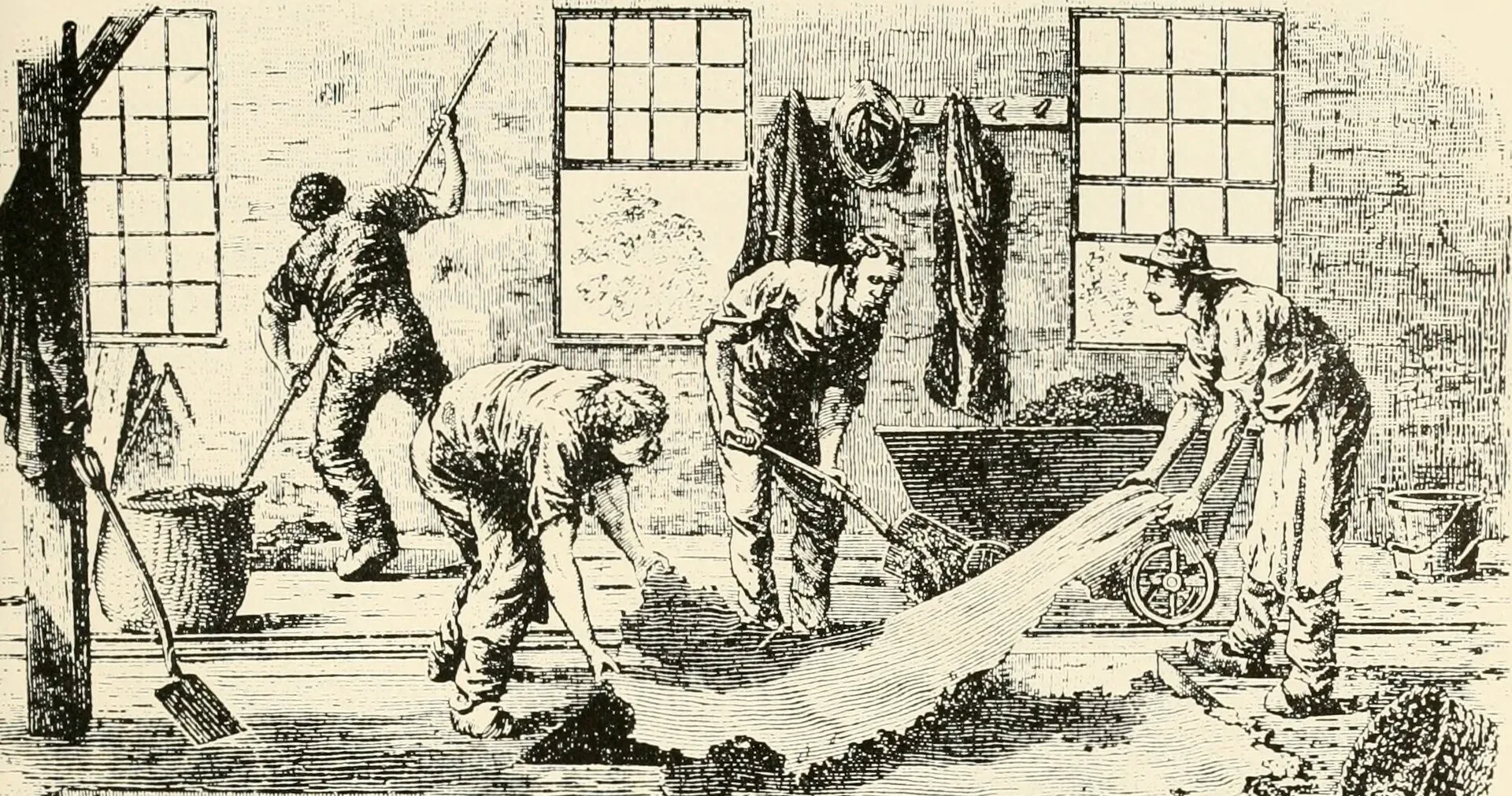
Vegetable tanning uses tannins, a group of phenolic compounds found in woody flowering plants and extracted from roots, bark, leaves and seed husks. Britannica lists the main commercial sources used for leather. The bark of oaks (Quercus) and the European chestnut, mainly Castanea sativa, yield hydrolysable tannins. Wood or bark extracts of quebracho (Schinopsis) and extracts of wattle (Acacia) give condensed tannins, the larger of the two chemical groups. The extracts are made into tanning liquors, and hides are soaked in progressively stronger baths over weeks or months. The result is a firm, water-resistant leather.
The tannery of J. & F.J. Baker in Colyton, Devon, still tans hides with oak bark in pits. The same family has run the business since 1862, across six generations. Its oak bark is crushed in a grinder driven by a water wheel. It is then soaked in water from the River Coly to make tannin liquors that range from strong to weak. Each hide first hangs from a wooden pole over a pit and is washed in oak bark tannin for three months, while the water wheel rocks the frames for an even tan.
The hides are then laid flat in stacks with oak bark between each layer for nine months, bringing the tannage to twelve months in all. Out of the pits, the leather is treated with fat liquors and oils, and harness and stirrup leather is also dipped in tallow and grease. It is stained by hand in four coats and finished with one of nearly 20 dubbins, each blended for a particular use, which is left to soak in for a week. The tannery gives fourteen months as the time taken to produce each piece of its leather.
CHROME TANNING AND THE INDUSTRIALISATION OF LEATHER TANNING
Chrome tanning is a form of mineral tanning that uses chromium salts, the most widely used mineral agent; aluminium and zirconium salts are also used. Hides are soaked in increasingly strong saline baths, or in acidic baths in which the salts settle into the fibres. The leather is soft and pliable. In the United States, according to a 1999 Iowa State University thesis by Catherine Elizabeth Guise-Richardson, chrome first took hold in the fringe industries of the leather trade. Mainstream tanneries showed interest only in the 1870s and 1880s, alum tanneries first and vegetable tanneries after them.
The practical breakthrough came in 1893, when Martin Dennis invented and marketed a ready-made one-bath liquor called Tanolin. Chrome then became the main method for kidskin and calfskin, and chrome leather became available for footwear in the late 1890s, although vegetable tanning remained the most common industrial method in the country until about 1910. By 1918 more than 80 per cent of leather produced in the United States was chrome tanned. Leather Naturally's guide puts chrome at about 80 per cent of leather produced today. At the wet stage, chrome leather is blue and is called wet blue.
WHERE DOES CORDOVAN COME FROM? THE LEATHERS OF CÓRDOBA
Britannica records that Arab craftsmen refined vegetable tanning in the Middle Ages and that two of the leathers produced in that period, morocco and cordovan, were highly valued. Spain's tourism board says Spanish artisans raised leather goods to an art form in medieval times, with the first major flourishing in southern cities such as Córdoba and Granada, where Arab and Jewish cultures shaped the craft. The word cordovan records the connection. Merriam-Webster traces it to the sixteenth-century Spanish cordován, now usually cordobán, formed from the name of the city where the leather was made. The English adjective is first recorded in 1591 and the noun around 1625.
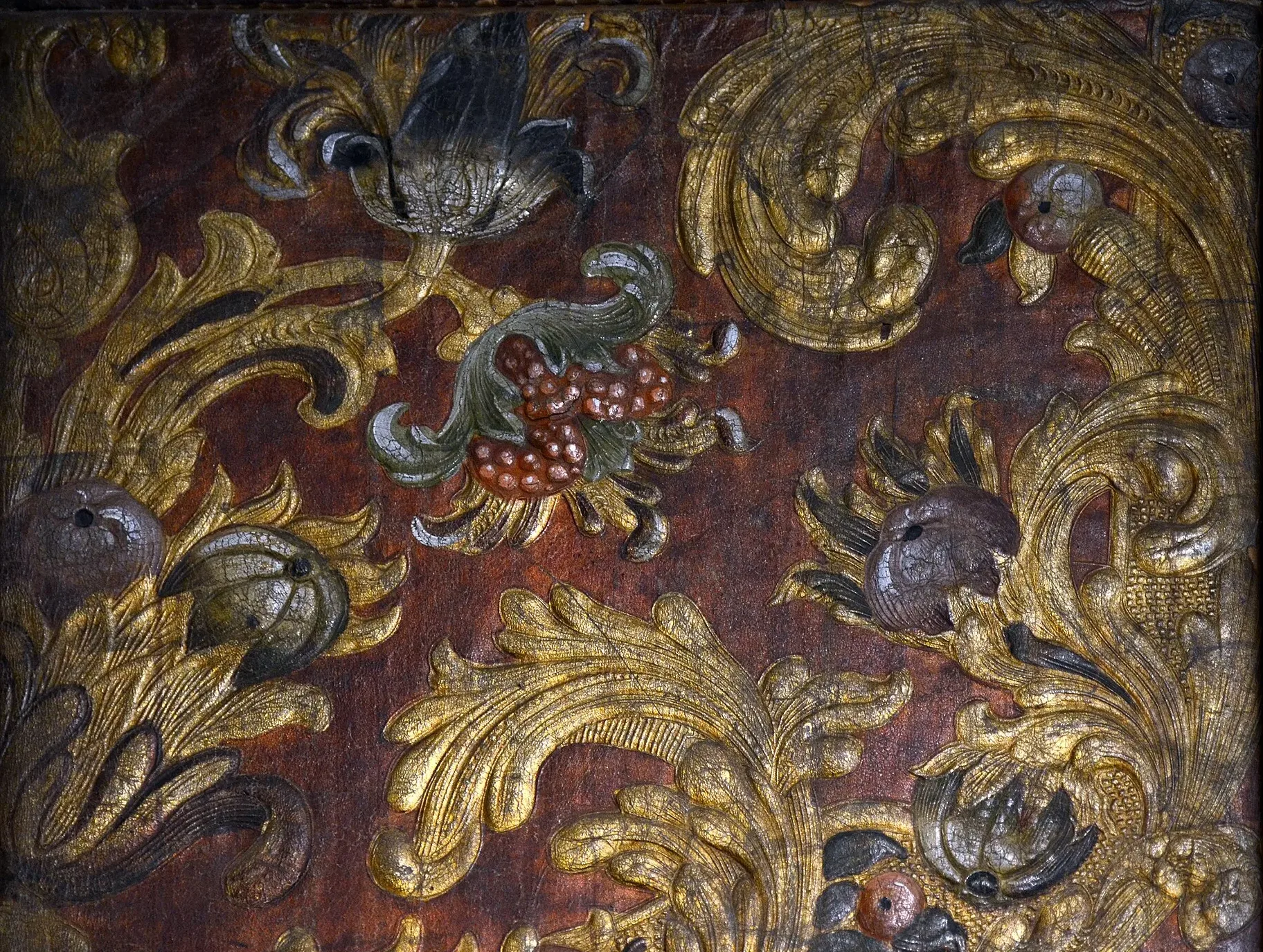
The noun was first used for a soft, fine-grained coloured leather. Its second sense is a dense, non-porous leather tanned from the inner layer of horsehide. In Córdoba itself, whose historic centre is a UNESCO World Heritage Site, the tourism board distinguishes two crafts. The Cordoban technique produces embossed leather for belts, gloves, shoes and book covers. Guadamecil is painted leather decorated with drawings and reliefs and was used for chairs, rugs, tapestries and paintings. Leather artisans work around the Calleja de las Flores in Córdoba, and also in Granada and Seville.
The Victoria and Albert Museum in London holds a sixteenth-century Spanish wall hanging of gilt leather, made of eight panels and fourteen borders, which its older catalogue attributes probably to Córdoba. The panels carry bands of lozenge-shaped compartments, each holding an artichoke with leaves, with floral scrolls between them. The catalogue describes the surface as leather covered with silver foil lacquered to represent gilding, then stamped and painted. The museum's record notes that the panel design matches a hanging in the Palacio de Viana in Córdoba.
UBRIQUE AND SPAIN'S LEATHER TOWNS

Spain's tourism board describes Ubrique, in the mountains of Cádiz province, as today's greatest centre for leather art in Spain. One of its streets is called Marroquinería, the Spanish term for leather goods, and the board says items are made in the town for brands including Louis Vuitton, Loewe, Dior, Givenchy and Chanel. Ubrique's Leather Museum occupies the old Capuchin convent. In 2010 a leather wallet made by local artisans broke the Guinness World Record as the largest in the world, measuring more than three metres unfolded and weighing 250 kilos. The board notes that Spanish production has been largely mechanised in recent decades.
In the Montes de Toledo, in Toledo province, towns including Los Yébenes, Polán, San Pablo de los Montes and Las Ventas con Peña Aguilera make leather for hunting, horse riding and falconry, such as pouches, harnesses and saddles. Igualada, in Barcelona province, has a history in wool and leather tanning; its Leather Museum is considered one of the pioneers in this field in Europe, and Rec is its old tanners' neighbourhood. In Madrid, the street of Ribera de Curtidores, where the Rastro market is held every Sunday, was once the centre of leather tanning.
THE CHOUARA TANNERY: LEATHER TANNING IN FEZ
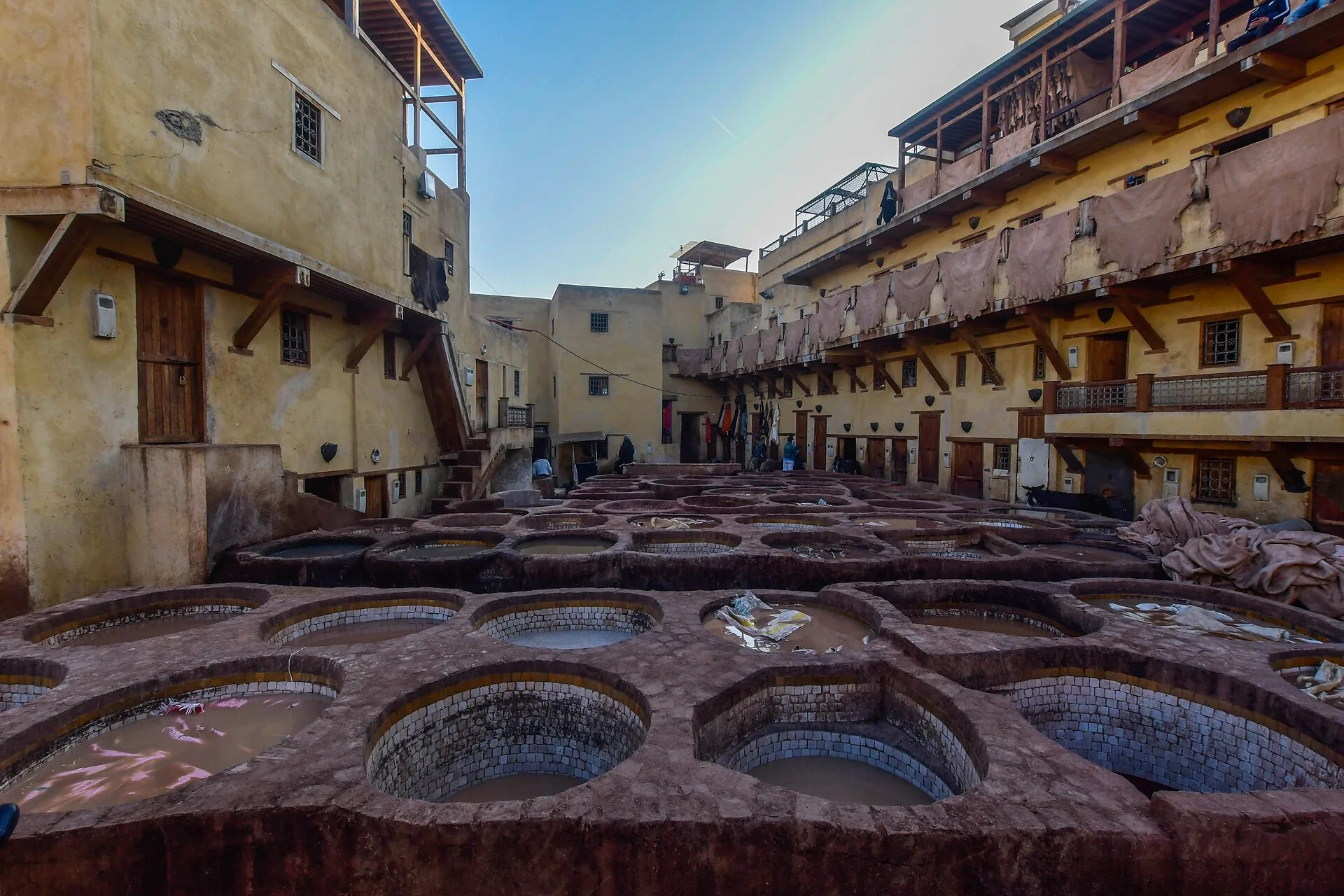
Fez was founded by Idrīs I on the east bank of the Wadi Fès around 789, and Idrīs II founded the west bank around 809; the Almoravids united the two parts in the eleventh century. The old city, Fès el-Bali, contains the Qarawīyīn Mosque, a university founded in 859, and was named a UNESCO World Heritage Site in 1981. Britannica describes Fez as a centre for trade and traditional crafts, including leatherwork and pottery, which are practised in the narrow streets of the old city and sold in its sūqs.
The Chouara tannery, Dar Dbagh Chouara, stands inside Fès el-Bali and was built near waterways and canals because water is essential to the process. The Moroccan news site Le360 describes the work. Raw hides arrive from the Aïn Nokbi market and soak for up to two weeks in a mixture of lime and pigeon droppings, stirred regularly to soften them and remove residual tissue. Tanners then colour the hides in the vats using natural materials: roses for red, cedar wood for brown and saffron for yellow, the colour associated with ziwania babouches. The hides are dried around the tannery and sent to other artisans, who make babouches, bags, wallets and belts.
HOW IS UPHOLSTERY LEATHER FINISHED FOR SEATING?
After tanning, leather is dried and dyed by drum dyeing, spraying, brushing or staining, and oils and greases are added for softness and water resistance. Britannica describes it being dried to about 14 per cent moisture, reconditioned with damp sawdust to around 20 per cent, then stretched. The grain surface is then coated so that it resists abrasion, cracking, peeling, water, heat and cold. The Leather Naturally guide describes a common build of a pigmented base coat, an intermediate coat and a transparent topcoat, with acrylic and polyurethane water emulsions as binders and very finely ground coloured particles as pigments. The amount of pigment defines the finish.
Aniline leather is coloured with dyes alone or under a transparent finish, so that in the best examples the pores of the grain remain visible; it requires the best grades of hide. Semi-aniline leather has small amounts of pigment added to the coating, which reduces transparency and makes the surface more uniform while the pores stay visible. Pigmented leather receives additional pigment coats so that the pores are no longer visible, and stamps can then simulate pores or other textures. Corrected grain leather has its surface sanded more heavily to reduce defects. For furniture, the guide states that a good-quality piece will use full or corrected grain leather, or upholstery-grade suede, throughout.
RED LEATHER BANQUETTES AT TAPAS, MANDARIN ORIENTAL SHENZHEN

Tapas at Mandarin Oriental Shenzhen is a restaurant and bar whose interiors were completed in 2022, and its seating includes red leather banquettes. In the sequence described above, colour enters a hide at the dyeing stage after tanning, by drum dyeing, spraying, brushing or staining. The finishing coats applied afterwards decide whether the grain of a seat surface stays visible, as in aniline and semi-aniline leather, or is covered by pigment, as in pigmented leather. For furniture, the Leather Naturally guide points to full or corrected grain leather throughout.
The room combines exposed brick, a glass-fronted wine display set in the brick walls and framed photographs. Its metalwork includes steel-framed glazing, a type of window whose development is traced in a separate history of steel windows from wrought iron to the Crittall W20, along with suspended black metal shelving and a wrought-iron chandelier. Spain's own forged ironwork has its history in rejería and the cathedral screens of Spain. The bar counter is marble and has views over the city.
SOURCES
- Encyclopaedia Britannica Leather
- Encyclopaedia Britannica Tannin
- J. & F.J. Baker & Co The Process
- Iowa State University Digital Repository American tanning, 1850-1920: the introduction of chrome tanning and its effects on footwear
- Leather Naturally Modern Cow Leather Processing
- Merriam-Webster Cordovan
- Spain.info (Turespaña) Spanish leather goods destinations
- Victoria and Albert Museum Gilt leather hanging, Spain, 16th century
- Encyclopaedia Britannica Fès
- Le360 Inside Fèz's Chouara Tannery: how Morocco's centuries-old leather craft survives