FROM THE CANGSHAN MOUNTAINS TO MING AND QING TABLE SCREENS

Dali marble is the veined stone of Mount Cangshan, the mountain range above Dali in Yunnan province, south-western China. The Chinese word for marble, dalishi (大理石), takes its name from the area, and the Dali Mount Cangshan Global Geopark describes Cangshan as the place that named marble in China. The geopark dates the processing of the stone to the Tang dynasty, more than 1,000 years ago. Slabs whose veining could be read as mountains, mist and water were cut, framed, titled and inscribed as stone paintings, then set into table screens and wall panels. Dali marble became fashionable among the Ming elite, and the Qing scholar Ruan Yuan collected and catalogued it. Mount Cangshan was approved by UNESCO as a Global Geopark in 2014.
WHAT IS DALI MARBLE?
Dali marble is a metamorphic stone quarried in Yunnan province, from the Cangshan range in Dali Prefecture. In its overview of the geopark, the Dali Mount Cangshan Global Geopark states that the Chinese term for marble, given there as dali yan, takes its name from this area. The everyday word for the stone is dalishi. It appears, for example, in the Chinese title the Metropolitan Museum of Art gives to a Ming table screen of veined marble dated 1624, 大理石插屏, in which the first three characters spell dalishi.
The geopark describes the marbles of Cangshan as colourful, with beautiful patterns, and states that they have been admired and cherished since the Tang dynasty, regarded as a masterpiece of nature and the basis of a distinct marble culture. Its overview calls the geopark a textbook of metamorphic rocks, formed through the complex deformation of rocks about 2 billion years old. The overview also names the Cangshan Geological and Geomorphologic Landscape District as one of the geopark's three components. Below the range lies Erhai Lake, which it describes as a plateau rift lake caused by the uplift of Mount Cangshan during the Himalayan orogenesis.
WHERE DOES DALI MARBLE COME FROM? THE CANGSHAN MOUNTAINS
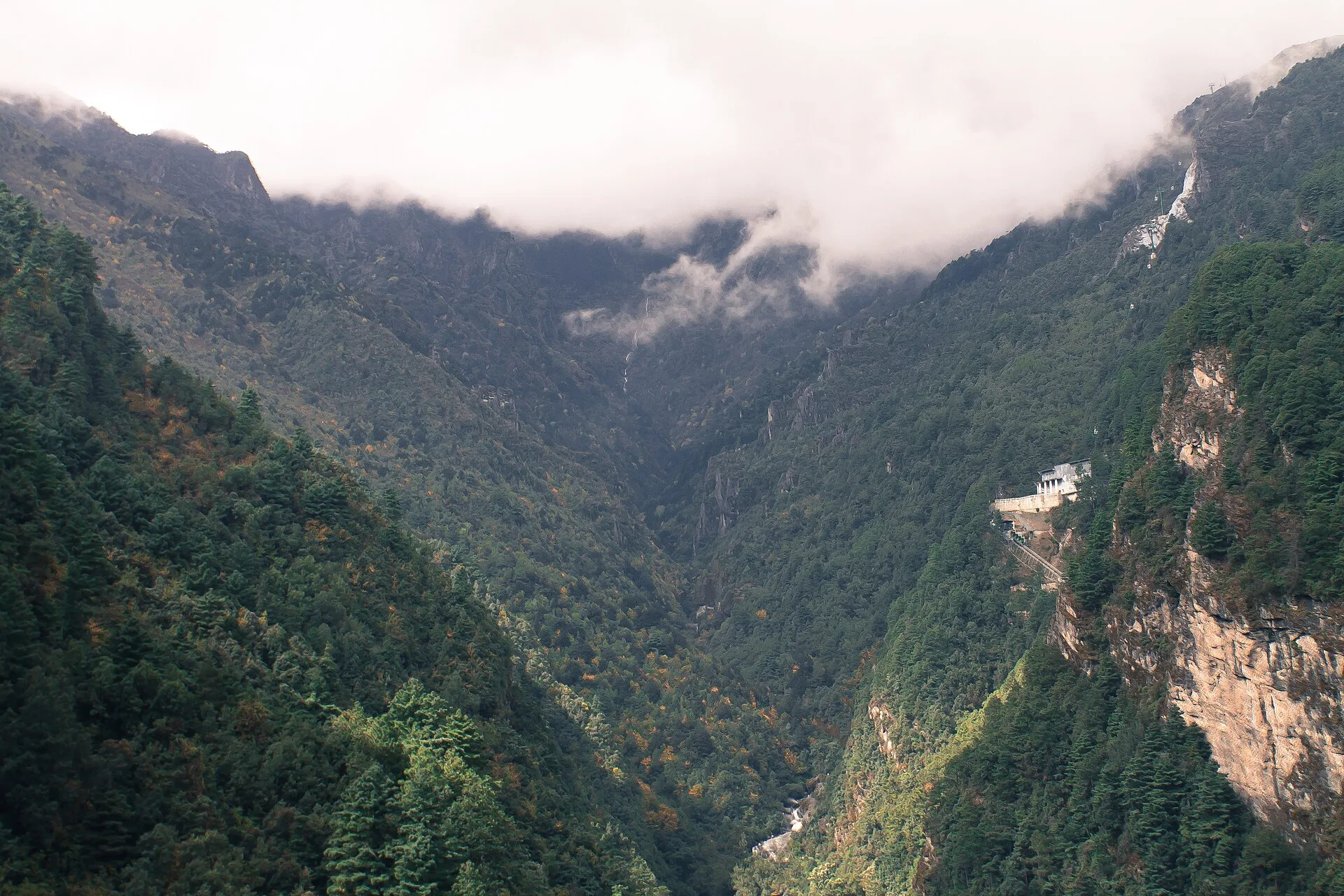
Cangshan has nineteen peaks, with a stream between every two of them, a landscape the geopark calls the "Nineteen Peaks and Eighteen Streams". The geopark covers 933 square kilometres, at elevations from 1,700 to 4,122 metres above sea level. The mountain also preserves Quaternary glacial landforms from about 15,000 years ago. In 1937 the Austrian scholar H. V. Wissmann named the glacial period they record the Dali Glacial Period, a name the geologist Li Siguang accepted and linked to China's last Quaternary glaciation.
Scientific study of the mountain began with the German scholar Credner, who investigated Cangshan in 1932. Protection followed in stages. A provincial nature reserve covering Cangshan and Erhai Lake was set up in 1981, and in 1982 Cangshan-Erhai was listed in the first national batch of 44 key scenic spots. The reserve was upgraded to national level in 1994. Dali Mount Cangshan Geopark was approved as a national geopark in 2005 and opened in 2007. In 2014 it was accepted into the Global Geoparks Network as China's 31st UNESCO Global Geopark, according to the geopark's own history, and it opened under that title in April 2015. It passed its first re-evaluation in 2018.
WHAT ARE STONE PAINTINGS? DALI MARBLE AS A NATURAL LANDSCAPE
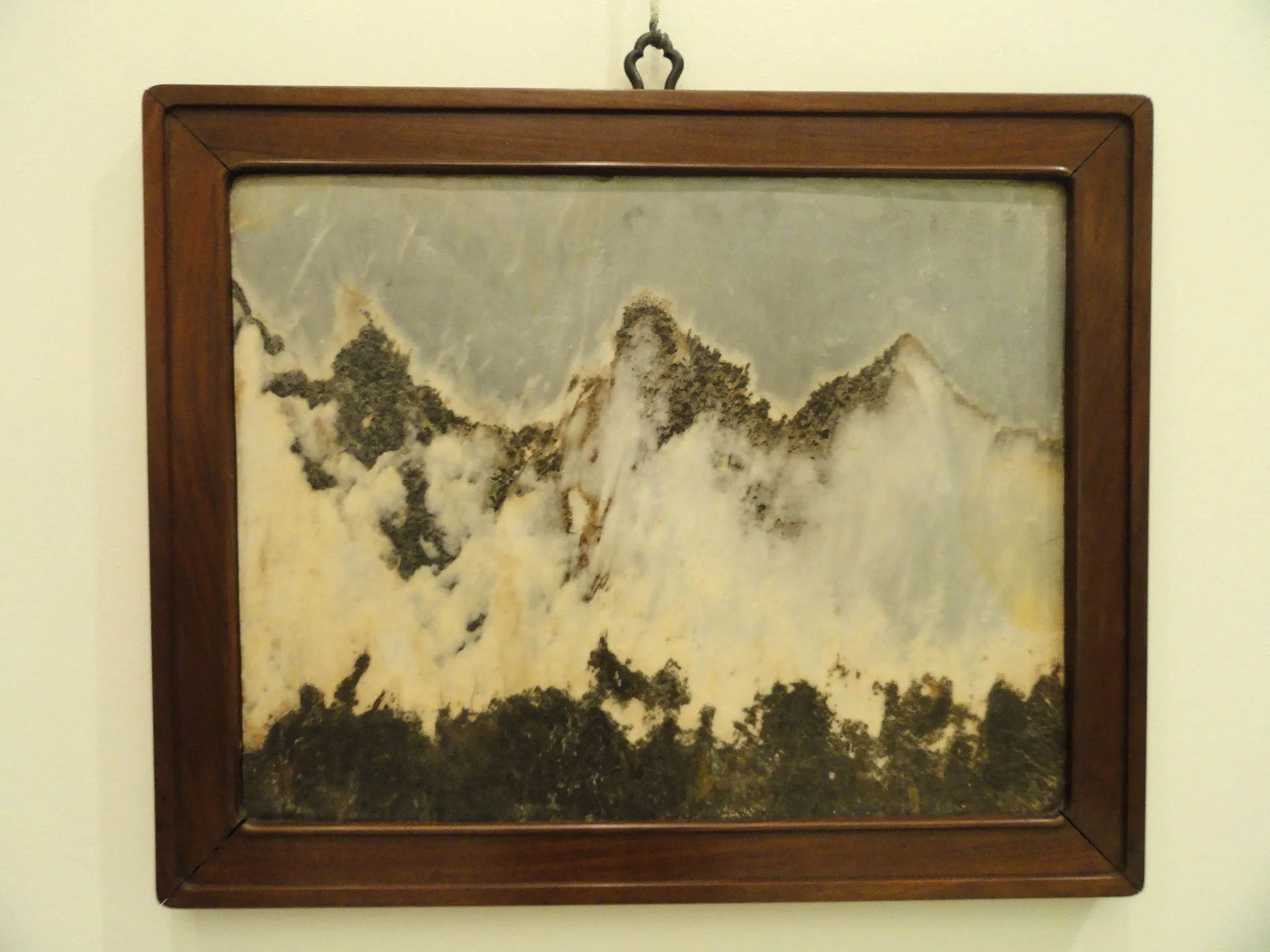
According to the Metropolitan Museum of Art, Chinese appreciation of the veins and swirls in marble as a kind of natural painting dates to at least the Song dynasty (960 to 1279). Especially fine slabs were cut, framed, inscribed with poems and given imaginative titles. In English such pieces are called stone paintings, the term the Met uses, or dream stones, the term used in a report on a 2011 lecture at the Musée Cernuschi in Paris. The image is the natural veining of the slab; the work of the maker and the owner lies in selecting, cutting, framing, titling and inscribing it.
A 19th-century Qing set of wall panels in the Met applies the format at architectural size. Its panels, each 166.4 by 87 centimetres, are made of hardwood with veined marble and brass fittings, and the marble slabs are set in rosewood frames. Their titles include "Morning Mist in a Spring Forest", "Overhanging Cliff and Sheer Wall", "Autumn Mountains in Mist and Clouds" and "A Magic Tower after Snow", and together they cover the full range of seasonal landscapes. Each slab carries a title in clerical script, followed by a short comment and the inscriber's signature in running script. Two slabs in one panel also carry a line of Tang poetry, and a round slab titled "Range of Mountains in the Sunset" is signed by Yibai Shanren.
DALI MARBLE IN MING AND QING TABLE SCREENS
In an online talk for the Huntington Library, Art Museum and Botanical Gardens on 20 April 2023, the art historian Aurelia Campbell of Boston College traced how the meaning of Dali marble shifted with time and place. In the Ming dynasty the stone, quarried in Yunnan in south-western China, became highly fashionable among the country's elite. Its natural patterns were prized for their resemblance to monochromatic ink landscapes, the genre of shan shui painting, and this tied the stone closely to the literati. In the Qing dynasty, court paintings made for the emperor used it as a marker of the sophisticated urban cultures of the south-east.
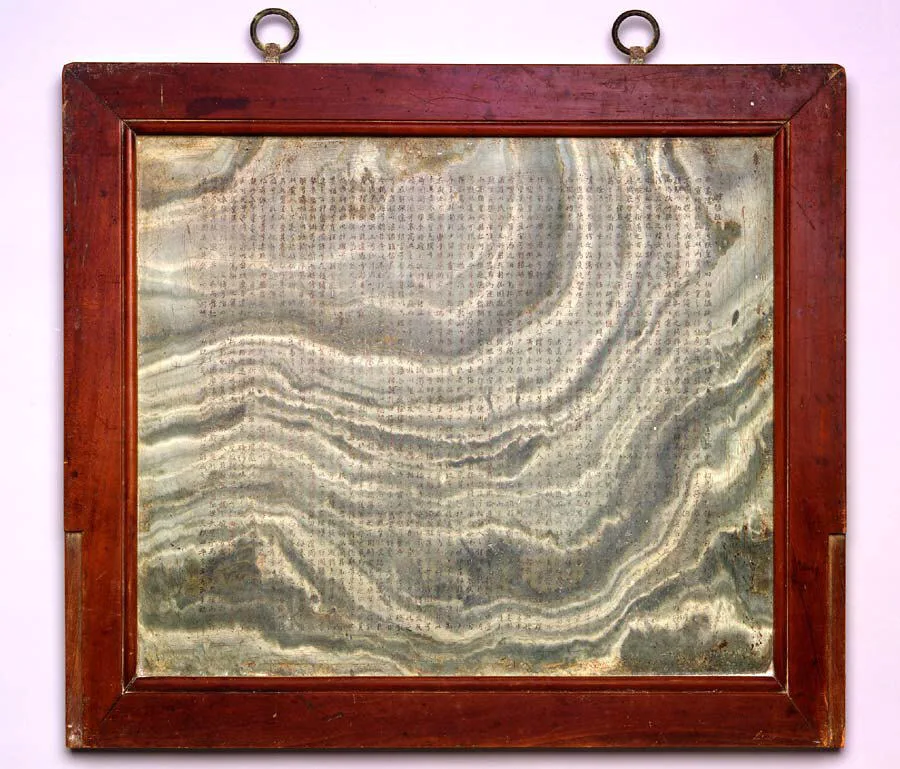
The Met holds a Ming table screen by Li Mi, active in the early 17th century, and dated 1624. Made of veined marble in a wood frame, it measures 42.2 by 36.5 centimetres, is inscribed with the poem "Lisao" and was later converted to a wall panel; the museum classifies it as furniture. The geopark lists screens, hanging panels and screens with a base among the products of Dali marble, alongside sculptures, reliefs, bonsai and vases. It also describes the stone as commonly used as decorative material in many ancient Chinese buildings and in classical furniture.
RUAN YUAN AND THE SCHOLAR'S COLLECTION OF DALI MARBLE
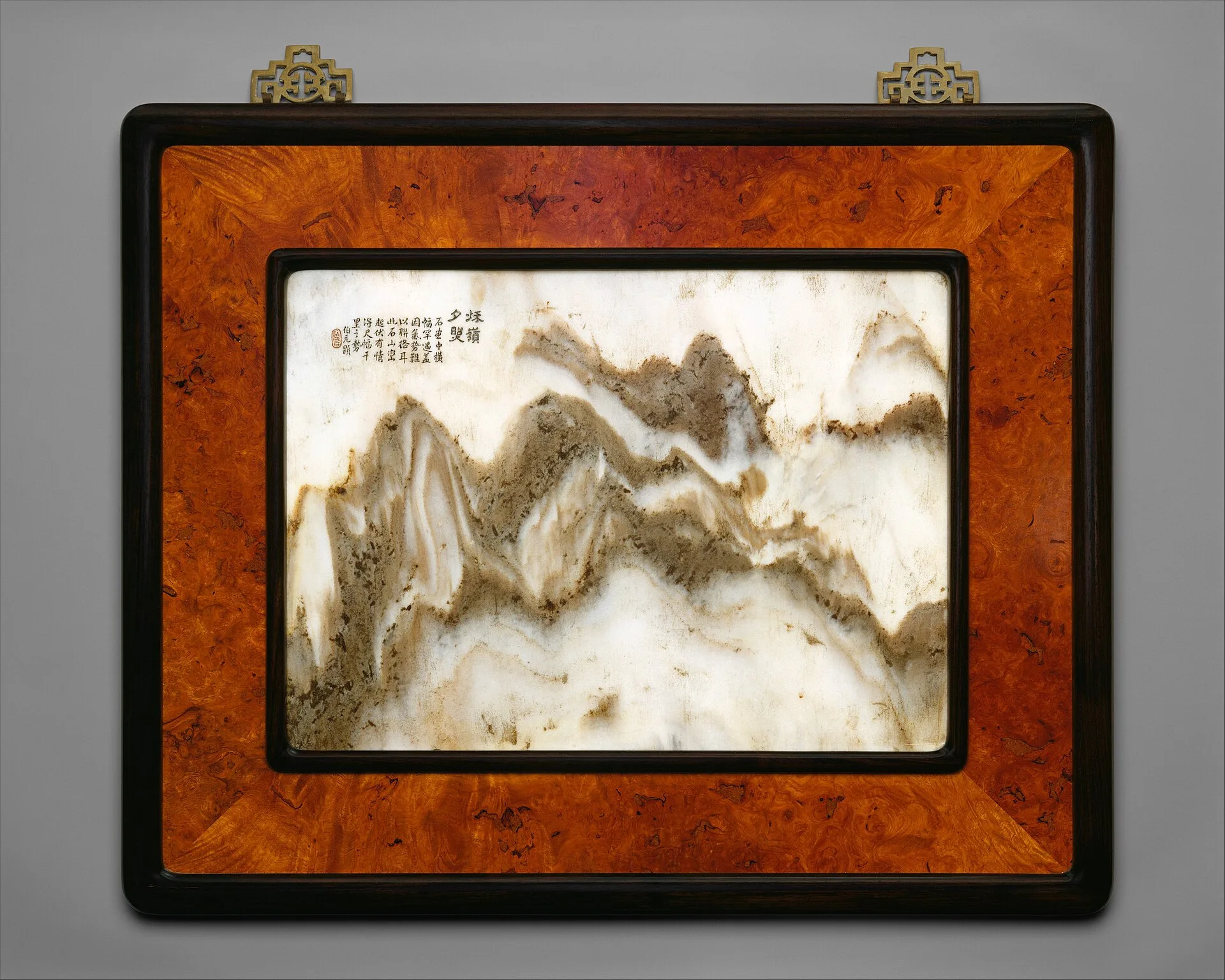
One Qing collector of Dali marble was Ruan Yuan (1764 to 1849), a scholar and senior official of the Qing empire born in Yangzhou. In a lecture at the Musée Cernuschi on 13 April 2011, reported by the museum's friends' society, the curator Eric Lefebvre followed his career, including his post as governor-general of Yunnan and Guizhou from 1826 to 1833. The appointment saddened him because it took him far from his literati friends. Alongside inkstones, he developed a taste for dream stones: he engraved poems on them and sent them to friends across China, and built a pavilion to display his collection of stone paintings.
According to the same report, his taste and knowledge of painting shaped the way he approached stone paintings, and he compiled a catalogue of stone paintings in Dali marble. One of the stones he inscribed is in the Metropolitan Museum of Art: a 19th-century table screen of marble mounted in a wood frame, 28.9 by 40 centimetres, signed by Ruan Yuan and later converted to a wall panel. The inscription at the upper left is translated as "Evening Glow on the Autumn Mountain", and its comment notes that horizontal compositions are rare in stone painting.
HOW DALI MARBLE IS MADE INTO SCREENS AND PANELS
The geopark presents the processing of Dali marble as a traditional production technique of Dali, created in the Tang dynasty more than 1,000 years ago and handed down from generation to generation. It credits the craft to the creative work of all the ethnic groups of Dali. The process runs through six stages: mining, cutting, polishing, moulding, waxing and ornamenting. In August 2009 the People's Government of Yunnan Province included the technique in the second batch of its provincial list of intangible cultural heritage. The geopark describes the marble as world-known and its products as art forms of high aesthetic and artistic value.
The stone painting format continued into the 20th century. The Victoria and Albert Museum in London holds a marble table screen dated 1973, 22 centimetres high and 36 centimetres wide, bearing the seal of Shi sheng. The museum describes its decoration as the Great Wall at Badaling near Beijing, with the inscription Chang cheng qiu se, "Autumn colours at the Great Wall", and a second inscription recording that the stone was selected at Dali in spring 1973. The museum records Shi sheng as the maker, China as the place where the screen was made and marble as its only listed material.
HYATT REGENCY HENGQIN: PALE VEINED STONE AND VIEWS TO THE HILLS

Hyatt Regency Hengqin, a Silverfox Studios project in Zhuhai, was completed in 2019. With 493 rooms and suites, it is the anchor of Lai Sun Creative Culture City in Novotown on Hengqin Island. The Hong Kong-Zhuhai-Macao Bridge connects the hotel to Hong Kong and Macau. Two outlooks from the hotel shaped its design: views towards the hills of Hengqin and views towards Macau. The interiors are built from a short list of materials: vertical timber slats, woven linen, rattan and pale veined stone.
In the Chinese tradition of stone painting described by the Met, the most beautiful slabs of marble were cut, framed, titled and inscribed so that their veining could be read as mountains, mist and water. The Dali geopark also describes its marble as "the best building and furniture decoration material". At Hyatt Regency Hengqin, the stone is pale and veined, and it is used with timber, linen and rattan in interiors whose design was shaped by the views to the Hengqin hills and to Macau.
SOURCES
- Dali Mount Cangshan Global Geopark Geopark overview
- Dali Mount Cangshan Global Geopark Landscape
- Dali Mount Cangshan Global Geopark History of the geopark
- Dali Mount Cangshan Global Geopark Production process of marble
- The Metropolitan Museum of Art Wall panel with stone paintings
- The Metropolitan Museum of Art Table Screen Inscribed with the Poem "Lisao," now converted to a wall panel
- The Metropolitan Museum of Art Table screen, converted to a wall panel
- The Huntington Library, Art Museum and Botanical Gardens Landscapes in Stone: Placing Dali Marble in Ming and Qing China
- Société des Amis du Musée Cernuschi From archeology to dream stones: in the footsteps of a Chinese scholar
- Victoria and Albert Museum Table screen, marble, China, 1973