MOUNTAINS, WATER AND INK FROM THE TANG TO THE YUAN
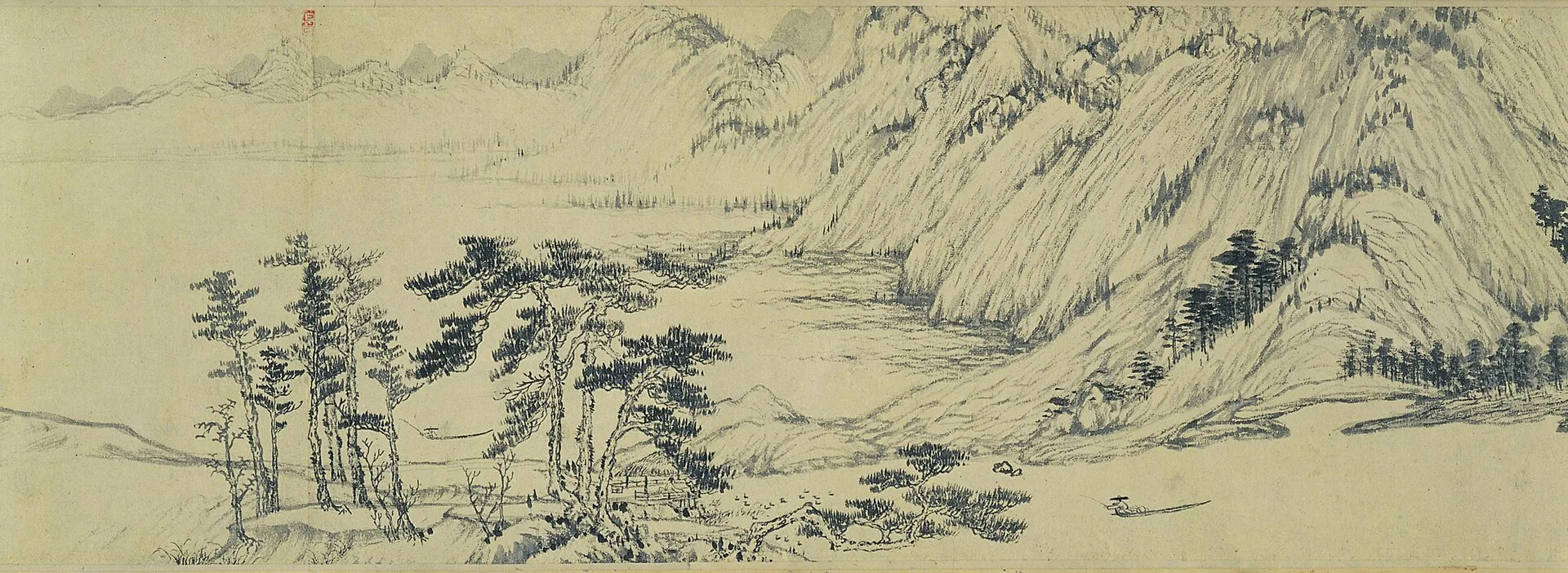
Shan shui painting is the Chinese tradition of landscape painting, named after the characters for mountain (shan) and water (shui). It had become an independent genre by the late Tang dynasty and the dominant subject of mainstream Chinese painting by the 11th century. Among the works that define it are Fan Kuan's Travelers Among Mountains and Streams and Guo Xi's Early Spring of 1072, both at the National Palace Museum in Taipei; Guo Xi's handscroll Old Trees, Level Distance at the Metropolitan Museum of Art in New York; and Huang Gongwang's Dwelling in the Fuchun Mountains, divided since a fire in 1650 between Taipei and the Zhejiang Provincial Museum.
WHAT IS SHAN SHUI PAINTING?
The full Chinese term is shanshuihua, literally "mountain and water painting". The JAANUS dictionary of Japanese art historical terminology, compiled by Mary Neighbour Parent, notes that "landscape" is the usual English translation, though the paintings show an idealised nature rather than landscape in the Western sense. Its images are built mainly from mountains, rivers, clouds, rocks and trees. Together with figure painting and bird-and-flower painting, it forms one of the three major subject categories of East Asian painting in the dictionary's classification.
According to JAANUS, shan shui painting mirrors the natural world while also expressing human thought and philosophical principles. Taoist attitudes towards nature stimulated its growth, and it also served Buddhist and Confucian contexts. The Metropolitan Museum of Art's essay on Chinese landscape painting likewise reads Chinese depictions of nature as expressions of the mind and heart of the individual artist rather than simple records. The National Palace Museum says the same of the three Song landscapes it calls its national treasures, which may not reflect any identifiable scenery and instead set out each painter's ideas about landscape, drawn from observing and reflecting on nature.
WHERE DID SHAN SHUI PAINTING COME FROM?
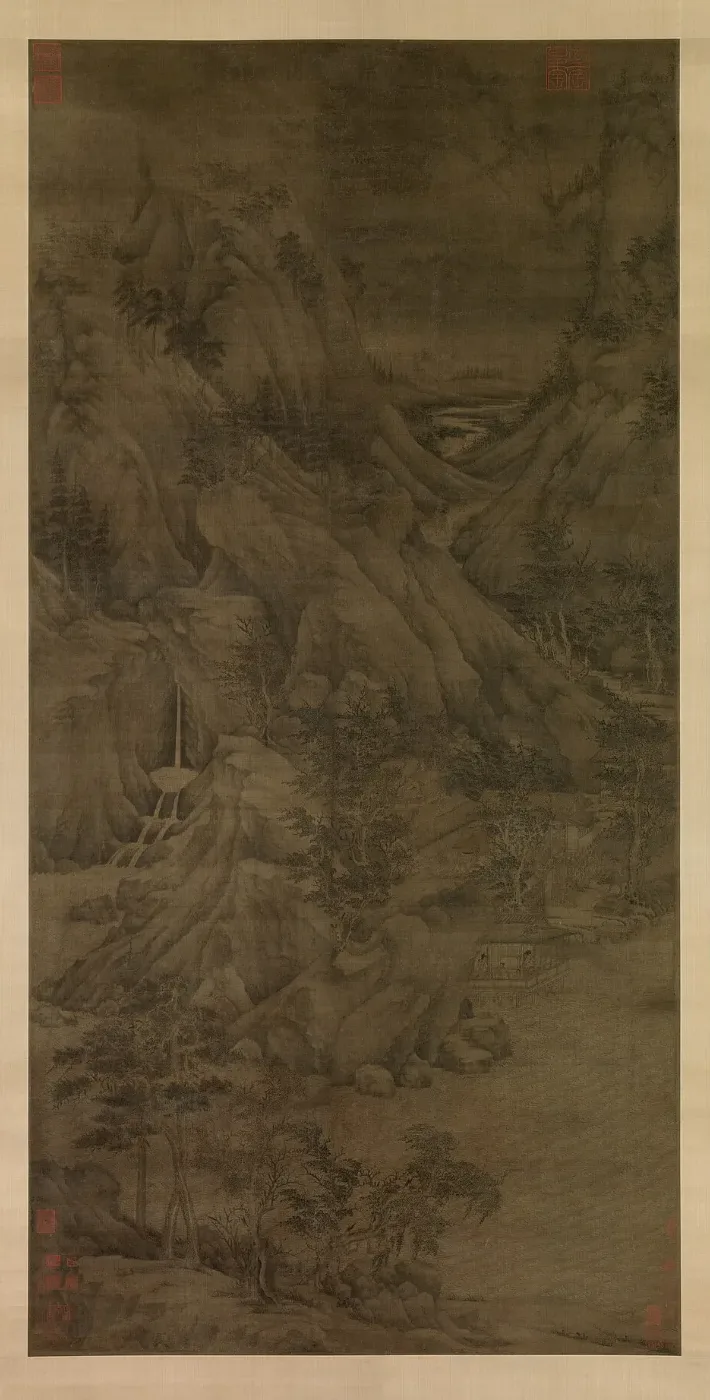
The Met's essay records that by the late Tang dynasty, landscape painting had evolved into an independent genre that expressed educated men's wish to step away from everyday life and commune with nature. As the dynasty came to an end, withdrawal into the natural world became a major theme for poets and painters alike, and learned men looked for permanence among the mountains. JAANUS records that the earliest landscapes in Japanese painting appeared as settings in Buddhist pictures and were influenced by the blue-and-green landscapes of the Tang.
In the early Song dynasty, the Met notes that visions of the natural hierarchy were read as metaphors for a well-regulated state. At the same time, images of the private retreat multiplied among a new class of scholar-officials, who used calligraphic brushwork to express themselves; their monochrome images of old trees, bamboo, rocks and retirement retreats became emblems of their character. JAANUS dates the formation of the genre's basic compositional types and brushwork methods to the Song, from the 11th to the 13th centuries. Later critics sorted these into two broad approaches: a Northern School or academy style, and a Southern School associated with literati painters.
FAN KUAN AND THE NORTHERN SONG MONUMENTAL LANDSCAPE
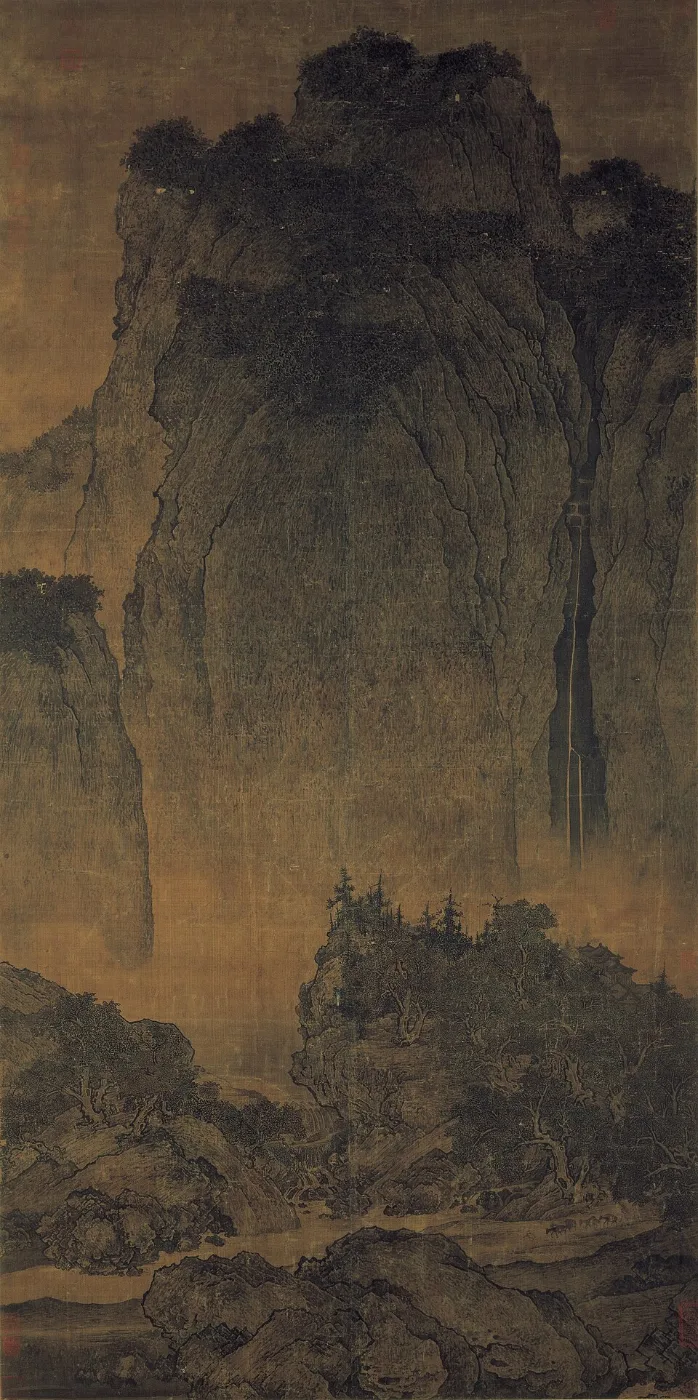
Fan Kuan, whom the National Palace Museum dates to about 950 to after 1032, came from Huayuan, now Yaoxian, in Shaanxi province. He first studied under the Shandong painter Li Cheng (919 to 967), then concluded that to paint the land truthfully he had to learn from nature rather than from other artists. He withdrew to Mount Hua to study the mountains directly, and contemporaries praised his ability to "commune with the mountains". Travelers Among Mountains and Streams, his work at the National Palace Museum, is a hanging scroll in ink and light colours on silk measuring 206.3 by 103.3 cm, and the museum describes it as a classic example of Northern Song monumental landscape painting.
A single tall mountain occupies the vertical axis of the scroll, with distant forests clinging to ledges near its summit. A complex of buildings sits in the right middle ground, a mule train moves along a path past rocks in the right foreground, and a slender waterfall drops from the heights into a stream that runs towards the viewer. Fan Kuan drew the mountains and slopes with jagged outlines and filled them with dabs of the brush that resemble raindrops, a texture that stresses the monumental and enduring character of the mountains. His signature is hidden among the leaves to the right of the mule train.
GUO XI, EARLY SPRING AND THE THREE DISTANCES OF SHAN SHUI PAINTING
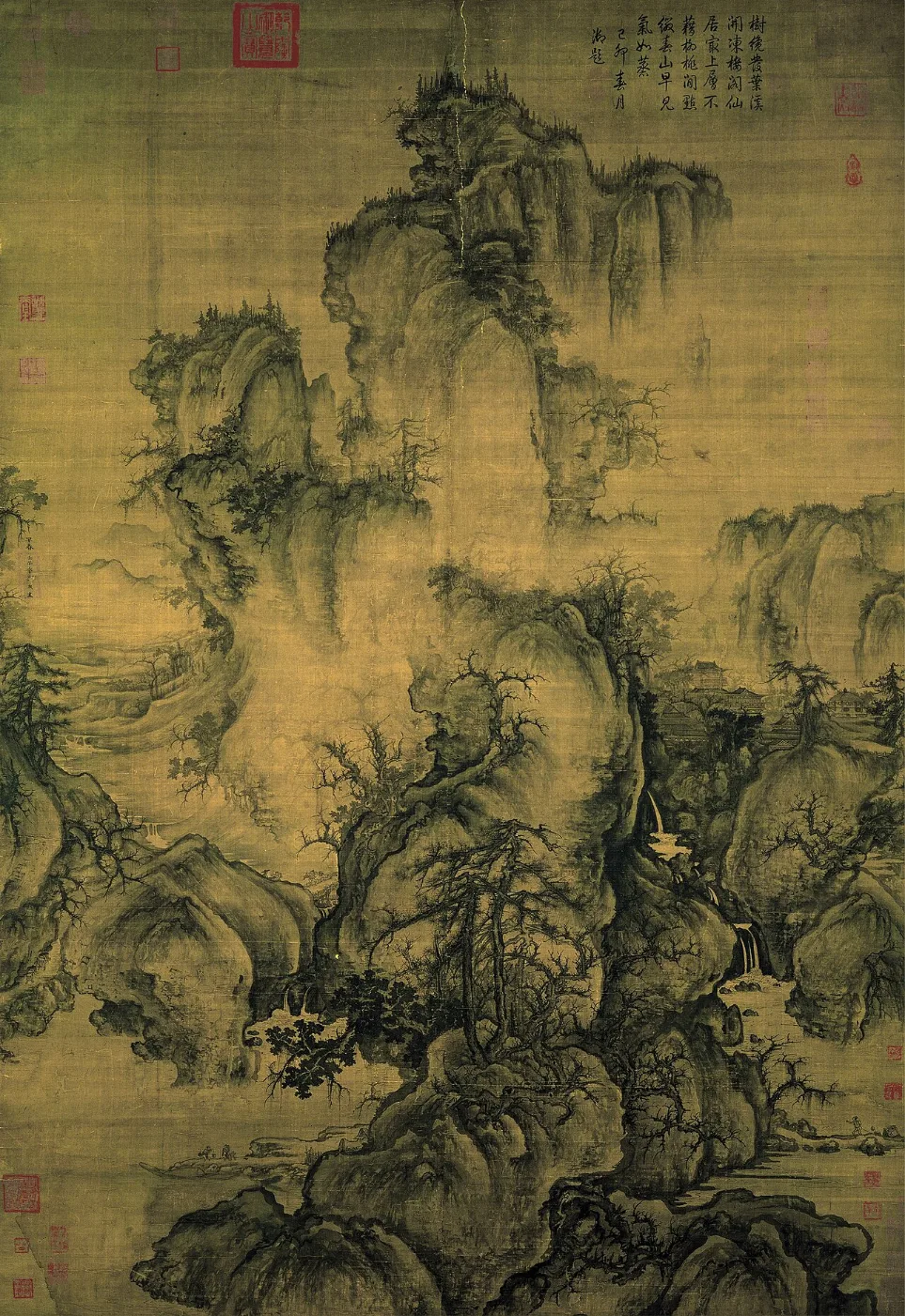
Guo Xi (about 1023 to after 1087) came from Wenxian in Henan province and served Emperor Shenzong, who reigned from 1068 to 1085. He first drew attention by painting large screens and walls for palaces in the capital and rose to become Painter-in-Attendance at the Hanlin Academy of Painting. Early Spring, dated 1072, is his most famous work: a hanging scroll in ink and light colours on silk, 158.3 by 108.1 cm. Large rocks and pines in the foreground lead into an S-shaped middle ground, a central peak rises behind, and streams and waterfalls cut diagonally across the scene. The museum identifies his personal style in the "curled cloud" texture of the slopes and the "crab claw" branches of the trees.
Guo Xi's ideas survive in The Lofty Message of Forests and Streams (Linquan gaozhi), in which he described three types of distance based on his observation of nature. High distance is the view looking up at a mountain from below. Deep distance looks from the front of a mountain to the ranges behind it. Level, or flat, distance looks out from a mountain towards low-lying hills nearby. Early Spring combines all three: the central mountain supplies height, deep distance opens on either side of it, and a level distance on the left forms a wide horizontal view that balances the steep peaks.
The Met holds a later variation on the level-distance formula. Old Trees, Level Distance, painted about 1080, is a handscroll in ink and colour on silk with an image 35.6 cm high and 104.4 cm long, set in a mounting that runs to 853.8 cm. Tall trees in the foreground stand against a wide river valley, and the museum suggests the scroll was made for a fellow official about to retire. In its last section, leafless trees and deepening mist give an autumn mood as two elderly figures approach a pavilion.
MA YUAN, XIA GUI AND THE ONE-CORNER COMPOSITION
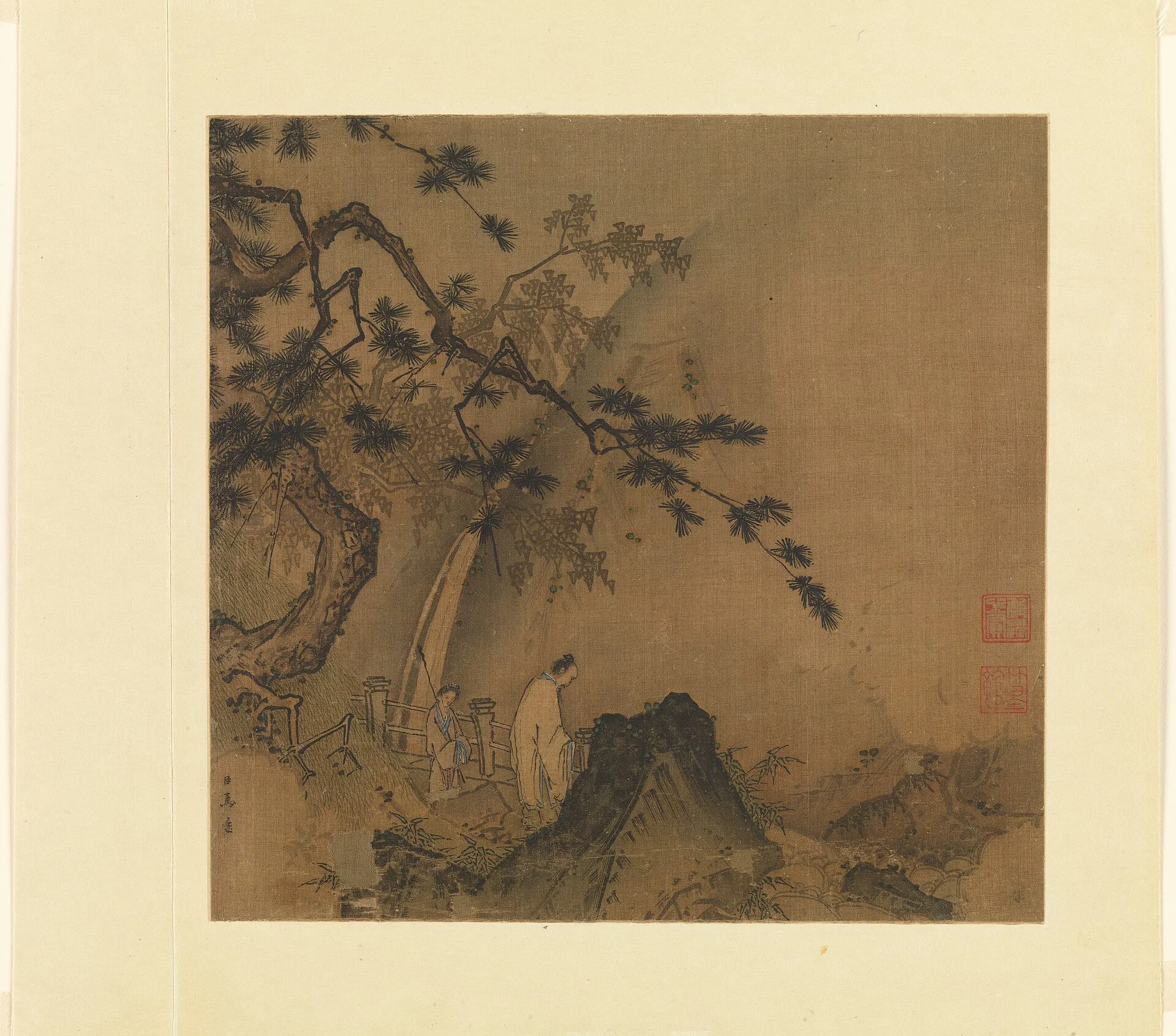
Li Tang (about 1049 to after 1130) painted Whispering Pines in Myriad Valleys in 1124, and the National Palace Museum presents it with the scrolls of Fan Kuan and Guo Xi as marking a shift in the monumental formula of landscape painting. In the Southern Song period, from 1127 to 1279, the court was based at Hangzhou. Ma Yuan, active about 1190 to 1225, was a fourth-generation member of a family of painters and a leading artist of the Southern Song painting academy. His album leaf Scholar Viewing a Waterfall at the Met, in ink and colour on silk and 25.1 by 26 cm, sets the jagged forms of a pine against the quiet figure of a gentleman watching the cascade.
The University of Washington's Visual Sourcebook of Chinese Civilization describes the one-corner composition for which Ma Yuan was famous, in which a scholar placed in one corner of the picture acts as the viewer's alter ego. It calls Xia Gui, active about 1190 to 1230, probably the most successful Southern Song court landscapist after Ma Yuan. His handscroll Streams and Mountains with a Clear Distant View, in ink on paper and about twenty inches tall, is viewed in sections from right to left, and the sourcebook asks readers to look for his "axe-cut" strokes.
HUANG GONGWANG AND THE YUAN LITERATI LANDSCAPE
Under the Yuan dynasty (1279 to 1368), the Met notes, scholar painters communicated through a symbolic shorthand in which a villa might be represented by a humble thatched hut, and developed what the museum calls the "mind landscape", a painting that conveys the inner landscape of the artist's heart and mind. The National Palace Museum names four masters of the period: Huang Gongwang (1269 to 1354), Wu Zhen (1280 to 1354), Ni Zan (1301 to 1374) and Wang Meng (1308 to 1385), with Huang revered as their spiritual leader. Born in Changshu, Jiangsu, and orphaned young, he was adopted by Huang Le of Yongjia, studied Taoism, and joined the Quanzhen sect.
Huang's landscapes draw on Dong Yuan and Juran, 10th-century painters of the soft, rolling scenery of the south. Dwelling in the Fuchun Mountains, painted for a fellow Taoist, Master Wuyong, occupied him intermittently from about 1347 to 1350. The surviving main section, at the National Palace Museum, is a handscroll in ink on paper of six joined sheets, 33 by 636.9 cm. It is an idealised panorama of the Fuchun mountains west of Hangzhou, moving from a wide river on the right through hills and marshes to a conical peak and ending in distant ink-wash hills over water. Huang laid the design out in light ink, then built it up with darker, drier brushwork, texture strokes, groups of trees and dots used as accents.
HOW TO READ A SHAN SHUI PAINTING ON A HANGING SCROLL OR HANDSCROLL
A hanging scroll unfolds vertically. In both Travelers Among Mountains and Streams and Early Spring the main elements are arranged along a central vertical axis: in Fan Kuan's scroll a stream runs from the mountain towards the viewer, and in Guo Xi's the foreground rocks and pines lead into the middle ground and up to the peak. The National Palace Museum describes the aim of Early Spring as presenting a landscape that can be walked through, viewed, lived in and travelled through in the imagination. The halls, pavilions and thatched kiosk of Early Spring are tucked into the mountains on the right, and the museum reads Fan Kuan's concealed signature as a sign of human insignificance beside nature.
A handscroll is viewed from right to left, as the Met notes for Old Trees, Level Distance, and a long one such as Xia Gui's is taken in section by section. Huang Gongwang's scroll runs for more than six metres, and Guo Xi's mounting extends the scroll to over eight. The Song masterpieces in Taipei are painted on silk, while Xia Gui and Huang Gongwang worked in ink on paper. Silk this old is fragile, and the National Palace Museum limits the light exposure of its three Song treasures: each may be displayed for no more than 42 days at a time and must then rest in storage for at least three years.
HYATT REGENCY HENGQIN: HILLS, MACAU AND NATURAL MATERIALS

Hyatt Regency Hengqin in Zhuhai, a Silverfox Studios project, was completed in 2019. The hotel is the anchor of Lai Sun Creative Culture City in Novotown on Hengqin Island and has 493 rooms and suites. The hotel is connected to Hong Kong and Macau via the Hong Kong-Zhuhai-Macao Bridge. Two outlooks from the hotel shaped its design: views towards the hills of Hengqin and views towards Macau. The interiors use vertical timber slats, woven linen, rattan and pale veined stone.
Shan shui painting is organised around mountains and the way they are seen from different positions. Guo Xi set out three such positions in The Lofty Message of Forests and Streams: looking up at a mountain from below, looking from its front to the ranges behind it, and looking out from a mountain towards low-lying hills. At Hyatt Regency Hengqin, the design was shaped by views of a different kind, to the Hengqin hills and to Macau, and was carried through in timber, linen, rattan and pale veined stone.
SOURCES
- The Metropolitan Museum of Art Landscape Painting in Chinese Art
- The Metropolitan Museum of Art Old Trees, Level Distance, Guo Xi
- The Metropolitan Museum of Art Scholar viewing a waterfall, Ma Yuan
- National Palace Museum Travelers Among Mountains and Streams
- National Palace Museum Early Spring
- National Palace Museum A Trio of National Treasures: Fan Kuan, Guo Xi, and Li Tang at the National Palace Museum
- National Palace Museum Dwelling in the Fuchun Mountains (Master Wuyong Scroll)
- JAANUS, Dictionary of Japanese Architectural and Art Historical Terminology sansuiga
- JAANUS, Dictionary of Japanese Architectural and Art Historical Terminology san-en
- University of Washington, A Visual Sourcebook of Chinese Civilization Southern Song Landscape Painting