THE CHINESE PAINTING GENRE OF BIRDS, FLOWERS AND BAMBOO, FROM TENTH-CENTURY COURTS TO THE LINGNAN SCHOOL

Bird-and-flower painting, huaniao in Chinese, is a long-established genre of Chinese painting that takes birds, flowers, branches and bamboo as its subjects. Flower painting had been associated mainly with Buddhist art until the Five Dynasties period (907 to 960), when, according to Britannica, it became a separate branch of painting. Two rival court painters of that period, Huang Quan and Xu Xi, set standards followed for centuries: one built forms from careful colour, the other from free ink brushwork. Chinese bird-and-flower painting then passed through the academy of the Song emperor Huizong in the early twelfth century, the Ming court painters Lü Ji and Lin Liang, the boneless flower painting of Yun Shouping in the early Qing, and the Lingnan school of Guangdong in the twentieth century.
WHERE DID CHINESE BIRD-AND-FLOWER PAINTING BEGIN?
The genre took shape in the regional courts of the Five Dynasties and Ten Kingdoms. Britannica identifies two of them, the state of Shu at Chengdu and the Southern Tang at Nanjing, as centres of comparative peace and prosperity. Both began to formalise court patronage by organising a central painting workshop with a teaching element, and both gave painters an elevated position within the official hierarchy, a policy that later dynasties followed or modified. The two founding figures of bird-and-flower painting worked at these two courts, Huang Quan at Chengdu and Xu Xi at Nanjing.
Huang Quan brought to maturity the technique known as mogu hua, or boneless painting. He laid light colours over a pale underdrawing, so that the strong brush outline normally used to define a form was effectively absent. His naturalistic manner was also called xiesheng, meaning lifelike painting, and it was adopted mainly by professional painters. After the founding of the Song dynasty, the Sichuan painters working in this manner, including Huang Quan and his sons Huang Jucai and Huang Jubao, moved to the new court at Bianjing, present-day Kaifeng. There they established a tradition that dominated court painting during the Northern Song.
Xu Xi, at the Southern Tang court, worked the other way round. He first drew his flowers in ink in a bold, free manner that Britannica compares to caoshu, the cursive draft script of Chinese calligraphy, and added only a little colour afterwards. His approach was called xieyi, painting the idea, and scholars admired it for its calligraphic freedom. The two men were rivals and both were noted painters of bamboo, a subject that carried symbolic meaning for scholars and tested a painter's control of the brush. Huang Quan's method dominated the early Song court, while Xu Xi found greater favour in the Yuan, Ming and Qing periods.
EMPEROR HUIZONG AND THE SONG PAINTING ACADEMY

The Huang tradition reached its height under Emperor Huizong (1082 to 1135), who reigned from 1100 to 1125 and whom the Metropolitan Museum of Art describes as the most artistically accomplished ruler of the Song line. Britannica notes that he was chiefly a painter of birds and flowers in the realistic tradition that went back to Huang Quan, the tradition also followed by the court painter Cui Bai in the late eleventh century. Huizong reorganised court painting along bureaucratic lines. Entry was by examinations modelled on the civil service, painters received ranks and promotions like those of scholar officials, and the emperor could take part in instruction as chief academician. He also had the imperial painting collection catalogued in the Xuanhe Huapu, which lists 6,396 paintings by 231 painters.
Huizong's own bird-and-flower paintings carry poetic themes inscribed on the painting, and he expected the same qualities from his court painters. He added his cypher to pictures he approved, which Britannica notes makes it very difficult to separate the emperor's work from that of his favoured artists. Finches and Bamboo, a handscroll in ink and colour on silk now in the Met, shows the realistic flower-and-bird style practised at his academy. The finches are minutely observed, and drops of lacquer were added to their eyes as a final lifelike detail. The Met notes that, whether he worked from nature or illustrated a line of poetry, Huizong valued the spirit of a subject over literal likeness.
The academy's demand for accuracy survives in an anecdote about Huizong that the Met cites in describing a later painting. According to the story, the emperor corrected his court painters for failing to notice that a peacock always begins to climb with its left leg. The painting is Peahen and Hibiscus by Bian Lu, who was active in the mid-fourteenth century under the Yuan dynasty. The bird stands balanced on one leg as if about to take another step, a pose the Met suggests may allude to the story.
GONGBI AND XIEYI: HOW BIRD-AND-FLOWER PAINTINGS ARE MADE

Chinese painting is traditionally divided into two broad styles: gongbi, meaning meticulous, and xieyi, meaning freehand. The Chinese University of Hong Kong, which teaches gongbi bird-and-flower painting at its New Asia College, describes gongbi as detailed and realistic and notes that the style reached its peak in the Song dynasty. The academy paintings of Huizong's court are an example of the style: forms are built up in ink and colour, usually on silk, with close attention to feathers, petals and leaves, and with details such as the lacquered eyes of the Met's finches added at the end.
Bian Lu's Peahen and Hibiscus, which the Met places in the highly polished tradition of the Song Imperial Painting Academy, shows the method on a large scale. It is a hanging scroll in ink and colour on silk, almost 170 centimetres high. The Met describes the peacock's plumage as meticulously detailed, the rock as gritty in texture and the leaves and blossoms as subtly shaded, a combination it calls a tour de force of realistic illusion. It also notes that the calligraphic quality of the brushwork, particularly the rhythmic outlines of the leaves, is what dates the painting to the fourteenth century.
LÜ JI, LIN LIANG AND BIRD-AND-FLOWER PAINTING AT THE MING COURT
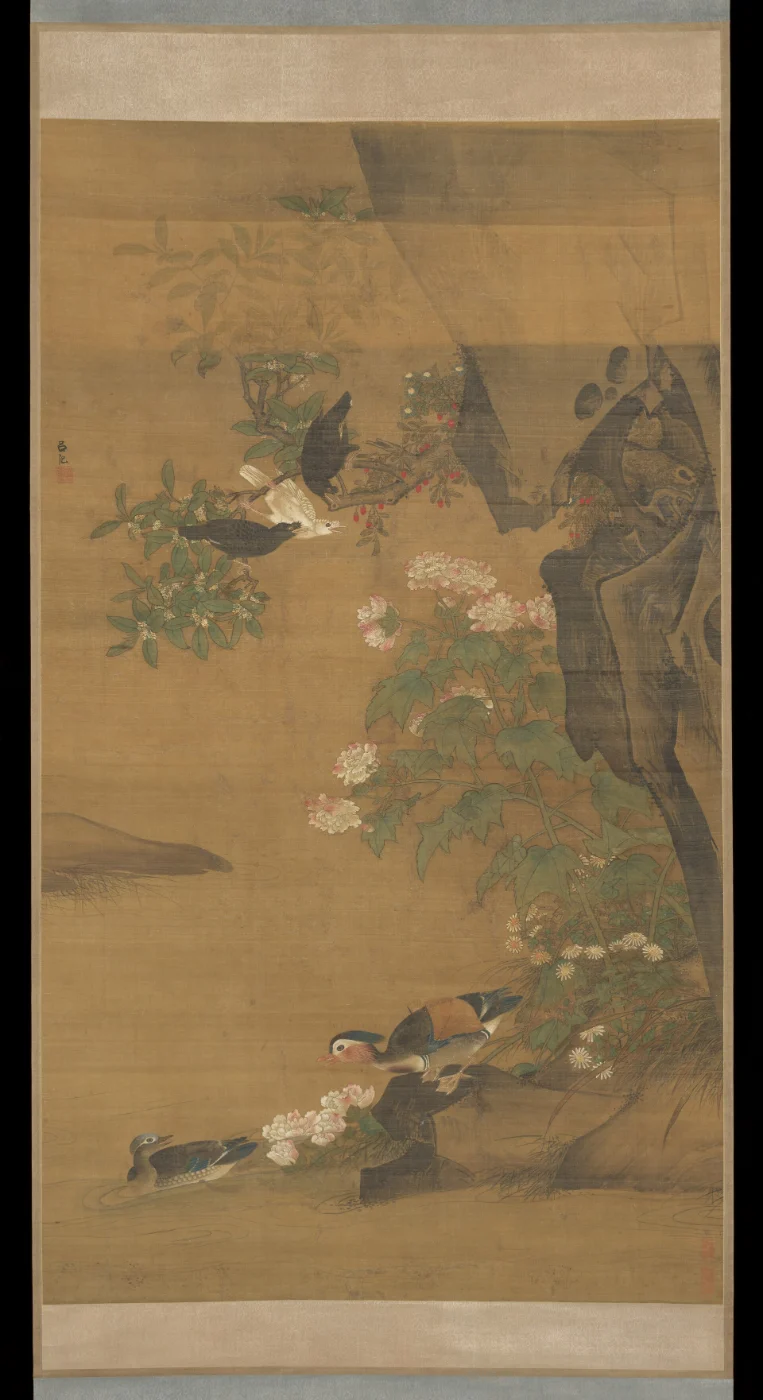
The early Ming emperors did not organise their painters into a central teaching academy, according to Britannica, but their court painters revived Song models. Bian Wenjin and his follower Lü Ji carried forward the bird-and-flower tradition of Huang Quan, Cui Bai and Huizong. Lü Ji, active in the late fifteenth century, was the most highly regarded bird-and-flower painter at the court of the Hongzhi emperor, who reigned from 1488 to 1505. His Mandarin Ducks and Cotton Rose Hibiscus in the Met, a hanging scroll about 173 centimetres high, would have hung in a palace. The pair of ducks stands for a happy marriage, and the hibiscus, furong, and cassia, gui, together form the phrase furong qigui, prosperous groom and honourable bride, an example of the animal symbolism in Chinese art built into court painting.
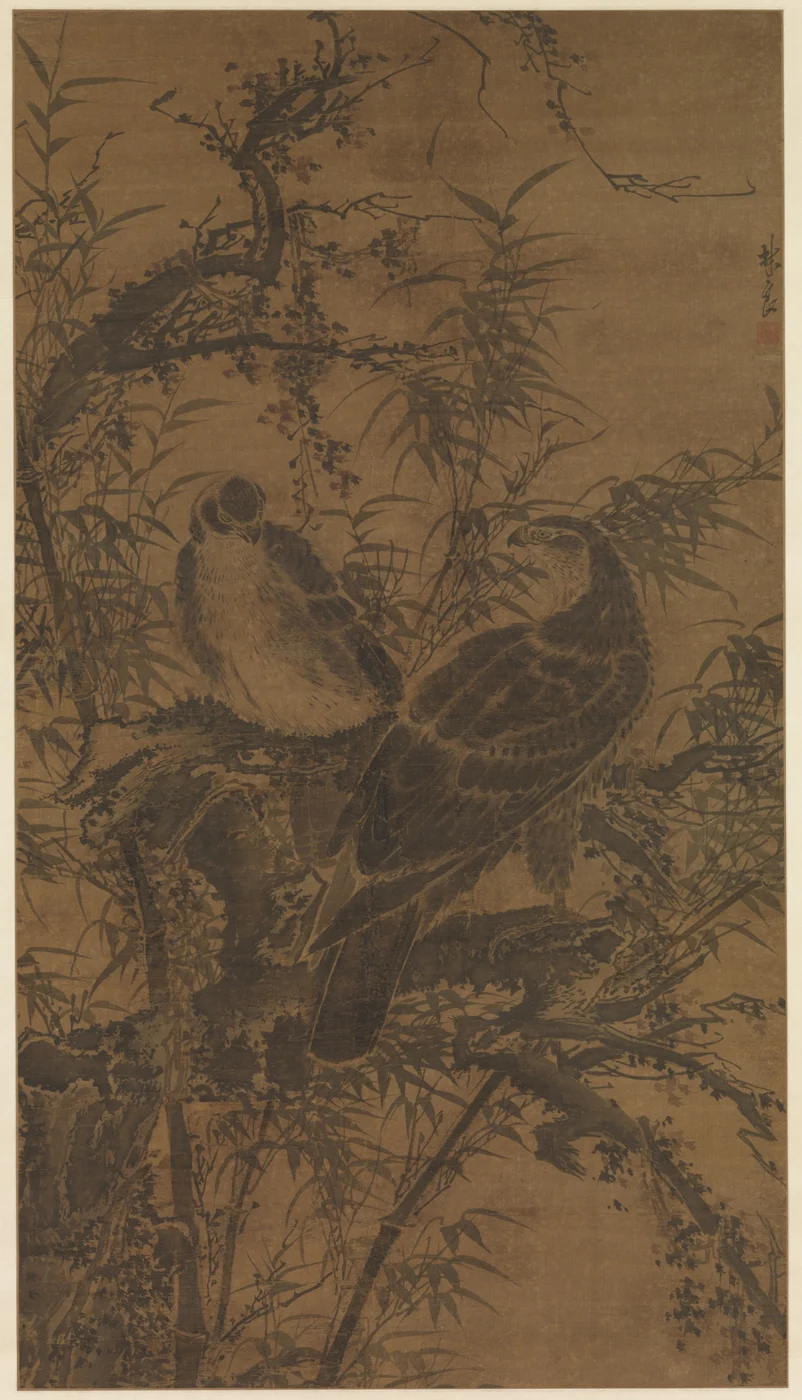
Lin Liang (about 1416 to 1480), a Cantonese painter and one of the leading court painters of bird-and-flower subjects, worked differently. The Met describes him as known for bold, expressive pictures of wild birds in monochrome ink; in Two Hawks in a Thicket his hawks sit hidden among dense old trees and thick bamboo. Outside the court, Britannica credits Shen Zhou, the leading painter of the Wu school in the late fifteenth century, with establishing the first flower painting tradition among literati painters, combining the boneless manner of the tenth-century court artists with the freedom of the late Song Chan painter Muqi. Xu Wei followed in the late Ming with what Britannica calls explosive paintings, chiefly of flowers, plants and bamboo.
YUN SHOUPING AND THE BONELESS METHOD IN THE QING DYNASTY

In the early Qing, the boneless method is most closely associated with Yun Shouping (1633 to 1690). He is counted among the Six Masters of the early Qing period, with Wang Shimin, Wang Jian, Wang Hui, Wang Yuanqi and Wu Li, and is known for developing the boneless, or mogu, technique of flower painting. The Macao Museum of Art, introducing his work, describes the technique as colour washes and loose, graceful brushwork that keep attention on the likeness of form while moving beyond naturalistic shapes, so that the paintings carry the moods of literati painting.
A fan painting of carnations and amaranthus by Yun in the Met is painted in colour on paper and mounted as a folding fan. The flowers are made from blocks of colour with no ink outlines, the entire painting is free of ink, and the veins of the leaves and petals are drawn in deeper shades of the surrounding colours. In 2023 the Macao Museum of Art, working with the Palace Museum in Beijing and the Shanghai Museum, showed more than 180 landscape paintings, bird-and-flower paintings and works of calligraphy by Yun, his disciples and fellow artists, from 2 September to 12 November.
THE LINGNAN SCHOOL: BIRD-AND-FLOWER PAINTING IN GUANGDONG
In the late nineteenth century bird-and-flower painting developed a distinct regional form in Guangdong. Ju Chao (1811 to 1865) and Ju Lian (1828 to 1904) of the Geshan school, a line that the Chinese University of Hong Kong traces back to the Jiangsu bird-and-flower painters Song Guangbao and Meng Jinyi, inspired the three painters later known as the Three Masters of Lingnan: Gao Jianfu (1879 to 1951), his younger brother Gao Qifeng (1889 to 1933) and Chen Shuren (1884 to 1948). All three studied in Japan and learned from Japanese painting. Their stated aim was to modernise Chinese painting by making the best of the Chinese and Western worlds and bridging the past and the present.
Gao Qifeng worked across many subjects, and his brushwork was most vivid in bird-and-flower and animal paintings. In 1929 he moved to Ersha Island in Guangzhou to recover his health, and the following year he founded the Tianfeng lou, or Heavenly Breeze Studio, where he held gatherings with his apprentices. The seven best known became the Seven Apprentices of the Heavenly Breeze. The youngest, Chao Shao-an (1905 to 1998), settled in Hong Kong in 1948, taught Chinese painting at Chung Chi College in the 1950s and brought the Lingnan school international recognition.
HYATT REGENCY HENGQIN: LANDSCAPE, MATERIALS AND MACAU

Hyatt Regency Hengqin, completed in 2019, anchors the Lai Sun Creative Culture City in Novotown on Hengqin Island, Zhuhai, and has 493 rooms and suites. The island is connected to Hong Kong and Macau by the Hong Kong to Zhuhai to Macau Bridge, and views from the hotel to the Hengqin hills and to Macau shaped its design. Macau is where the Macao Museum of Art showed the work of Yun Shouping and his circle in 2023, and Hong Kong is where Chao Shao-an settled in 1948 and taught the Lingnan style of bird-and-flower painting.
The connection between the hotel and the genre is one of approach rather than imagery. Bird-and-flower painting was built on close study of natural subjects: Huang Quan's xiesheng, or lifelike painting, the observed finches of Huizong's academy and the flowers Yun Shouping built from colour alone. The hotel's design took its direction from the surrounding landscape, the hills of Hengqin and the view to Macau, and its interiors use natural materials: vertical timber slats, woven linen, rattan and pale veined stone.
SOURCES
- Encyclopaedia Britannica Chinese painting: Five Dynasties and Ten Kingdoms, Song dynasties
- Encyclopaedia Britannica Chinese painting: Ming dynasty (1368 to 1644)
- The Metropolitan Museum of Art Emperor Huizong, Finches and Bamboo
- The Metropolitan Museum of Art Bian Lu, Peahen and Hibiscus
- The Metropolitan Museum of Art Lü Ji, Mandarin Ducks and Cotton Rose Hibiscus
- The Metropolitan Museum of Art Lin Liang, Two Hawks in a Thicket
- The Metropolitan Museum of Art Yun Shouping, Carnations and Amaranthus
- Macao Government Information Bureau Macao Museum of Art exhibition: Yun Shouping, Paintings and Calligraphy from the Palace Museum and the Shanghai Museum
- The Chinese University of Hong Kong Legacy of the Heavenly Breeze: The Art of Gao Qifeng, Chao Shao-an and Au Ho-nien
- The Chinese University of Hong Kong, New Asia College Story of Chinese Ink in the Mountain Town: Gongbi Painting Programme