HOW THE GASLIT GIN SHOPS OF 1830S LONDON SET THE LOOK OF THE VICTORIAN PUB
The gin palace was a London invention of the 1830s: a spirit shop refitted with plate glass, gas lighting, gilding and a long polished mahogany bar, built to sell gin quickly to working customers. The Royal Institute of British Architects holds the 1829 to 1830 drawings by John Buonarotti Papworth for the wine merchants Thompson & Fearon at 94 Holborn Hill, the premises said to have opened the country's first gin palace. Critics called these shops vulgar and dangerous, and Charles Dickens described one in detail in 1835. Historic England notes that none of the original gin palaces survives, but their mirrors, mouldings, etched glass and gilding shaped British pub history in the late 19th century, the peak decades of urban pub building. Heritage bodies still describe the finest surviving Victorian pub interiors, in London, Liverpool and Belfast, as gin palaces.
WHERE DID GIN COME FROM? THE GIN CRAZE BEFORE THE PALACES
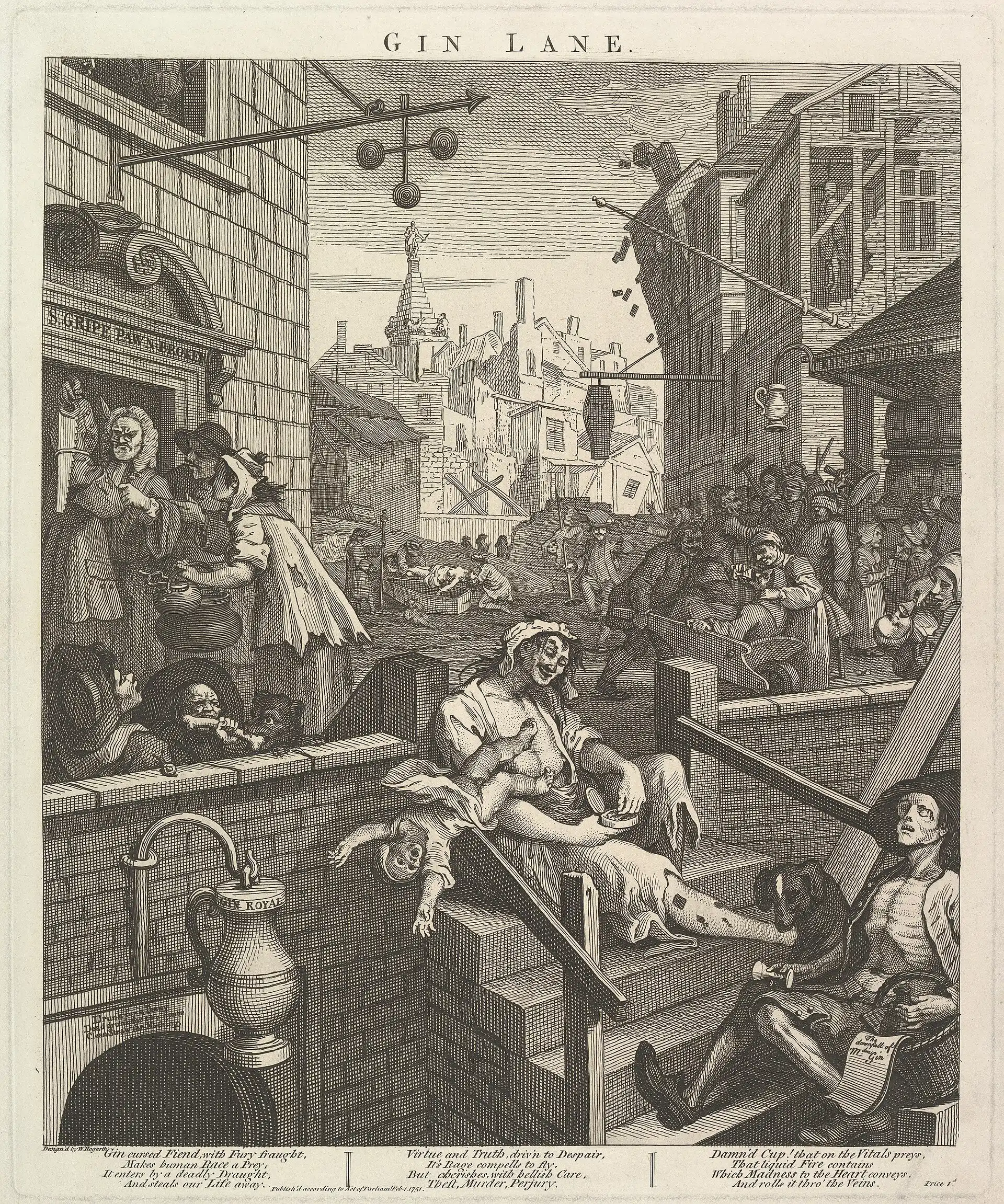
Gin reached England from the Netherlands. Art UK explains that Dutch juniper spirit, called jenever or genever, was imported after the Glorious Revolution of 1688 brought William of Orange to the throne as William III, and the English word gin is taken from the Dutch name. London distillers were soon making and selling it across the city. It was cheaper than French brandy and beer, the main drinks of London's taverns and alehouses during the conflict with France, and production was largely unregulated. Illegal home distillers sometimes added harmful substances such as sulphuric acid, turpentine and lime oil.
Historians call the period that followed the Gin Craze. Consumption peaked between the 1720s and the 1740s, and by 1730 an estimated 7,000 gin shops were operating in London alone, selling around 10 million gallons a year. Parliament passed a series of acts to curb the trade between 1736 and 1751. The Gin Act of 1751 was the eighth attempt, and it followed Henry Fielding's enquiry into rising crime, which linked gin drinking to robbery. Opposition to a ban was also voiced: in 1743 Samuel Johnson warned that taking gin away from the poorer classes could provoke rebellion.
William Hogarth's print Gin Lane belongs to that campaign. The British Museum records that it was published as a pair with Beer Street in February 1751, and Art UK describes the two as made to be viewed together in support of the act. Gin Lane is set in St Giles in Bloomsbury, a district known for its brothels and gin shops, with the tower of St George's Bloomsbury in the background. In the foreground a drunken mother lets her baby fall over a stair rail into a gin cellar, while Beer Street shows a prosperous, well-fed street.
WHAT WAS A GIN PALACE? THOMPSON & FEARON AND THE HOLBORN DRAWINGS
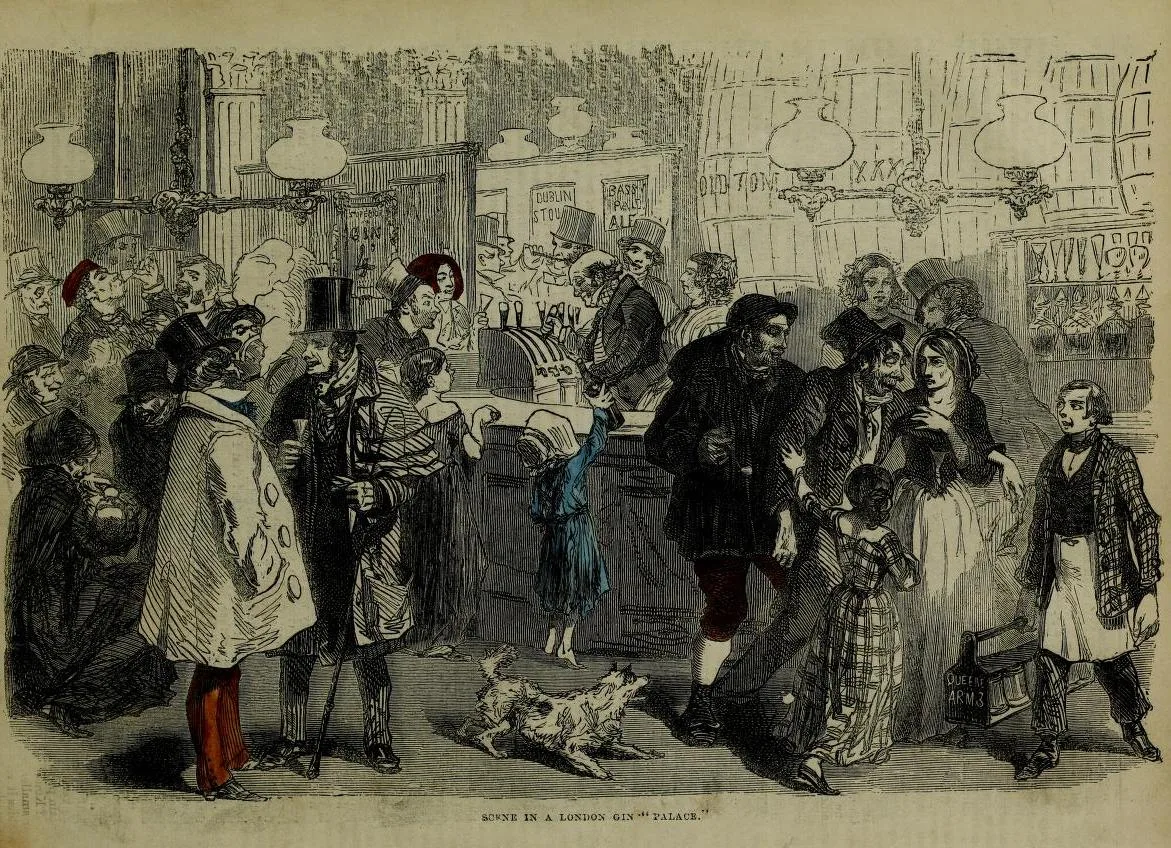
The drawings by Papworth (1775 to 1847) for Thompson & Fearon are dated 1829 and 1830 and are kept in the RIBA Collections. The set includes a plan of new vaults under the pavement in front of the shop, a coloured interior section through the counting house, and details of a screen dividing the upper and lower parts of the shop. RIBA's catalogue notes for the drawings state that the design of such establishments strongly influenced the design of later pubs and bars.
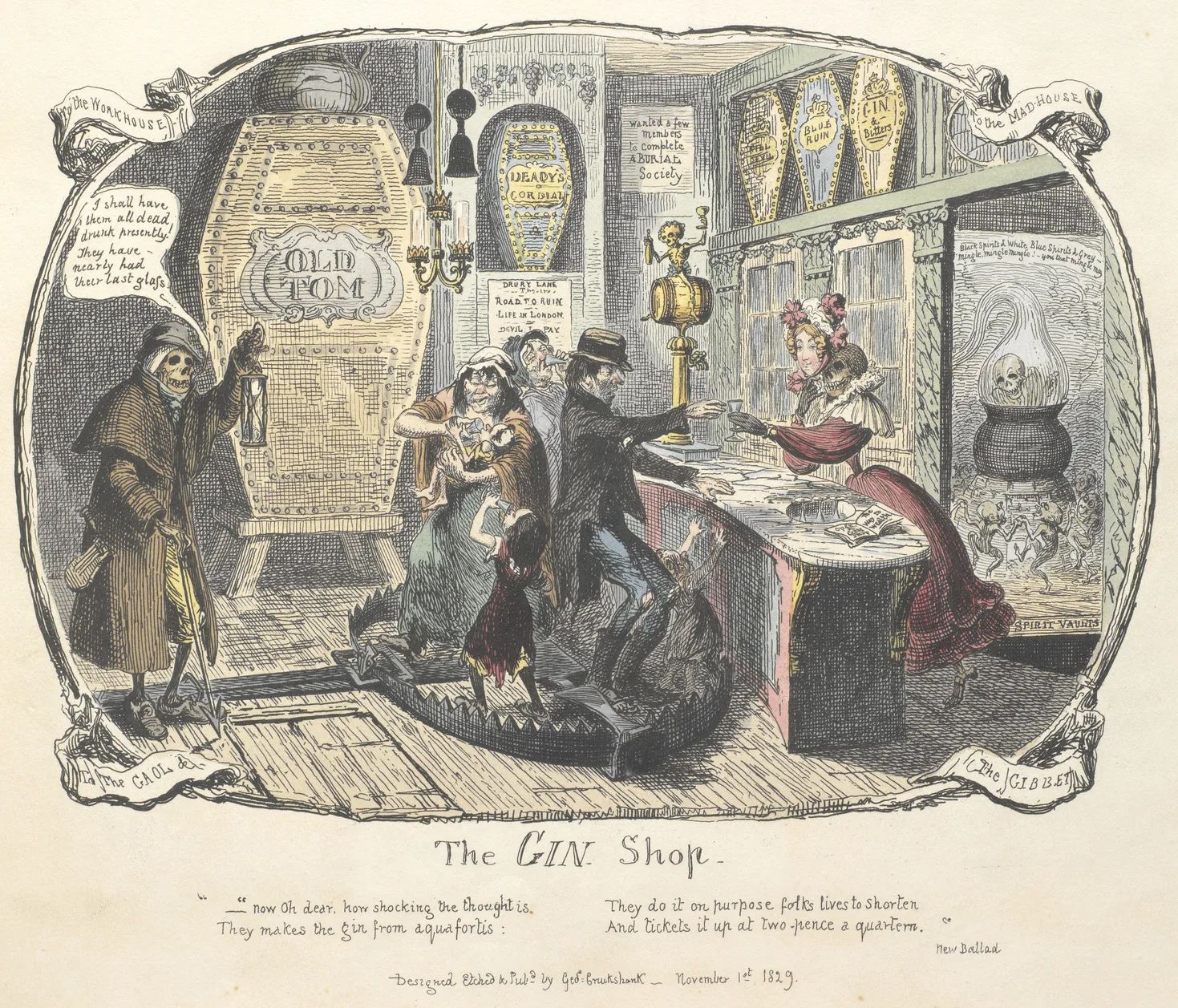
The historian Lee Jackson, writing for Yale University Press, describes gin palaces as gaslit, gilded public houses aimed at the ordinary drinker. Their typical features were illuminated clocks, etched plate-glass windows, oversized gas lamps and long bars of polished mahogany, backed by large barrels of branded spirits with names such as Old Tom and Cream of the Valley. The American writer Sedgwick described gas displays of about fifty or sixty jets in a single lantern, and the shops were often called flaring. There was no seating. Customers stood at the counter and drank quickly, which landlords said discouraged loitering and critics said encouraged binge drinking.
DICKENS AND THE GIN-SHOP: A DESCRIPTION FROM 1835
Charles Dickens's sketch of a London gin-shop first appeared in the Evening Chronicle on 7 February 1835 and was later collected in Sketches by Boz, where George Cruikshank illustrated it for the 1839 edition. Dickens placed the handsomest shops in and around Drury Lane, Holborn, St Giles's, Covent Garden and Clare Market, and observed that the most elaborate were in the dirtiest and poorest streets. His narrator walks towards Drury Lane, past the slum known as the Rookery near the brewery at the bottom of Tottenham Court Road.
The sketch describes the interior in detail. Outside there was an ornamented parapet, an illuminated clock, plate-glass windows framed by stucco rosettes and gas lights in gilt burners. Inside, a bar of French-polished mahogany ran the full width of the room. Behind a light brass rail stood rows of huge casks painted green and gold, labelled Old Tom, Young Tom and Samson with numbers that the Victorian Web's editor suggests refer to gallons. Ground-glass doors carried signs for a Counting-house, a Bottle Department and a Wholesale Department. A lofty saloon behind had a gallery and more casks, and small wicker-covered baskets of cakes and biscuits sat on the counter.
WHY VICTORIAN CRITICS ATTACKED THE GIN PALACE
Jackson records that journalists, magistrates and temperance campaigners opposed the new shops, and that magistrates threatened to remove licences. Moralists called them gin temples. The satirist George Cruikshank wrote scornfully of their customers, and the MP James Silk Buckingham, a temperance and sabbatarian reformer, warned of a flood of disease, crime and destruction. The Times objected that decoration once found in gentlemen's clubs and hotels was now being spent on the lower classes. Jackson notes that the common description of the shops as flaring belonged to their lights and implied garish vulgarity. The American writer Alexander Slidell Mackenzie criticised their stained glass, with its rosettes and bunches of grapes.
Critics also objected to the architecture itself. The multiple entrance doors, hung on smooth patent hinges, were said to let thieves and prostitutes slip away from the police, and the standing bar was blamed for fast, heavy drinking. The lighting was copied so widely that some drinkers were reportedly confused when bakers and other shopkeepers adopted it. Jackson argues that the panic over gin palaces in the 1830s was part of a longer argument about what a public house should look like and do, and a reaction against the modernisation and commercialisation of the licensed trade.
FROM GIN PALACE TO LATE-VICTORIAN PUB INTERIOR
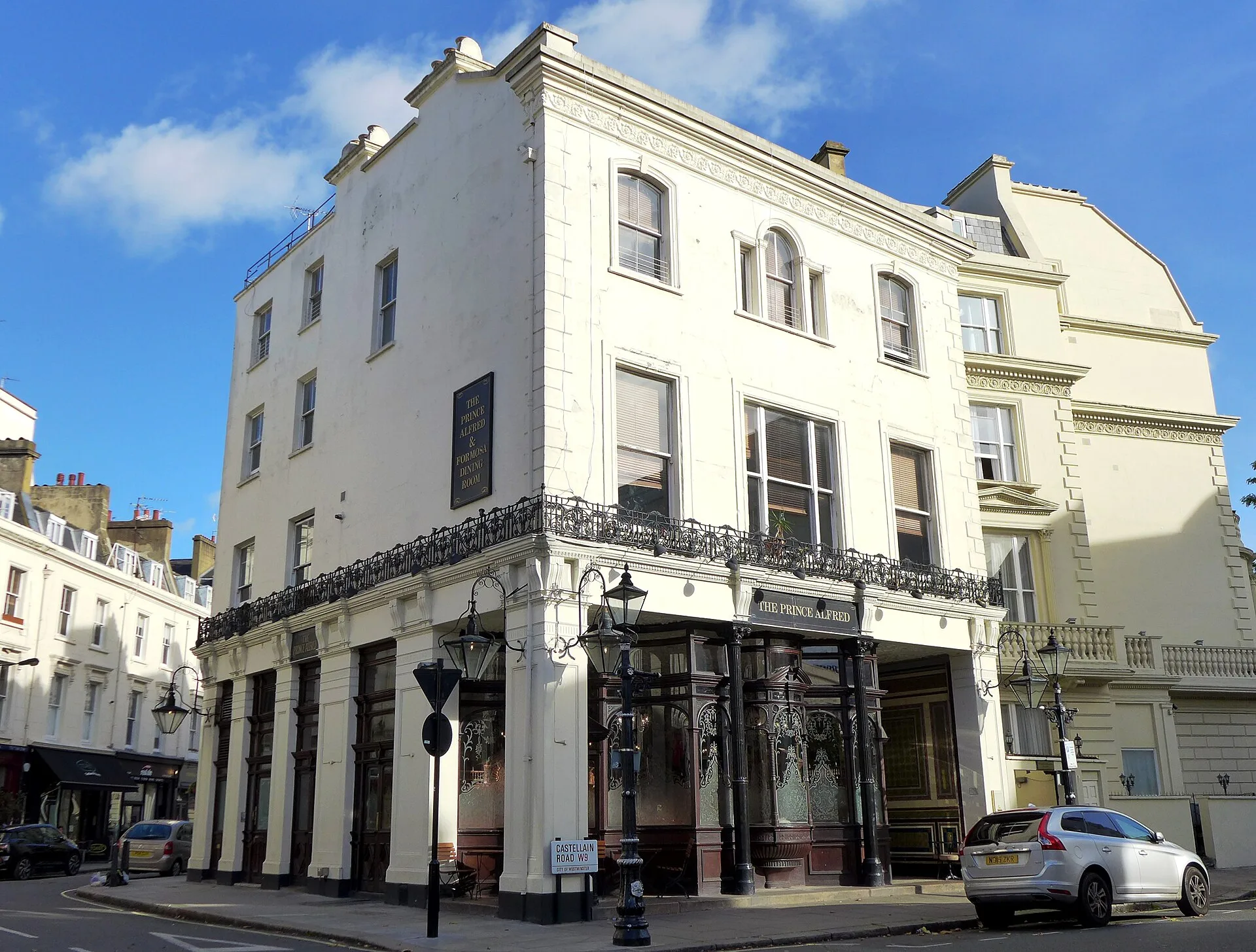
Historic England's listing of the Prince Alfred in Maida Vale, a Grade II* pub of 1863 refitted around 1898, explains that the remodelling took place during the late-Victorian pub boom, when breweries and publicans competed for trade under strict licensing controls and spent heavily on their premises. London pubs of the period were divided into several small drinking spaces rather than one room. At the Prince Alfred, ornate carved timber screens with etched-glass upper panels radiate from a long servery and divide the main bar into five compartments, with small low doors that let pot boys collect glasses without going outside.
The same listing records the snob screens in the former ladies' bar: rotating etched-glass panels set on the counter that gave customers privacy. The pub also has bowed windows of etched and engraved glass, wall tiling, mosaic floors and an island bar back with a clock carrying the pub's name. A billiards hall was added at the rear, another common feature of 1890s London pubs. Larger saloon bars became fashionable in the 1890s, but the Prince Alfred kept its compartments, which Historic England says give a tangible sense of how such pubs worked.
THE SURVIVORS: PRINCESS LOUISE, THE PHILHARMONIC AND THE CROWN
The Princess Louise at 208 High Holborn was built in 1872 and completely remodelled in 1891 by the little-known architect Arthur Chitty. It is listed Grade II* and rated by CAMRA's pub heritage register as an interior of outstanding national importance. The tiling is by W. B. Simpson & Sons, the gilded and etched mirrors by R. Morris & Son, and the large mahogany island bar back, with a central archway and a four-sided clock, by W. H. Lascelles & Co. Its original screens were removed by about the 1960s and reinstated in 2008, using surviving glass and an original plan, to recreate seven drinking areas divided by mahogany and etched-glass partitions.
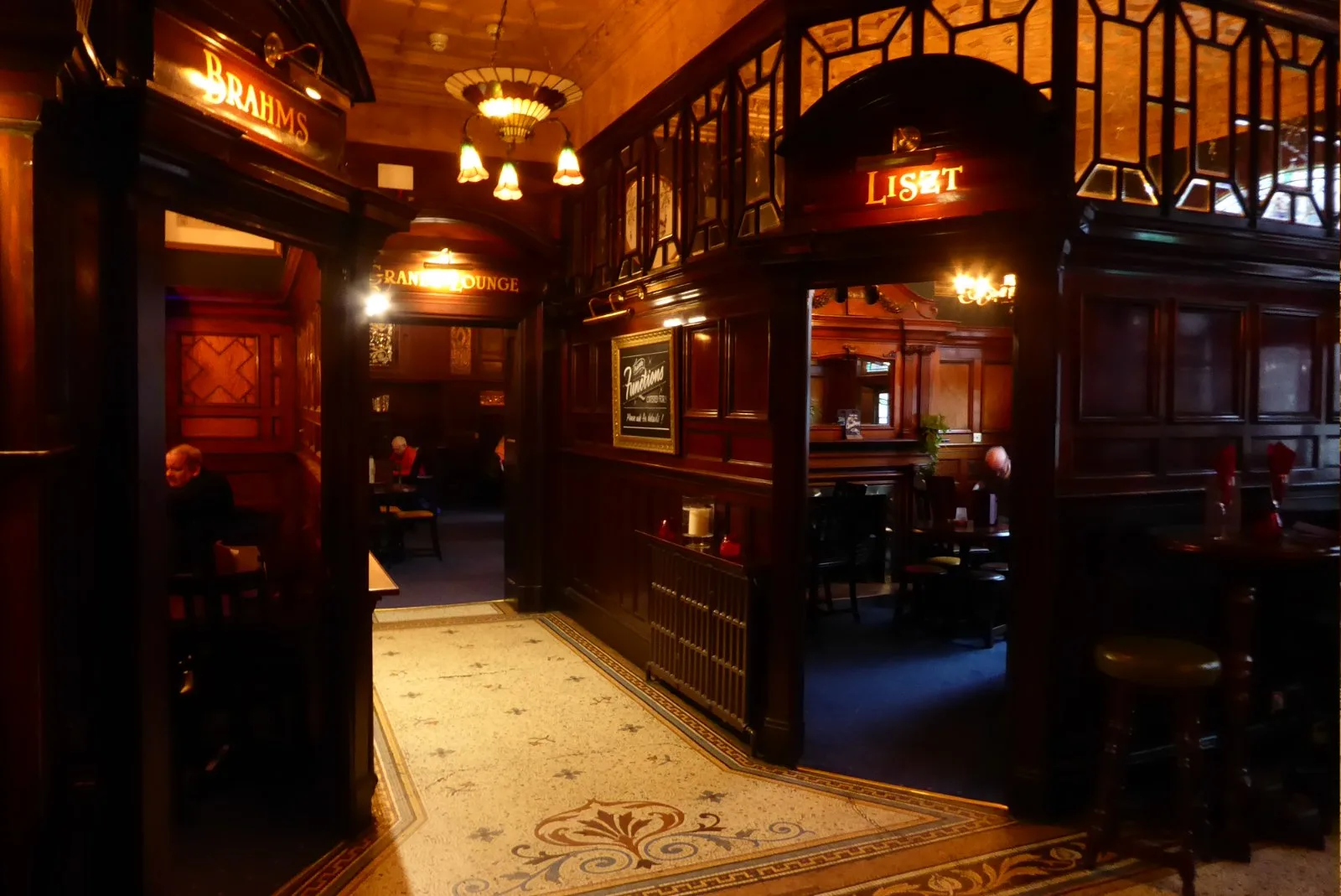
In Liverpool, the Philharmonic Dining Rooms on Hope Street were built from 1898 to 1900 by the architect Walter W. Thomas for the brewer Robert Cain, whose firm owned more than 200 Liverpool pubs by the late 1880s. Historic England, which lists the building at Grade I, calls it one of England's finest public houses and the pinnacle of the gin palace form. Inside are a horseshoe bar with a mosaic front, a Jacobean-style plaster ceiling, repoussé copper panels of musicians by H. Bloomfield Bare and two small rooms known as Brahms and Liszt. In Belfast, the National Trust's Crown Bar, originally the Crown Liquor Saloon, keeps a red granite bar, ten wooden snugs with call bells and gunmetal match strikers, stained-glass windows, a carved and painted ceiling, a mosaic floor and period gas lighting.
VICTORIAN PUB INTERIORS AT GORDON RAMSAY PUB & BAR

Gordon Ramsay Pub & Bar at The Londoner Macao was designed by Silverfox Studios and completed in 2023. Its main design cue is the London Bridge to Greenwich railway viaduct, built in the 1830s with 878 brick arches, many of which now house shops, restaurants, bars and pubs. The fit-out layers steel, timber, metal and cast iron into brickwork and vaults, and the dining room sits beneath arched brick vaults. Scalloped ceiling profiles and dark green enamel cast iron columns are combined with Victorian pub cabinetry, panelling and mouldings.
SOURCES
- Art UK The Gin Craze: how William Hogarth captured the spirit of Georgian Britain
- The British Museum Gin Lane, William Hogarth, 1751
- RIBA Collections Designs for alterations to the premises of Thompson & Fearon, 94 Holborn Hill, London, creating a 'gin palace'
- Yale University Press The Gin Palace, by Lee Jackson
- The Victorian Web Gin-Shops, from Sketches by Boz, by Charles Dickens
- Historic England, Heritage Calling 10 of the Best Gin Palaces
- Historic England Prince Alfred Public House (List Entry 1066328)
- Historic England The Philharmonic Dining Rooms (List Entry 1207638)
- CAMRA Pub Heritage Princess Louise, Holborn
- National Trust Visiting the Crown Bar