HOW GOLD IS BEATEN INTO LEAF AND LAID ON WOOD, GLASS AND BUILDINGS

Gold leaf is gold beaten into extremely thin sheets for gilding, the decorative art of covering all or part of an object with gold. Britannica gives the thickness of modern leaf as about 0.1 micrometre, or four millionths of an inch, and the metal is gold alloyed with small amounts of silver and copper. Gilders lay it on wood, plaster, metal, glass, paper, ceramics and textiles. Egyptian craftsmen were already producing leaf as thin as one micron, and Britannica notes that the goldbeating process has changed little since antiquity. The Royal Collection Trust describes two methods used on frames: water gilding, which can be burnished to a polished finish, and oil gilding, which gives a more matt surface with considerably less preparation. In Japan, more than 99 per cent of gold leaf is produced in the city of Kanazawa, and in Nanjing gold foil was flattened on paper and cut into thread for Yunjin brocade.
WHAT IS GOLD LEAF MADE OF AND HOW THIN IS IT?
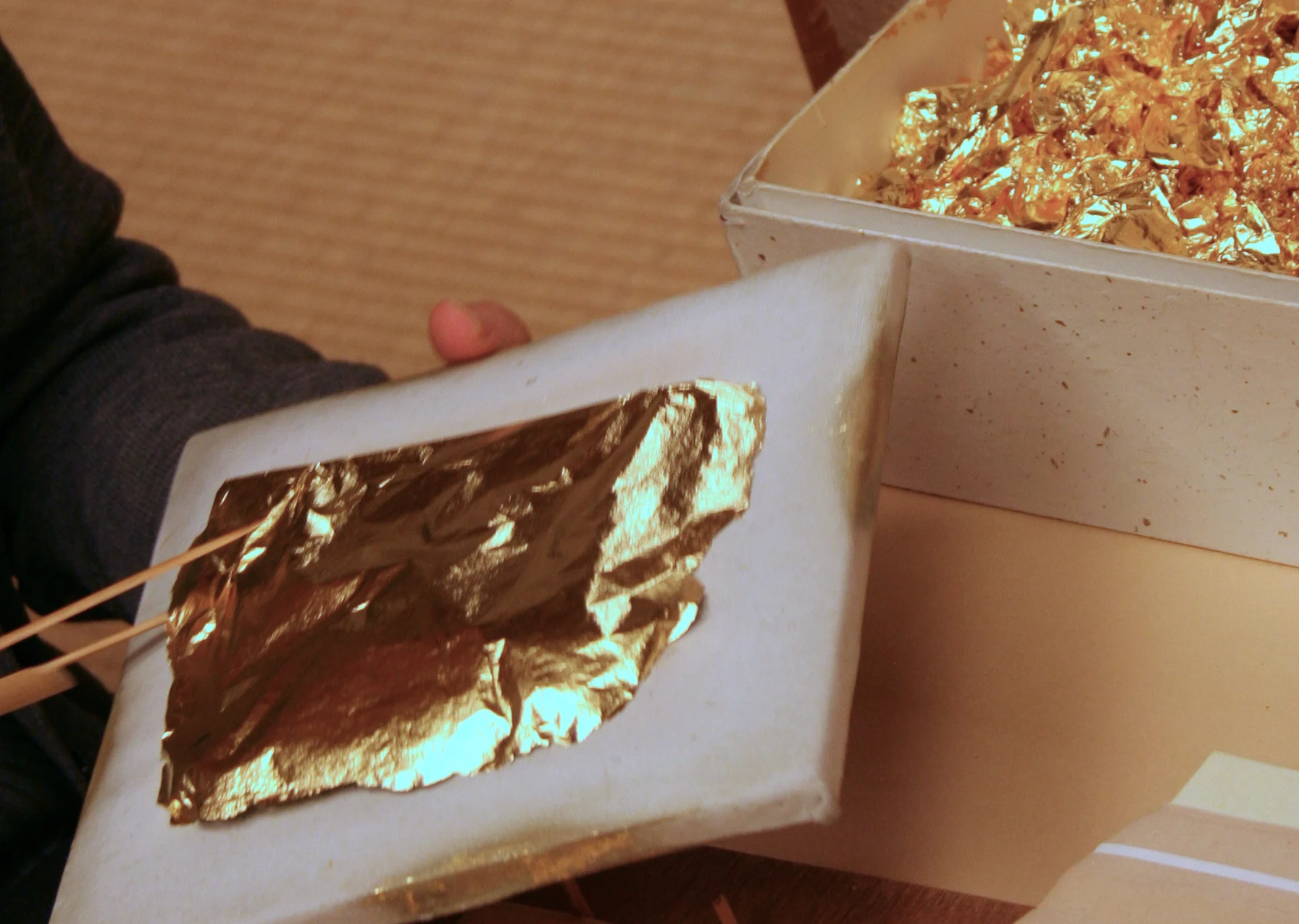
Gold is malleable enough to be hammered into very thin sheets, and the Metropolitan Museum of Art notes that most surviving ancient Egyptian gold is in this form. Egyptian gold usually contained substantial silver and was generally not refined for most of Egypt's history; electrum, a natural alloy of gold and silver, is defined after Pliny the Elder as containing more than 20 per cent silver. Modern leaf starts with a deliberate alloy. Britannica describes a small ingot cast from gold with small amounts of silver and copper, and Kanazawa's makers use the same mix.
Published thickness figures vary slightly by source. Britannica gives about 0.1 micrometre, Japan's tourism agency gives one ten-thousandth of a millimetre for Kanazawa leaf, and a Kanazawa maker gives 0.0001 or 0.00012 millimetres, thin enough for light to show through. China Daily reports that one gram of gold could be hammered into foil 0.12 micrometres thick, covering 0.47 square metres. Finished leaves are trimmed to squares of about 8.5 centimetres and packed between sheets of tissue paper in books of 25. Britannica notes that the leaves are so delicate that a light breath can move or straighten them.
WHERE DID GILDING COME FROM? EGYPT, GREECE AND ROME
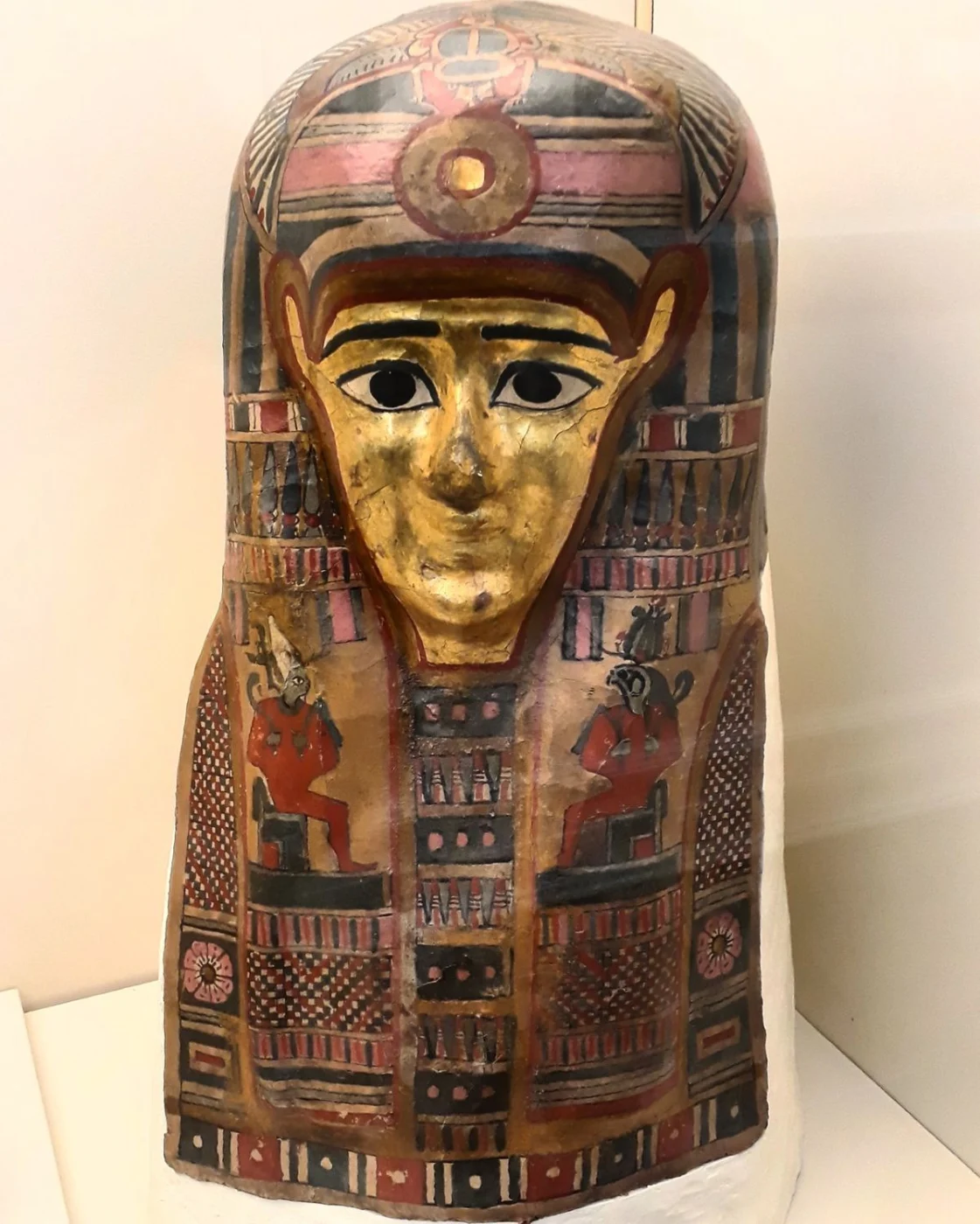
The earliest surviving Egyptian gold dates from the fourth millennium BC, mostly beads and small adornments, and the hieroglyph for gold appears from the First Dynasty. The Egyptian word for gold, nbw, reflects one of its sources, Nubia; miners also worked the Eastern Desert. According to the Met's conservator Deborah Schorsch, gold leaf as thin as one micron was produced in ancient times, while thicker foils and sheets were fixed to wood and bronze mechanically or with adhesive. A model collar made for an official named Hapiankhtifi in the Twelfth Dynasty has gold leaf laid over gesso, a plaster with adhesive gum, on a linen base. Britannica describes the Egyptians as master gilders and records thin gold leaf overlays on royal mummy cases and furniture.
The Greeks gilded wood, masonry and marble sculpture, and gilded metal by fire gilding: they applied an amalgam of gold and mercury and drove off the mercury with heat, leaving a coating of gold. Britannica records that the Romans learnt gilding from the Greeks and used it extensively on temples and palaces. The Met notes that mercury gilding, imported from East Asia, became the most common process for gilding silver in the Mediterranean world during the Roman period, and that gilded glass jewellery was popular in the Ptolemaic and Roman periods. In China, artisans decorated wood, pottery and textiles with gold designs from early times.
GOLD LEAF IN GLASS: THE GOLD GROUNDS OF BYZANTINE AND ISLAMIC MOSAICS

Gold leaf also went into glass. A 2023 study in the European Physical Journal Plus by Maria Guerra, Elisabetta Neri and Martin Radtke describes gold leaf tesserae as a leaf less than 0.5 micrometres thick placed between two layers of glass: a bottom layer as support and a thinner top layer covering the leaf. The earliest known gold leaf tesserae date from the first century BC, and silver leaf tesserae from the second century BC. The authors analysed tesserae from nine sites, including the Palatine Chapel at Aachen and the mosque at Damascus, and found alloys typically above 95 per cent gold, matching those used for gold leaf gilding. Their data do not support the idea that gold coins were hammered directly into leaf for mosaics.
The Met dates the height of glass mosaic to the Byzantine period (330 to 1453). Hagia Sophia in Constantinople, completed in 537, had glass mosaics across its central dome and the vaults of its side aisles and narthex, and its earliest mosaic sections set green, blue and red tesserae against a gold background. Glass mosaics cover the upper half of the interior and exterior of the Dome of the Rock in Jerusalem (691), and the congregational mosque in Damascus, completed under the caliph al-Walid I (reigned 705 to 715), shows pavilions, palaces and landscapes against a golden background. A tile in the Met, said to come from a church near Ma'arrat al-Nu'man, shows the method at small scale: gold leaf on purplish glass, with triangles cut away to form a cross, sealed under a layer of clear glass.
HOW IS GOLD LEAF MADE? THE GOLDBEATING PROCESS
Britannica sets out the sequence. The cast ingot is rolled into a ribbon about 0.025 millimetres thick, which is cut into squares of about 3 centimetres a side. Each square is placed between sheets of heavy paper, the stack is enclosed in sheepskin, and it is hammered until each square measures about 10 centimetres a side. The squares are then cut into quarters, repacked between parchment and beaten again, and this cutting and beating is repeated until the leaves reach their final thinness.
In Kanazawa, gold is alloyed with a little silver and copper, rolled into strips, and sections of the strip are beaten in many stages between washi paper made specifically for the process. Japan's tourism agency notes that preparing this paper is itself a process lasting several months. Kanazawa's production is attributed to local conditions that suit the work: humidity that suppresses static electricity, which interferes with production, and good water for the washi used in beating. At the gilding stage static is put to use: Britannica describes how the gilder draws the brush over their hair so that static electricity holds the leaf in place as it is lifted and laid.
KANAZAWA AND NANJING: GOLD LEAF CENTRES OF JAPAN AND CHINA
According to a local legend recorded by Japan's tourism agency, gold leaf production in Kanazawa began when Maeda Toshiie (1537 to 1599), the first Maeda lord, ordered gold-tipped spears for his warriors. From 1603 the Tokugawa shogunate strictly controlled gold and allowed beating only in Edo and Kyoto, so Kanazawa's production was suspended. After Kanazawa Castle burned in 1808, its reconstruction needed a large quantity of gold leaf, and the city's leading merchants obtained permission for production to resume. Once production in Edo ceased, Kanazawa's share grew through the second half of the 19th century, and the city now makes more than 99 per cent of Japan's gold leaf.
Kanazawa leaf was used in luxury residences, temples and on Buddhist altars, and today it decorates lacquerware, pottery, cosmetics and food. The leaf is edible but has no flavour, and soft-serve ice cream topped with a sheet of it is popular with visitors. The World Monuments Fund states that Kinkaku-ji, the Golden Pavilion in Kyoto, is mostly covered in Kanazawa gold leaf, and that a three-year professional training programme for eight trainees began in Kanazawa in April 2022 with Kanazawa City, the Agency for Cultural Affairs and the Society for the Conservation of Traditional Kanazawa Gold Leaf Techniques.
In China, gold foil was woven into silk. China Daily reports that Yunjin brocade from Nanjing traces its start to 417, when a government office for brocade production was set up in the city, and that the technique reached its height under the Yuan, Ming and Qing dynasties. Ancient texts describe brocade as silk containing gold. To make gold thread, craftspeople flattened gold foil on paper and cut it into fine strips, controlling their breathing so the foil would not blow away. According to the Nanjing Yunjin Museum, two weavers working together for a day can produce only 5 to 6 centimetres of the fabric. The Nanjing Yunjin Research Institute was founded in 1957.
WATER GILDING VS OIL GILDING: HOW GOLD LEAF IS APPLIED

All gilding starts with preparation of the ground. Britannica describes priming the surface with flat paints, lacquers or sealing glues according to the material, and protecting corrodible metals with red lead or iron oxide paint. The design is set out in pencil or chalk, then coated with size, an adhesive chosen to dry quickly or slowly, which is ready when it just sticks to the fingertips. The gilder cuts the required piece of leaf with a pointed tool, lifts it with the brush and lays it on the design, then pounces the gilded area with soft cotton to bring it to a high lustre.
The Royal Collection Trust explains that from the 17th century most wooden frames were carved and then gilded, and that water gilding, the labour-intensive method, was used on them. The wood is coated with layers of gesso, a mix of dilute animal glue and chalk: applied thinly, it lets carved detail show through; applied thickly, it can be carved itself. A layer of coloured bole mixed with glue follows, giving the leaf depth of colour and a surface to bond to. Water reactivates the glue in the gesso and bole, and the gold adheres as it dries. The leaf can then be left matt or burnished with an agate stone.
Oil gilding uses an oil-based adhesive called oil size. It needs considerably less preparation, can be applied to lightly prepared or unprepared surfaces, works on materials other than wood, and usually gives a more matt appearance. From the late 18th and early 19th centuries, frames also used composition, or compo, a press-moulded ornament of animal glue, chalk, linseed oil and rosin that shrinks and cracks over time. Britannica notes that leaf can also be powdered by rubbing it through a fine sieve, but because powdered gold is expensive, bronze powders are used almost universally instead.
GRAND IMPERIAL COURT: RED AND GOLD AT MGM MACAU

Grand Imperial Court at MGM Macau is a Chinese fine dining restaurant designed by Silverfox Studios and completed in 2024. An automated sliding entry opens onto a display wall for Moutai, made of floating, individually lit jewel-box vitrines in red and gold that hold rare vintage bottles. The wall serves as a brand statement and a ceremonial introduction to the restaurant. Because the sliding entry opens directly onto this wall, the red and gold vitrines are the first display guests reach.
The private suites are themed on gemstones: sapphire, emerald, ruby and gold. Each is fitted with custom hand-crafted tapestries. Gold appears at Grand Imperial Court in the red and gold vitrines of the Moutai wall and as the theme of one of the private suites. In Chinese textiles gold was used as thread: Yunjin brocade from Nanjing, which reached its height under the Yuan, Ming and Qing dynasties, incorporates gold and silver thread, made by flattening gold foil on paper and cutting it into fine strips.
SOURCES
- Britannica Gilding
- Britannica Gold leaf
- The Metropolitan Museum of Art Gold in Ancient Egypt
- The Metropolitan Museum of Art Glass Ornaments in Late Antiquity and Early Islam (ca. 500 to 1000)
- European Physical Journal Plus (Università degli Studi di Firenze repository) Gold leaf tesserae: tracing the origins of gold using synchrotron-based techniques
- Royal Collection Trust Frames in the Royal Collection: processes and materials
- Japan Tourism Agency Kanazawa gold leaf
- Go! Central Japan Gold Leaf Sakuda Co., Ltd. Main Store
- World Monuments Fund Kanazawa Haku: Gold Leaf Production Craftsmanship Inheritance Program
- China Daily Yunjin's scintillating silks