THE SAP OF THE LACQUER TREE, BUILT UP IN THIN LAYERS, FROM NEOLITHIC CHINA TO THE PALACES OF EUROPE
Chinese lacquerware is decorative work made by building up thin coats of lacquer, the refined sap of the lacquer tree, Toxicodendron vernicifluum, over a core of wood or another material. Once hardened, lacquer forms a natural plastic that resists water, acid and, to a degree, heat. Lacquered objects in China go back to the Neolithic period: a wooden bow coated with raw lacquer from the Kuahuqiao culture is more than 8,000 years old. Han dynasty records priced one lacquer cup at ten bronze ones. Carving and gold-filled engraving followed, and the Ming and Qing courts commissioned lacquer furniture. From the 16th century, export lacquer reached European palaces and prompted imitations known as japanning.
WHAT IS CHINESE LACQUER AND HOW IS IT MADE?
Lacquer is a resin obtained from the sap of Toxicodendron vernicifluum (listed by the Met as Rhus verniciflua), a tree native to East Asia. The Metropolitan Museum of Art describes the raw sap as highly toxic and the tree as a close relative of poison ivy. The sap is collected once a year by cutting notches into the trunk and drawing off the viscous liquid, which is then gently heated to remove excess moisture and impurities. A 2023 study in the journal Coatings notes that catechol and phenol derivatives make up 60 to 65 per cent of the sap, and that an enzyme, laccase, drives the polymerisation that turns the liquid into a solid film.
Purified lacquer can be applied to almost any surface or built up into a thick mass. Each coat is laid on thinly and left to dry in a warm, humid, draught-free cabinet before the next is added, and work of high quality may need thirty or more coats, which made lacquer slow and costly to produce. Only a few colouring agents combine well with lacquer. The earliest Chinese lacquers were black or red, coloured with charcoal or with cinnabar, the mercuric sulphide that also gives later carved red lacquer its colour.
WHERE DID CHINESE LACQUERWARE COME FROM?
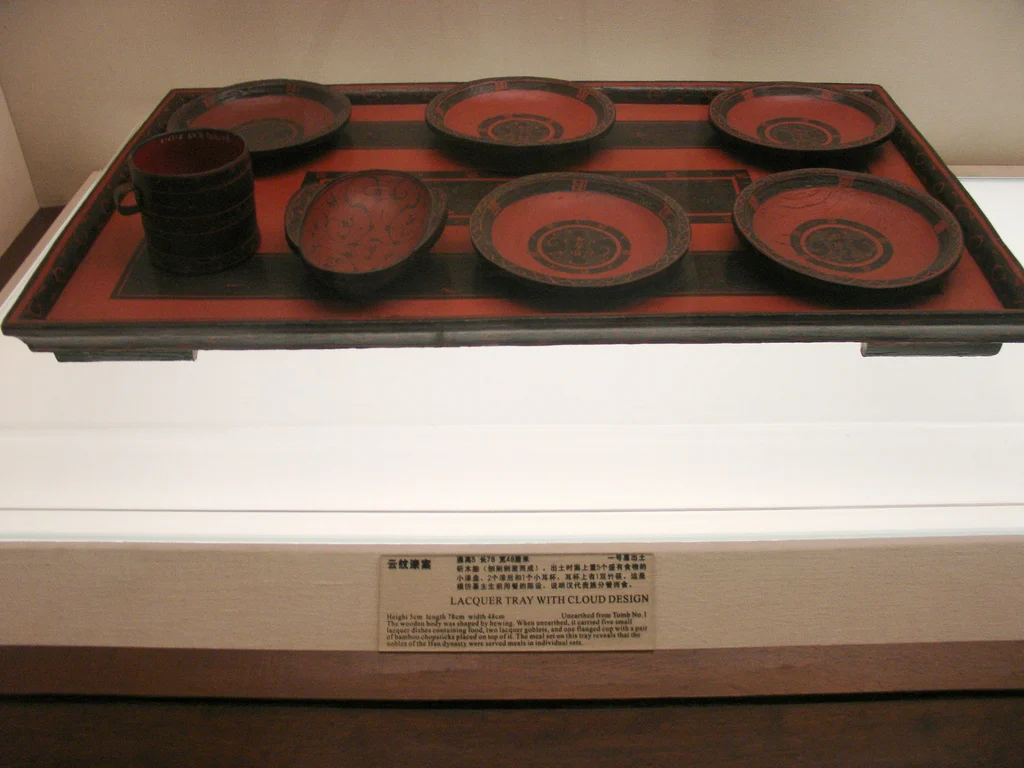
Lacquered objects have been recovered from Neolithic sites in China. The earliest evidence cited in the 2023 Coatings study is more than 8,000 years old: a wooden bow from the Kuahuqiao culture, decorated with raw lacquer. The same study refers to a red lacquered wooden bowl from a Neolithic site in the Yangtze River Delta, dated to roughly 6,000 to 7,000 years ago. According to the Met, elaborately decorated lacquerware first appeared in the Warring States period (475 to 221 BC), and from then on Chinese lacquer developed along two lines: surface decoration by painting or inlay, and carving. The two were rarely combined on one object.
Han dynasty (202 BC to AD 220) tombs show the scale of production. At Mawangdui in Changsha, Hunan, archaeologists excavated the tombs of the Marquis of Dai, his wife and his son between 1972 and 1974. A final inventory of the three tombs, completed in 2024, counts 26,937 items. Of these, 1,017 are pieces of lacquerware, and 869 of the lacquer pieces are very well preserved. Incised decoration, cut into the hardened surface, was also in use in the Han period.
HAN LACQUER WORKSHOPS AND THE PRICE OF A LACQUER CUP
A lacquer wine cup in the British Museum records how Han lacquer was produced. Its inscription dates it to the fourth year of the Yuanshi reign, AD 4, and states that it was made in Sichuan province, although it was found at Pyongyang in present-day North Korea. The cup is lacquered and gilded and decorated with angular birds and scrolls like those on contemporary bronzes. The 65-character inscription around its base names the emperor for whom it was made, the reign year and the place of manufacture, together with six craftsmen responsible for each stage, from the wooden core to the bronze handles, and seven inspectors who checked the work.
The museum's notes cite the scholar Rawson, who observes that several similarly inscribed pieces show an early and widespread division of labour in Chinese manufacturing. The state controlled raw materials and ran workshops that supplied the palaces with goods ranging from ritual objects to clothing and tools. Michaelson, also cited, calls the cup an example of early mass production and quality control. Lacquer was far more expensive than bronze: contemporary records state that ten bronze cups could be bought for the price of one lacquer cup. Michaelson suggests that the emperor may have given this cup to an official in place of salary.
HOW IS CHINESE LACQUERWARE DECORATED? CARVING, INLAY AND QIANGJIN

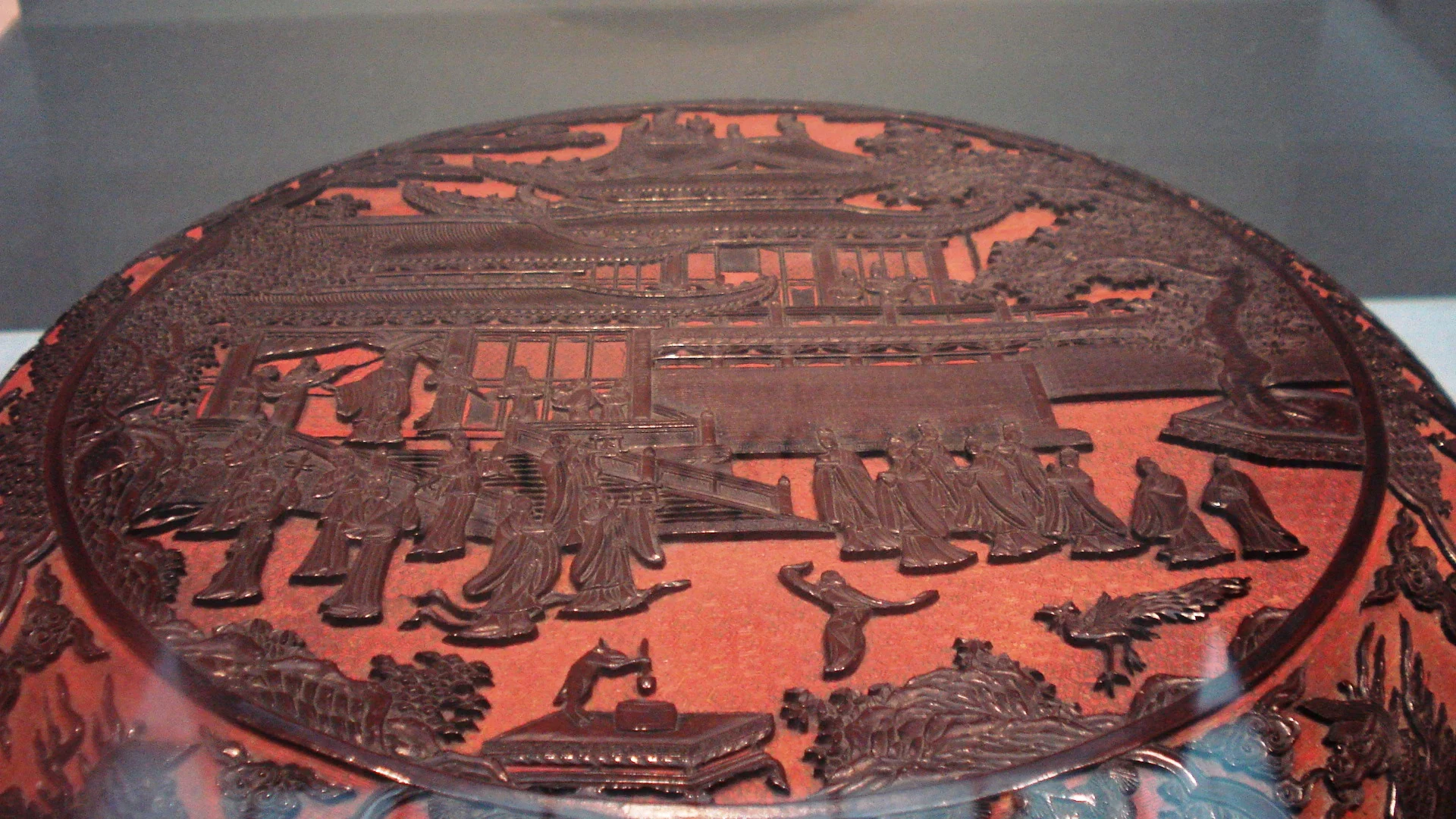
Carved lacquer, diaoqi, is made by building up many thin coats until the lacquer is thick enough to be cut into three-dimensional designs. The Met notes that its date of invention is unknown, but lacquer thick enough for relief carving existed by the Southern Song period, and the technique flourished most between the 13th and 15th centuries. Most carved Chinese lacquer is red, coloured with cinnabar. Carving and surface decoration remained separate traditions: when painting on lacquer was revived in the 16th century, it was seldom used on carved pieces.
Surface techniques decorate a flat lacquer ground. In qiangjin, or engraved gold, lines are incised into the lacquer and filled with a lacquer adhesive, and gold foil or gold powder is pressed into the grooves. In filled-in lacquer, known as diaotian or tianqi, the hardened lacquer is carved and the hollows inlaid with lacquer of a different colour, or the design is produced by a method the Met calls polish-reveal, moxian. Mother-of-pearl inlay was developed intensively in the Song period. Inlay of gold and silver foil, used in Tang China, nearly died out in China after the Tang dynasty ended in the 10th century.
MING IMPERIAL LACQUER: YONGLE, XUANDE AND THE ORCHARD FACTORY
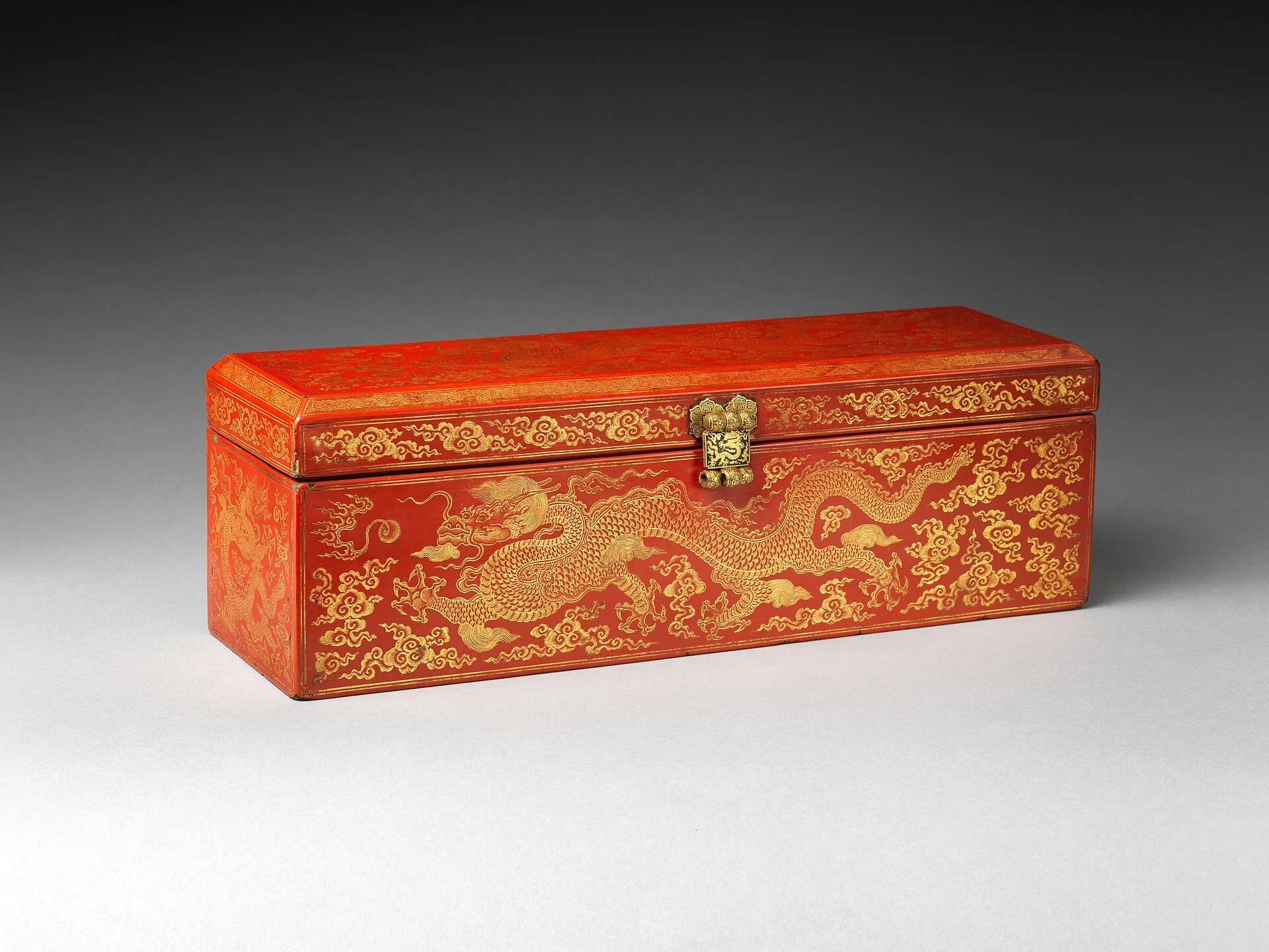
The Ming court used lacquer to carry imperial imagery. A sutra box in the Met, made in the imperial workshop of the Yongle emperor during the Yongle period (1403 to 1424), was designed to hold Buddhist scriptures in the form of Chinese handscrolls. It is 40.6 centimetres long, made of red lacquer and fitted with a damascened brass lock and key. Golden five-clawed dragons, symbols of imperial power, fly among clouds across the box and its lid. Each dragon was first incised into the red surface and then filled with gold, the qiangjin technique.
The Victoria and Albert Museum holds a large folding horseshoe armchair in carved red lacquer on a wood core, dated 1500 to 1560 and decorated with five-clawed dragons, flaming pearls and sea-water motifs. A six-character Xuande reign mark is incised on the back splat, but the museum notes that the style points to a date nearer the mid-16th century. It records that the chair may be a product of the Orchard Factory, an imperial palace workshop that later sources say was set up in Beijing at the start of the Ming dynasty to make the finest carved lacquer.
QING IMPERIAL LACQUER AND THE COROMANDEL SCREENS
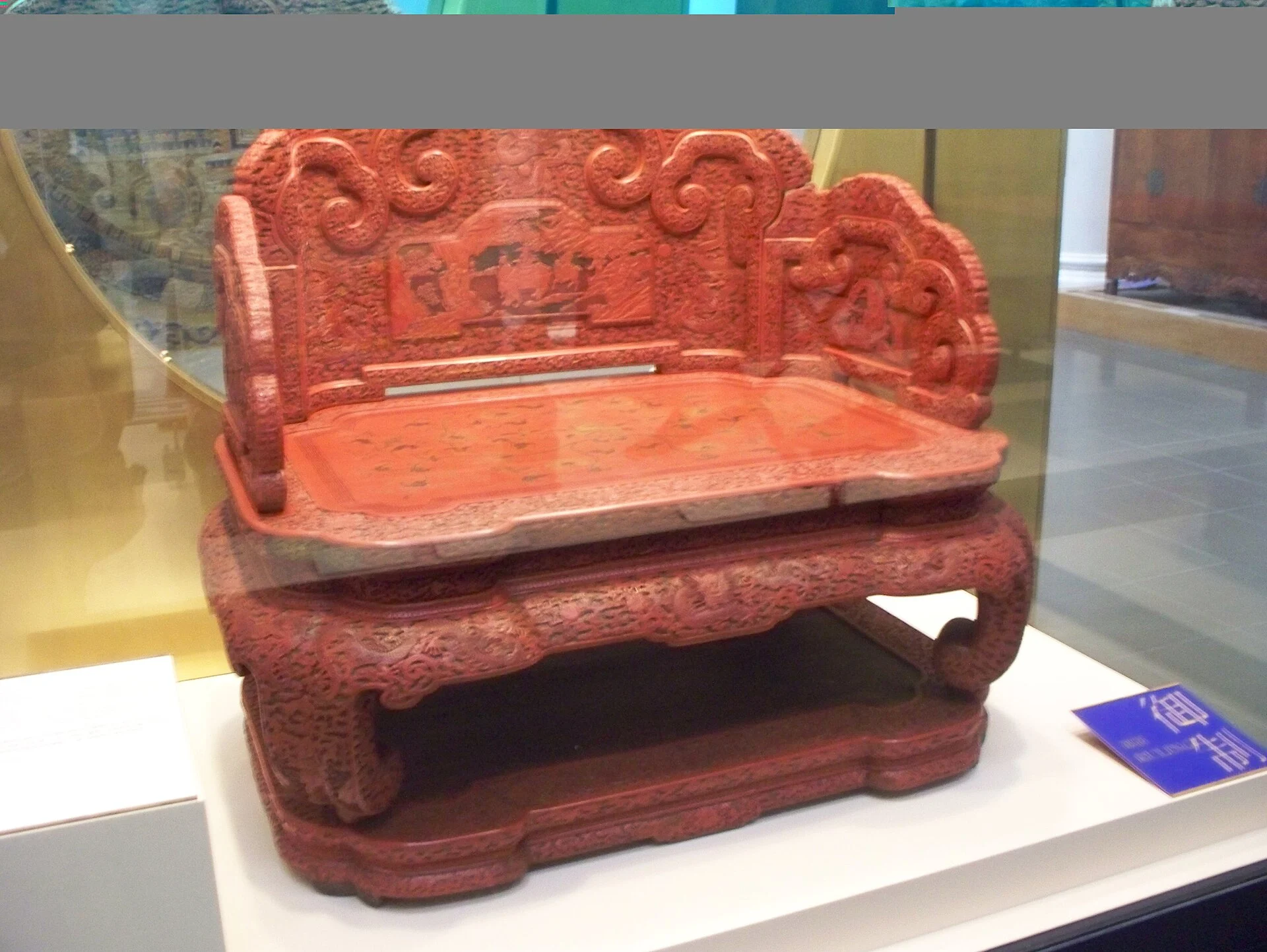
The Qing court continued to commission lacquer furniture. A throne in the V&A, made in carved polychrome lacquer on a wood core during the reign of the Qianlong emperor (1736 to 1795), is 119.3 centimetres high and 125.7 centimetres wide. Its decoration includes five-clawed dragons and figures carrying tribute from foreign lands, and it was meant to stand in front of a matching screen. The museum considers it almost certainly from the Tuanhe Travelling Palace, one of the temporary imperial residences in the Nan Haizi hunting park south of Beijing. Russian troops removed it in 1900 to 1901, after eight allied powers occupied Beijing.
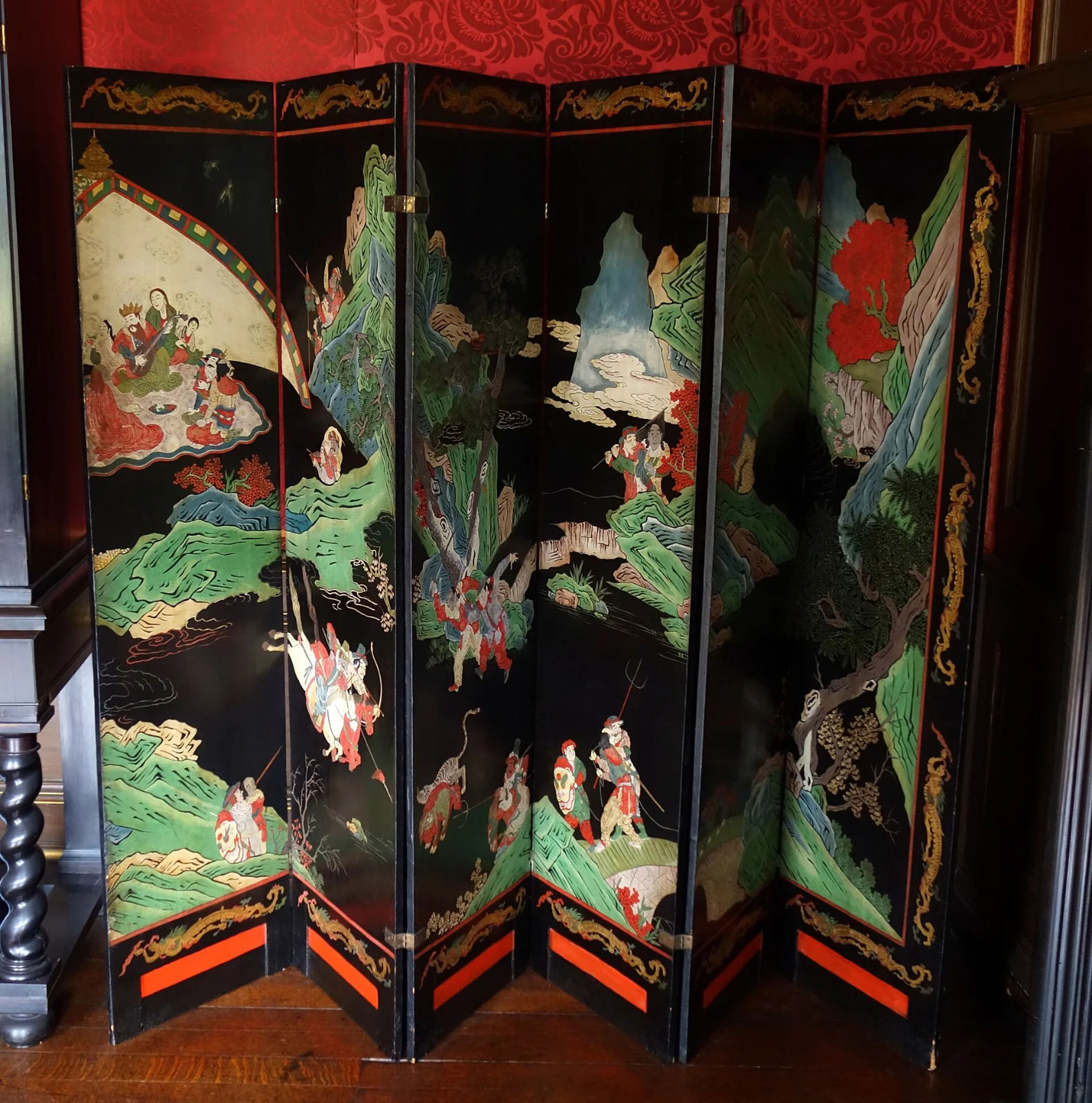
For export, the main Chinese lacquer product of the 17th century was the folding screen. A 12-leaf screen in the V&A, made between 1670 and 1690 in the Kangxi period, stands 270 centimetres high and about 640 centimetres wide. It is made in kuan cai, incised polychrome: the design was cut into a base of brick dust, pig's blood and lacquer, and the hollows were filled with coloured lacquer. The front shows a continuous landscape of pine, plum, waterfalls and pavilions with cranes, qilin, deer, parrots and mandarin ducks, symbols of happiness and long life. Costly twelve-leaf examples were often given as birthday gifts to high-ranking officials.
In Britain these screens were first called Bantam work, after the Indonesian port through which they were shipped, a name recorded in a treatise of 1688. They later became known as Coromandel screens, because they reached Europe by way of the Coromandel coast of India; the V&A notes that the earliest known use of the term is in a Parisian auction catalogue of 1782. In Britain such screens were very expensive, and large ones were sometimes cut up to make wall panels or furniture.
JAPANNING AND CHINOISERIE: HOW EUROPE IMITATED LACQUER
East Asian lacquer reached Europe from the early 16th century, after Portuguese explorers opened a sea route around southern Africa and across the Indian Ocean. Trade grew in the 17th century through the English East India Company, founded in 1600, and the Dutch East India Company, founded in 1602. By 1700 many European palaces and country houses held East Asian export lacquer. Raw lacquer itself could not make the journey: the V&A notes that the resin hardened beyond use on the long sea voyage, which added to the rarity of finished pieces.
European imitations became known as japanning, because Japanese lacquer was regarded as the finest and 'japan' came to mean lacquer in Britain, as 'china' meant porcelain. Japanners used substitute resins such as sandarac and shellac. The most widely circulated printed source was A Treatise of Japaning and Varnishing, published in 1688 by John Stalker and George Parker. Japanned bureau-cabinets, often bright red with gold and coloured painting, were popular in Britain from about 1700 and were exported to Spain, Portugal, Italy and Germany. In Paris, Vernis Martin, named after the Martin brothers, became a general term for high-quality French imitation lacquer.
Chinoiserie, decoration inspired by Chinese and other Asian art, peaked in France and England between 1750 and 1765. In mid-18th-century Paris, luxury dealers known as marchands-merciers dismantled imported Japanese cabinets and Coromandel screens and reused the panels on new French furniture, hiding the joins with gilded brass mounts. At Schönbrunn Palace in Vienna, Maria Theresa turned the study of her husband, Francis Stephen I, into a memorial room after his death in 1765. Its black and gold Chinese lacquer panels were originally made as screens for the European market; they were cut down and set into gilded wainscoting. After Japan reopened its ports in 1853, Japanese goods shaped European decoration again in the era of Japonism.
MAN WAH: NAVY PANELLING AND GOLD AT MANDARIN ORIENTAL HONG KONG
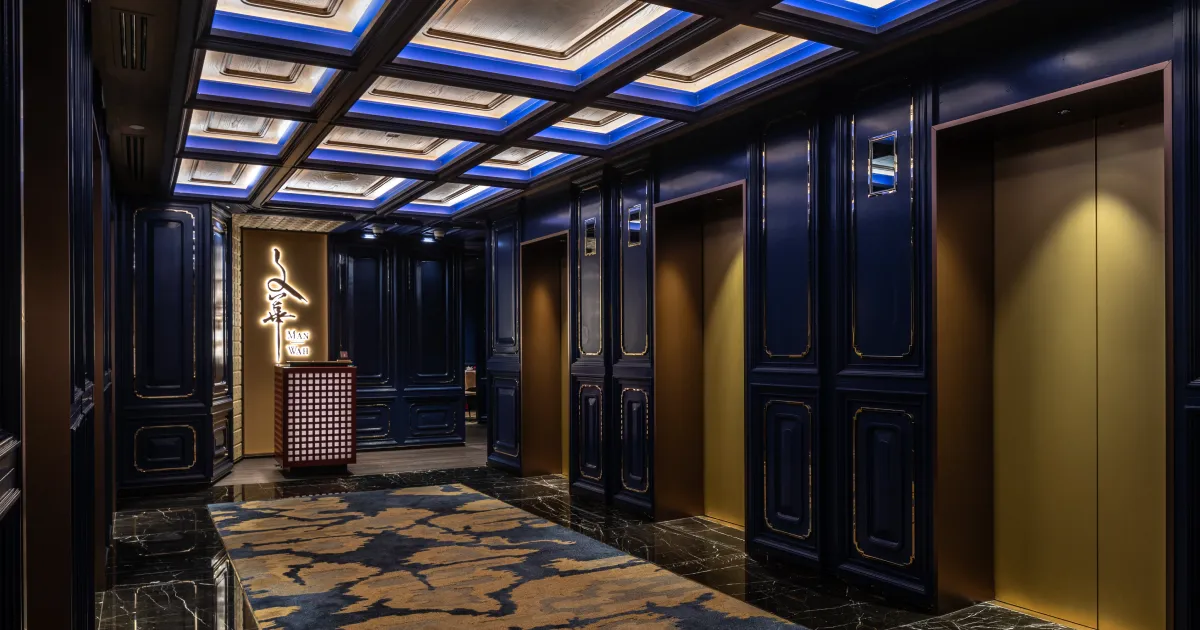
Man Wah is the Cantonese restaurant on the 25th floor of Mandarin Oriental Hong Kong. Silverfox Studios redesigned it in 2021, and it holds One MICHELIN Star. The design interprets the Hong Kong skyline and Victoria Harbour seen from its windows, with references to the hotel's heritage. Lanterns reinterpret the original Man Wah lanterns as clustered brass cage forms holding embroidered pleated shades, and a bespoke blue and gold carpet, mixing silk with hand-carved patterning, evokes light on the harbour.
The interior uses navy panelling with gold trim, and an embroidered dragon and floral artwork sits on a navy wall panel. The pairing of gold with a dark or red ground appears in Chinese lacquer, from the gold-filled dragons incised into the red lacquer of the Yongle sutra box to the black and gold export panels set into gilded wainscoting at Schönbrunn. At Man Wah the dragon is embroidered rather than lacquered, and the dark and gold palette is carried by the panelling, the carpet and the brass of the lanterns.
SOURCES
- The Metropolitan Museum of Art Lacquerware of East Asia
- Coatings (MDPI) Systematic Investigation into Evolution of Materials and Techniques Used in Lacquer Lian from the Warring States Period to the Yuan Dynasty
- People's Government of Hunan Province Mawangdui Tombs artefact inventory, August 2024
- British Museum Lacquer wine-cup, Western Han dynasty, AD 4
- The Metropolitan Museum of Art Sutra box with dragons amid clouds
- Victoria and Albert Museum Chair, carved red lacquer, Ming dynasty
- Victoria and Albert Museum Throne, carved lacquer, Qianlong reign
- Victoria and Albert Museum Folding screen, Kangxi period, 1670 to 1690
- Victoria and Albert Museum The influence of East Asian lacquer on European furniture
- Schloss Schönbrunn Vieux-Laque Room