FROM KNOTTED TOWEL FRINGES TO SAILORS' ROPEWORK AND 1970S PLANT HANGERS
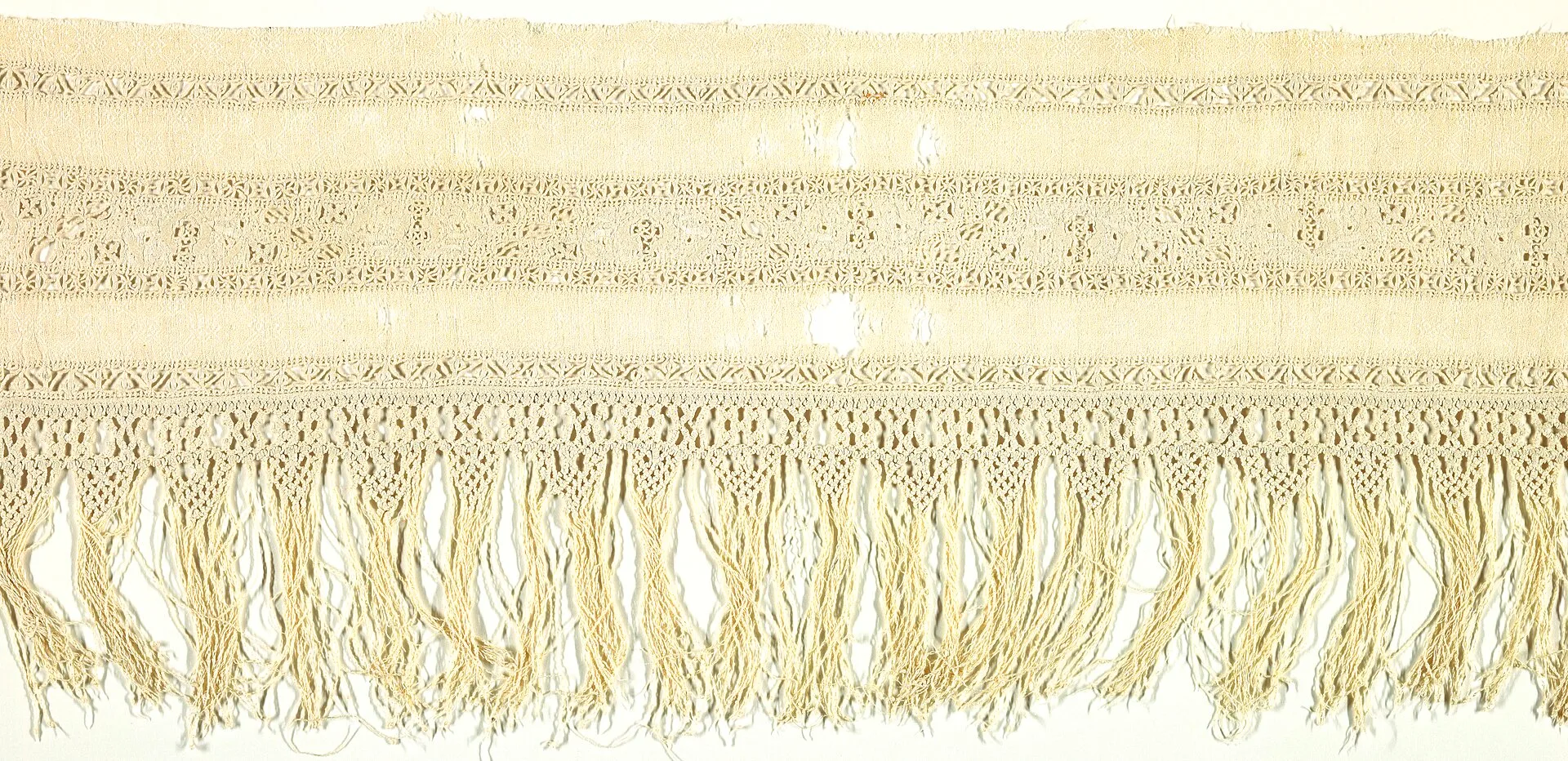
Macramé is a coarse lace or fringe made by knotting cords or thick threads in a geometric pattern. The technique is linked by museums and historians to the knotted ends of woven towels and cloths in the Arab world and southern Europe. It appears in 17th-century Italian linen borders and English silk purses, in the ropework that British and American sailors made at sea in the 19th century, and in Victorian pattern books for household trimmings. It returned as a popular craft in the 1960s and 1970s, when plant hangers, wall hangings and lampshades were among its most common forms, and again in the late 2010s, when cotton rope and social media brought macramé back into interiors.
WHERE DOES THE WORD MACRAMÉ COME FROM?
No single etymology is agreed. Britannica derives macramé from the Turkish makrama, meaning a napkin or towel. The Victoria and Albert Museum's catalogue record for a 17th-century knotted purse offers a different lead: the name may come from the Arabic miqram, a bedcover, and was applied to the craft in the 1860s during a revival. Thérèse de Dillmont (1846 to 1890), whose Encyclopedia of Needlework was printed by Brustlein and Co. in Mulhouse, Alsace, opened her macramé chapter by calling it an Arabic word for an ornamental fringe or trimming. She explained that she preferred the Arabic name because of its less definite meaning, and recorded that the same knotted fringe work was also known as Mexican lace.
The written histories place its origin in the finishing of woven cloth. The V&A record states that the knotting is thought to have come from the Islamic world and reached Europe through Arabs in Spain, where it was used to tie off the warp threads of woven fabric. The Maritime Museum of British Columbia repeats the attribution to 13th-century Arab weavers who knotted the excess threads at the edges of textiles into patterns, and a 2018 Star Tribune report on the craft names 13th-century weavers on the Arabian peninsula. The Herreshoff Marine Museum in Bristol, Rhode Island, notes that the craft is probably much older than any of the words now used for it, and that its popularity has risen and fallen for centuries.
EARLY MACRAMÉ IN ITALY AND ENGLAND
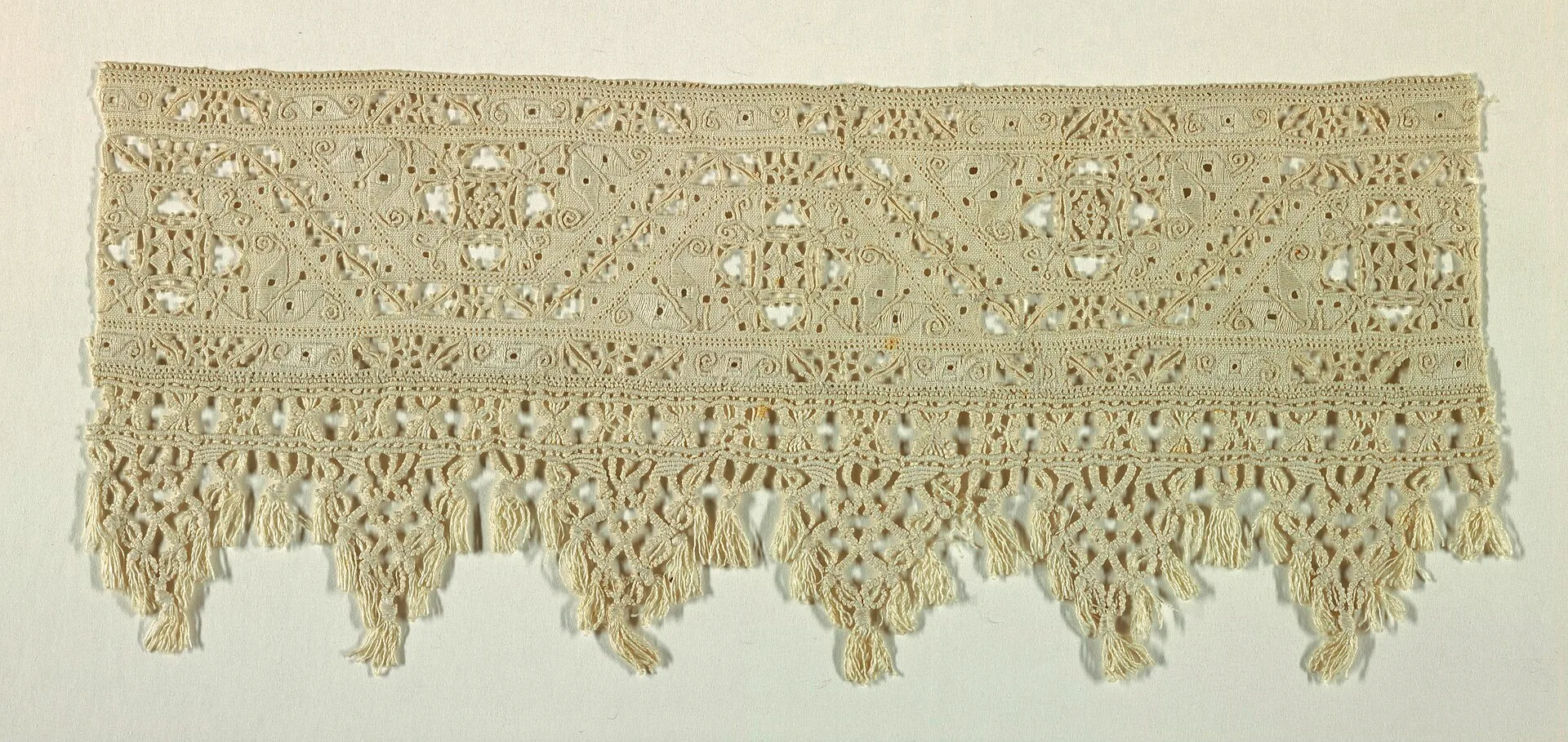
The V&A record states that knotted work was used in France and Italy from the 14th century for fringes and decorative linen borders. Britannica traces macramé's roots to a 16th-century Italian lace-knotting technique called punto a groppo, and identifies Genoa as a centre of the work, where knotted-cord towels were popular in the 19th century. Sylvia's Book of Macramé Lace, a Victorian manual, calls the area around Genoa the home and birthplace of the work and dates it as far back as the 15th century. Cooper Hewitt, Smithsonian Design Museum holds an early 17th-century Italian border fringe in knotted linen measuring 19.2 by 48 centimetres, part of the bequest of Richard Cranch Greenleaf received in 1962.
In England the technique was used for small luxury objects. The V&A holds a thimble-shaped purse made in Great Britain between 1660 and 1680, about 9.5 centimetres long, in yellow and green silk. Its mesh of square-knotted silk was worked over a mould and gathered at the base into a short tassel, and a plaited silk drawstring runs through loops at the top. The square knots are so fine that a magnifying glass is needed to see them clearly, and the museum suggests the purse was meant to hold a keepsake rather than everyday money. By Dillmont's account, the art then became almost extinct for centuries and survived mainly in convents until its 19th-century revival.
HOW SAILORS CARRIED MACRAMÉ KNOTTING BETWEEN PORTS
The Herreshoff Marine Museum cites Ashley's Book of Knots for the view that macramé became especially popular among sailors of the American and British navies in the mid-19th century, because it took up little space and was easy to stow. The museum describes fancy knotwork as a popular way for sailors to pass time on board, used for bracelets, belts, lanyards, bottle covers, fringed hammocks and handbags. The museum's own collection includes macramé-covered bottles made as commemorative pieces by America's Cup crews in the 1930s, among them one made by crew member Stanislaw Supricick aboard the defender Ranger in 1937.
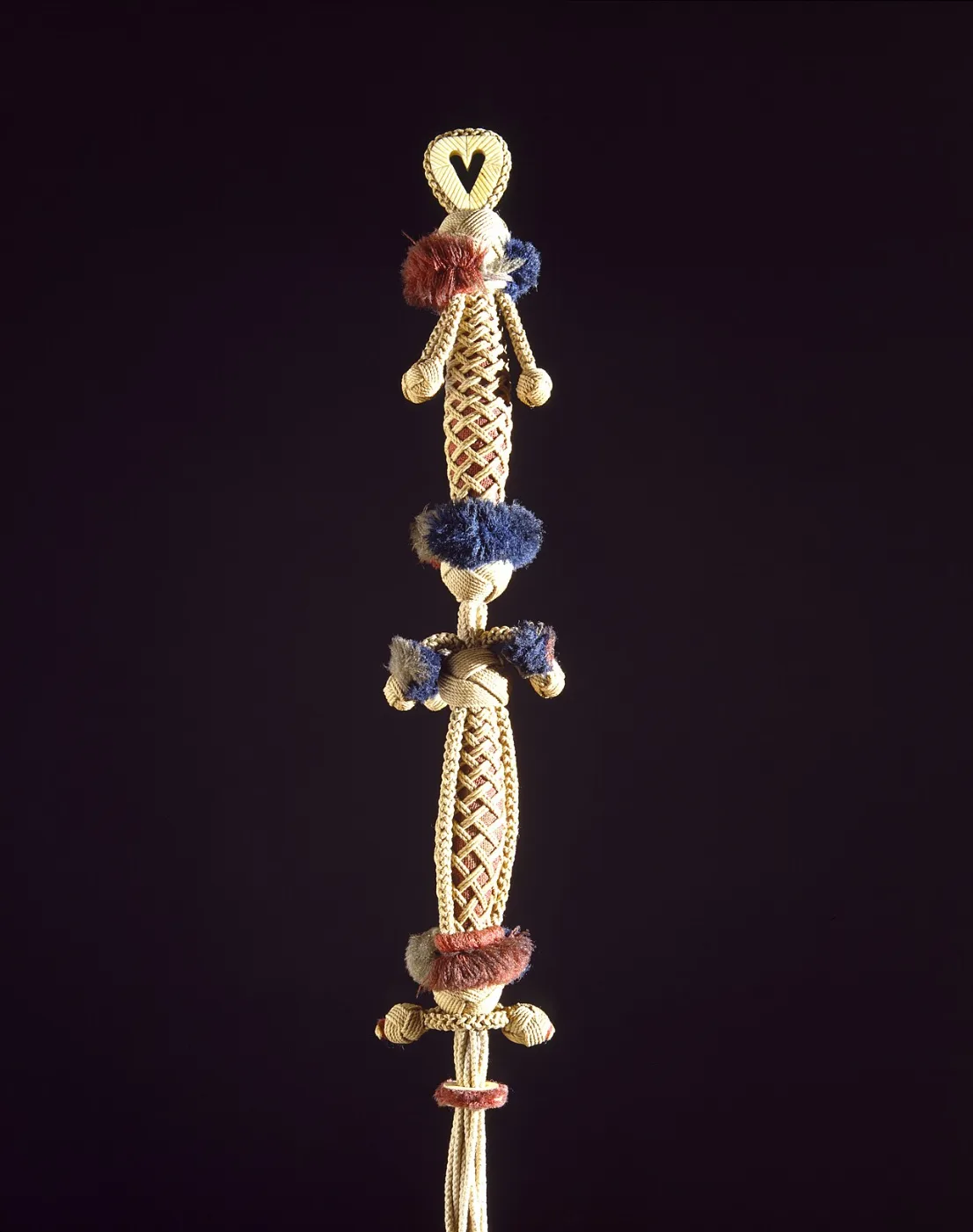
Knotting was also a working skill. The Maritime Museum of British Columbia in Victoria notes that sailors learned and used hundreds of knots and shared them with crewmates and with people they met in new ports. Knotwork made in off-duty hours was bought, sold and traded across continents. The museum's collection includes a pair of slippers made entirely from reef knots, possibly worked at sea and sold in port, and a telescope whose knotted covering protected the user's hands from cold metal. The Smithsonian American Art Museum holds a Sailor's Fancy Ropework piece by an unidentified maker, dated to the late 19th or early 20th century and made of cotton, wool, wood and carved bone, 108 centimetres long.
VICTORIAN MACRAMÉ LACE AND HOUSEHOLD TRIMMINGS
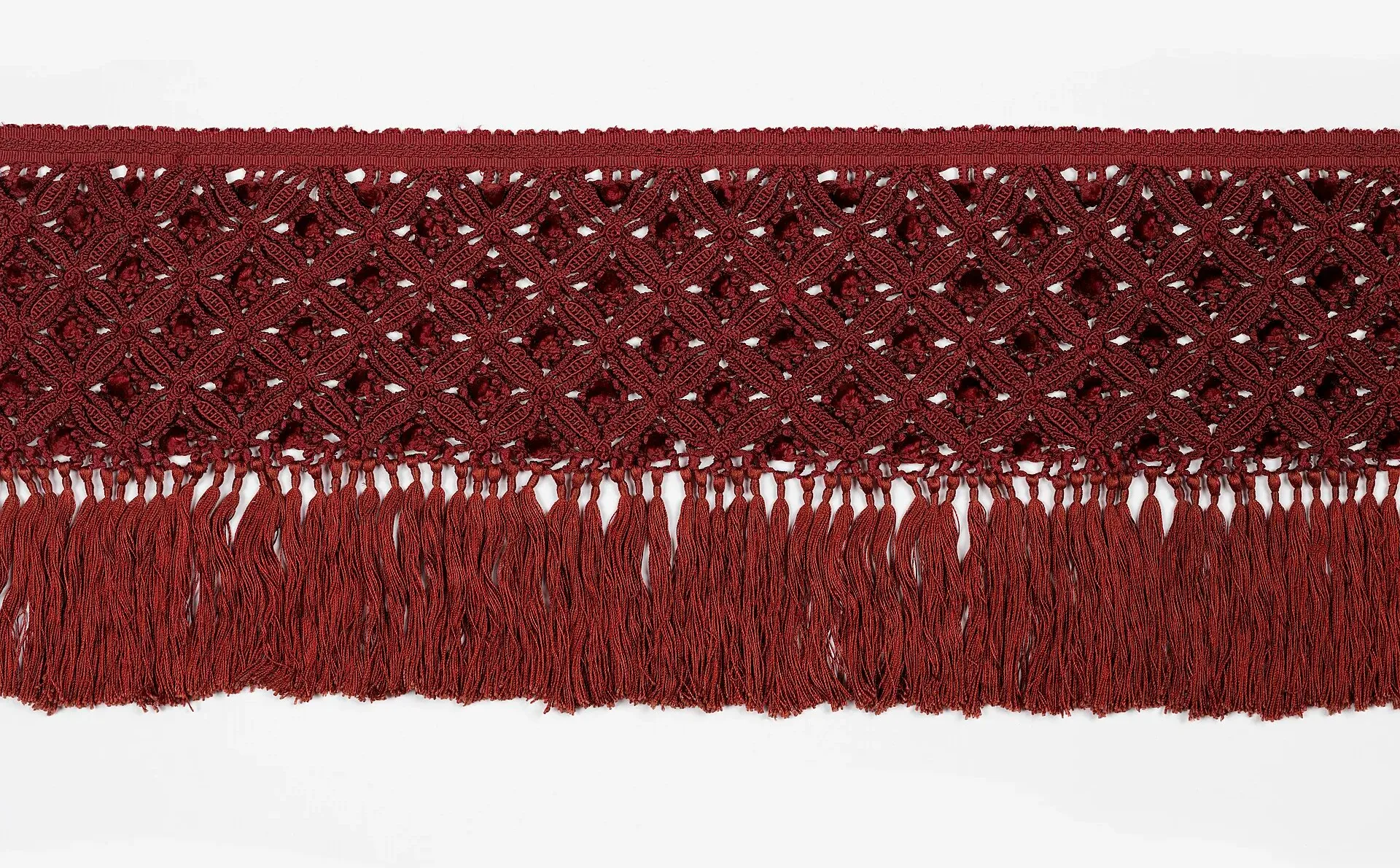
In Victorian Britain macramé became a domestic craft taught through manuals. Sylvia's Book of Macramé Lace, published in London and New York by Ward, Lock, Bowden and Co. in an 1890 edition now digitised from the Smithsonian Libraries, promised illustrations of many new and original designs with complete instructions for working, choice of materials and suggestions for their adaptation. The book explains that the name was applied to a coarse towelling material whose fringed ends were knotted. It recommends coarse macramé twine to beginners and describes it as the cord generally preferred for trimming brackets, while warning that no other cord was as good as the twine made and sold for the purpose. The Herreshoff Marine Museum still recommends the book for its project ideas and illustrations.
Dillmont's chapter dates the revival to about ten years before she wrote it, when many people regarded macramé as a new invention. She extended it beyond fringes to bands, stripes and headings, and listed silk, gold thread, cord, wool and cotton as suitable threads. Her chapter works through headings with picots, scallops and loops, then flat double knots, bead knots, shell knots and bars of knots worked to the right and left. She also recorded ring knots, single and double chains, and looped and knotted picots among the forms a worker could combine.
WHAT ARE THE BASIC MACRAMÉ KNOTS?
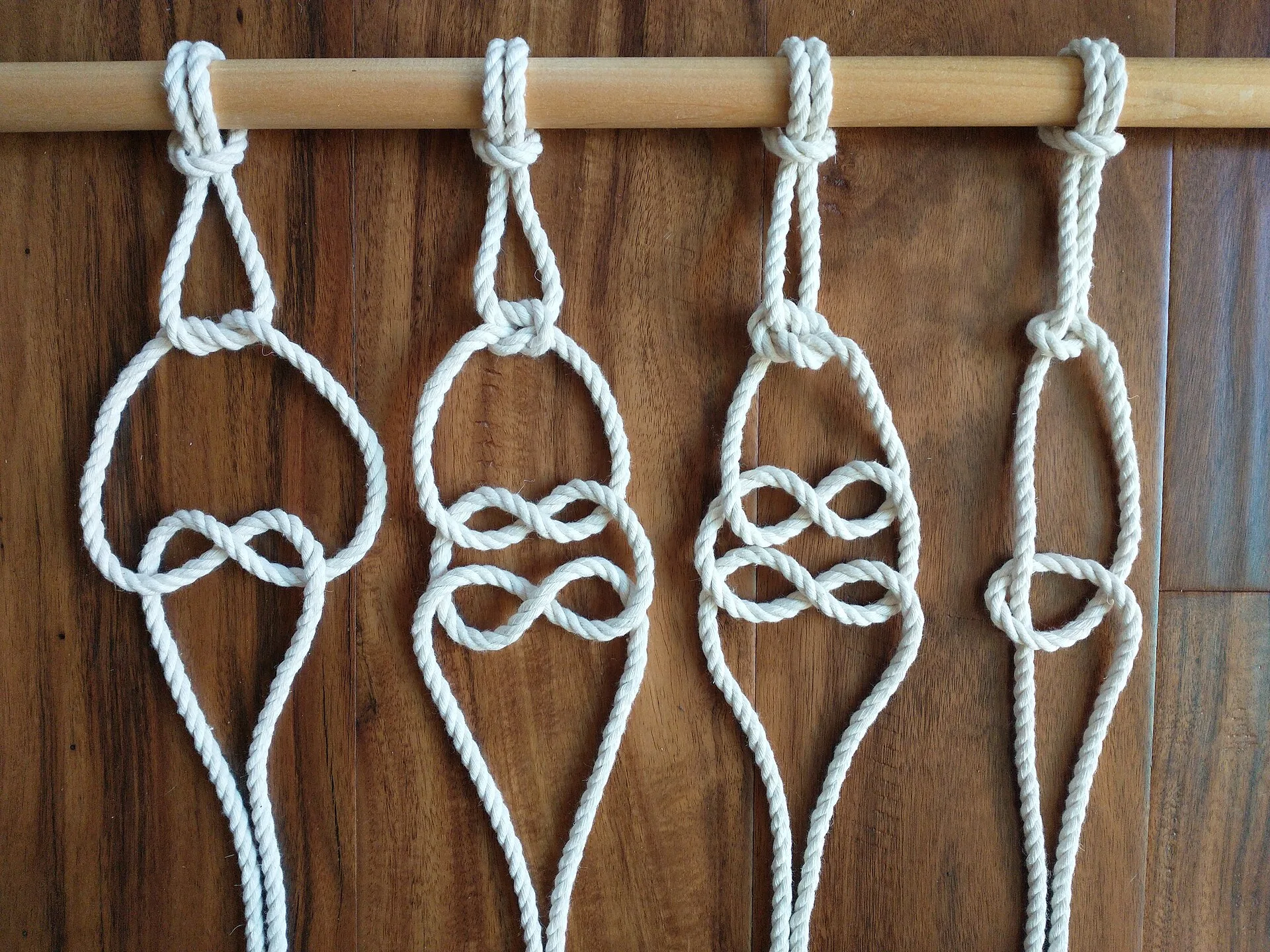
Most macramé rests on a small number of knots. The Herreshoff Marine Museum names the square knot and the half hitch as the basic building blocks, combined to form bars and spirals. Dillmont's flat double knot is worked over four hanging threads: the two outer threads are crossed, the right one under and the left one over the two centre threads. Repeating the first crossing alone produces what she called plaited knots. At a 2018 macramé workshop in Minneapolis reported by the Star Tribune, beginners learned the lark's head, the square knot and the horizontal double half hitch.
Victorian manuals named many more. Sylvia's Book of Macramé Lace lists the macramé knot, the knotted bar or chain knot, the buttonhole knot, the tatted knot, the twisted bar, Solomon's knot, the double knot, the Josephine knot and the Genoese knot, also called the Italian or ornamental knot. Dillmont's final pattern combines ring knots with what she called the Chinese knot. Her list of equipment covers a macramé cushion, metal clamps, glass-headed pins, a crochet needle, a French measuring tape, scissors, a metal comb, a ruler and macramé shuttles. The Herreshoff Marine Museum adds that, worked in much thinner thread, macramé is structurally related to tatting and lace making.
MACRAMÉ MATERIALS: SILK, FLAX, JUTE AND COTTON CORD
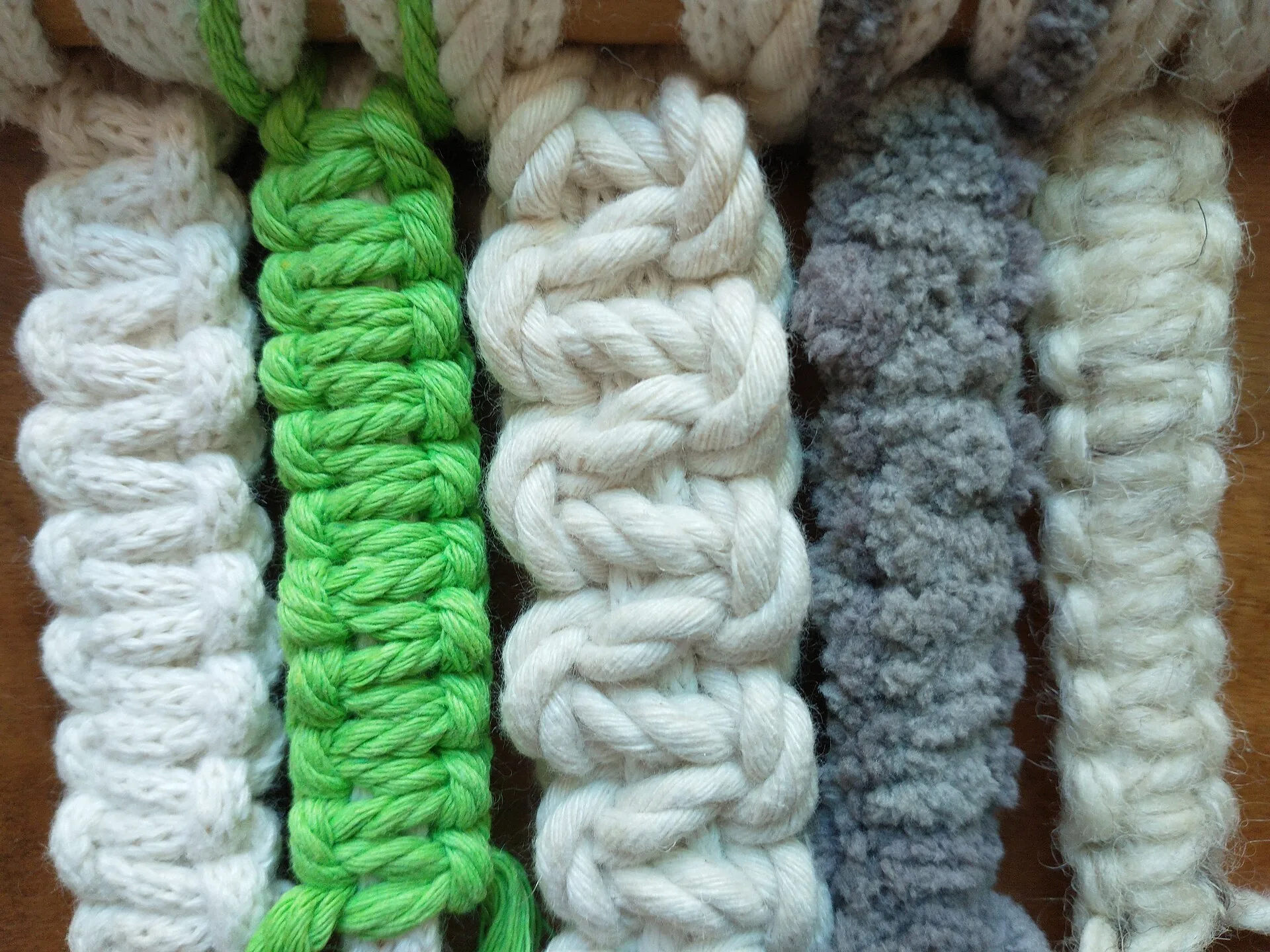
The surviving objects show how wide the range of materials has been. The 17th-century fringe at Cooper Hewitt is linen and the V&A purse is silk. Sylvia's manual recommends black, white and coloured silks made for macramé work, fine and coarse flax thread for white linen, and arrasene, filoselle and coloured twine, as well as the macramé twine sold for the purpose. Dillmont added gold thread and wool. The Smithsonian's sailor's ropework piece combines cotton and wool with wood and carved bone.
The 20th-century revivals changed the cord. According to the Star Tribune, jute was the standard material of 1970s macramé, and the craft's brief return in the 1990s took the form of hemp bracelets and necklaces. Macramé in the late 2010s typically used white or coloured cotton rope instead of rough jute, giving it a more polished look, and the Portland maker Emily Katz sold Turkish rope spools alongside her workshops. One Wisconsin maker interviewed by the paper used driftwood from her family's lake cabin as a base.
THE 1970S MACRAMÉ REVIVAL AND MACRAMÉ IN INTERIORS TODAY
Britannica records that macramé became a popular craft and creative art technique in America and Europe in the 1960s, used for lampshades, plant hangers, hammocks, window coverings and wall hangings. The Star Tribune places its reappearance in the United States in the 1960s alongside batik, decoupage and tie-dyeing, taught in schools and at summer camps. Pattern books and pamphlets of the period spread owls, plant hangers and jute decor, and the V&A records that macramé became popular again in the 1970s. It fell out of favour in the 1980s and had a brief comeback in the 1990s.
Designers also took up the look of knotting. In 1996 the Dutch designer Marcel Wanders designed the Knotted Chair for Dry Tech, a project that paired Droog Design's low-tech aesthetic with high-tech materials from the Aviation and Space Laboratory at Delft University of Technology. Aramid fibres around a carbon core were hand-knotted, impregnated with epoxy and hung upside down over a mould to form the seat and back, producing a stiff chair with the appearance of loose, hand-knotted macramé. Wanders made the first versions himself, and Cappellini later took over production in Italy. The V&A acquired an example manufactured in 2005.
A wider revival followed in the late 2010s. By 2018 the Star Tribune counted more than a million Instagram posts carrying the macramé hashtag and linked the trend to interest in 1970s style and in houseplants. Emily Katz, author of Modern Macramé, was teaching workshops internationally. Urban Outfitters sold more than 20 macramé items, including a set of five plant hangers, a metallic wall hanging and large fringed curtains that the retailer called portals, and Anthropologie sold a macramé chandelier priced at $598.
HANGING PLANTERS AND RATTAN AT THE CLUB LOUNGE, MANDARIN ORIENTAL JUMEIRA DUBAI

Plant hangers were among the forms most closely associated with macramé from the 1960s onward, alongside wall hangings, lampshades and window coverings. The Club Lounge at Mandarin Oriental Jumeira, Dubai, whose interiors were completed in 2019, places hanging planters beside rattan window seating, overlooking the skyline and the Burj Khalifa. A buffet in white marble and timber stands under a black steel frame. A lounge area combines a cushioned banquette, a dark timber armchair and a large abstract painting, and the lounge also has sofas, timber display shelving and a bar counter.
The lounge's finishes include marble, timber, black steel and rattan. Marble-topped tables stand under a cove-lit ceiling with timber beams, and timber also appears in the buffet, the dark armchair and the display shelving. The materials of macramé itself have ranged from the silk of the 17th-century V&A purse and the linen of the Cooper Hewitt fringe to the jute of the 1970s, the cotton rope of the late 2010s and the aramid fibre and epoxy of the Knotted Chair, which Cappellini put into production as a piece of furniture.
SOURCES
- Encyclopaedia Britannica Macramé
- Victoria and Albert Museum Purse, Great Britain, 1660 to 1680 (T.265-1973)
- Victoria and Albert Museum Knotted Chair, Marcel Wanders (W.49-2005)
- Cooper Hewitt, Smithsonian Design Museum Border Fringe (Italy), early 17th century
- Smithsonian American Art Museum Sailor's Fancy Ropework
- Herreshoff Marine Museum Fancy knotwork
- Maritime Museum of British Columbia Collections Connections: Rope Keychains
- Internet Archive (Smithsonian Libraries) Sylvia's Book of Macramé Lace
- Project Gutenberg Thérèse de Dillmont, Encyclopedia of Needlework: Macramé
- Star Tribune Macramé makes comeback in Minnesota