THE CORK OAK, THE MONTADO AND THE STOPPER INDUSTRY

Portuguese cork is the bark of the cork oak, Quercus suber, stripped by hand from living trees and turned into wine stoppers and construction materials. Portugal leads the world industry, ahead of Spain, France and Italy, and AFP reported in 2017 that seven of every ten wine bottles in the world were topped with Portuguese corks. Most of the country's cork oaks stand in the Alentejo in southern Portugal, where the trees grow in open, grazed woodland known as montado. The harvest follows a long cycle: a tree is first stripped at about 25 years of age and then roughly every nine years, and the bark is then dried, boiled, graded and punched into stoppers.
WHAT IS PORTUGUESE CORK?
Cork is a natural plant tissue. The Portuguese Cork Association (APCOR) describes it as a mass of microscopic cells holding a gas similar to air, coated mainly with suberin and lignin, and Britannica describes commercial cork as thin-walled, wax-coated cells from the bark of the cork oak. The tree is native to the Mediterranean region. Smithsonian magazine put the extent of the Mediterranean's cork country at about five million acres. Because the bark grows back after it is removed, the tree is stripped rather than felled, and the same oak is harvested again and again over its life.
Portugal has about 8,000 square kilometres of cork oak, according to the University of Kassel's Landscape Chains research project, and about 7,300 square kilometres of that lies in the Alentejo, where around 41 percent of the landscape is agroforestry dominated by cork oak. Cork is among the region's main forestry products, alongside wood, charcoal and acorns. AFP reported that cork oaks can live for 300 to 400 years. Smithsonian described the Whistler Tree, a 45 foot cork oak in the Alentejo, as the oldest known cork tree; it produced its first cork crop in 1820 and yielded about a ton of bark at its 2009 harvest, enough for about 100,000 corks.
THE MONTADO: THE CORK OAK LANDSCAPE OF THE ALENTEJO
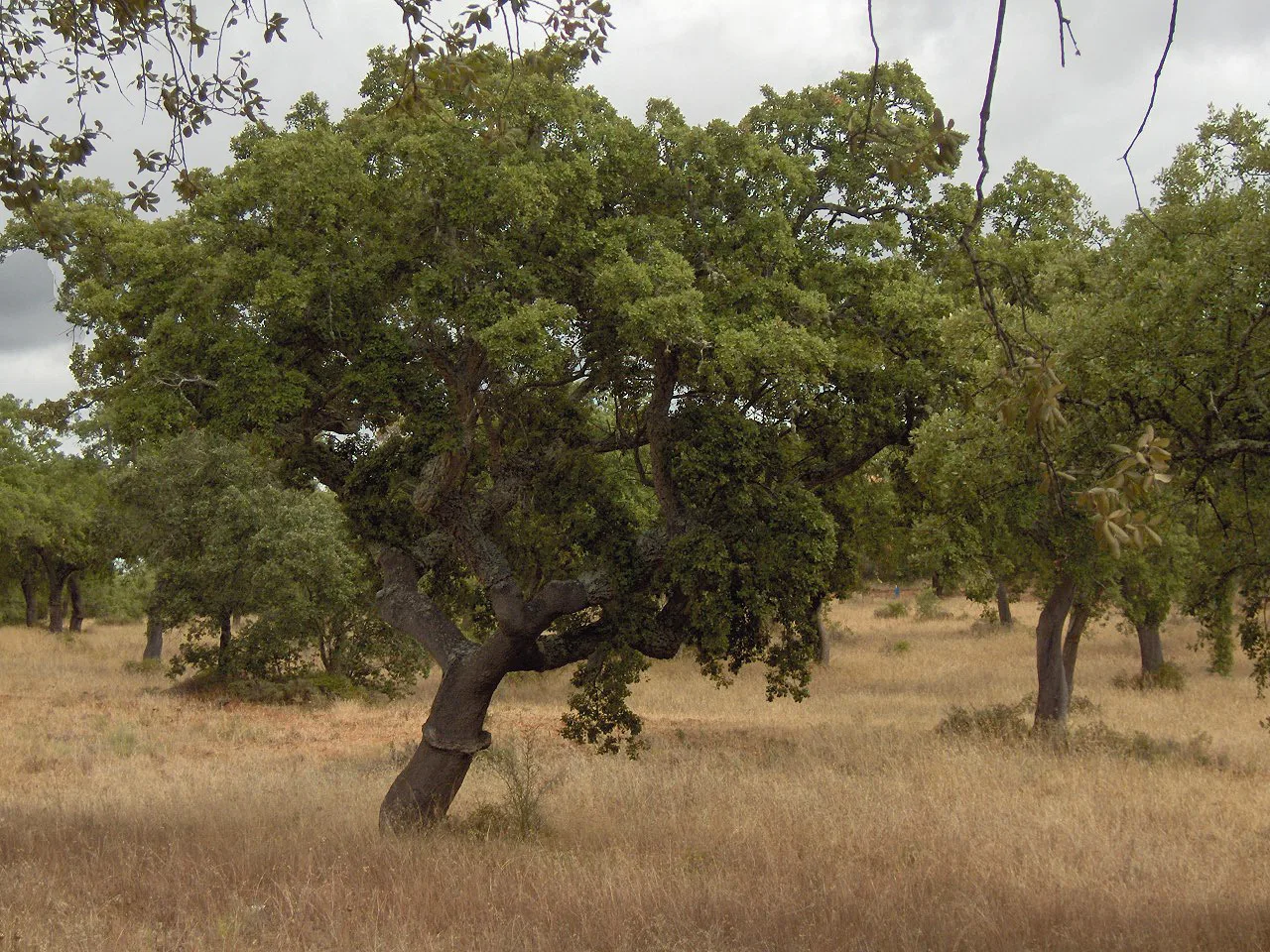
The montado is a farmed landscape. The Kassel researchers, working in the central Alentejo municipalities of Montemor-o-Novo and Évora, describe it as a savannah-like mosaic of cork oak and holm oak at varying densities, shaped by people and kept open by thinning, grazing, ploughing and shrub clearing. About 70 percent of Portugal's cork oak area is agro-silvopastoral land with 40 to 80 trees per hectare, where the understorey is cleared for pasture or crops. The remaining 30 percent is cork oak forest with more than 80 to 100 trees per hectare, managed for cork alone.
Beneath the trees, farmers grow wheat, barley and oats in long rotations with fallow years and graze cattle, sheep, goats and the Iberian pig; the project names Carne alentejana beef and Porco preto pork among the local products, along with honey and mushrooms. In 2023 Euronews visited Herdade S. Luís, an Alentejo estate whose oak groves cover 700 hectares, where black Alentejano pigs are given maternity huts under the oaks. Old or fragile trees there are no longer stripped but are left standing for acorns and shade. The same report noted that the montado supports hundreds of species, including the Iberian lynx and the Imperial Eagle.
HOW IS PORTUGUESE CORK HARVESTED?
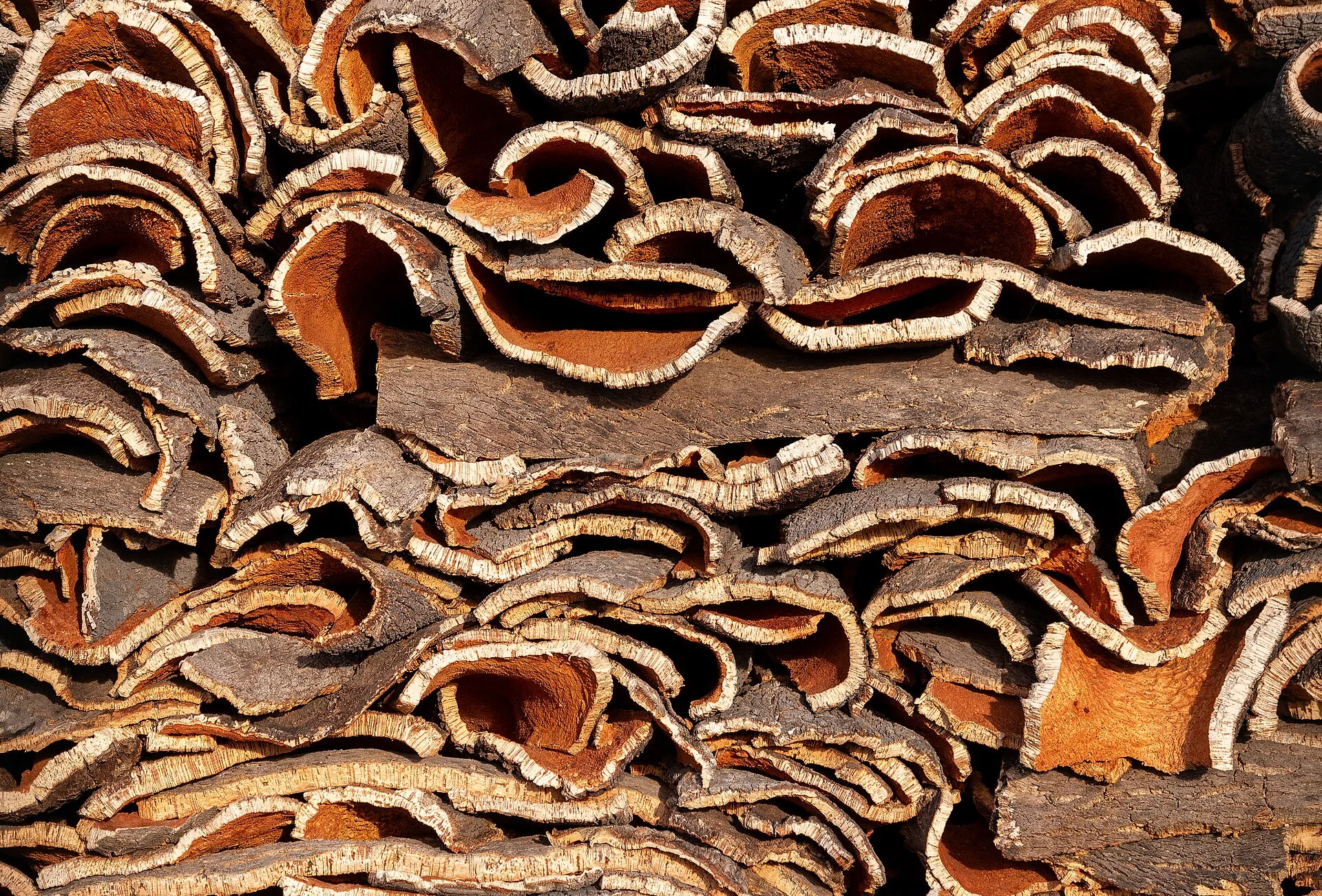
Cork is stripped in summer. Euronews reported that the cork cutter working at Herdade S. Luís, José Mendes, a man with more than four decades in the trade, is hired from May to August, the months when the trees are actively growing. His tool is an axe, used to peel the outer bark from the trunk without harming the tree beneath, and he stacks the harvested planks as they come away. Smithsonian described the same work being done by crews using knives and axes.
A cork oak is not stripped until it is mature. Smithsonian put the age of the first harvest at about 25 years and AFP at between 25 and 35 years, while Britannica gives about 20. According to Smithsonian, the first two harvests are often unsuitable for bottle stoppers, and AFP reported that only the third harvest, about two decades after the first, is really productive. Jean-Marie Aracil of the French Federation of Cork Unions told AFP that a tree takes around 50 years to become profitable. Euronews reported that a cork oak can be harvested roughly 15 times over its life.
Between harvests the tree needs about nine years to recover, which Smithsonian describes as the normal interval between strippings. To keep track of the cycle, a number is often spray painted on the trunk to indicate the year in which the tree was last harvested. An average cork oak produces about 100 pounds of cork at each stripping, according to Smithsonian, which also noted that the cork forests give a home to wildlife including lynx, red deer and pigs, and that the industry employs tens of thousands of people full time or seasonally.
HOW IS CORK BOILED, GRADED AND MADE INTO STOPPERS?
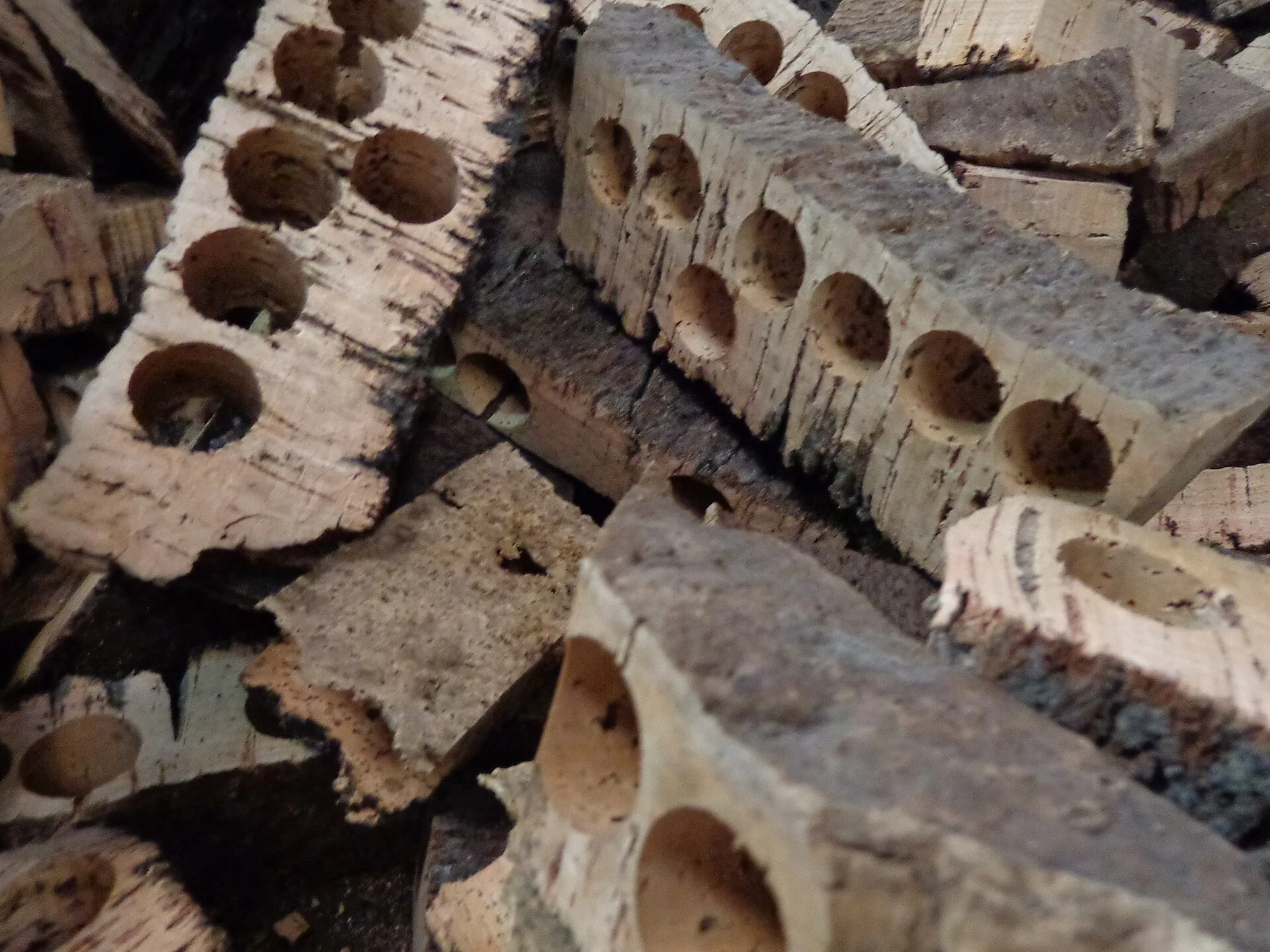
After the harvest the planks are left outside to dry for about six months, AFP reported in 2017 from a cork forest in the Ribatejo region of central Portugal. The raw cork is then boiled, a step that gives it thickness and elasticity and removes tannins. The boiled cork is cut into strips, and stoppers are perforated, or punched, from the strips before being washed, dried, labelled and treated with paraffin or silicone for export. Corticeira Amorim, which AFP described as the world's biggest cork producer, runs a plant at Coruche, a few kilometres from the forest the agency visited.
Grading decides what each plank becomes. Only about 15 to 30 percent of the cork is of sufficient quality for whole natural stoppers, which are used for fine wines, AFP reported. Of the rest, about half goes to plant boilers and half into technical stoppers, made from slivers of cork glued together and intended for wines consumed within two to three years. Carlos de Jesus, Amorim's marketing director, told AFP in 2017 that cork was regaining market share. The corks of Spain and Portugal have played a key role in winemaking for more than 200 years, according to Smithsonian.
PORTUGAL'S SHARE OF WORLD CORK PRODUCTION
Portugal is the industry's leading producer, followed by Spain, France and Italy, AFP reported in 2017. Wine stoppers are the main product by value: according to the Portuguese Cork Association, quoted by AFP, they account for 72 percent of the value of the annual global cork harvest. The same report put the growth of Portugal's cork exports at 2 percent a year, or 1.4 percent for stoppers, against growth in global wine consumption of 0.8 to 1 percent a year. AFP also reported that cork had lost share to screwcaps over many years, especially in the United States, France and Italy.
That competition had been widely expected. Smithsonian noted that a 2006 World Wildlife Fund report predicted that by 2015 some 95 percent of all wine bottles would be sealed with screwcaps, synthetic corks or bag-in-box packaging. Certification has since become part of the trade. The Kassel project records at least about 1,000 hectares of Portuguese cork land certified by the Forest Stewardship Council (FSC) since 2005, and notes that the PEFC scheme also certifies non-timber forest products, including cork, in Portugal. According to Amorim, its Amorim Cork Composites unit in Mozelos became the first packaging company in the world to receive FSC certification, in 2004.
AMORIM AND THE CORK INDUSTRY AROUND SANTA MARIA DA FEIRA
The largest company in Portuguese cork began as a single stopper workshop. According to Corticeira Amorim's corporate history, António Alves Amorim set up a manual cork stopper factory on the quay at Vila Nova de Gaia in 1870. In 1908 the family opened a new workshop in Santa Maria de Lamas to expand production, and on 11 March 1922 Amorim & Irmãos, Lda. was formally established, with a capital of 90,000 escudos, by the children of António Alves Amorim and Ana Pinto Alves. By 1930 the company described itself as the largest cork stopper factory in the north of Portugal, with 150 workers.
In 1952 Henrique Alves de Amorim funded a museum, schools and a cinema in Santa Maria de Lamas. The group's first processing plant outside Portugal, Comatral, opened at Skhirat in Morocco in 1972. In 2001 it acquired Discork Cortiças, a disc producer with an output of 700 million discs a year, in S. João de Ver in the municipality of Santa Maria da Feira. In 2009 a cork recycling facility that the company describes as the world's first opened at Amorim Cork Composites in Mozelos, and in 2023 Amorim Top Series opened two industrial units there, doubling its production capacity.
HOW IS PORTUGUESE CORK USED IN ARCHITECTURE AND INTERIORS?

Álvaro Siza Vieira and Eduardo Souto de Moura designed Portugal's pavilion for Expo 2000 in Hannover, with Cecil Balmond as co-author, according to the Czech architecture database Archiweb. The building was prefabricated and made to be dismantled. A metal frame carried walls insulated with about 55 tons of expanded cork agglomerate; the river-facing facade was clad in lias stone engraved with the letters PORTUGAL, the welcome patio was lined with hand-made glazed tiles, and the roof was a translucent double membrane of glass fibre canvas. After the Expo the pavilion was rebuilt on Avenida da Lousã in Coimbra.
Cork lined another pavilion in London in 2012. The Serpentine Gallery Pavilion that year, the twelfth in the series, was designed by Herzog & de Meuron and Ai Weiwei, their first collaborative built structure in the UK, and was open from 1 June to 14 October 2012 as part of the London 2012 Festival. The architects dug about five feet into the lawn, down to the groundwater, exposing traces of the eleven pavilions built from 2000 to 2011. According to the Serpentine, the interior was clad in cork, chosen as a sustainable material that echoed the excavated earth, and twelve columns, one for each pavilion, supported a floating platform roof 1.5 metres above the ground.
Souto de Moura has returned to the material since Hannover. In May 2023 Amorim reported that he was studying a site in Lisbon, by the Tagus, for a site-specific installation focused on the innovative use of cork, as part of the City Cortex programme. The company described the work as a resting place protected from urban noise and quoted him: "Cork is not to be hidden. It is to be seen." APCOR notes that recycled cork is never made into wine stoppers again but is used for corkboards, flooring and insulation, among other products.
TASCA AT MANDARIN ORIENTAL JUMEIRA, DUBAI
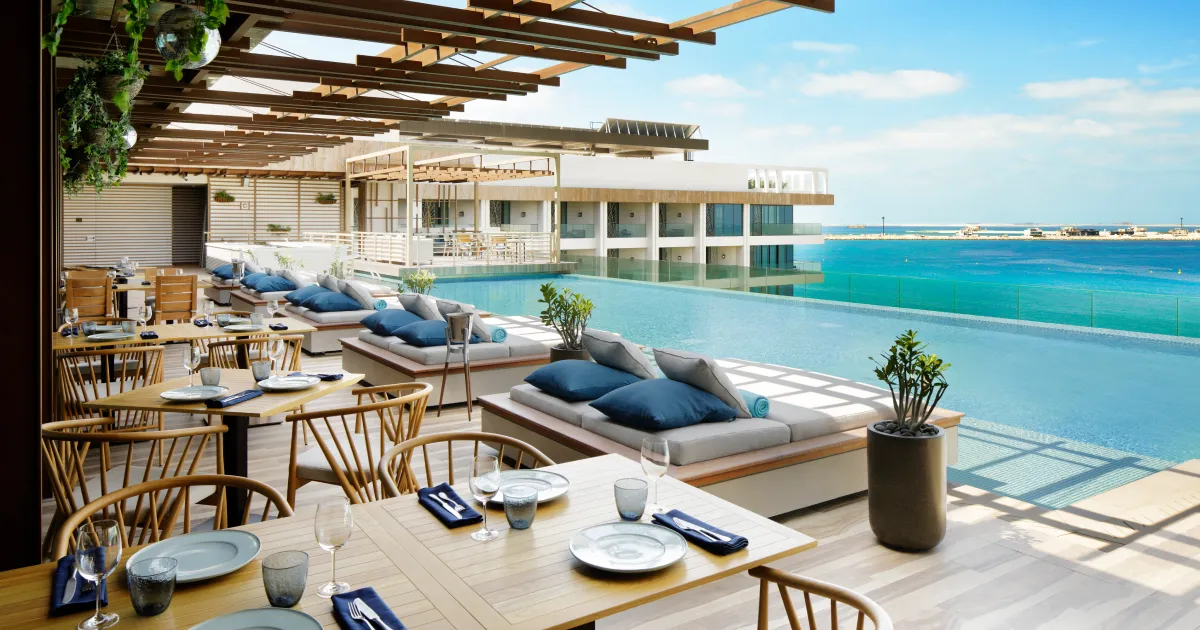
Siza and Souto de Moura insulated Portugal's pavilion at Expo 2000 in Hannover with expanded cork agglomerate and set it against lias stone, hand-made glazed tiles and a translucent roof membrane of glass fibre canvas, and Herzog & de Meuron and Ai Weiwei clad the interior of the 2012 Serpentine Pavilion in London in cork, chosen to echo the excavated earth. Tasca, a contemporary Portuguese restaurant by chef José Avillez at Mandarin Oriental Jumeira, Dubai, was completed in 2019 and holds One MICHELIN Star.
Tasca's interior, at Mandarin Oriental Jumeira in Dubai, is built from a different set of materials from those two pavilions. Timber is used for the tables and marble for the bar counters, and a slatted ceiling runs overhead. Colour comes from turquoise glassware and blue cushions set against the timber and marble, while illuminated shelving holds a display of ceramics within the restaurant. The restaurant also has a bar and a terrace, and the terrace is on the rooftop, overlooking the Arabian Gulf.
SOURCES
- Smithsonian Magazine Cork Trees: Soft-Skinned Monarchs of the Mediterranean
- AFP via Phys.org In Portugal, corks still top screwcaps
- Encyclopaedia Britannica Cork oak
- APCOR, Portuguese Cork Association Cork
- University of Kassel Landscape Chains: Alentejo, Portugal
- Euronews In this farm in Portugal's Alentejo trees get to retire and pigs go on maternity leave
- Corticeira Amorim Corporate milestones
- Corticeira Amorim Eduardo Souto de Moura studies the location of his site-specific project
- Archiweb Pavilion of Portugal at Expo 2000
- Serpentine Galleries Serpentine Gallery Pavilion 2012 by Herzog & de Meuron and Ai Weiwei