HAND PUPPETS, CARVED HEADS AND WOODEN STAGES OF QUANZHOU AND ZHANGZHOU
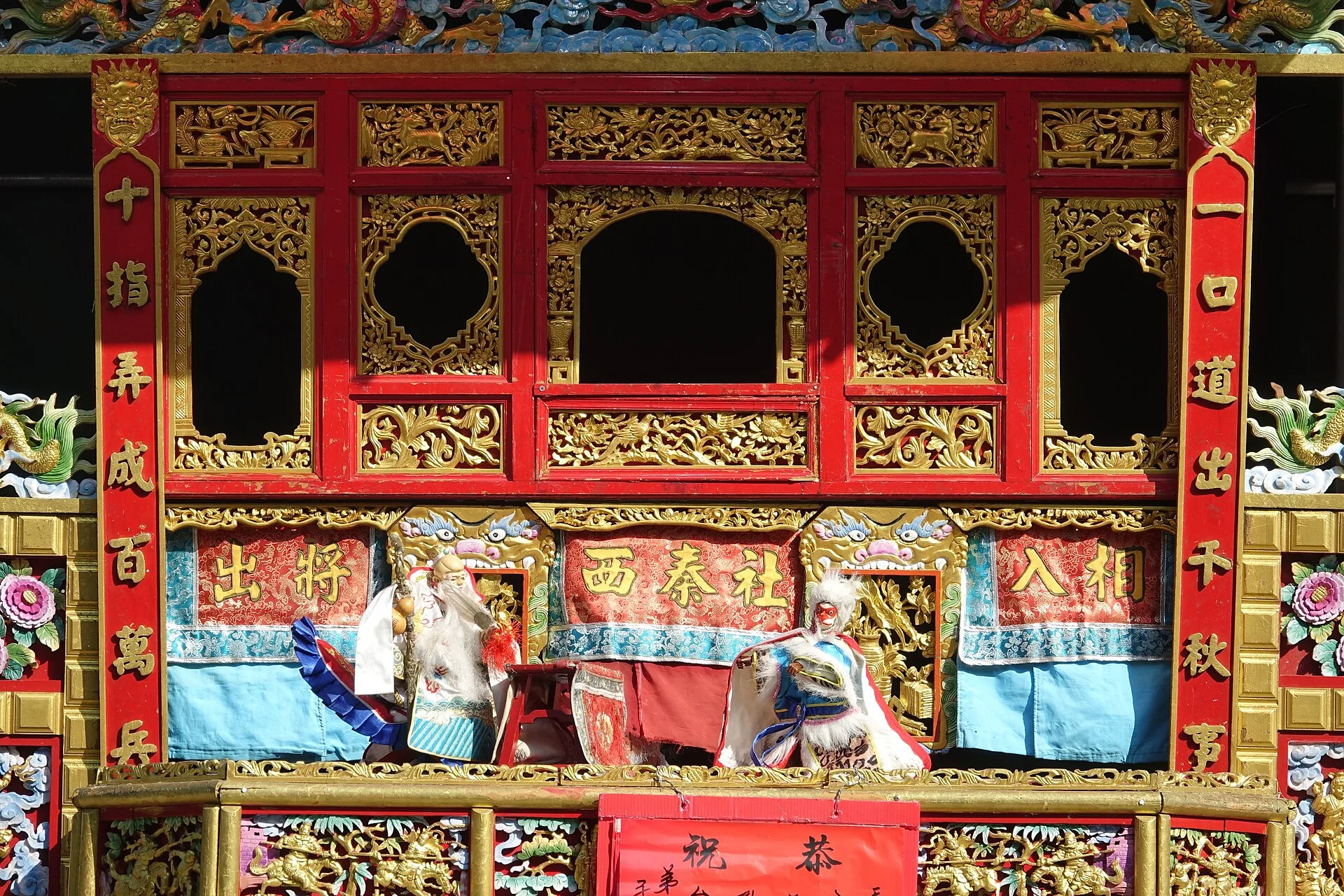
Glove puppetry, known in Mandarin as budaixi, is a theatre of hand-worn puppets that took shape in Fujian Province, with Quanzhou and Zhangzhou as its main centres. Its puppets combine carved wooden heads with embroidered costumes, and troupes perform historical and martial arts stories on wooden stages. In 2006 China's State Council placed Jinjiang and Zhangzhou glove puppet theatre, together with Zhangzhou puppet head carving, on its first national list of intangible cultural heritage. In 2012 UNESCO selected Fujian's strategy for training new puppetry practitioners for its Register of Good Safeguarding Practices. The form also travelled with migrants from Fujian to Taiwan, where it was performed mainly at religious festivals, and a related cloth glove puppet theatre of southern Fujian origin is performed in Java as wayang potehi.
WHAT IS GLOVE PUPPETRY?
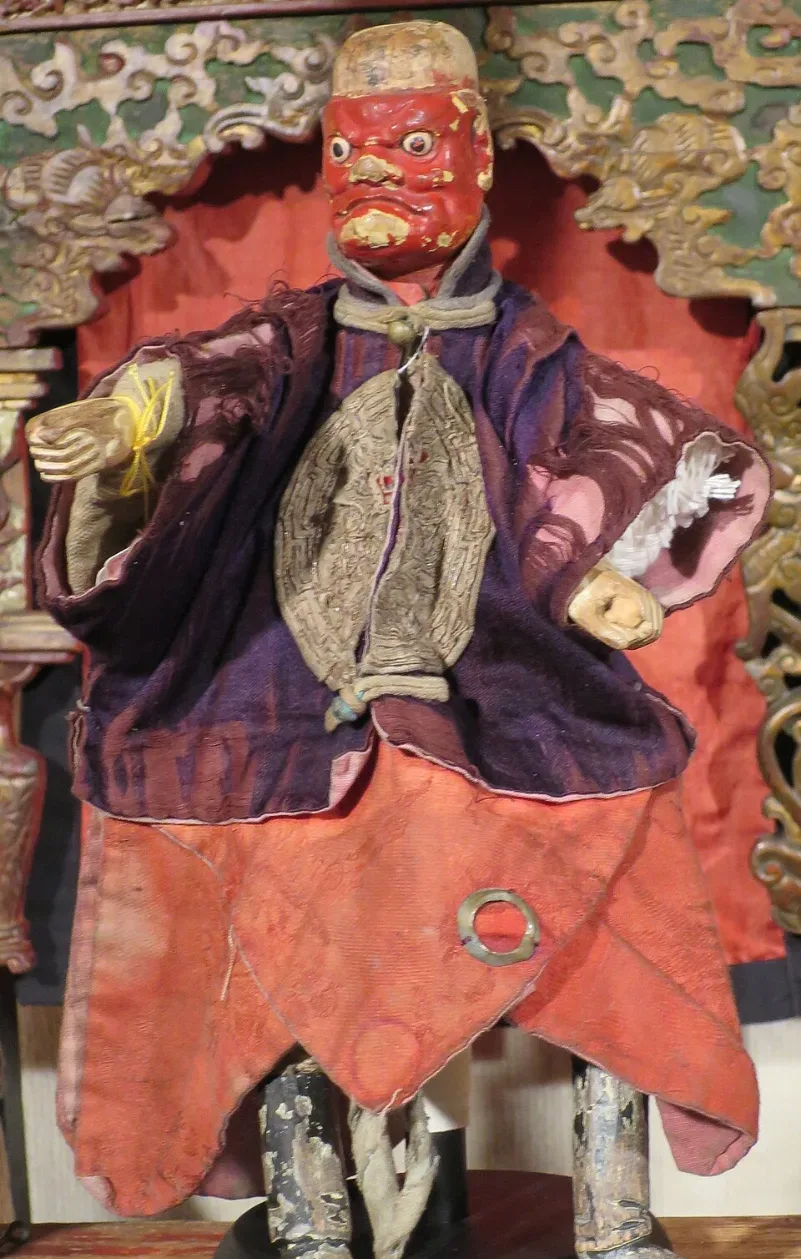
In a 2023 study in the journal Religions, Yanghuan Long and Chen Fan define the glove puppet as a puppet with a hollow head into which the performer puts his hand, moving the figure with his fingers. Taiwan's National Museum of Natural Science, in its exhibition on the form, describes the basic structure as a frame, clothing and accessories, and a cap. The frame is made up of the head, a cloth body, arms, cloth legs and shoes, and the puppeteer operates it by inserting a hand into the costumed frame. The museum notes that puppet heads were traditionally carved from wood or formed from clay, and that modern heads are made from celluloid or plastic.
Size has changed with the venue. According to the museum, puppets in the earliest form of the theatre were about 30 centimetres tall and one performer handled the leading roles. When performances moved onto the stage, the puppets were made larger so that audiences in the back row could see them, and puppets made for television can reach 100 centimetres. The Zhangzhou carver Xu Zhuchu gives a different traditional figure: in a 2018 China Daily report, puppets were described as having been made about 20 centimetres tall, while he makes his between 30 and 50 centimetres. The same report notes that the puppets have moved from street theatre to stages, film and museum display.
WHERE DID GLOVE PUPPETRY COME FROM?
The date of origin is uncertain, and sources give different accounts. A 2008 Taipei Times report notes that no records show when glove puppetry began, although some academics believe it dates back to the Song dynasty (960 to 1279). Taiwan's National Museum of Natural Science states that it originated in Quanzhou in the 17th century and spread through Quanzhou and Zhangzhou. The World Encyclopedia of Puppetry Arts, published by the international puppetry association UNIMA, states that the art was well established by the Ming dynasty. A 2018 China Daily report gives puppet shows in Zhangzhou a history of more than 1,000 years, a figure that covers puppetry in general rather than the glove form alone.
Glove puppets developed alongside other puppet forms in the same region. UNESCO describes Fujian puppetry as mainly string and hand puppetry, with its own performance techniques, puppet-making methods, plays and music. Quanzhou is known for its marionette shows, and Long and Fan record that Quanzhou marionettes were closely tied to religious activity, and that many Daoist priests were also puppet masters, performing on stages decorated in the shape of the eight trigrams. For the glove form, the 2008 Taipei Times report records that the Dutch sinologist Robin Ruizendaal, who earned his PhD in Sinology on Chinese marionette theatre at the University of Leiden, carried out research in Fujian, where glove puppetry was popular in the 19th century.
QUANZHOU, JINJIANG AND ZHANGZHOU: THE CENTRES OF FUJIAN GLOVE PUPPETRY
The State Council circular announcing China's first batch of national intangible cultural heritage was signed on 20 May 2006 and published on 2 June 2006. Its entry for puppet theatre, item IV-92 in the category of traditional theatre, names Quanzhou, Jinjiang and Zhangzhou among the applying areas, and lists Jinjiang glove puppet theatre and Zhangzhou glove puppet theatre as separate sub-items, alongside Quanzhou string puppet theatre. A second entry, item VII-44 in the category of folk fine arts, lists Zhangzhou puppet head carving, with the city of Zhangzhou as the applying area. The two entries recognise the performance and the making of the puppets as separate traditions.
The Zhangzhou Puppet Troupe, founded in the 1950s, performs Fujian style glove puppetry. The UNIMA encyclopedia records that in 1960 it presented scenes from the novel Water Margin at the Second International Puppet Festival in Bucharest and won the gold medal, and that it performed in London in 1987. Its repertoire includes Eight Immortals Crossing the Ocean, Li Kui, the Black Cyclone and the demonstration piece Art in the Palm. The company has toured more than thirty countries in Asia, Europe, the United States, Australia and Africa, and has created two hundred films and television programmes with Beijing Film Studio, Shanghai Animation Film Studio and CCTV.
WHO CARVES ZHANGZHOU GLOVE PUPPETRY HEADS? THE XU FAMILY

One carving family in Zhangzhou, the Xu family, has a recorded lineage of seven generations. A 2018 China Daily report by Lin Qi states that for more than two centuries the family has carved faces on small pieces of camphor wood, which are then attached to limbs and dressed. The family's first studio was opened in 1807 by Xu Ziqing, who lived from 1768 to 1858. Xu Zhuchu, aged 80 at the time of the report, is the sixth generation of carvers, and his son Xu Qiang is the seventh. The report adds that carvers historically supplemented their incomes by sculpting Buddhist figures for temples.
Xu Zhuchu inherited a repertoire of around 100 puppet characters and has expanded it to between 500 and 600. In 2018 the National Museum of China in Beijing showed more than 300 puppets made by seven generations of the family in an exhibition titled Craftsmanship, together with four puppet films, among them Qiang Qin. Long and Fan describe puppet heads passed down in the Xu Zhuchu family that are about 4 centimetres high and carved with fierce, glowering expressions and scowling, closed mouths. The two authors interpret these faces as intended to exorcise evil spirits.
COSTUMES, ROLE TYPES AND THE PUPPET STAGE

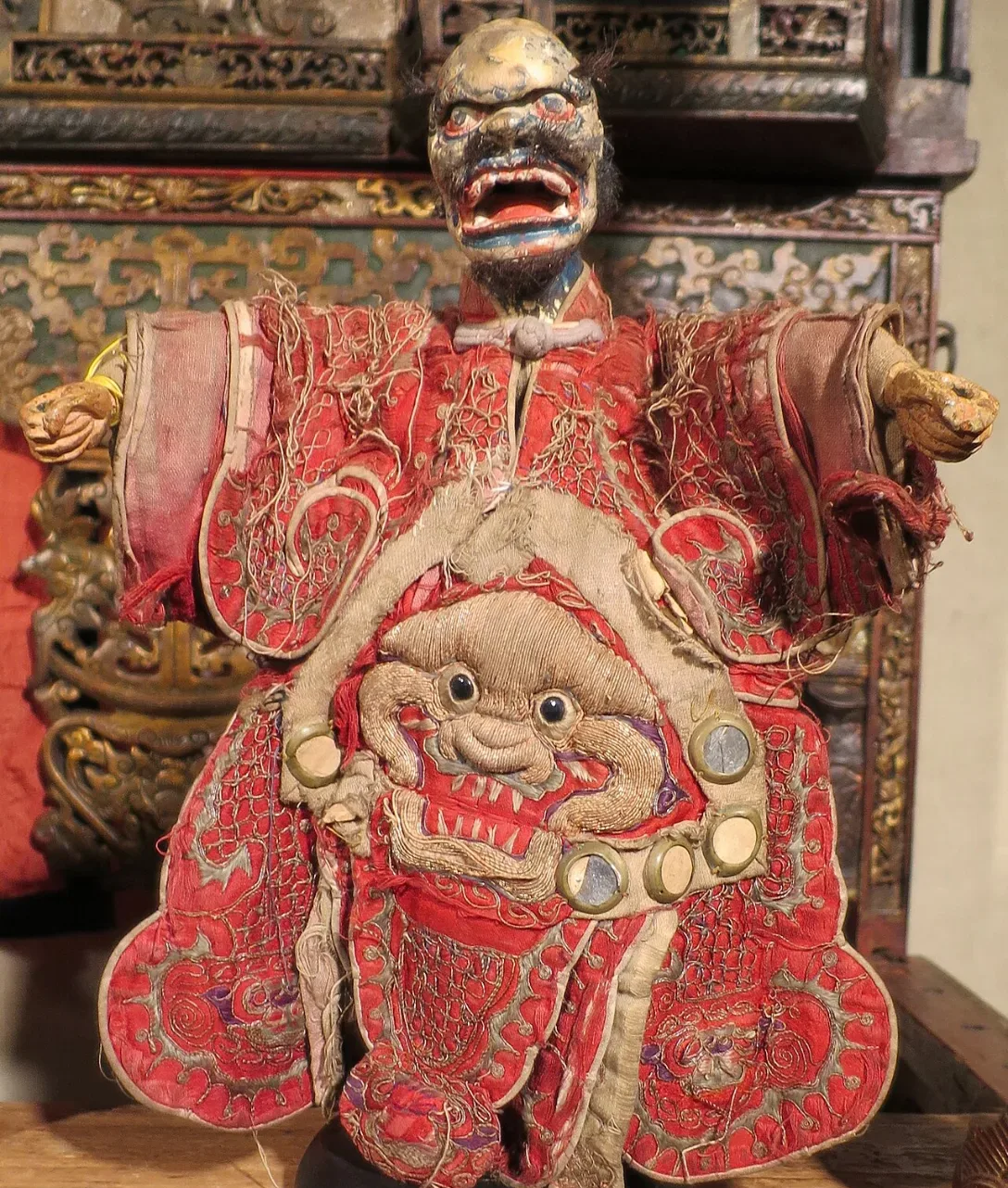
The costume identifies the character. Taiwan's National Museum of Natural Science notes that traditional puppet costumes are scaled-down versions of traditional Chinese clothing with the same embroidery, and that headgear follows set standards so that audiences can recognise the identity and status of each role at once. The museum lists the role categories of traditional puppet theatre as sheng, dan, dahua, erhua, sanhua, xiaoquezai, monsters, animals, immortals and miscellaneous roles. These differ from the sheng, dan, jing, mo and chou of Beijing opera, although the Zhangzhou Puppet Troupe, according to UNIMA, groups its puppets into the opera types dan, sheng, jing and chou.
The UNIMA encyclopedia describes Zhangzhou performances as given on elaborate wooden stages with finely carved puppet heads and embroidered costumes. In Taiwan the 2008 Taipei Times report describes the same ornate wooden stages, and the troupe of the Lin Liu-hsin Puppet Theater Museum in Taipei performs the traditional piece The Honorable Thief Liao Tian-ding on a vintage wooden stage. Taiwan's Ministry of Culture records that the museum of the Taiwanese puppet master Li Tian-lu holds his props, puppets and stage settings, together with six 100-year-old puppets in ancient Chinese costume.
HOW GLOVE PUPPETRY REACHED TAIWAN AND SOUTHEAST ASIA

From Quanzhou and Zhangzhou the form spread to Chaozhou in Guangdong and to Taiwan, according to the National Museum of Natural Science. The Taipei Times reports that it reached Taiwan as people migrated from China and was performed mainly at religious festivals. Among its Taiwanese masters was Li Tian-lu (1910 to 1998), born in Taipei to a puppet troupe organiser. Taiwan's Ministry of Culture records that he joined a touring troupe at fourteen, founded his own troupe, I Wan Jan, in 1931, and became a household name after a three-way puppet theatre contest in 1935. He closed the troupe in 1978 to promote the art in elementary schools in Taiwan and abroad.
The French government made Li a knight of the Order of Arts and Letters, and The Puppetmaster, a film by Hou Hsiao-hsien based on his memoirs, won the Jury Prize at the 1993 Cannes Film Festival. The Li Tian-lu Hand Puppet Museum opened in his hometown of Sanzhi on 31 December 1996. His son Chen Xi-huang also became a puppet master. In Taipei's Dadaocheng district, where puppet troupes once worked, the Lin Liu-hsin Puppet Theater Museum holds some 7,000 puppetry artifacts from across Asia and is directed by Robin Ruizendaal, who also leads its troupe.
The form also travelled south. Josh Stenberg, writing in the Journal of Southeast Asian Studies in 2015, describes wayang potehi as a cloth glove puppet theatre of southern Fujian origin performed on Java, with a repertoire weighted towards Qing fiction set in the Tang dynasty. He notes that the National Museum of Singapore owns articles from troupes that arrived in the 1930s, and that all sources agree the art is now in decline. Citing Matthew Cohen, he adds that Malay and Hokkien were already being combined in potehi in late nineteenth-century Surabaya.
FUJIAN GLOVE PUPPETRY AND UNESCO'S REGISTER OF GOOD SAFEGUARDING PRACTICES
UNESCO records that since the 1980s the number of young people learning puppetry in Fujian has fallen, because of changing lifestyles and the long training needed to master the techniques. In response, concerned communities, groups and bearers drew up the Strategy for Training Coming Generations of Fujian Puppetry Practitioners, covering 2008 to 2020. Its aims included professional training for a new generation of practitioners, the compilation of teaching materials, the establishment of performance venues, training institutes and exhibition halls, public education through formal and non-formal channels, and regional and international cooperation and artistic exchange.
UNESCO's Intergovernmental Committee selected the strategy for the Register of Good Safeguarding Practices at its seventh session in 2012. UNESCO notes that the strategy has seen wide participation from practitioners, local people and educational institutions. By UNESCO's account, about 200 potential practitioners had received professional training, 20 public puppetry groups had been established and representative bearers had received financial support. Three years earlier, in 2009, UNESCO had inscribed nanyin, a musical performing art of the Minnan people of southern Fujian, on its Representative List.
HYATT CENTRIC OCEANFRONT XIAMEN

Silverfox Studios completed the full-scope interior design of Hyatt Centric Oceanfront Xiamen in 2025. The hotel stands on the Xiamen coast beside Zengcuo'an Food Street. Its design draws on street scenes and lanes, on kiln-fired local bricks and on local craft, and the hotel is designed as a series of connected "houses". In Fujian the making of glove puppets is recorded as a craft in its own right: China's 2006 national list places Zhangzhou puppet head carving in the category of folk fine arts, separately from Jinjiang and Zhangzhou glove puppet theatre.
Music culture is central to the hotel's ground floor, and among the connected houses a House of Music is the focal point for live evening music. Music is one of the elements UNESCO names in describing Fujian puppetry, alongside its performance techniques, puppet-making methods and plays. The UNIMA encyclopedia records that Zhangzhou glove puppetry was performed on elaborate wooden stages with finely carved heads and embroidered costumes, and UNESCO counts performance venues and exhibition halls among the aims of the 2008 to 2020 strategy for Fujian puppetry.
SOURCES
- UNESCO Strategy for training coming generations of Fujian puppetry practitioners
- UNESCO Nanyin
- State Council of the People's Republic of China Circular on announcing the first batch of national intangible cultural heritage (2006)
- National Museum of Natural Science, Taiwan Puppetry: from Tradition to Innovation
- Ministry of Culture, Taiwan Li Tian-lu Hand Puppet Museum
- Taipei Times Robin Ruizendaal and the Lin Liu-hsin Puppet Theater Museum (16 May 2008)
- UNIMA World Encyclopedia of Puppetry Arts Zhangzhou Puppet Troupe
- China Daily Handcrafted puppets are focus of exhibition
- Religions (MDPI) Belief in Drama: A Study of the Religious Factors in Ancient Chinese Puppet Dramas
- Journal of Southeast Asian Studies (Cambridge University Press) Wayang potehi: Glove puppets in the expression of Sino-Indonesian identity