A FOLK CRAFT THAT TIES SILK CORD INTO DOUBLE-LAYERED, SYMMETRICAL AND AUSPICIOUS ORNAMENTS
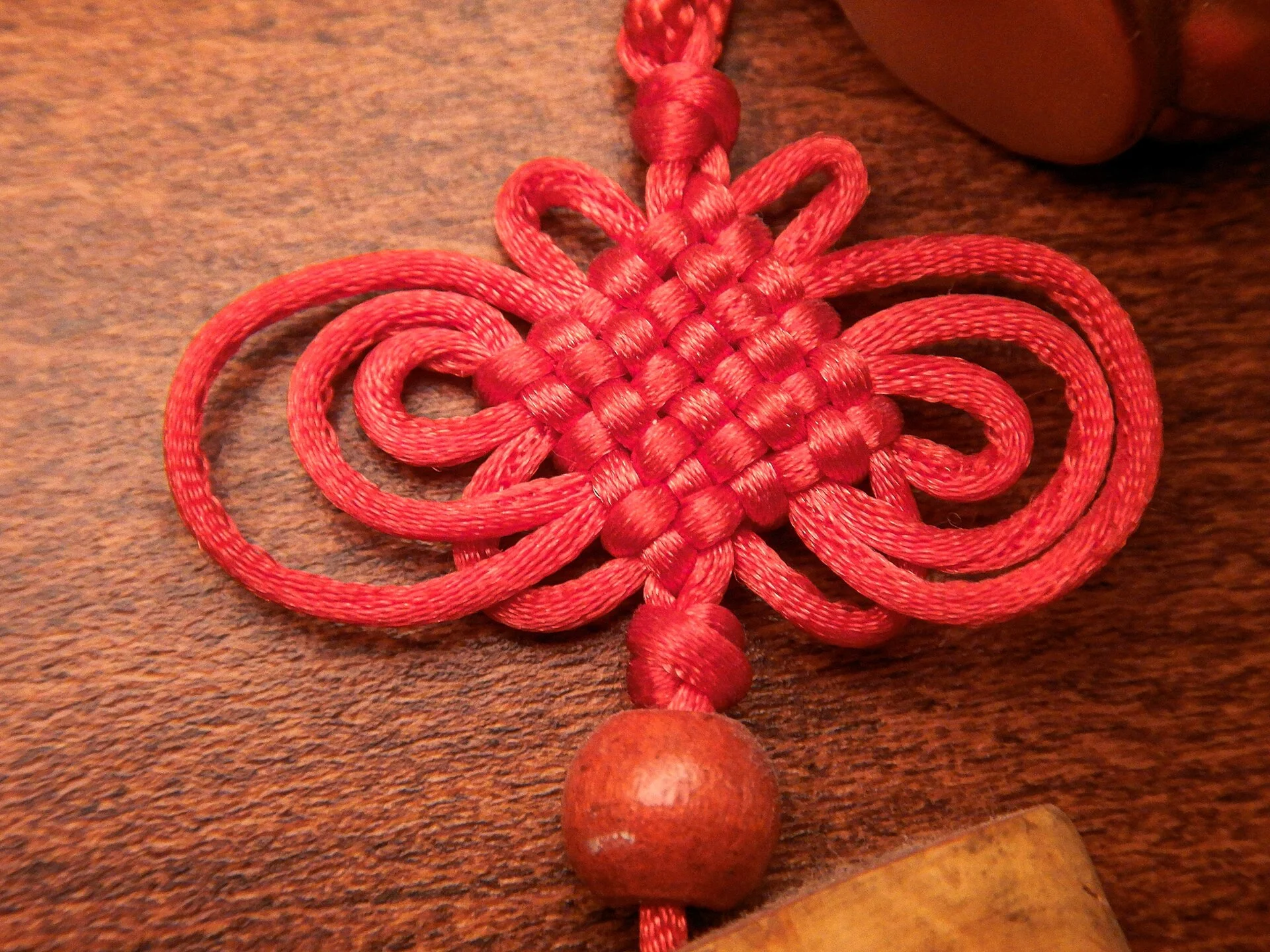
Chinese knotting is the craft of tying cord, traditionally coloured silk thread, into decorative knots that are usually double-layered and symmetrical. The finished knots are hung as ornaments or attached to clothing, accessories and household objects. Beijing's official tourism site describes the typical form as lanyard-style, with two cords entering at the top and two leaving at the bottom. The craft began with practical work: Lydia Chen's book Chinese Knotting lists recording events, fishing and hunting, wrapping and tying, and decorating clothing and jewellery among the early uses of knots in China. Its decorative forms carry wishes for good fortune, wealth, love and marriage. Because thread decays, no ancient Chinese knotwork has survived, and the early history of the craft is pieced together from literature, sculpture and decorated bronzes and ceramics. Its best-documented period is the Qing dynasty (1644 to 1911), and its modern form owes much to a revival led from Taipei from the late 1970s.
WHAT IS CHINESE KNOTTING? THE BASIC KNOTS AND MATERIALS
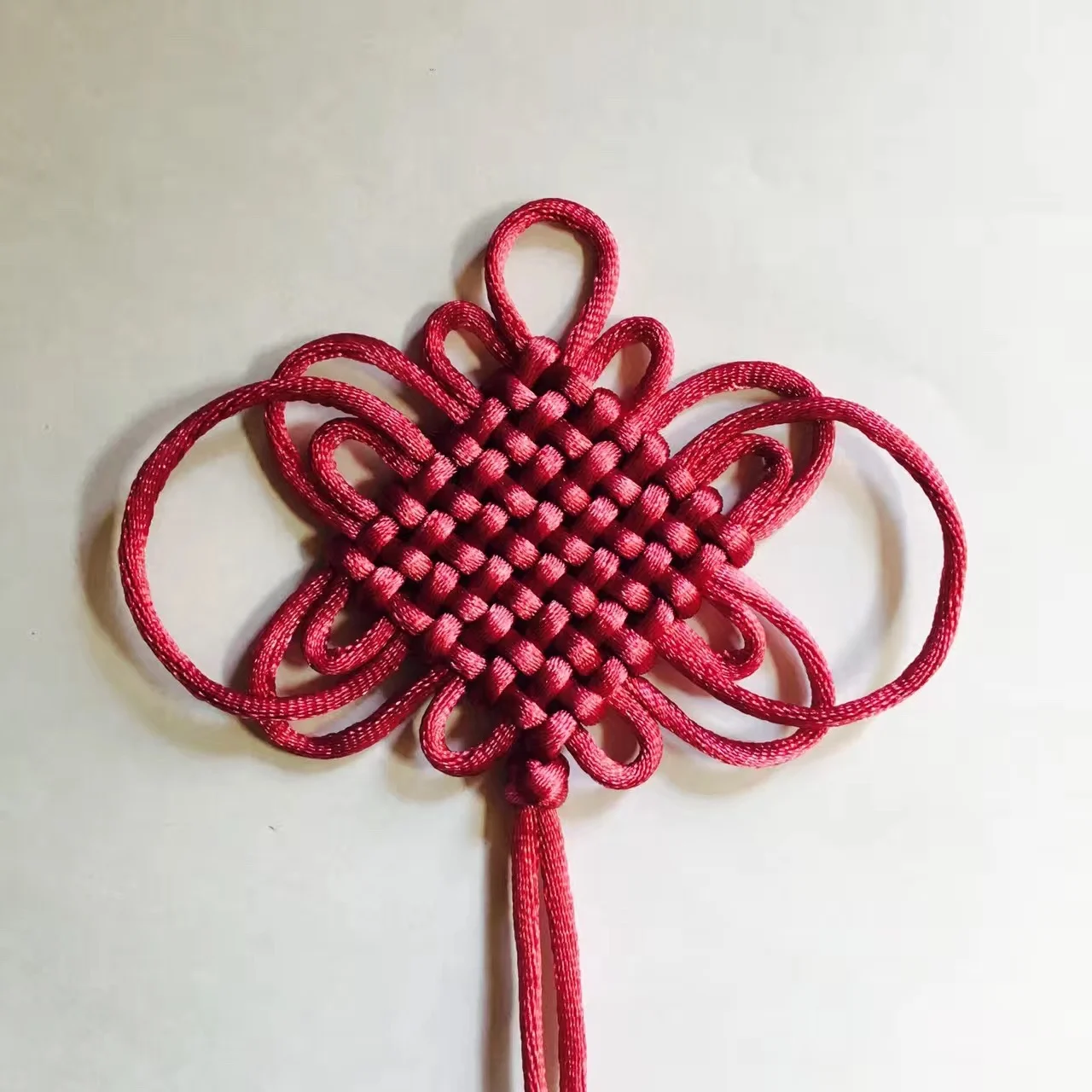
Chinese knotting is built from a small set of basic knots that are tied on their own or combined into larger designs. EBSCO's reference entry on the craft states that most Chinese knots rely on 15 to 24 basic techniques, and it names 14 of the most basic knot types: the alternating, button, cloverleaf, cross, double coin, double connection, flat, good luck, longevity, pan chang, petal, prosperity, ruyi and snake knots. Beginners are expected to master each basic knot before moving on to combinations and advanced methods.
The traditional material is coloured silk thread. Beijing's tourism site notes that the knots are typically double-layered and symmetrical, and that over time the craft developed more sophisticated techniques and intricate woven patterns. EBSCO records that some practitioners combine Chinese knots with Celtic or English knotting, or with beading, cloth dyeing and weaving. Lydia Chen's Chinese Knotting, the standard English manual, teaches 11 basic knots and 14 compound knots, which it defines as combinations and variations of the basic forms, followed by 41 projects of increasing difficulty.
WHERE DID CHINESE KNOTTING COME FROM?
The physical record of early Chinese knotting is thin. When the China Institute in New York staged The Art of Chinese Knotting in 1981, its exhibition text noted that knotting had long been overlooked as an art form because it was mainly a functional handicraft. Thread decays easily, and no ancient Chinese knotwork has survived. Evidence instead comes from literature, from knots carved on the clothing of sculptures, and from decorative patterns on bronzes and ceramics. EBSCO dates archaeological evidence of knot-tying to the Warring States period (481 to 221 BCE), and Beijing's tourism site points to knots depicted on bronze vessels of that period, on Buddhist carvings of the Northern Dynasties and on silk paintings of the Western Han.
By the Southern Dynasties (420 to 589), according to the China Institute, people were tying named knots and using them as symbols; one example is the true lover's knot, which expressed love. EBSCO places the main development of the craft in the Tang dynasty (618 to 907). Knots were used first on clothing and accessories, later in religious rituals, and then to mark events in a person's life, with small knots for minor milestones and large knots for major occasions. During the Song dynasty (960 to 1279), particular knots came to carry fixed meanings, and knotwork was given as a gift for important events. Beijing's tourism site describes knotting in the Tang and Song as a folk art that became more widely popular under the Ming.
THE ENDLESS KNOT AND THE MEANING OF CHINESE KNOTS
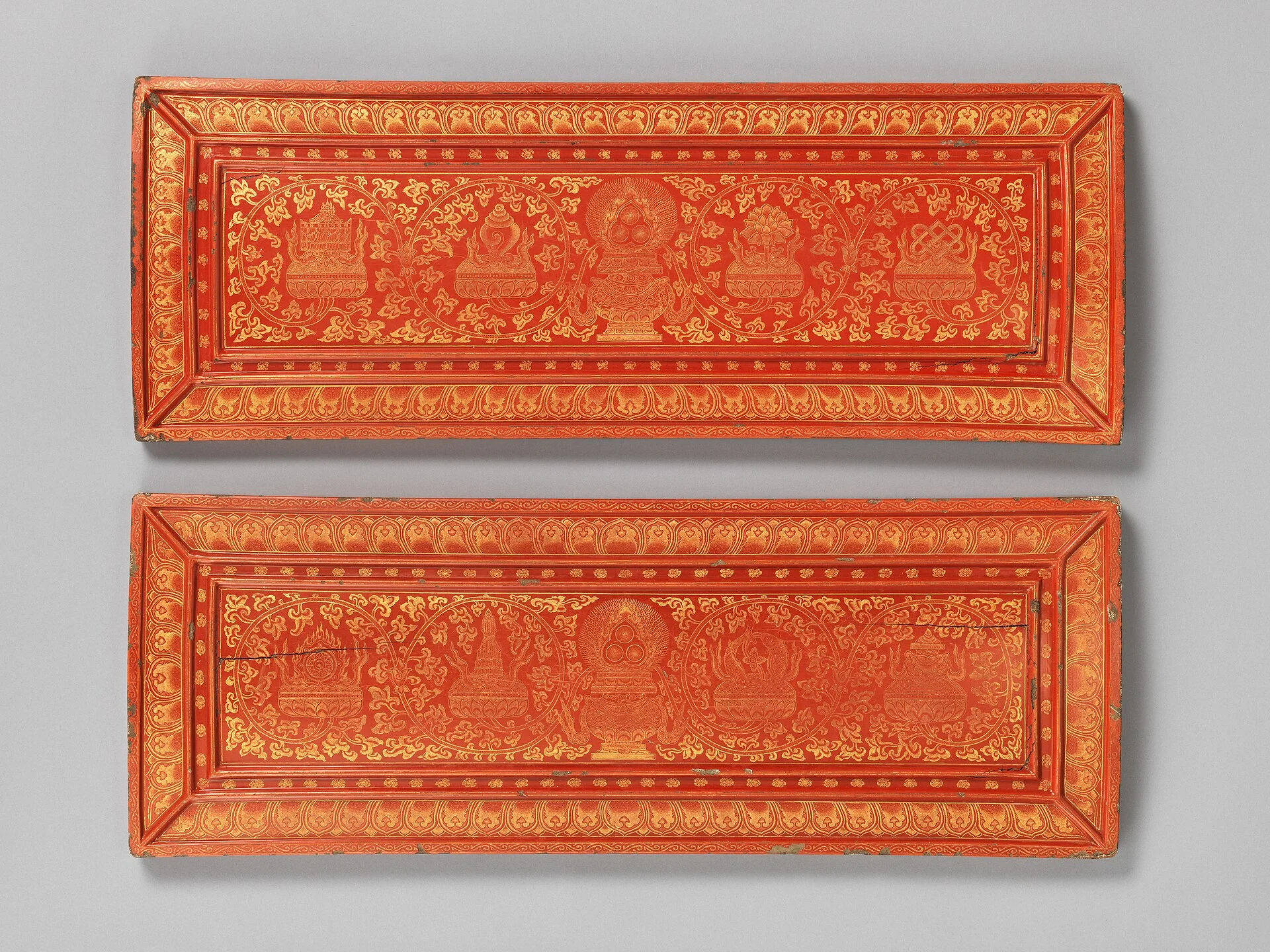
One knot form became part of the standard vocabulary of Chinese decorative art through Buddhism. The endless knot is one of the Eight Auspicious Emblems, a group the Metropolitan Museum of Art describes as introduced to China with Buddhism and later common across the decorative arts. The Met's examples include an 18th-century Qing sutra cover woven in kesi silk tapestry, which shows the umbrella, double fish, vase, flower, conch shell, endless knot, canopy and wheel, each resting on a lotus with ribbons on either side and linked by a vegetal scroll, within borders of five-clawed dragons.
The Horniman Museum in London holds an endless knot from an altar set of the eight emblems, carved in wood, covered in red lacquer and gold pigment and mounted on a tiered lotus pedestal. Its record explains that the endless knot has no beginning and no end and represents the Buddha's boundless wisdom, and that a full set of these pieces stood on the altar of a Buddhist temple. Outside religious settings, knots carried more domestic meanings. EBSCO notes that some knots stand for luck, happiness or wealth and are hung in homes or displayed at festivals and rituals as blessings, and that knots in general symbolise union and togetherness, which made them popular gifts at weddings and between lovers.
CHINESE KNOTS IN QING DYNASTY DRESS AND ACCESSORIES
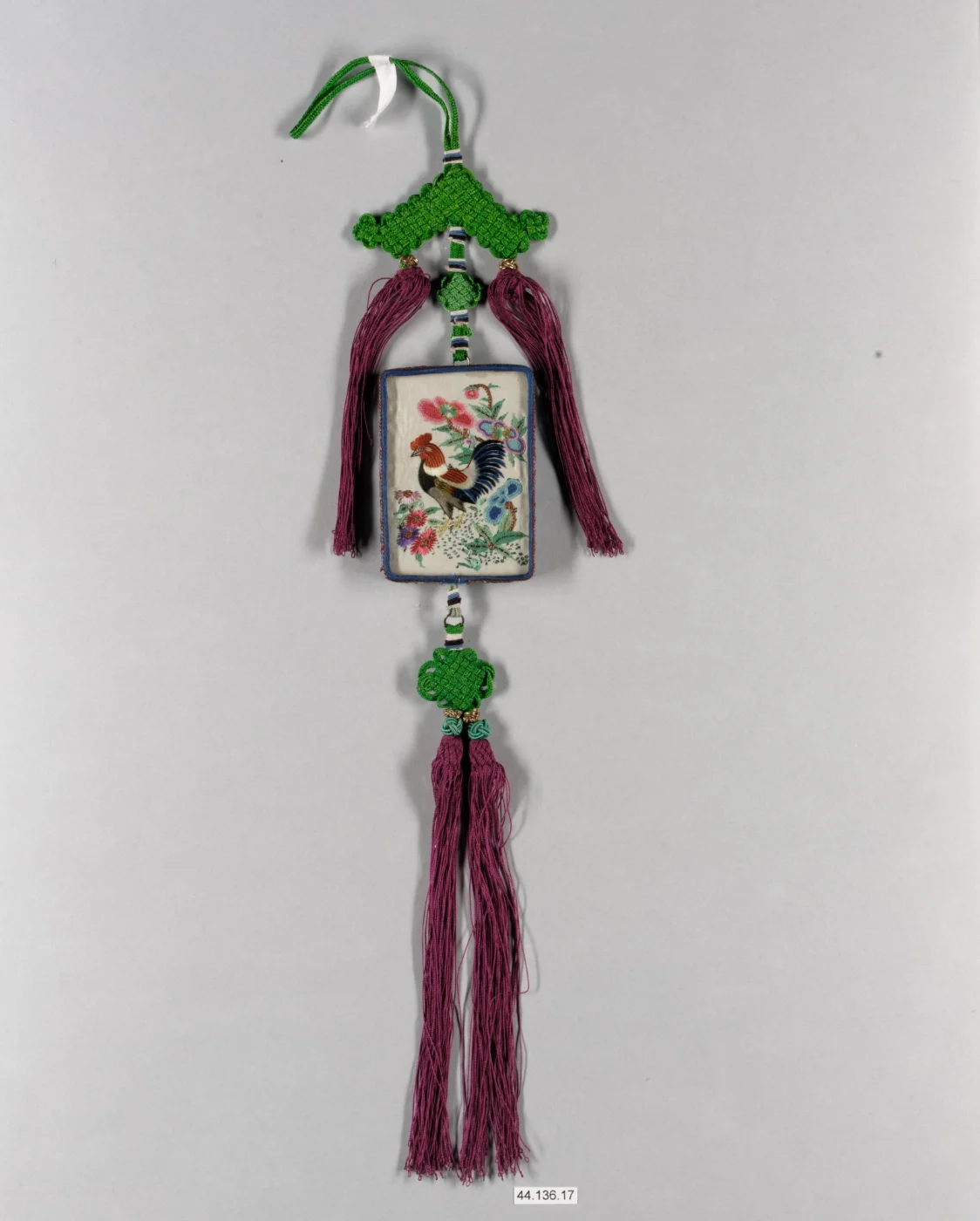
The Qing dynasty is the period in which Chinese knotting is best documented. According to EBSCO, knotting had been regarded as a folk or village art before the Qing, but in the early Qing it spread across all social classes and was used in official decorations for the imperial family. Many new patterns were created at that time, including most of the techniques used today. Beijing's tourism site describes the Qing as the period in which knotting became an accepted art form and reached its peak, and notes that Dream of the Red Chamber, the 18th-century novel of a great family's household, discusses the craft at length.
Qing dress made everyday use of knotted cord. A Han Chinese woman's jacket of 1875 to 1900 in the Victoria and Albert Museum, made of navy cut velvet patterned with butterflies, prunus and chrysanthemum, with sleeve bands embroidered in gold and coloured silks, fastens at the right side with five loop and knot buttons. Knots also finished the small accessories that hung from a belt. A 19th-century embroidered silk tobacco pouch in the same museum, given by the Commissioners for the Exhibition of 1851, is drawn closed with red running cords tied with green decorative knots and finished with four long white tassels.
LYDIA CHEN AND THE REVIVAL OF CHINESE KNOTTING IN TAIPEI
EBSCO records that interest in knotting waned in the late 19th and early 20th centuries, and that the craft became extremely rare, kept alive by a small number of practitioners in villages. Its modern revival is associated with Lydia Chen (Chen Hsia-sheng), who was born in 1940 in Yueqing, Zhejiang. Her interest began when her father-in-law, a deputy curator at the National Palace Museum in Taipei, arranged for her to learn simple knots from an elderly museum custodian. She then worked out how more complex knots were formed by studying antique pieces she collected, and went on to invent designs of her own. Beijing's tourism site credits her with leading a revival in the late 1970s and founding the Chinese Knotting Promotion Center.
Chen's Chinese Knotting was published in English in Taipei in 1982 by Echo, as a 116-page title in its Echo Craft Books series, with step-by-step instructions, diagrams and colour photographs. A copy in the collection of the International Guild of Knot Tyers is now catalogued by the SS Great Britain Trust in Bristol. The craft was already reaching foreign audiences: the China Institute's exhibition ran in New York from 29 July to 21 September 1981, showing Qing dynasty knotting works alongside objects related to knots in ancient China. EBSCO dates the popularity of knotting in Taiwan to the early 1980s, when knots became common in gift markets, before the craft spread to Europe and the United States.
CHINESE KNOTTING TODAY: TEACHERS, NEW MATERIALS AND NEW USES

Chen's manual has remained in print. Tuttle Publishing reissued the book in 2017, describing Chen as a leading authority on traditional Chinese decorative knotting who has taught the craft at colleges and exhibited at home and abroad. Teaching has since spread well beyond the colleges where she taught: EBSCO notes that some makers sell their work through novelty shops and online, or teach classes at arts institutions and cultural associations. Contemporary makers have widened the range of materials. In February 2008, Corra Liew of Malaysia developed a wire-based form of jewellery using Chinese knotting techniques, which she calls Wired Chinese Knot.
Knotting has also moved into large-scale production and design. EBSCO notes that computer programs are now used to design and produce knots in quantity, that mass-produced knotted ornaments are widely sold in Asian boutiques alongside handmade pieces by hobbyists, and that knots appear in Asian-themed home decoration, in feng shui interior schemes and as ornaments hung from car rear-view mirrors. On an international stage, the logo for Beijing's bid to host the 2008 Olympic Games was based on a traditional knot design, according to the city's official tourism site.
MAN WAH: SILK, EMBROIDERY, NAVY AND GOLD

Man Wah is a Cantonese restaurant on the 25th floor of Mandarin Oriental Hong Kong, redesigned by Silverfox Studios in 2021, and it holds One MICHELIN Star. The design interprets the Hong Kong skyline and Victoria Harbour seen from its windows, with references to the hotel's heritage. Its lanterns reinterpret the original Man Wah lanterns as clustered brass cages with embroidered, pleated shades. The walls are lined with navy panelling with gold trim, and an embroidered artwork of a dragon and flowers sits on a navy wall panel.
The floor is a bespoke blue and gold carpet in silk, with hand-carved patterning that evokes light on the harbour. Silk, embroidery, navy and gold also appear together in the Qing objects described above. Traditional Chinese knots were tied in coloured silk thread. The Han Chinese woman's jacket of 1875 to 1900 in the Victoria and Albert Museum pairs navy velvet with embroidery in gold and coloured silks and fastens with loop and knot buttons, and the museum's 19th-century tobacco pouch combines embroidered silk with knotted silk cords and tassels.
SOURCES
- EBSCO Research Starters Chinese Knotting
- China Institute The Art of Chinese Knotting
- Visit Beijing (Beijing Municipal Bureau of Culture and Tourism) Chinese Knotting
- Tuttle Publishing Chinese Knotting by Lydia Chen
- SS Great Britain Trust Chinese Knotting, Lydia Chen, Echo, Taipei, 1982
- The Metropolitan Museum of Art Sutra Cover with Eight Buddhist Treasures
- Horniman Museum and Gardens Altar piece: endless knot from a set of the Eight Buddhist Emblems
- Victoria and Albert Museum Jacket (ao), China, 1875 to 1900
- Victoria and Albert Museum Tobacco pouch, China, 19th century