HOW A LIGHT LIT FOR THE BUDDHA BECAME THE CLOSING NIGHT OF THE CHINESE NEW YEAR

Chinese lantern history is usually traced to the Han dynasty (206 BC to AD 220), when, according to the most widely repeated account, lanterns were lit on the 15th night of the first lunar month to honour the Buddha. That night became the Lantern Festival, the first full moon of the lunar year and the event that closes the Chinese New Year. Over the following dynasties the lantern moved from temple and palace ritual into city streets and markets, and the imperial court developed its own type, the palace lantern, built from carved hardwood, glass and painted silk. The history of Chinese lanterns is therefore two connected stories: a festival that spread from religious practice to the whole population, and a craft that produced carved and painted lanterns for the imperial court. Both survive, in festival displays across China and Hong Kong and in workshops whose techniques are now protected as intangible cultural heritage.
WHAT IS THE LANTERN FESTIVAL
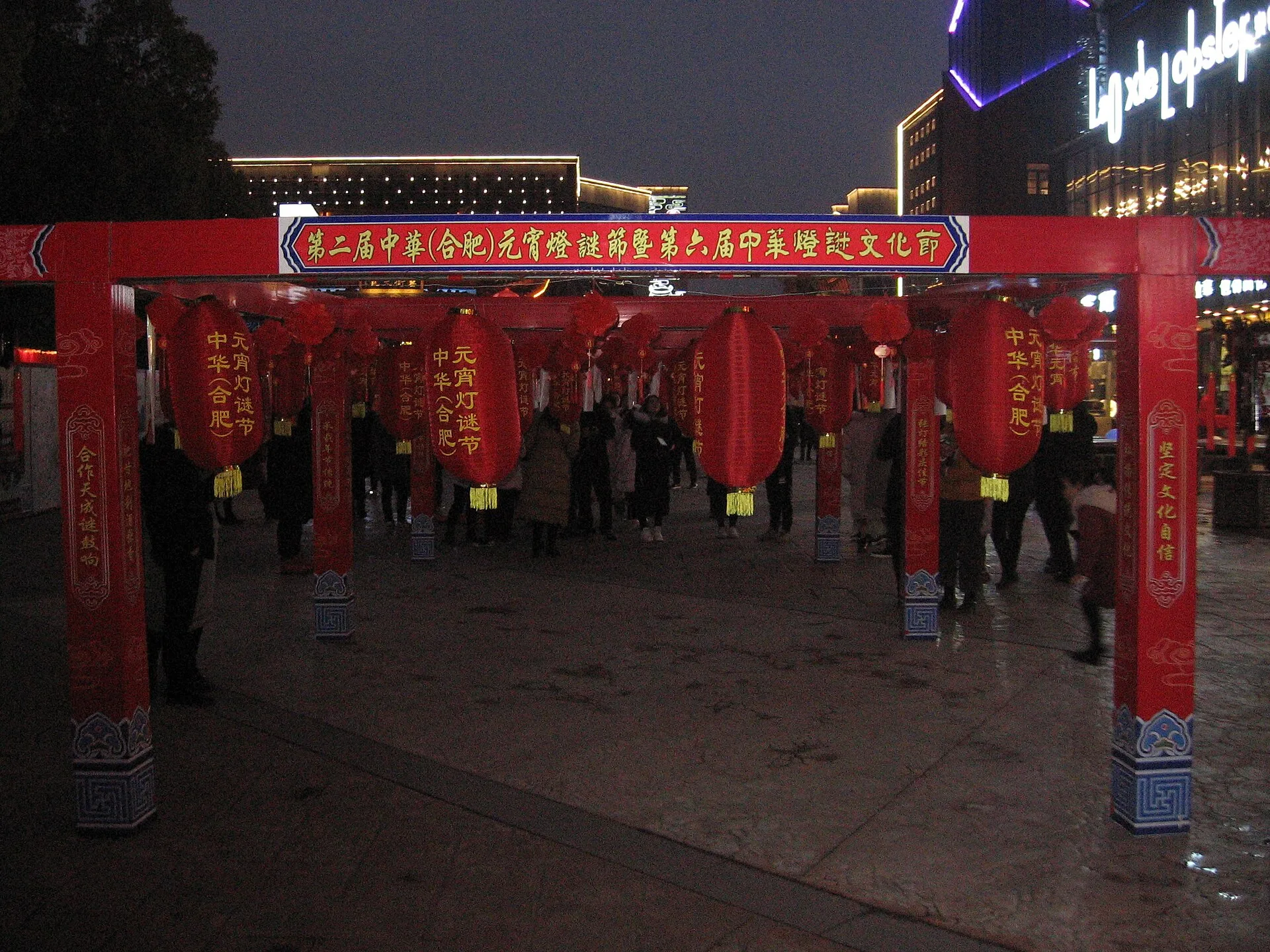
The Lantern Festival falls on the 15th day of the first month of the lunar calendar, the first full moon of the new year, and marks the end of the New Year celebrations. Its Chinese name, Yuanxiao, combines yuan, meaning the beginning, and xiao, meaning night, a reference to that first full moon. The National Palace Museum in Taipei records other names for the day, including Minor New Year and Spring Lantern Festival. Daoist tradition calls it the Shangyuan Festival and holds that the Heavenly Official, the deity in charge of good fortune, was born on this date.
Houses and streets are decorated with lanterns, many of them carrying riddles that passers-by try to solve for a small prize. Lion and dragon dances, parades and fireworks fill the evening. Families eat yuanxiao or tangyuan, glutinous rice balls with sweet fillings such as sesame, red bean paste, rose paste or nuts, and some regions make savoury versions with pork, shrimp or vegetables. The round shape of the rice balls stands for wholeness, and the name tangyuan sounds close to tuanyuan, the Chinese word for reunion, which is why the dish is tied to family togetherness and to relatives who are away from home.
WHERE THE CHINESE LANTERN TRADITION CAME FROM
Sources agree that the 15th day of the first month was already an important date under the Han, but they give more than one origin for its lanterns. The National Palace Museum links the custom to Emperor Wudi, who made lantern offerings to Taiyi, the God of Great Unity. The account most often repeated in China links it to Buddhism: Emperor Ming of the Eastern Han, a supporter of the religion, learned that monks lit lamps on this night to honour the Buddha and ordered lanterns lit in the imperial palace and in temples. The practice then passed to the nobility and to ordinary people. UNESCO's Silk Road programme describes the same sequence, with a Buddhist act of worship growing into a popular festival that spread from the Central Plains across China.
Alongside these accounts sits a folk legend told in several versions. In the version given by Britannica, the Jade Emperor, ruler of Heaven, resolved to burn a town after its people killed his goose; in another telling the bird was his favourite crane. A fairy advised the townspeople to hang lanterns everywhere on the appointed night. Looking down and seeing the glow, the Jade Emperor assumed the town was already on fire and spared it, and the people continued to light lanterns every year in gratitude. Both sources present the story as a folk tale rather than history.
FROM COURT RITUAL TO CITY FESTIVAL: THE TANG TO THE QING

The Tang dynasty (618 to 907) turned the lanterns into a fixed public event. Under the Tang the festival became an annual celebration on the 15th day of the first month, and the display of lanterns became an official practice as well as a folk custom. The National Palace Museum notes that in this period lanterns began to be admired as objects in their own right, while evening dances and entertainments made the night grander. The festival's popularity peaked under the Tang, according to China Daily's history of the palace lantern craft.
The Song (960 to 1279) and Yuan dynasties added commerce. Lantern markets were set up around the festival to sell colourful and unusual lanterns, and by the Ming dynasty (1368 to 1644) these markets were an established custom. The Song also gave the night an intellectual side. Lantern riddles appeared in this period and matured under the Ming and Qing (1644 to 1911); records from Suzhou describe riddles drawn from classical texts, poetry and proverbs, with prizes such as handkerchiefs or sachets. The Song name for the festival rice balls was fuyuanzi, or floating round balls. The length of the celebration varied from one dynasty to the next, and the Ming held a ten-day festival, the longest in Chinese history.
PALACE LANTERNS: HOW CHINA'S COURT LANTERNS ARE MADE
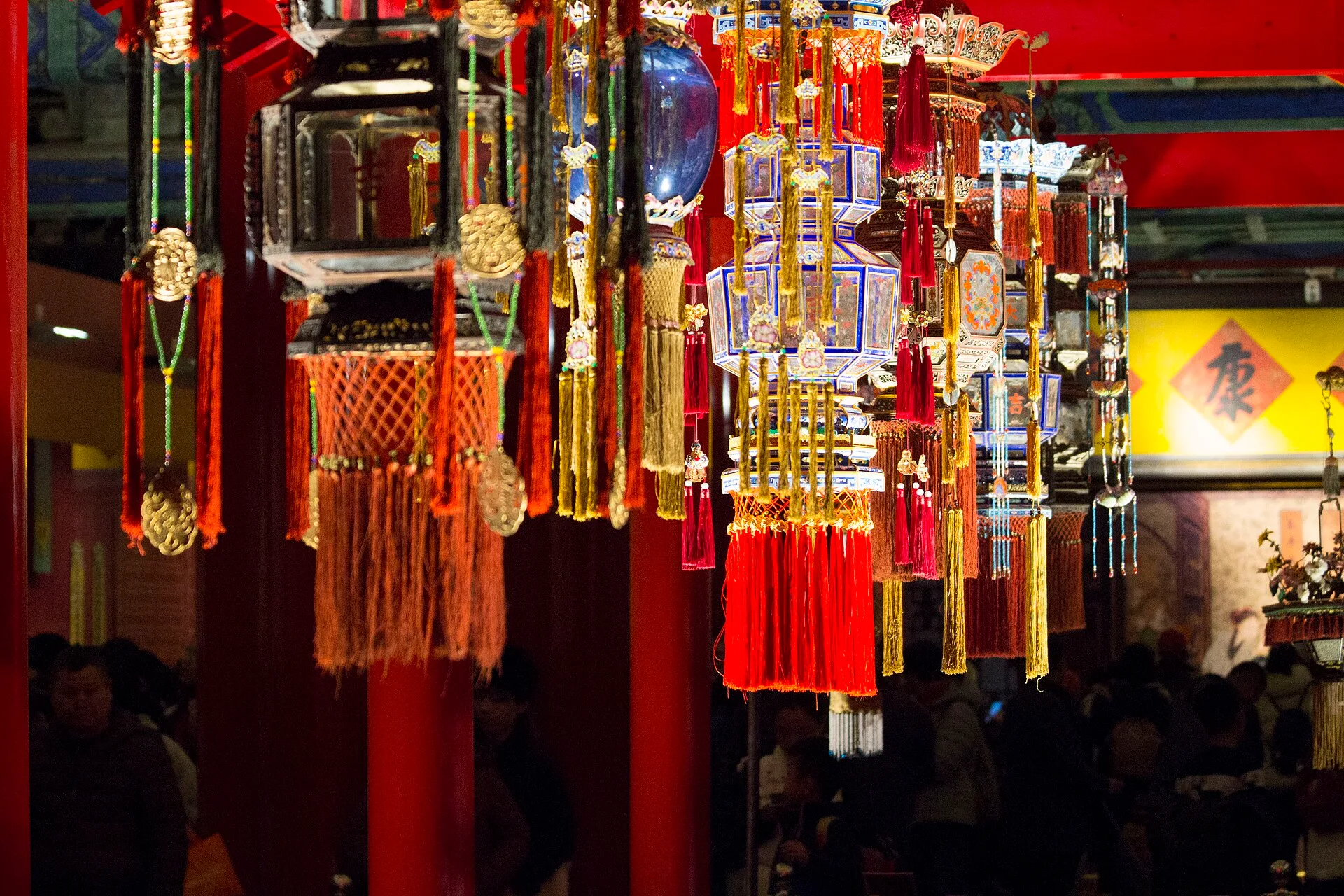
The palace lantern, or gongdeng, is the court's version of the form. Accounts of the Beijing craft say the earliest examples, from the Han, were simple: four wooden sticks wrapped in cloth and set around a candle to protect the flame from wind. Palace lanterns were first made only for the imperial court, where their decorative role mattered more than the light they gave. Lanterns made for imperial birthdays were decorated with flowers and peaches as wishes for longevity. Qing emperors began awarding palace lanterns to officials as rewards, which carried the form out of the palace; by the end of the imperial period, lanterns of this kind were part of ordinary life.
The standard model is the double-layered hexagonal lantern, with arched spines, eaves, pillars and windows, and dragon or phoenix heads mounted on the tops of the pillars. Makers prefer rosewood and sandalwood from Guangdong and Guangxi for their fine, hard grain. The frame is joined with mortise-and-tenon joints rather than nails, the method used in traditional Chinese architecture and furniture. Patterns are cut with a fine iron wire strung on a bow, and the carved openings finish in small projecting notches known as flower teeth. A standard hexagonal lantern has more than 100 wooden parts and needs around 100 separate processes, including carving, assembly, painting and the hanging of tassels or Chinese knots. Painted silk is applied to the glass panels by hand, because a machine cannot keep it smooth on a curved surface.
Production spread from Beijing to Shanghai, Guangzhou and Hebei, and regional styles followed: southern lanterns are more delicate and intricately carved, while northern lanterns, Beijing's in particular, are grander and more formal. The palace lantern craft was listed as national intangible cultural heritage in 2008. Zhai Yuliang, an inheritor of the Beijing tradition, began as an apprentice at a Beijing lantern factory in 1975 under masters who had made lanterns for the imperial household. That year the factory had more than 300 workers, a third of them on palace lanterns; CGTN later reported that only seven or eight people still did the work.
THE PALACE LANTERN BEYOND THE PALACE

The palace lantern became one of the most widely reproduced images of China. The red gauze lanterns that hang on the Tian'anmen gate tower are a type of palace lantern, and the Beijing factory made new ones for the tower in the 1980s. The lanterns that carried the flame at the 2008 Beijing Olympic Games were designed with reference to ancient palace lanterns. The Beijing workshop's main clients today are important buildings, Chinese restaurants, film and television productions and private collectors. Hand lanterns, the kind carried through the streets at the Lantern Festival, belong to a separate folk tradition, and families once made their own in many different styles.
Foreign buyers knew the form by the early 19th century. The Metropolitan Museum of Art in New York holds a watercolour design for a hall lamp by the Chinese painter Lamqua, dated to around 1800 to 1810, which is modelled on a Chinese palace lantern. It shows a lamp in two parts joined by thin cords: a hexagonal canopy with tassels hanging from its six projecting points, above a hexagonal body with painted glass sides that narrow towards the base. The design keeps the structure of the court lantern, a carved frame holding painted panels, while adapting it as a hanging light for an interior.
LANTERNS AND PAPER CRAFT IN HONG KONG

In Hong Kong, lanterns are closely associated with the Mid-Autumn Festival as well as the Lantern Festival. The Hong Kong Tourism Board notes that children once made their own paper lanterns and that people still carry lanterns to parks at night to light the way while they watch the moon. Victoria Park hosts the city's largest Mid-Autumn lantern carnival, and riddles written on slips of paper are still attached to lanterns. For the Lantern Festival itself, Lee Tung Avenue in Wan Chai is lined with more than 800 traditional red-and-gold lanterns.
Hong Kong's handmade lanterns belong to the city's paper crafting tradition, which was added to Hong Kong's Representative List of the Intangible Cultural Heritage in 2017. Makers work with bamboo strips, iron wire, tissue paper, coloured fabric and adhesive paste. The frame is built from bamboo strips fastened with tissue paper, then covered with paper and fabric, painted with patterns or inscriptions, and assembled. The same craft produces paper floral tributes and offerings for religious rituals. The Intangible Cultural Heritage Office names urbanisation, changing lifestyles and the retirement of masters as threats to the craft, and records the full lantern-making process to preserve it. For the 2019 Mid-Autumn Festival it invited the paper craft master Hui Ka-hung to build a dragon lantern covering about 40 square metres, with a coiled body formed from up to 70 bamboo skeletons.
MAN WAH'S REINTERPRETED LANTERNS

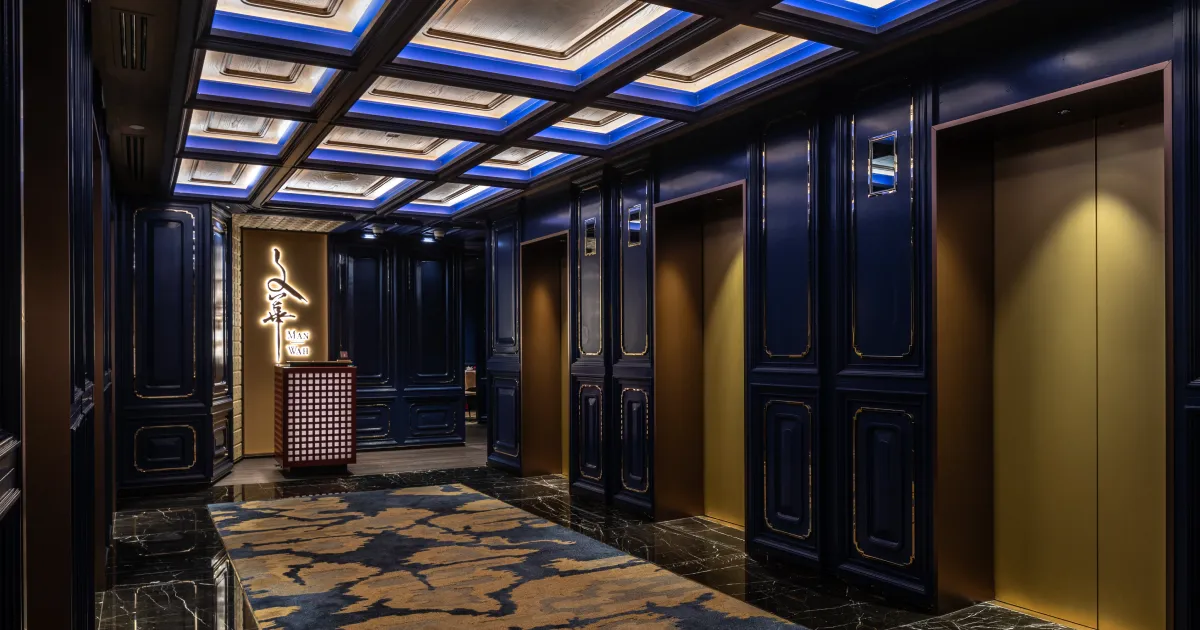
Man Wah is the Cantonese restaurant on the 25th floor of Mandarin Oriental Hong Kong, and it holds One MICHELIN Star. Silverfox Studios redesigned it in 2021. The design interprets the Hong Kong skyline and Victoria Harbour seen from the restaurant's windows, with references to the hotel's heritage. The lanterns are one of those references: they reinterpret the original Man Wah lanterns as clustered brass cage forms holding embroidered, pleated shades.
The lanterns sit within a navy and gold scheme. Navy panelling is finished with gold trim, and an embroidered dragon and floral artwork is set on a navy wall panel. A bespoke blue and gold carpet mixes silk with hand-carved patterning to evoke light on the harbour.
SOURCES
- Britannica Lantern Festival
- UNESCO Silk Roads Programme The Lantern Festival
- National Palace Museum, Taipei Celebrations Lighting Up the Night: A Special Exhibition of Paintings on the Lantern Festival
- Shanghai Municipal People's Government Lantern Festival
- South China Morning Post What is the Lantern Festival, plus 6 ways to celebrate it in Hong Kong
- China Daily Hong Kong Illuminating tradition
- CGTN Beijing palace lantern maker keeps the traditional craft alive
- The Metropolitan Museum of Art Lamqua, Design for a Hall Lamp, ca. 1800 to 1810
- Hong Kong Government, news.gov.hk Keeping traditions alive
- Hong Kong Tourism Board Mid-Autumn Festival traditions, festivities and delicacies