SMALL OYSTERS, SWEET POTATO STARCH AND EGG FROM THE MINNAN COAST

Oyster omelette is a street dish of small oysters fried in pork lard and bound with a batter of sweet potato starch and egg. In the Hokkien of southeastern Fujian it is called o-a-tsian or e'ajian, and The World of Chinese records it at street stalls across Fujian, the Chaoshan region of Guangdong and Taiwan, sold at any time of year from early morning until late at night. China Daily's Xiamen guides list it among the city's local dishes, made with oysters from the coast. Through the Hokkien and Teochew diasporas it reached Southeast Asia, where it is orh luak in Singapore and or chien in Penang. Each place has changed the recipe: the starch, the vegetables, the size of the oysters and the sauce served with it all differ, from the sweet and spicy sauce of Taiwan's night markets to the chilli dips of Singapore's hawker centres.
WHAT IS OYSTER OMELETTE AND WHAT IS IT CALLED?
The Hokkien name is written 蚵仔煎. In Taiwan, the Taipei Times explains, it is usually pronounced o-a-tsian in Taiwanese Hokkien, which translates literally as "oyster fried", because Taiwanese dish names list the main ingredients first and the cooking method second. China Daily's guide to Xiamen food gives the dish as hailijian, written 海蛎煎. In Chaozhou, in the Teochew-speaking Chaoshan region, Global Views Monthly writes the local version as 蠔烙. In Singapore it is orh luak, the name the MICHELIN Guide uses for the city's hawker versions, and in Penang it is or chien, which the Malay Mail glosses as "oyster fried" in Hokkien.
Across these places the base stays the same. The World of Chinese describes every version as small oysters fried in pork lard and covered with a batter of sweet potato starch and egg. Writing in Global Views Monthly in 2017, Yufu, a professor at Hungkuang University in Taiwan, lists the common Minnan ingredients as a sweet potato starch batter with fresh local oysters, shrimp and bean sprouts. Optional additions include spring onion and coriander scattered on top, or carrot and cabbage mixed into the batter. In some regions fish sauce or another seasoning is poured over the finished omelette for a savoury xian (鲜) taste.
HOW IS OYSTER OMELETTE MADE?
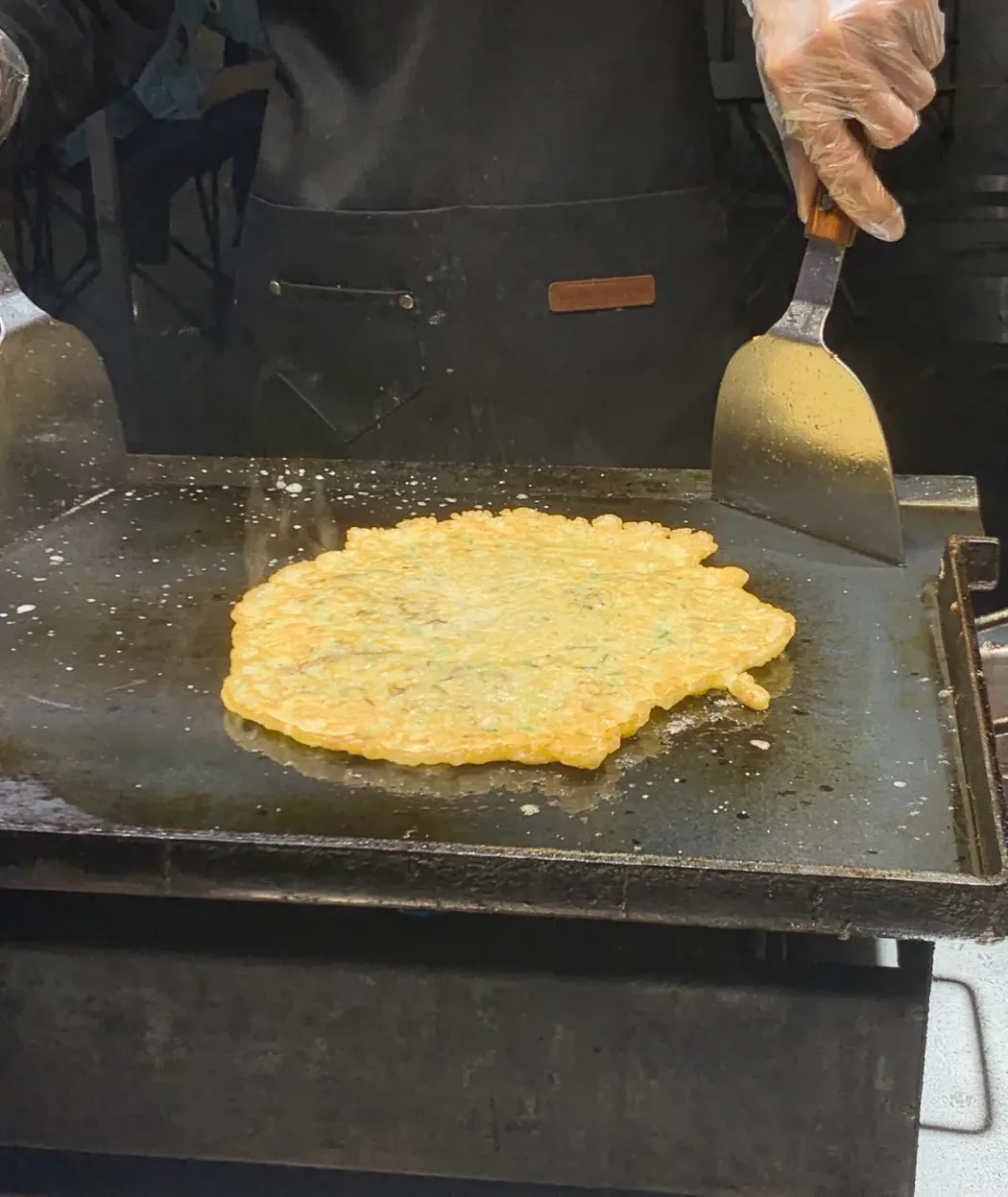
The recipe published by The World of Chinese uses 100 grams of oysters, 100 grams of sweet potato starch, 50 grams of potato starch and one egg, with spring onion, coriander, bok choy, salt, MSG, ground pepper, fish sauce and pork lard. The two starches are mixed with water into a batter, and the spring onion, salt and MSG are stirred in. The batter goes into lard over low heat until its edges set, the oysters and bok choy are laid on top, and the beaten egg is poured over. The omelette is flipped as it firms and fried until the batter turns solid and transparent and the edges crisp, then finished with coriander, pepper and a few drops of fish sauce.
China Daily's Xiamen description gives a different method: fresh oysters, sweet potato, starch and egg are blended together, seasoned with a tablespoon of soy sauce and pan-fried in shallow oil until crisp. Chilli sauce and Chinese parsley go with it, and local residents often eat it with porridge. Taiwan's night market cooks change the order again. The Taipei Times describes oysters, eggs and vegetables fried first, with the sweet potato starch batter poured over them. The result, in the paper's description, has a soft, sticky texture and a slightly crisp edge.
Teochew cooks in Chaozhou work differently. Yufu writes that they use stone oysters, which are smaller than oysters kept permanently under water in farmed beds but have more bite because they are exposed by the tides, and fry them quickly in plenty of lard over a fierce flame. The Chaozhou batter comes out drier and crisper, without the translucent sweet potato starch layer or the soft, springy chew of the Taiwanese omelette. On Kinmen, cooks also use stone oysters, known locally as pearl oysters: a spoonful of batter goes into the pan, an egg is broken over it, and a large handful of oysters is spread evenly on top.
WHERE DID OYSTER OMELETTE COME FROM?
How the dish began is not recorded. The World of Chinese states that how local residents first made it is unknown, and that folk tales have supplied a backstory instead. The Taipei Times notes that the dish has several origin stories. The best known, retold by both publications, credits the Ming general Zheng Chenggong, known as Koxinga and spelled Cheng Cheng-kung in Taiwan, with creating it after his arrival in Tainan in 1661. In the legend, food was short, and he improvised a dish from what was locally available: oysters and sweet potatoes. Within the story, the Taipei Times writes, that dish was the prototype of today's oyster omelette.
Yufu rejects the story. In his 2017 history of the dish for Global Views Monthly he argues that oyster omelette was an ordinary Minnan folk food that needed no famous inventor, and he turns to the record of oysters themselves. The Zeelandia journals kept in Taiwan during the Dutch period already mention oyster production. Japanese-era records named Lukang, in Changhua, as the birthplace of bamboo-stake oyster farming on the island, but Kayaba Saburo, a technician in the industry section of the Japanese-era administration, concluded after his own research that Dongshi in Chiayi came first, with settlers from Quanzhou bringing the farming method in 1719. On that account, oyster farming in Taiwan came from Quanzhou almost six decades after 1661.
HAILIJIAN IN XIAMEN AND THE LANES OF ZENGCUO'AN
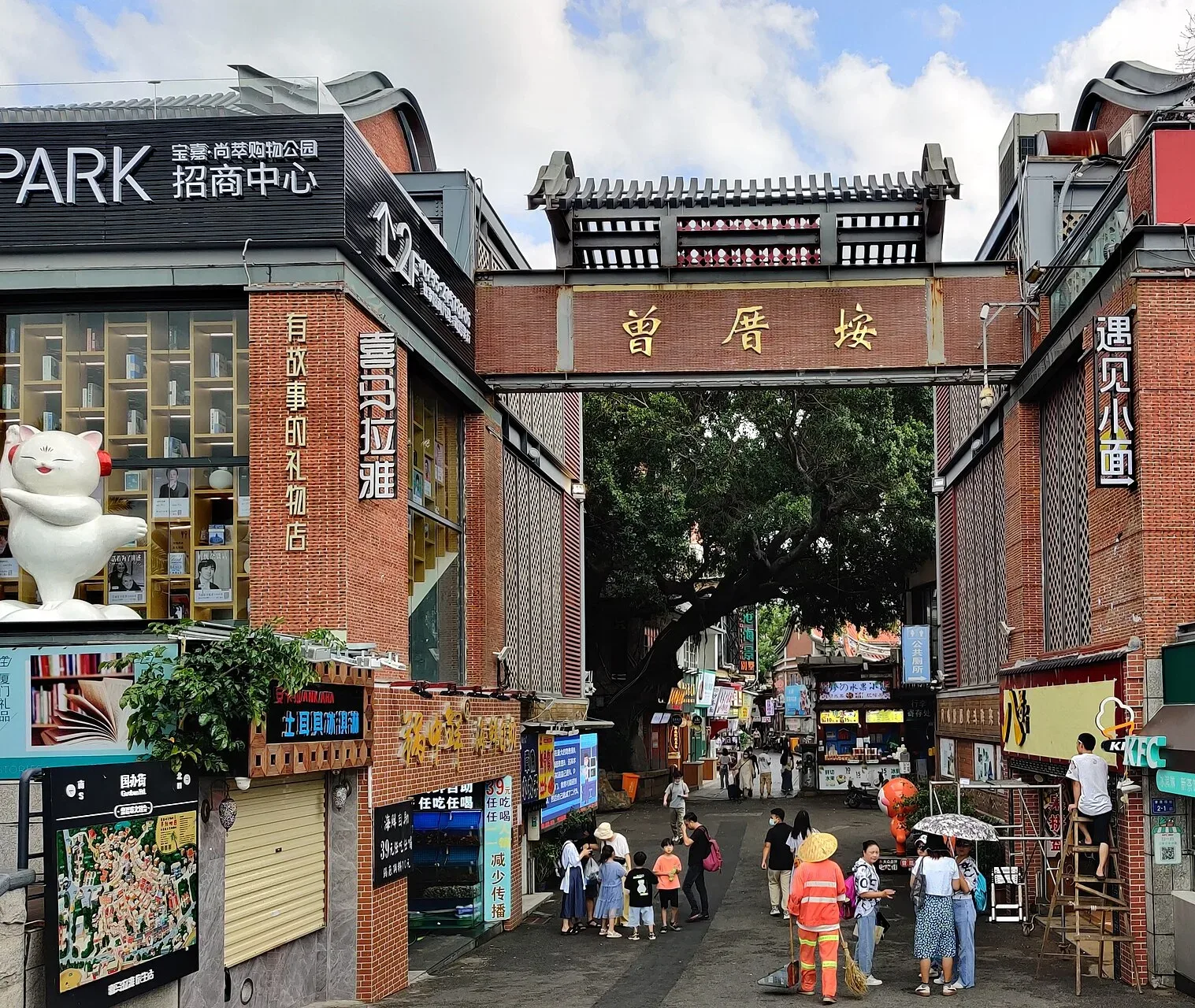
Xiamen has the oysters to support the dish: China Daily notes that they are found in mass quantity in the city's coastal areas. Besides the omelette, the same paper describes oysters at the Xiamen breakfast table, where residents eat oyster porridge with deep-fried dough sticks. It adds that in some Southeast Asian countries, including Singapore, vendors sell oyster porridge from vehicles during breakfast hours, prepared in the traditional Xiamen style. The word for oyster in the name hailijian, 海蛎, is also the one used in the ingredient list of The World of Chinese recipe.
Zengcuo'an is a former fishing village in Siming district, set beside beaches next to Xiamen University. A 2019 China Daily feature describes its winding lanes, its irregular houses, some two or three storeys high, its temples and churches, and red-brick houses that trace back to Minnan culture and the red-brick building tradition of southern Fujian. Decades ago, Xiamen University graduates rented homes there to paint and sculpt, and from 2012 local authorities developed the village as a tourist destination built around music, traditional culture and art galleries. The Xiamen municipal government describes it as a village with a thousand-year history beside Huandao Road, covering 1.25 square kilometres, with 1,600 stores that draw more than 10 million tourists a year.
China Daily lists tusundong and shacha noodles among the village's local dishes, and seafood with beer as a favourite of residents and visitors. The MICHELIN Guide Xiamen 2026 gives a MICHELIN Plate to Wu Lan Sha Cha Mian at 300-1 Jiaotang Street in Zengcuo'an, a small shop with a bright red wall in a side alley. Its owner, Wu Lan, has made shacha noodles for decades and has held the same spot for more than 20 years, cooking a sweet, mildly spicy broth every morning and topping the noodles with pork liver, shrimp and even abalone. Alongside the noodles, the inspectors recommend her golden, crispy oyster omelette.
TAIWAN'S NIGHT MARKET VERSION

In Taiwan the oyster omelette has been one of the most popular night market dishes for generations, according to the Taipei Times. It is typically served with a sweet and spicy sauce made with ketchup, miso and chilli bean sauce, and it can be garnished with basil or coriander. The greens change with the region: baby bok choy and crown daisy are common in the north, while southern Taiwan uses more mung bean sprouts. The paper links the sprouts to Ming dynasty trade, when merchant ships from Guangdong and Fujian packed porcelain cargo in mung bean sprouts to prevent breakage, and sailors on long voyages found them a welcome addition to their meals.
Yufu names the four main oyster-farming areas of Taiwan's main island as Wanggong in Changhua, Taixi in Yunlin, Dongshi in Chiayi and Qigu in Tainan. Because the water at Tainan is cleaner, many oysters are sent there to be fattened, and Tainan's stalls fry these plump oysters. So many oysters in one omelette can turn the flavour fishy, he writes, so Tainan cooks add rouzao, a minced pork sauce, to balance it. Stalls also adapt the dish to their customers: the Taipei Times notes a version made with shrimp for diners who hesitate to eat oysters, and another with no seafood for those allergic to it.
ORH LUAK IN SINGAPORE AND OR CHIEN IN PENANG

The World of Chinese attributes the dish's arrival in Southeast Asia to the Hokkien and Teochew diasporas, and notes that Singapore and Thailand have adapted it with local ingredients. In Singapore it belongs to hawker culture, which UNESCO inscribed on its Representative List of the Intangible Cultural Heritage of Humanity in 2020, describing hawker centres as community dining rooms where people from diverse backgrounds gather. Writing for the MICHELIN Guide in 2017, Meryl Koh treated orh luak as a late-night supper dish and named a hot wok and fresh, plump oysters as essential. At Lim's Fried Oyster in Berseh Food Centre on Jalan Besar, the dish dates to the 1960s, when the owner's father sold it from a pushcart.
Other stalls in the same guide show the range. Huat Heng Fried Oyster at Whampoa Drive Hawker Centre was listed in the MICHELIN Guide Singapore 2017 for fried baby oysters with eggs cooked to order. Song Kee Fried Oyster at East Coast Lagoon Food Village serves a slightly wet omelette with a spicy chilli dip and chopped coriander, and Hup Kee at Newton Circus Food Centre serves its crispy omelette whole and uncut. In Penang, Opalyn Mok of the Malay Mail reported in 2014 that or chien is made from eggs, cornstarch and oysters, garnished with spring onions and parsley, with diced garlic from some hawkers. Penang versions range from starchy and sticky, where more cornstarch is used, to soft and runny, and every stall serves chilli sauce, usually garlic chilli, on the side.
HYATT CENTRIC OCEANFRONT XIAMEN BESIDE ZENGCUO'AN FOOD STREET

Silverfox Studios completed the full-scope interior design of Hyatt Centric Oceanfront Xiamen in 2025. The hotel stands on the Xiamen coast beside Zengcuo'an Food Street, in the former fishing village where the MICHELIN Guide lists Wu Lan's shacha noodle shop and her oyster omelette, and where China Daily records shacha noodles, tusundong and seafood with beer as local dishes. The design draws on street scenes and lanes, on kiln-fired local bricks and on local craft. Zengcuo'an itself is the village China Daily describes, with winding lanes, irregular houses of two or three storeys and red-brick houses of Minnan origin.
The hotel is designed as a series of connected "houses". Music culture is central to the ground floor, where a House of Music is the focal point for live evening music. China Daily reports that Zengcuo'an's development as a tourist destination since 2012 has been built around music, traditional culture and art galleries, and the Xiamen municipal government counts 1,600 stores in the village, drawing more than 10 million tourists a year to the streets beside the hotel and its food street.
SOURCES
- The World of Chinese How to Make Southern China's Famous Oyster Omelet
- Taipei Times Oyster omelet (蚵仔煎), language column, 19 February 2024
- Global Views Monthly (遠見雜誌) 蚵仔煎成名史
- China Daily Oyster Omelet
- China Daily Fishing village finds new identity as artsy tourist hub
- Xiamen Municipal Government Zengcuoan Wenchuang Village
- MICHELIN Guide Wu Lan Sha Cha Mian
- MICHELIN Guide Supper Series: 5 Late-Night Spots in Singapore for That Orh Luak Craving
- UNESCO Hawker culture in Singapore, community dining and culinary practices in a multicultural urban context
- Malay Mail Presenting... the oyster omelette, otherwise known as or chien