THE BONFIRES THAT CLOSE THE JAPANESE NEW YEAR

Dondo yaki is the bonfire that closes the Japanese New Year. Around 15 January, during koshogatsu or Little New Year, communities collect the pine kadomatsu, straw decorations and first calligraphy of the year from their homes and burn them on one fire at a shrine, beside a roadside dosojin shrine or on a riverbank. Areas near Kyoto call it sagicho, most of Japan uses names of the tondo group, including dondo and dondo yaki, eastern Japan uses saito, and Kyushu uses onibi and hokkengyo. The fires are built from bamboo, wood and rice straw, and mochi is grilled over the embers. Two large regional versions are held at Omihachiman in Shiga Prefecture and Nozawa Onsen in Nagano Prefecture.
WHAT IS DONDO YAKI AND WHEN IS IT HELD
Koshogatsu is the New Year observance centred on the 15th day of the first month of the old lunar calendar, the first full moon of the year. Shogakukan's dictionary Nihon Kokugo Daijiten gives its dates as 14 to 16 January, and Heibonsha's encyclopedia Mypedia notes that before knowledge of the calendar spread, the full moon of the 15th was an easy marker for the turn of the year. It is distinguished from oshogatsu, the Big New Year of 1 January. Heibonsha's Sekai Daihyakka Jiten treats the 14th as the eve of the Little New Year and describes the period as the general close of New Year events.
Most koshogatsu rites concern the harvest, and many are carried out by children and young people. Red bean porridge, azuki-gayu, is eaten on the morning of the 15th, a custom Shogakukan's encyclopedia Nipponica traces to the Tosa Nikki of 935. Porridge in bamboo tubes, one for each of the early, middle and late rice crops, is used to forecast the harvest. Branches are hung with mochi shaped as rice blossoms, mochibana, or silkworm cocoons, mayudama. The fire festival belongs to this group of rites. Most sources place it on the night of the 14th or the morning of the 15th, although some districts hold it on the 7th, the date of the onibi fires of Kyushu.
WHERE DID THE NAME SAGICHO COME FROM

The name sagicho comes from the imperial court. Heian period documents write it with characters meaning three gicho, and Shogakukan's Digital Daijisen explains the name as three gicho sticks set up together. According to Mypedia, on the 15th and 18th days of the first month three mallet-like gicho poles were set up in the garden of the Seiryoden in the palace and burned while those present sang and chanted. The Yamakawa dictionary of Japanese history records that the Heian court rite involved onmyoji, the court's yin and yang diviners.
Heibonsha's Sekai Daihyakka Jiten calls the origin of the name unclear. It cites a record of 1142 describing a three-forked staff set up at the Shingon-in on the 15th day, and links it to a passage on sagicho in the Tsurezuregusa. Nipponica suggests three poles tied together as a tripod for cooking over the fire, and notes that eating grilled mochi may be a survival of it. In the Muromachi period the court held the rite on the 15th with bundled bamboo decorated with calligraphy and fans, and on the 18th the wandering performers known as shomonji staged their own version.
WHAT IS BURNED ON A DONDO YAKI FIRE

The main fuel is the kadomatsu. Encyclopedias describe it as a yorishiro, an object into which the toshigami, the deity of the New Year, descends. Pine is the usual New Year tree, with bamboo added from the medieval period, though oak, camellia, chestnut and sakaki are also recorded. The trees were traditionally cut on the 13th day of the twelfth month, and removal dates vary between the 4th, 7th and 14th of the first month. In Kyushu the pine is burned in the onibi fire of the 7th; elsewhere it usually goes to the Little New Year fire.
The fire also takes the straw decorations. Shimenawa, ropes of straw twisted to the left that mark off sacred space, are hung at New Year on house entrances, gates and kamidana shelves, and shimekazari, the New Year decorations made with shimenawa, are displayed with the kadomatsu. An older Heibonsha entry describes setting up kadomatsu and shimekazari as marking the home as a sacred space for the New Year. The Britannica Japan entry describes children collecting the pine decorations and shimenawa from each house and burning them at a fixed place. Heibonsha adds the previous year's talismans and the paper used in the year-end soot cleaning, and the Yamakawa dictionary adds Daruma dolls.
KAKIZOME AND MOCHI AT THE LITTLE NEW YEAR FIRE

Kakizome, the first brush writing of the year, is traditionally done on 2 January. Writers set down auspicious phrases, waka or haiku. Heibonsha records the sheets being written in front of a kamidana or an image of Sugawara no Michizane and then placed on the shelf for the toshigami. The custom spread widely through the terakoya schools of the Edo period and through school calligraphy after the Meiji era, and mass kakizome events in schools remain popular. Nipponica records that the writing is displayed until koshogatsu and then burned on the dondo yaki fire.
Children held their sheets over the flames, and Heibonsha and Digital Daijisen record the same reading: if the burning paper flies high, the writer's handwriting will improve, expressed in the phrase te ga agaru, the hand rises. Food is cooked on the same fire. Mochi or dango dumplings are grilled over the embers and eaten, and according to the Britannica Japan entry the ashes are rubbed on the body in some places. Mypedia describes children gathering the night before in a hut built of logs and straw, sharing rice and mochi there, and burning the hut at the end.
HOW DONDO YAKI BONFIRES ARE BUILT FROM BAMBOO AND STRAW

The bonfire takes several forms. Heibonsha describes bamboo shaped into a cylinder, a cone or a square around a central core pole. Nipponica describes a central pillar of wood or bamboo ringed with pine decorations, or a hut of wood or straw in which children eat before setting it alight, and records that in some places the way the central pole fell was read as a forecast of the year's harvest. In parts of the Kanto and Chubu regions the fire merged with festivals for dosojin, the road-guardian deities, and dosojin statues were sometimes thrown into the fire. In Nagano Prefecture, a variant called sankuro-yaki burns a wooden doll named Sankuro.
Rice straw appears throughout the custom. The shimenawa and shimekazari burned on the fire are twisted straw, Britannica and Mypedia describe the children's huts as built of straw, and the Sagicho floats of Omihachiman are built on torches of wood and rice straw. The koshogatsu rites around the fire are concerned with rice: mochibana take the form of rice blossoms, porridge divination forecasts the rice crop, and in Omihachiman each float carries a figure made of grains and beans in thanks for the previous harvest and in hope of a good one. Heibonsha describes the original purpose of the fire as burning offerings and praying for the new year.
SAGICHO AT OMIHACHIMAN AND HIMURE HACHIMANGU SHRINE
The Sagicho Festival of Omihachiman in Shiga Prefecture has more than 400 years of history and, according to the Japan Tourism Agency, is designated a National Intangible Folk Cultural Property. The local account traces it to 1579, when the warlord Oda Nobunaga is said to have held a festival in Azuchi to celebrate the completion of Azuchi Castle, dancing with the crowd in flamboyant dress. After Nobunaga's death in 1582 the castle was abandoned and its residents moved to nearby Hachiman, now Omihachiman, where they revived the festival of their former town. It was originally held in the first lunar month and moved to March after Japan adopted the solar calendar in the late 19th century. It now takes place on the weekend closest to 15 March.
Each float, itself called a sagicho, is built on a pyramid-shaped torch of wood and rice straw about 3 m tall, topped with red paper streamers believed to ward off fire. The whole structure stands about 8 m high and weighs roughly 500 kg, and on its front sits the dashi, a figure of the year's zodiac animal made from grains, beans, dried fish flakes and kelp, or more recently corn flakes, pasta and chewing gum. Floats from 13 districts gather at Himure Hachimangu Shrine on the Saturday for judging and parade through the old town. On the Sunday they meet in kenka, trials of strength in which two floats push against each other until one falls. At about 8 pm the carrying poles are removed and the floats are burned at the shrine as an offering to the deities and a prayer for protection from fire, and participants dance around the fires until about 11 pm.
THE NOZAWA ONSEN DOSOJIN FIRE FESTIVAL
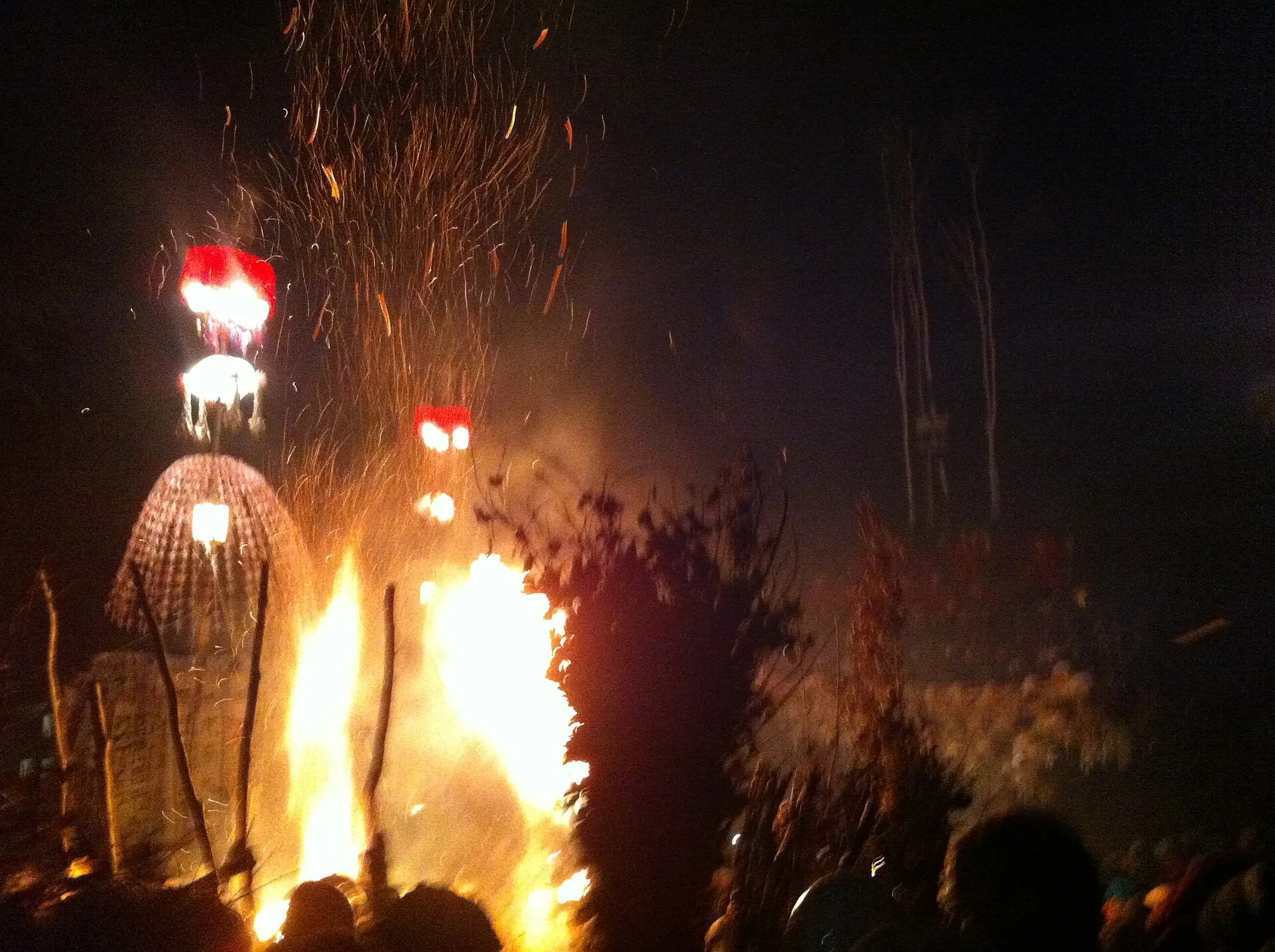
Nozawa Onsen, a hot spring village in Nagano Prefecture, holds its Dosojin Fire Festival from 13 to 15 January, with the fire on the night of the 15th, during koshogatsu. It is designated a national Important Intangible Folk Cultural Property, and the Shinshu Digital Commons record on the Japan Search portal describes it as one of Japan's three major fire festivals. The festival is led by men at the yakudoshi, the unlucky ages, of 25 and 42. Five straight beech trees about 30 cm across and 18 m tall are chosen from the village's jointly owned forest and felled in mid-October, led by the San'yanko group and the 25-year-olds.
On 13 January two of the trees are dragged from the Hikage ski area to the festival site. The shaden, a wooden shrine pavilion about 7 m tall, has the sacred trees rising more than 10 m above its top and a roof covering nearly 40 tatami mats. The builders abstain from alcohol and work in silence, and a priest from a nearby shrine gives the structure the spirit of Dosojin. On the night of the 15th, a flame kindled with flint and steel by the Kono family at Terayu lights the torches with which the village men attack the shaden. The 42-year-olds defend it from the roof, singing and chanting, while the 25-year-olds guard the base and put out the torches with pine branches. Afterwards the shaden is burned with the hatsu-toro, lantern pillars built by families when a first son is born, and villagers take charred pieces of the beams home to light their hearths.
STRAWFIRE ABU DHABI: RICE STRAW AND FIRE IN A JAPANESE RESTAURANT
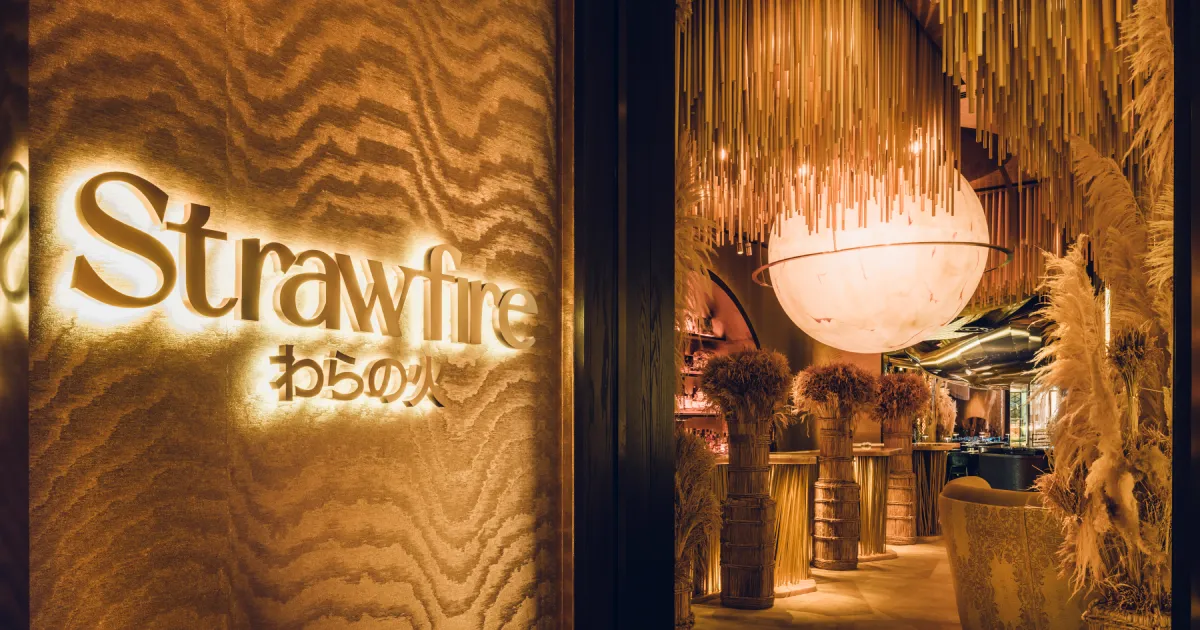
Strawfire is a Japanese restaurant by chef Ross Shonhan at Emirates Palace Mandarin Oriental, Abu Dhabi, completed in 2024. Its interior design is built around rice straw, wara, and warayaki grilling. The palette is divided into straw tones of cream, gold and mustard and fire tones of orange, gold and rust. Straw and fire are also the two materials of the Little New Year bonfires described above: the shimenawa and shimekazari burned at dondo yaki are twisted straw, and the Sagicho floats of Omihachiman are torches of wood and rice straw.
The warayaki counter sits under a hand-beaten brass hood, and the front of the hood is faced with faceted gold tiles. Behind it, a back-lit kumiko screen shows the shadows of the chefs at work. In the booths, straw bales rise up to 2 m. For comparison, the rice straw torch at the base of each Omihachiman float stands about 3 m tall, and in some districts children build huts of straw and logs that are burned on the Little New Year fire.
SOURCES
- Kotobank (Nihon Daihyakka Zensho, Shogakukan; Sekai Daihyakka Jiten, Heibonsha; Britannica Japan; Yamakawa) Sagicho
- Kotobank (Shogakukan; Heibonsha; Britannica Japan) Koshogatsu
- Kotobank (Shogakukan; Heibonsha; Britannica Japan) Kadomatsu
- Kotobank (Shogakukan; Heibonsha) Kakizome
- Kotobank (Shogakukan; Heibonsha; Britannica Japan) Shimenawa
- Japan Tourism Agency Sagicho Festival
- Omihachiman Tourism and Products Association Sagicho Festival
- Nozawa Onsen Tourism Association The Nozawa Onsen Dosojin Festival
- Japan Tourism Agency Nozawa Onsen Dosojin Festival: the organisation of the festival
- Japan Search Nozawa Onsen no Dosojin Matsuri