HOW A SATAY-DERIVED SAUCE BECAME THE NOODLE SOUP OF XIAMEN

Shacha noodles (shacha mian) are a noodle soup from Xiamen in southern Fujian, made by pouring a hot broth based on shacha sauce over briefly boiled noodles and greens, then adding toppings chosen by the diner. The name of the sauce is the Minnan rendering of satay, and food writers trace it to Southeast Asian satay, a food tradition brought home by men from the Chaoshan region of south-east China who took seasonal work in Indonesia and Malaysia. Around Chaoshan the sauce was rebuilt around dried seafood, and Chaoshan migrants later introduced it to Tainan, where it became an indispensable ingredient of Taiwanese beef hot pot. In Xiamen the noodles are sold from small cash-only shops, including three listed in the MICHELIN Guide Xiamen 2026.
WHAT ARE SHACHA NOODLES?

Xiamen's English-language city website sets out the method. Yellow noodles and a leafy green such as pak choi are boiled briefly and placed in a bowl, and hot satay soup is poured over them. Bean curd products, tripe or mixue, a rice cake, can then be added to suit personal tastes, and chilli oil goes in last. In 2017 a China Daily writer, after wandering around Gulangyu island in Siming district, ate a bowl at a shop in a narrow alley, where 10 yuan bought lettuce, lobster, tofu and sausage in a slightly spicy soup. The same writer described the dish as a speciality of Siming.
Three shacha noodle shops in Siming district appear in the MICHELIN Guide Xiamen 2026. Wu Lan Sha Cha Mian trades at 300-1 Jiaotang Street in Zengcuo'an, Shan Li Yan Sha Cha Mian at 285 Datong Road in the old town, and Yue Hua Sha Cha Mian at 78 Zhenbang Road, which holds a Bib Gourmand. All three carry the guide's single ¥ price symbol and accept cash only. The guide first covered Fujian in December 2024, when, as the South China Morning Post reported, it named 69 establishments across Xiamen, Fuzhou and Quanzhou: five with a MICHELIN Star, 47 Bib Gourmands and 17 MICHELIN Selected restaurants.
WHERE DID SHACHA SAUCE COME FROM?
The name records the sauce's origin. Writing in TASTE in 2021, the food writer Cathy Erway notes that shacha sounds like satay in Teochew and other Minnan dialects, and that the Mandarin pronunciation is sha-cha. Its Chinese characters roughly mean "sand tea", possibly a reference to the sauce's grainy texture. Xiamen's city website gives a related explanation: the "tay" of satay resembles cha, the Hokkien word for tea. Erway adds that satay is a name likely coined in Tamil. Jars and cans usually translate shacha as "barbecue sauce" in English, which she suggests may stem from the same satay origin, while noting that this is hard to confirm.
Accounts of how the sauce reached China agree on Southeast Asia but differ on dates. Erway, citing Diana Danxia Zheng, author of Jia! The Food of Swatow and the Teochew Diaspora, writes that throughout the twentieth century men from the Chaoshan region took seasonal work in Indonesia, Malaysia and elsewhere in Southeast Asia, brought food traditions home and adapted them to local tastes. Because of the Teochew pronunciation, Zheng calls the sauce satay sauce in her book. Xiamen's city website gives a longer timeline, dating Xiamen's satay noodle to more than 300 years ago and stating that it has its roots in Indonesia's satay sauce.
WHAT IS IN SHACHA SAUCE?

Erway contrasts two sauces. Southeast Asian satay sauce was a peanut-forward blend of chillies and herbs; around Chaoshan, a chunky, oil-based version replaced the nuts with local dried seafood. The Chaoshan sauce she describes contains dried baby shrimp and brill, a flatfish, both crushed and sun-cured, with shallots, garlic and chillies, a little coconut powder and ginger, all held in a burnt-orange oil with heavy sediment. Composition varies by region: some versions are slightly peanutty, some less fishy and some spicier.
Xiamen's city website gives the local version as dried shrimp, dried fish, scallions, garlic and ginger, fried until crisp and then ground into the sauce. MICHELIN inspectors' notes on all three Xiamen shops describe a nutty or peanut flavour in the broth. Wu Lan prepares her broth fresh every morning and the inspectors describe it as sweet, mildly spicy and strongly nutty. Shan Li Yan's broth is kept piping hot at any hour, with a balance of garlic, peanut and chilli. At Yue Hua the signature broth has a rich, deep peanut flavour.
HOW DID SHACHA SAUCE REACH TAIWAN?

A 2018 study by Lin-Yi Tseng of Taipei Medical University, published in Social Transformations in Chinese Societies, finds that Chaoshan migrants played an important role in introducing the sauce to Tainan, which it calls Taiwan's oldest city, after 1949. Making shacha gave those migrants a reliable income. Tseng argues that the sauce bolstered beef consumption among Taiwanese and contributed to new beef-eating habits in Tainan and beyond, using documents, oral interviews and the diary of Wu Xinrong, a Tainan gentry member whose entries from 1933 to 1967 record shifting attitudes to beef. The study describes shacha in present-day Taiwan as an indispensable ingredient for beef hot pot and stir-fried dishes.
Erway names the brand that carried it. In 1958 Liu Lai-qin, a Chaoshan-born noodle shop owner in Tainan, created Bullhead, sold in a silver tin; its first product was a powdered shacha. Sales rose in the late 1950s after a well-known radio host praised Liu's shacha noodles on his food programme, and Liu then closed the shop and opened a factory to mass-produce the powder and sauce. Tseng, who spells the name Bull-Head, describes it as the maker of the world's largest canned sha-cha sauce and an international brand of Taiwanese food products. Erway notes that it now comes in original and vegetarian varieties.
Beef had been avoided by earlier agrarian generations in Taiwan, and Erway writes that it slowly became acceptable over the 1960s and 1970s, mirroring shacha's rise in popularity. By the late 1970s meat hot pot, popularly eaten with a small dish of shacha sauce, had become a national craze. Xiao Haozhou, a Tainan restaurant specialising in shacha beef hot pot, opened in the 1970s under Chen Musheng, a native of Shantou, whose recipe came from an uncle who had worked as a plantation labourer in Singapore. By the 1980s most Taiwanese families could afford shacha for home cooking.
HOW DO XIAMEN SHACHA NOODLE SHOPS WORK?
A Xiamen shacha noodle shop serves one broth with a long list of toppings, and the diner chooses the combination. Yue Hua Sha Cha Mian has traded for more than 40 years from a small, plain room. MICHELIN inspectors list its toppings as pork intestine, pork bladder, dried tofu, fish balls, duck blood curd, pork liver and lean pork, and suggest a roast pork sticky rice dumpling alongside. China's Ministry of Culture and Tourism, on its Travel China site, calls Yuehua a definitive benchmark for Xiamen-style shacha noodles and highlights its fish balls and pork collar.
Wu Lan, owner of Wu Lan Sha Cha Mian, has made shacha noodles for decades and has run her Zengcuo'an shop, easy to find by its bright red wall, for more than 20 years. Her toppings include pork liver, shrimp and abalone. Shan Li Yan Sha Cha Mian, run by an owner couple in the old town, keeps fish balls, pork liver and pork tendon as year-round toppings and adds seasonal shellfish such as oysters and razor clams. Pork liver is the one topping named in all three MICHELIN listings.
WHAT IS ZENGCUO'AN?

Zengcuo'an is a former fishing village in Siming district, Xiamen, set beside beaches and next to Xiamen University. A 2019 China Daily report records that villagers once lived entirely from fishing. Several decades ago graduates of Xiamen University began renting houses there for oil painting and sculpture, and from 2012 local authorities developed the village as a tourist destination. A villager quoted in the report says most villagers now make a living by renting out their houses. The village has five main streets and 18 alleys, with workshops, restaurants, studios, family inns and hotels, and numerous tearooms.
The report describes red-brick houses in the original style of Minnan culture, often two or three storeys high, along winding lanes; "cuo" refers to old-style homes built around courtyards. The brick tradition behind these houses is covered in our article on Minnan red brick architecture. The report lists art galleries, traditional culture and music among the village's draws, and names its foods as wuxiang (meat fried in strips), tusundong, shacha noodles and seafood with beer, a favourite of villagers and tourists alike. Wu Lan Sha Cha Mian on Jiaotang Street is a MICHELIN-listed shacha noodle shop inside the village.
WHICH OTHER MINNAN SNACKS ARE EATEN IN XIAMEN?
The oyster omelette, hai li jian, is served by many restaurants in the MICHELIN Guide's Fujian selection, and the inspectors recommend Wu Lan's golden, crispy version. The South China Morning Post calls it one of Fujian's most famous specialities, said to date back to 1661, and reports that Du Guojin, head chef of the one-star Hokklo at Waldorf Astoria Xiamen, attributes it to Zheng Chenggong, a Ming dynasty general and native of Quanzhou. Travel China's guide to Zhongshan Road, a street of century-old arcades, describes the version at Lianhuan on Jukou Street as plump oysters wok-fried with sweet potato starch into a crisp pancake and served with Xiamen chilli sauce.
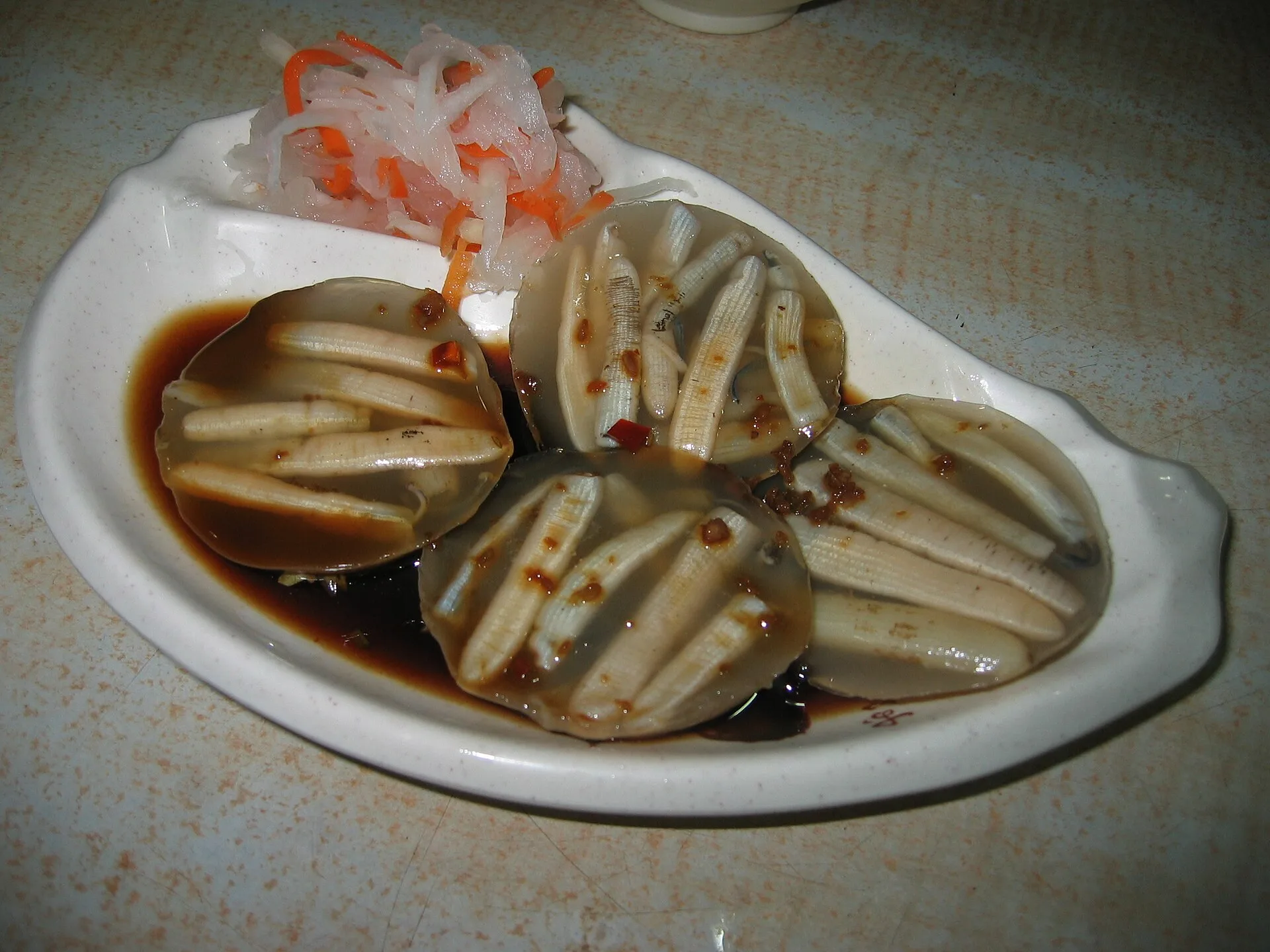
Sweet peanut soup is another of Xiamen's plain local foods. China Daily listed it in 2017 alongside salty fishball soup, calling it simple and sweet. Travel China singles out the time-honoured Huang Zehe shop, whose peanut soup it describes as sweet yet light and best paired with fried dough sticks. Tusundong is a jelly made from sea worms. China Daily reports that it is said to have been first introduced by Zheng Chenggong, whose men dug sea worms from the beaches for soup; as the broth cooled, it set into a brown jelly around the worms. A shop may serve several worms in a bowl with soy sauce, vinegar, chilli and chopped garlic.
HYATT CENTRIC OCEANFRONT XIAMEN AT ZENGCUO'AN

Silverfox Studios completed the full-scope design of Hyatt Centric Oceanfront Xiamen in 2025. The hotel stands on the Xiamen coast beside Zengcuo'an (Ceng Cuo An) Food Street, in the former fishing village that local authorities have developed as a tourist destination since 2012. The design draws on street scenes and lanes, on kiln-fired local bricks, and on local craft and music culture. China Daily describes the village's winding lanes and its red-brick houses in the Minnan style, often two or three storeys high, set along five main streets and 18 alleys.
The hotel is planned as a series of connected "houses". Music is central to the ground floor, where the House of Music is the focal point for live evening music. Music also appears among Zengcuo'an's draws in the China Daily report, alongside traditional culture and art galleries. The report names shacha noodles, tusundong and seafood with beer among the village's foods, and Wu Lan Sha Cha Mian, listed in the MICHELIN Guide Xiamen 2026, serves shacha noodles and oyster omelette from its red-walled shop on Jiaotang Street.
SOURCES
- Xiamen China (xmenglish.cn) Satay Noodles
- TASTE There Is No Substitute for Shacha Sauce
- Social Transformations in Chinese Societies (Emerald) An accidental journey: sha-cha sauce and beef consumption in Tainan since 1949
- MICHELIN Guide Yue Hua Sha Cha Mian
- MICHELIN Guide Wu Lan Sha Cha Mian
- MICHELIN Guide Shan Li Yan Sha Cha Mian
- South China Morning Post As Michelin Guide shines a light on Fujian cuisine, we sample the best food in Xiamen
- China Daily Fishing village finds new identity as artsy tourist hub
- China Daily Experience a love affair with Siming
- Travel China, Ministry of Culture and Tourism Xiamen's Zhongshan Road, A Boulevard of Century-Old Arcades with Nanyang-style Charm