FROM SPRING PLANTING RITES TO THE OFFERING OF NEW RICE ON 23 NOVEMBER
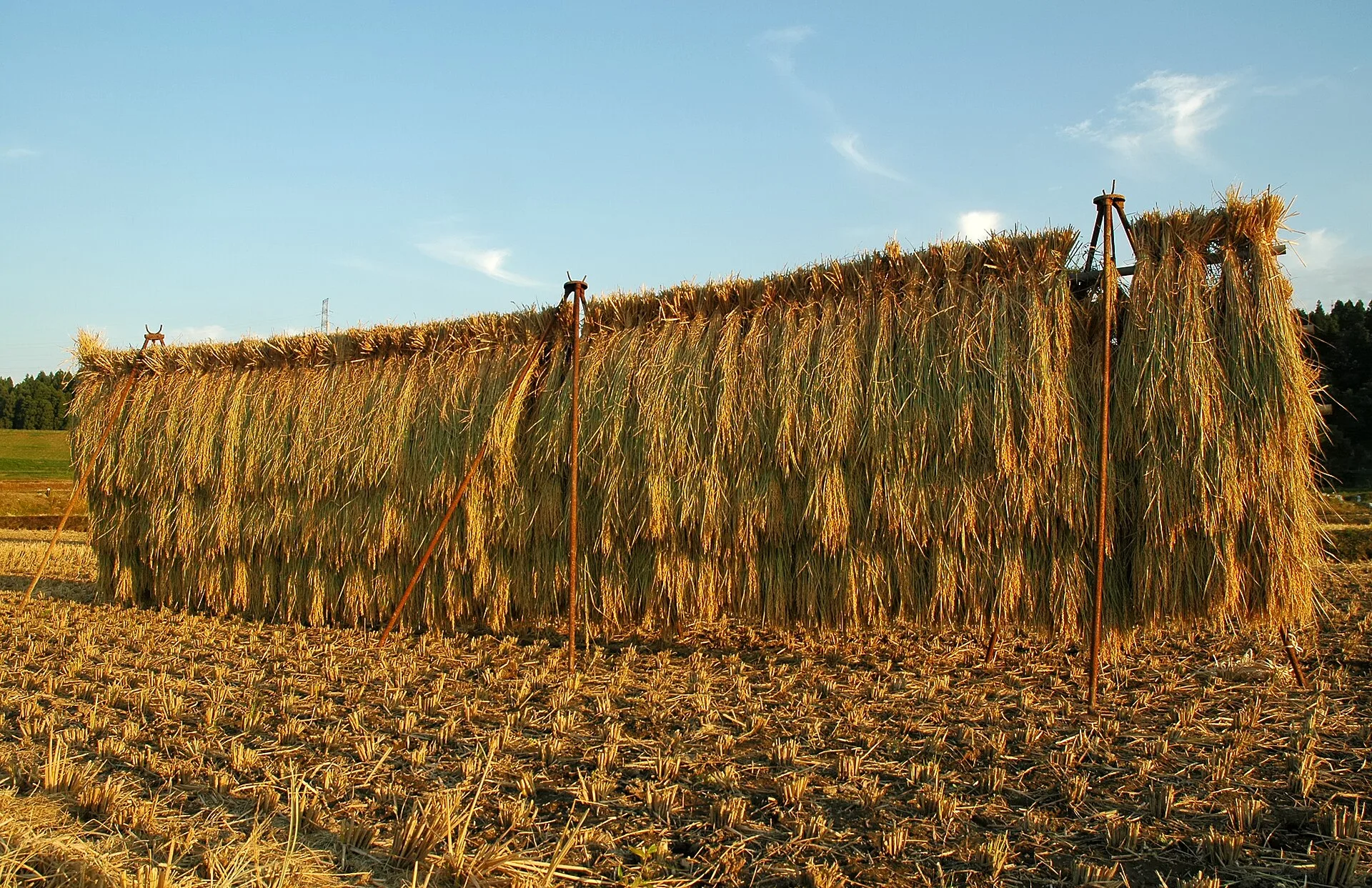
Wet rice cultivation reached Japan from the Asian mainland during the first millennium BCE, and the rice harvest in Japan is still marked by a sequence of Shinto rites. The central one is Niinamesai, in which newly harvested rice and sake are offered to the deities at the imperial palace and at shrines across the country. The cycle runs from ta-asobi and taue planting rites, through Kannamesai at Ise in October, to 23 November, the date fixed for Niinamesai in 1873 and, since 1948, the holiday Kinro Kansha no Hi.
WHEN DID RICE CULTIVATION REACH JAPAN?
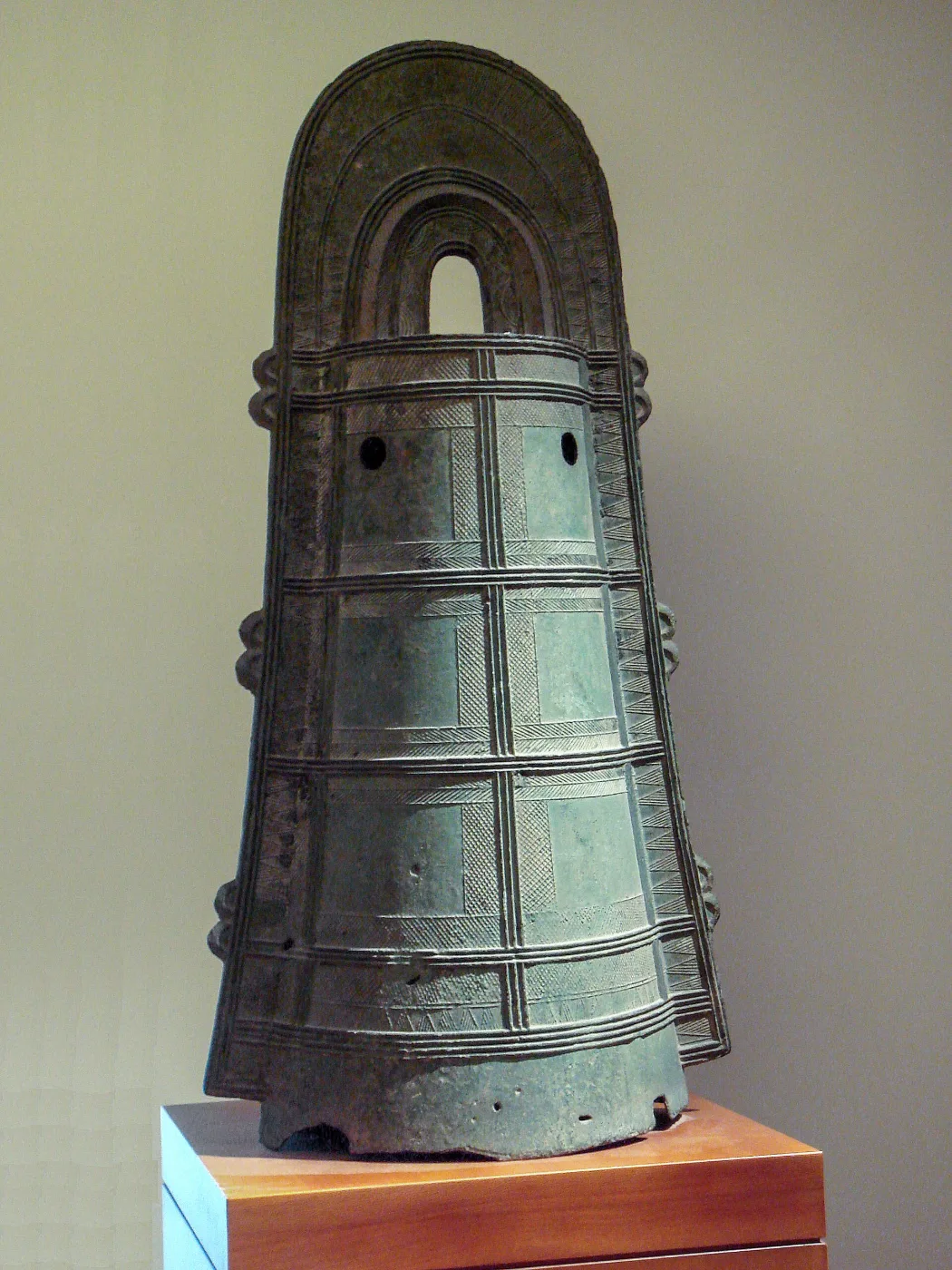
Britannica dates the Yayoi culture to about 300 BCE to 250 CE and identifies its defining practice as wet paddy rice cultivation, a method of Chinese origin. The culture arose on the southern island of Kyushu and spread north-east towards the Kanto Plain. Its people lived in villages of thatched, raised-floor houses, kept up Jomon hunting and shell-gathering, and mastered bronze and iron casting. Yayoi sites have produced bronze mirrors and coins resembling Han-dynasty pieces, ceremonial bronze swords, spears and halberds, and dotaku bronze bells decorated with incised geometric designs and matchstick drawings.
The Metropolitan Museum of Art's Heilbrunn Timeline places the spread of wet-rice agriculture north-east from Kyushu at about 500 to 300 BCE and dates the Yayoi culture to about 300 BCE to 300 CE. It notes that both the date and the route of rice's arrival are disputed, but that most recent evidence points to the practice being brought from Korea during the Final Jomon period. The museum calls the Yayoi Japan's first fully agricultural society and reports the general view that its people and technologies, rice cultivation among them, arrived from the mainland in successive waves and mixed with the existing Jomon population.
HOW DOES THE RICE YEAR BEGIN? TA-ASOBI AND TAUE PLANTING RITES

Kokugakuin University's glossary Basic Terms of Shinto describes ta-asobi, or field play, as a ceremony held around the first full moon of the lunar new year in which participants act out the whole process of rice cultivation as a prayer for a good harvest. Akazuka Suwa Jinja in Tokyo and Mishima Taisha in Shizuoka Prefecture are best known for it. A second group, taue no matsuri, is held in summer for the planting of young seedlings. Izo no Miya in Mie Prefecture, Katori Jingu in Chiba Prefecture and Sumiyoshi Jinja in Osaka are known for them, and in the Chugoku mountain region, particularly Hiroshima and Shimane prefectures, even ordinary rice planting is done to drums.
One of these Chugoku rites, Mibu no Hana Taue in Kitahiroshima, Hiroshima Prefecture, was inscribed on UNESCO's Representative List of the Intangible Cultural Heritage of Humanity in 2011. The communities of Mibu and Kawahigashi hold it on the first Sunday of June, after the real transplanting, to honour the rice deity. Decorated cattle, led by an elder with a sacred stick, plough a field kept for the ritual. The field is levelled with an eburi, a tool believed to hold the field deity, and girls transplant seedlings walking backwards, singing to drums, flutes and small gongs. At the close the eburi is laid upside down in the water with three bunches of seedlings.
WHAT IS NIINAMESAI?
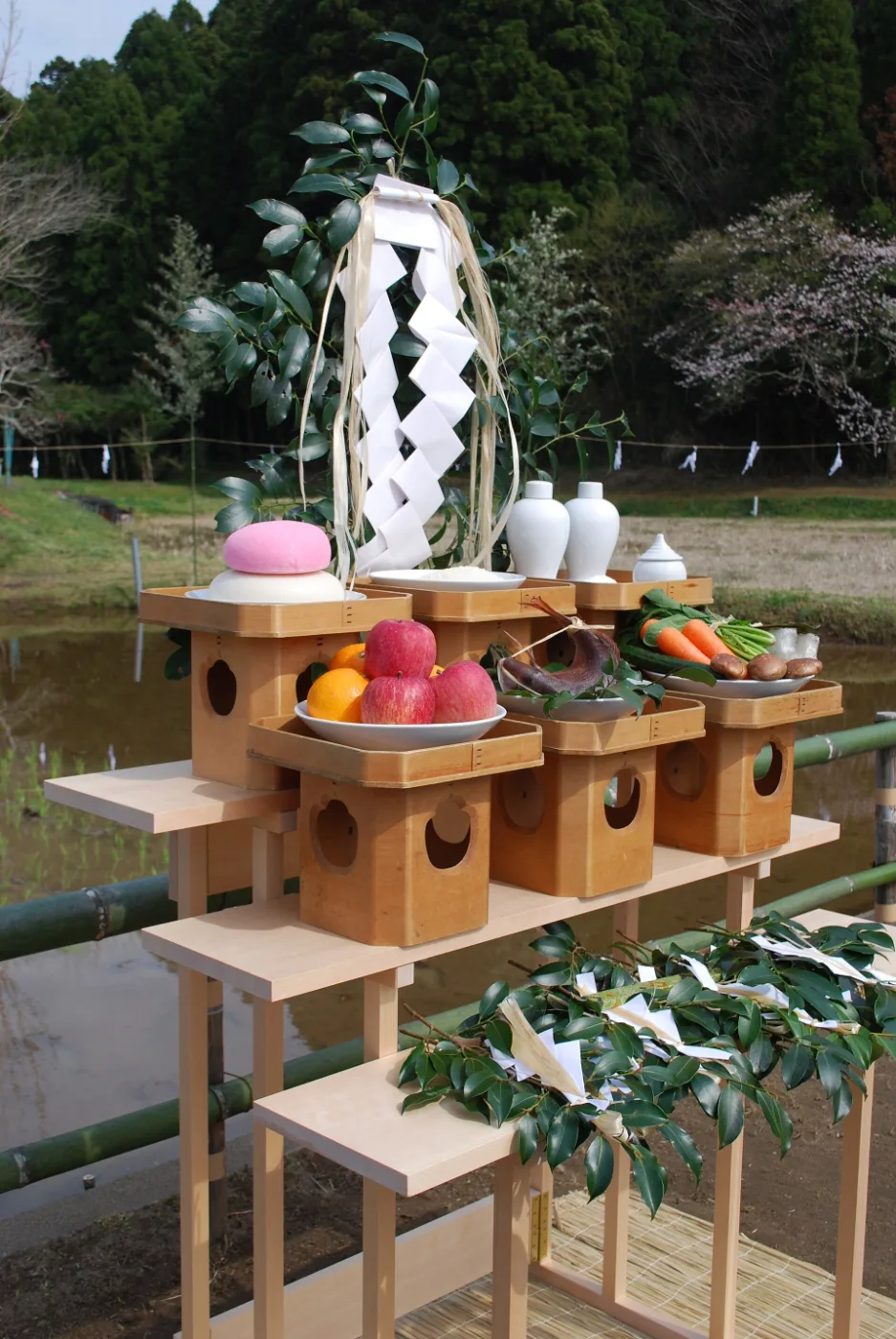
Niinamesai is a set of harvest festivals held in November at the imperial palace and at shrines nationwide. The Kokugakuin University Encyclopedia of Shinto, in an entry by Nakanishi Masayuki, renders the name as First Taste Celebration and gives its ancient forms as nihinahe and niha'nahi. The scholar Motoori Norinaga read it in his Kojikiden as feasting anew, a rite in which new rice is offered to the deities. The encyclopedia suggests its origins probably date to the Yayoi period, when rice cultivation began, and compares it with an ancient Chinese autumn rice festival, called Name no matsuri in Japanese.
The Nihon shoki records the rite twice: in its Age of the Gods section, where the sun goddess Amaterasu performs Niiname, and under the 40th year of Emperor Nintoku, when sake was given to palace ladies at the banquet. For centuries the rite fell on the last Day of the Rabbit in the 11th lunar month, or the middle one when the month had three. When Japan adopted the solar calendar in 1873 the date became 23 November, and the Ninth Article of the 1908 regulations for imperial house rituals listed Niinamesai as a Major Rite held on 23 and 24 November.
In the palace rite described by the encyclopedia, two daises are set up in the Shinka Hall, one for the deities and one for the emperor. Food is offered to Amaterasu and the deities of heaven and earth twice, in the evening and again at dawn. The offerings include sake, rice porridge and steamed rice from the new harvest, laid on woven kashiwa leaves and presented on a reed mat called kegomo. After the evening offering the emperor purifies himself in seclusion for the night, then changes robes before preparing the dawn offering. The first Niinamesai after an emperor's accession is called Daijosai.
KANNAMESAI, NIINAMESAI AND SHRINE HARVEST FESTIVALS
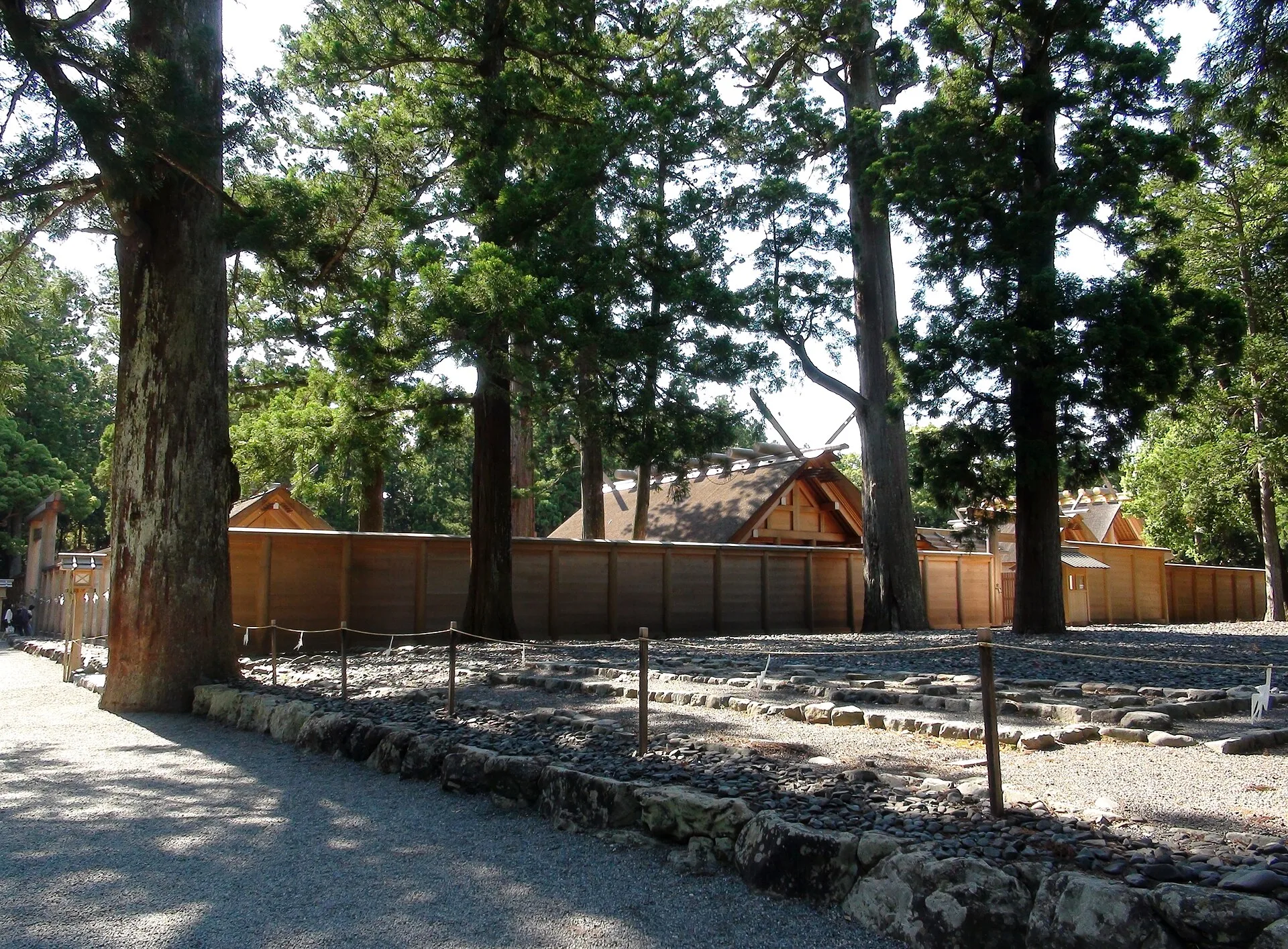
The largest harvest festival at the Grand Shrines of Ise, Kannamesai, comes before the November rite. Locals call it Omatsuri, and it offers the year's new rice to Amaterasu. The Encyclopedia of Shinto traces it to the legendary enshrinement of Amaterasu at Ise: in the reign of Emperor Suinin, Princess Yamatohime, searching for a place to enshrine the deity, made a sacred offering of rice ears eight palms long carried in the beak of a white-naped crane. It was held on the 15th and 16th of the ninth month at the Outer Shrine and the 16th and 17th at the Inner Shrine. After Japan adopted the Gregorian calendar in 1873, it moved in 1879 to the tenth month to coincide with the harvest of early-ripening rice.
Ise's own rice passes through a sequence of rites before the festival. Shinden geshusai in April marks the sowing of purified seed, Otaue hajime in May the transplanting of seedlings, and Nuibosai in early September the harvest, after which the rice is stored in the Mishine-no-mikura granary. From the evening of 15 October, Outer Shrine priests present the offerings called yuki no omike at dusk and dawn. The next day the Inner Shrine's offerings consist of sliced abalone dressed in salt. On the afternoon of the anniversary of Amaterasu's enshrinement an imperial envoy recites a prayer and presents offerings, and votive kagura is performed that evening.
The encyclopedia groups the harvest rites of farming households as shimotsuki matsuri, folk festivals of the 11th lunar month whose dates vary by region. In Kitakyushu, on the first Day of the Ox of that month, each head of household carried rice stubble home on his back, chanting “omoi, omoi”. The stubble served as a yorishiro, an object to hold the spirit of ta no kami, the field deity, and mochi, sake and daikon were offered on a winnowing basket set on a large mortar. In the Noto region the ae no koto welcomes the field kami into the house with a filled bathtub and food.
WHAT IS KINRO KANSHA NO HI, NIINAMESAI'S MODERN SUCCESSOR?
Kinro Kansha no Hi, Labour Thanksgiving Day, is a national holiday observed on 23 November and is the final public holiday of the calendar year in Japan. Nippon.com's guide to national holidays records that it was established under the Act on National Holidays of 1948; before that law, 23 November was officially observed as Niinamesai. The guide describes the holiday as honouring the work of the labour force and expressing gratitude for both the harvest and the people whose labour made it possible.
Shrines throughout Japan still hold Niinamesai ceremonies, offering the year's harvested grain to the kami in thanks, while local governments and communities mark the day with harvest festivals, farmers' markets and food fairs featuring local produce and specialities. The pairing of spring prayer and autumn thanks also survives in the shrine year: Kinensai, held on the fourth day of the second month, asks for good crops, and Niinamesai gives thanks for them in the 11th. Nippon.com notes that the holiday has no strong connection with Japan's labour movement, which is most active on 1 May, not a national holiday.
RICE STRAW AFTER THE HARVEST
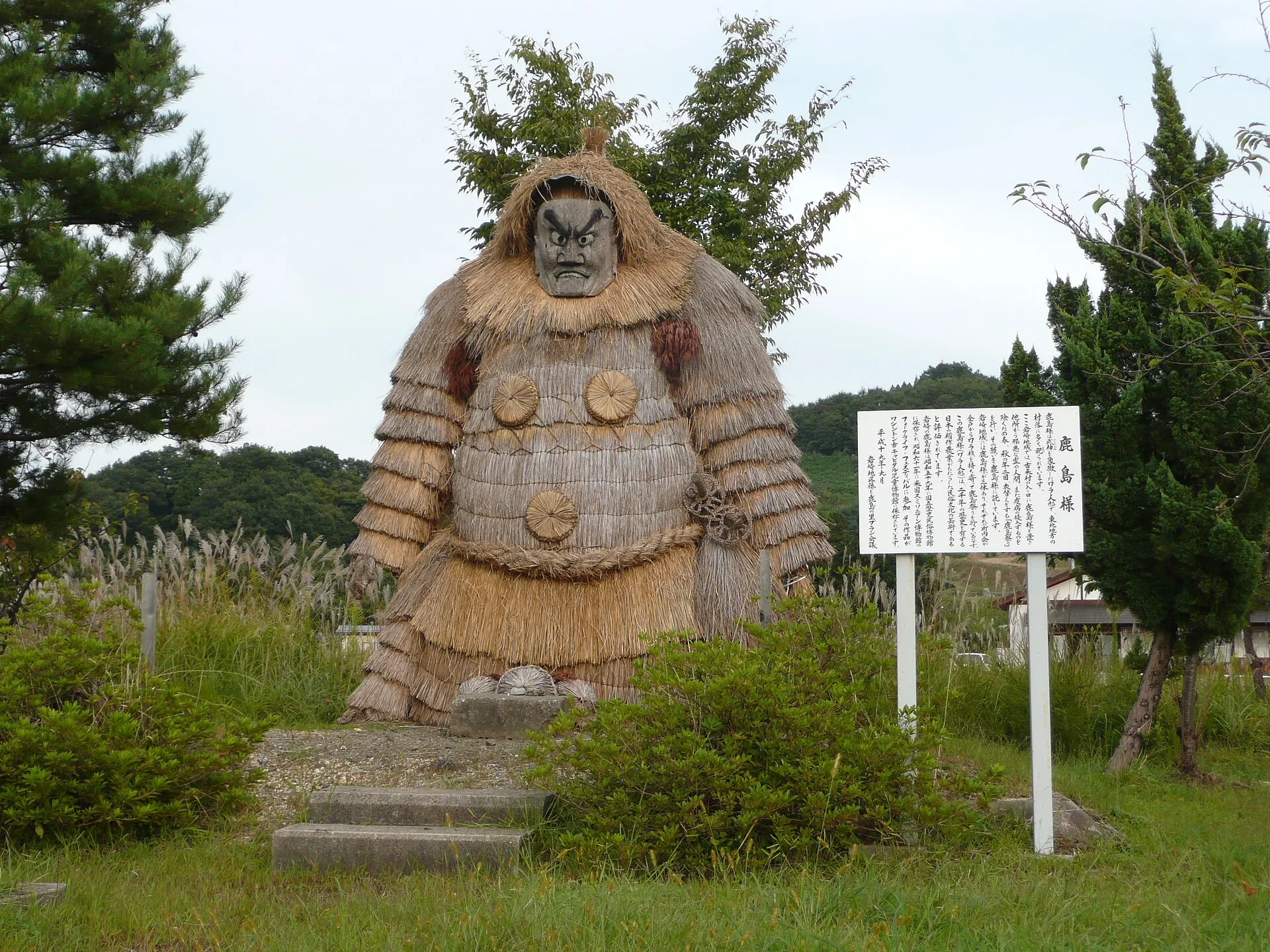
Cutting the rice leaves straw, wara. Kozo Yamaji's account of village farm life for the Smithsonian's Festival of American Folklife records that farmers saved it for winter work: woven rice sacks and mats, rope, raincoats, snow boots, coats and hats, which adult male villagers made without relying on specialists. The shrine needed woven dolls and symbolic ropes. In the village he describes, sacred straw dolls were made twice a year at the town's borders and placed at three locations to ward off sickness and evil spirits, and straw horses and boats housing the village's evil spirits were carried out for disposal in a river or fire.
After the summer planting, Yamaji records, straw figures representing evil spirits were carried out of town to musical accompaniment to avoid blight, and in the Kitakyushu shimotsuki rite the stubble carried home after the harvest became the dwelling for the field deity. The sandals, rain capes, baskets and New Year decorations made from the same material are covered in our article on wara-zaiku, Japan's rice straw crafts, and the twisted straw ropes hung at shrines in the sacred meaning behind Japan's shimenawa ropes.
WHAT IS SAKE RICE?
Part of each harvest is grown for brewing. Shuzo kotekimai, sake-brewing rice, has larger kernels than table rice, less protein and an opaque, porous starchy core called shimpaku, or heart white. National Tax Agency figures cited by Nippon.com in 2015 show polishing removing about 8% of a kernel's weight for eating rice but about 33% for sake rice. Sake is offered at Niinamesai with steamed new rice and porridge; its brewing history, grades and service are covered in the history of sake and its role in Japanese dining culture.
Nippon.com's 2015 report drew on Ministry of Agriculture, Forestry and Fisheries shipment data for the year to 31 March 2015, when 102 sake rice varieties were inspected. Yamadanishiki led with 33.3% of shipments, followed by Gohyakumangoku at 24.7%, grown mainly in Niigata, and Miyamanishiki at 8.7%, grown mainly in Nagano. Growers produced 29,577 tons of Yamadanishiki in 33 prefectures in fiscal 2014, up 28% year on year. Hyogo alone accounted for 21,036 tons, 71% of the national total. The variety arose in 1923 at what is now the Hyogo Prefectural Technology Center, from a cross of Yamadabo and Tankanwataribune, and was named in 1936.
STRAWFIRE AT EMIRATES PALACE MANDARIN ORIENTAL, ABU DHABI
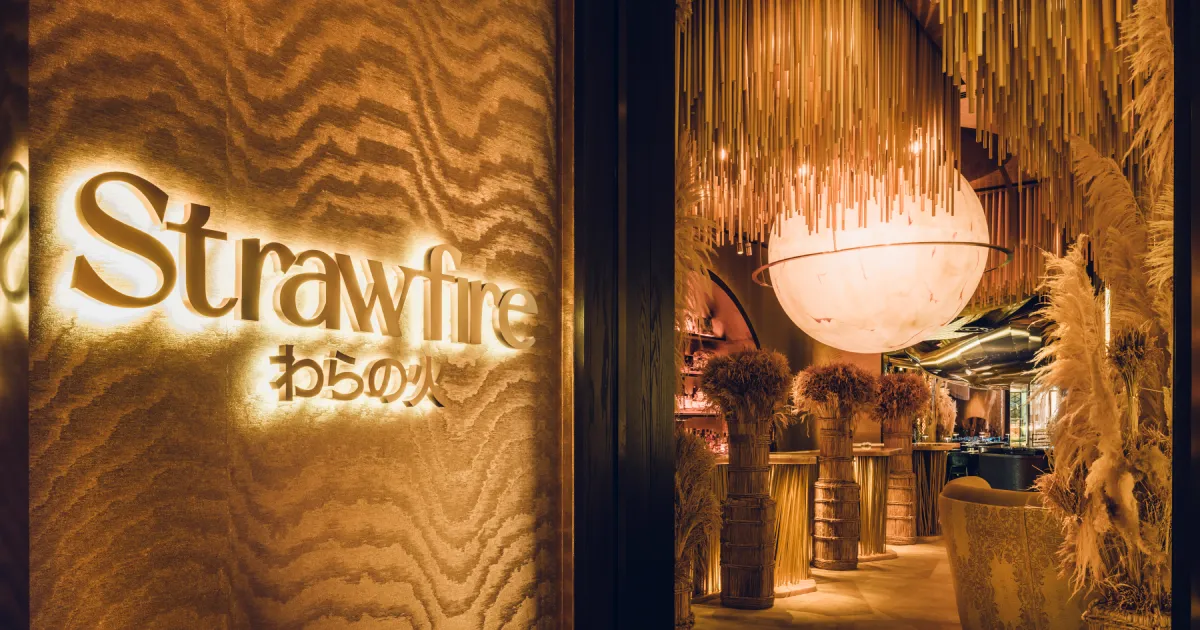
Strawfire is a Japanese restaurant by chef Ross Shonhan at Emirates Palace Mandarin Oriental, Abu Dhabi, completed in 2024. Its concept is rice straw, wara, and warayaki grilling. Straw is what the rice harvest leaves in the field: the stubble Kitakyushu households carried home for the field deity in the shimotsuki rites, and the stalks villages kept for winter crafts, shrine dolls and ropes. The interior uses two palettes: straw in cream, gold and mustard, and fire in orange, gold and rust.
The warayaki counter sits under a hand-beaten brass hood fronted with faceted gold tiles. A back-lit kumiko screen shows the chefs' shadows, and straw bales up to 2 m high stand in the booths. Rice straw is the material Yamaji's farmers saved for the long winter months to make woven rice sacks and mats, rope, raincoats, snow boots and hats, and that the village shrine required for its woven dolls and symbolic ropes, including the sacred dolls set at the town's borders twice a year.
SOURCES
- Britannica Yayoi culture
- The Metropolitan Museum of Art Heilbrunn Timeline of Art History: Japan, 1000 B.C. to 1 A.D.
- UNESCO Mibu no Hana Taue, ritual of transplanting rice in Mibu, Hiroshima
- Kokugakuin University Basic Terms of Shinto: Ta-asobi
- Smithsonian Center for Folklife and Cultural Heritage Kozo Yamaji, Japanese Village: Farm Life
- Kokugakuin University Encyclopedia of Shinto: Niiname sai (Nakanishi Masayuki)
- Kokugakuin University Encyclopedia of Shinto: Kannamesai, Grand Shrines of Ise (Nakanishi Masayuki)
- Kokugakuin University Encyclopedia of Shinto: Shimotsuki matsuri (Iwai Hiroshi)
- Nippon.com Labor Thanksgiving Day (Japan's National Holidays)
- Nippon.com Yamadanishiki Reigns Supreme Among Sake-Brewing Rice Varieties, 2015