WHY JAPANESE SHRINES DISPLAY STACKS OF STRAW-WRAPPED CEDAR SAKE BARRELS

Kazaridaru, literally decorative barrels, are the straw-wrapped sake barrels displayed in stacks at Japanese Shinto shrines. The barrels are empty. Sake brewers present them as offerings to the kami, the deities enshrined at each site, together with bottled sake. In form they reproduce the komodaru, a cedar sake cask wrapped in a woven rice straw mat called komo and printed with the brewer's brand. That cask was the shipping container of the Edo period (1603 to 1868), when sake travelled by sea from the brewing districts of Nada and Itami in the Osaka region to Edo, present-day Tokyo. The best-known display is at Meiji Jingu in Tokyo, where members of a nationwide sake brewers' association offer barrels every year.
WHAT IS A KAZARIDARU? DECORATIVE BARRELS AND WORKING CASKS
The Japanese term combines kazari, decoration, with taru, barrel, which becomes daru in compounds. The Japan Tourism Agency's multilingual explanation for Meiji Jingu uses it for the straw-covered barrels offered there and states that they are decorative and empty. Their model is the working cask of the sake trade. The Society for Nada Sake Research, which publishes a glossary of brewing terms, defines a taru as a cask of Japanese cedar boards formed into a cylinder and bound with woven bamboo hoops called taga, with the base and lid fixed in place. The fixed lid is what separates a taru from an oke, an otherwise similar wooden vessel, and the bound form is called yui-daru.
The glossary lists standard sizes based on the to, a traditional unit of 18 litres. The yon-to daru, or large cask, holds 72 litres, the han-daru 36 litres and the to-daru 18 litres, and small 1.8 litre casks also exist. The 72 litre cask, equal to 40 standard 1.8 litre bottles, is the size used for kagami biraki. A display barrel does not need to hold anything. Kishimoto Kichiji Syouten, a komodaru maker in Amagasaki, Hyogo Prefecture, builds its large decorative barrels around a core of polystyrene foam, which makes them far lighter to handle.
WHY ARE SAKE BARRELS OFFERED AT SHINTO SHRINES?
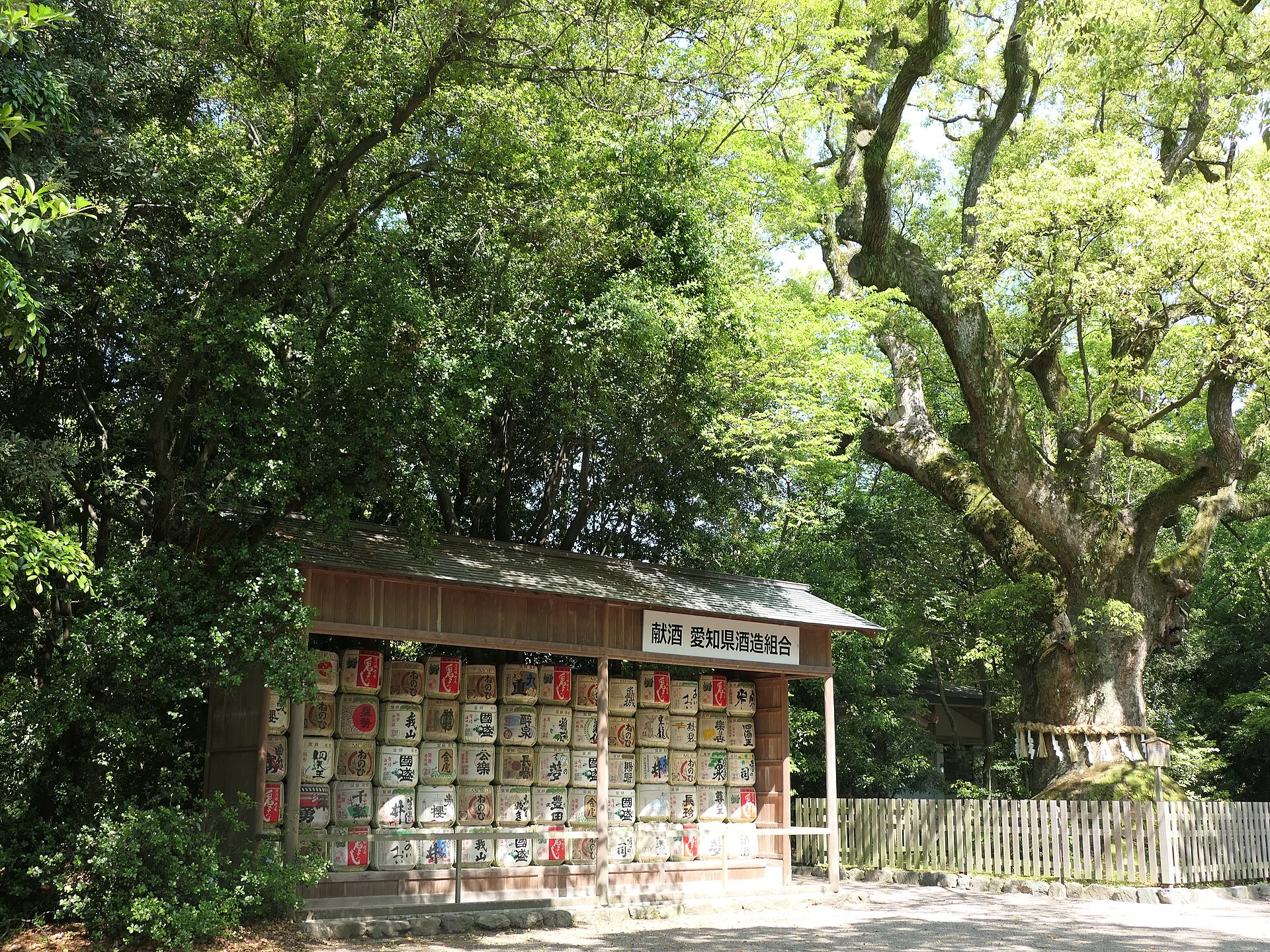
At a shrine, sake is not called nihonshu, its everyday name, but miki or omiki, written with characters meaning kami and alcohol. According to the Japan Tourism Agency text at Meiji Jingu, omiki is offered to the kami every day and shared with worshippers after rituals and festivals, and sake is understood as a link between people and the kami. Highlighting Japan, the Government of Japan's English-language magazine, places this in a longer history. Rice, rice cakes and sake made from rice have been offered in religious ceremonies since ancient times, and after an offering has been presented to the deities, priests and participants share it in a ritual meal called naorai.
The same source notes that shrines historically offered local produce such as fish, birds, deer and wild boar, and that after the Meiji era (1868 to 1912) most shrines centred their offerings on rice, rice cakes and sake. Sake barrels are now a common offering, particularly at large shrines, where they are donated by local breweries and worshippers; 1.8 litre isshobin bottles are also widely offered. Nippon.com, reporting on the Nada brewing district, notes that old sake barrels are stacked in rows at the entrances to shrines during festivals.
FROM NADA TO EDO: WHERE THE STRAW-WRAPPED SAKE BARREL CAME FROM

The barrel's form comes from the commercial sake trade. Hyogo Prefecture still ranks first in Japan for sake production and sales, and its Nada Gogo, five brewing districts along the shore from eastern Kobe to Nishinomiya, remain the country's leading production area. Nada's brewers drew on mineral-rich water from the Rokko mountains, the cold Rokko oroshi winds that cooled steamed rice in winter, and Yamadanishiki rice grown on the far side of the range. Kiku Masamune, one of the Nada brewers, was founded in 1659, and in the Edo period Nada was a leading supplier of sake to Edo.
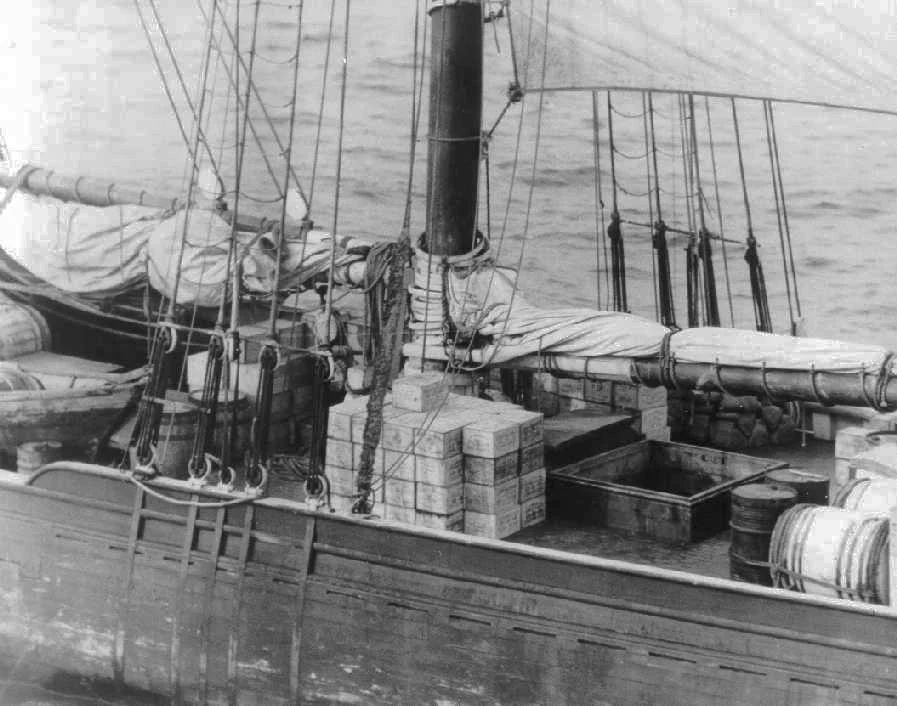
Ships carried the barrels north from Kamigata, the Kyoto and Osaka region. Because Kamigata was then the commercial and cultural centre, sake shipped from there was called kudarizake, sake coming down. The Society for Nada Sake Research records that casks went by boat from Nada and Itami to Edo, where taru-zake, cask sake, became a synonym for sake itself. The voyage took about ten days, during which the cedar gave the sake a fresh wood aroma that Edo drinkers came to like. The original straw covering was woven from dried rice straw to protect the barrels at sea. After 1868 sake was sold in glass bottles, later in paper cartons and single-serve jars, and demand for barrels fell sharply.
YOSHINO CEDAR: THE WOOD OF THE SAKE CASK
The preferred timber for sake casks was cedar from Yoshino in Nara Prefecture. Nara Prefecture's history of Yoshino forestry dates the first hand-planted trees in the region to around 1500, and records that Yoshino timber was used in the late 16th century at Osaka Castle, Fushimi Castle and in temples and shrines. Yoshino foresters planted saplings closer together than was usual in Japan, thinned them repeatedly and grew them over long rotations, producing timber with narrow, even growth rings and few knots. In the early 18th century the yamamori system, in which specialist caretakers manage forests for landowners over the long term, was established, and it continues today.
Production of tarumaru, the wooden staves for sake barrels, expanded in Yoshino in the 1720s. Fine, uniform growth rings and few knots made the wood resistant to leaks, and a damaged stave could be replaced individually, which allowed a barrel to stay in use for a long time. Nippon.com describes the wood as light red and low in acridity, and notes that the darker inner wood is used for barrels while the paler outer wood goes to building and furniture. Around 1940 Yoshino production shifted from barrel staves to architectural timber such as posts and structural members. Cedar chips cannot simply be added to sake for flavour: under Japan's Liquor Tax Act, the result would be classed as a liqueur.
HOW IS A SAKE BARREL MADE?
Coopers build sake barrels without nails or adhesives, which could pass odours to the sake. A form holds the staves and the wedge-shaped bottom pieces while the cooper assembles them into a cylinder. Seven hoops of woven bamboo are then wound around the outside, rough edges are smoothed, and the bottom and lid are fitted. Kiku Masamune opened its Tarusake Meister Factory in Kobe in 2017, opposite its brewery museum, and Nippon.com reports from there that a beginner can take up to an hour just to fit the staves and wedges together, and that a cooper needs nearly 30 years to become proficient.
The Nada glossary names each part. The lid board is the kagami, or mirror, with a filling hole closed by a wooden plug, and the hole for drawing off sake is the nomiguchi. The seven hoops, from the top, are the kuchiwa, kashira, onaka, konaka, sanban, niban and shiriwa; the konaka is omitted on the 18 litre cask. Sake made as taru-zake is kept in the barrel for about ten days, the length of the old voyage to Edo, because longer storage makes it harsh, and the barrels are used only once. Under Japan's labelling standard for seishu, sake sold as taru-zake must carry ki-ga, the aroma of wood, from storage in a cask, even if it is later moved into bottles.
HOW A KOMODARU IS WRAPPED IN STRAW
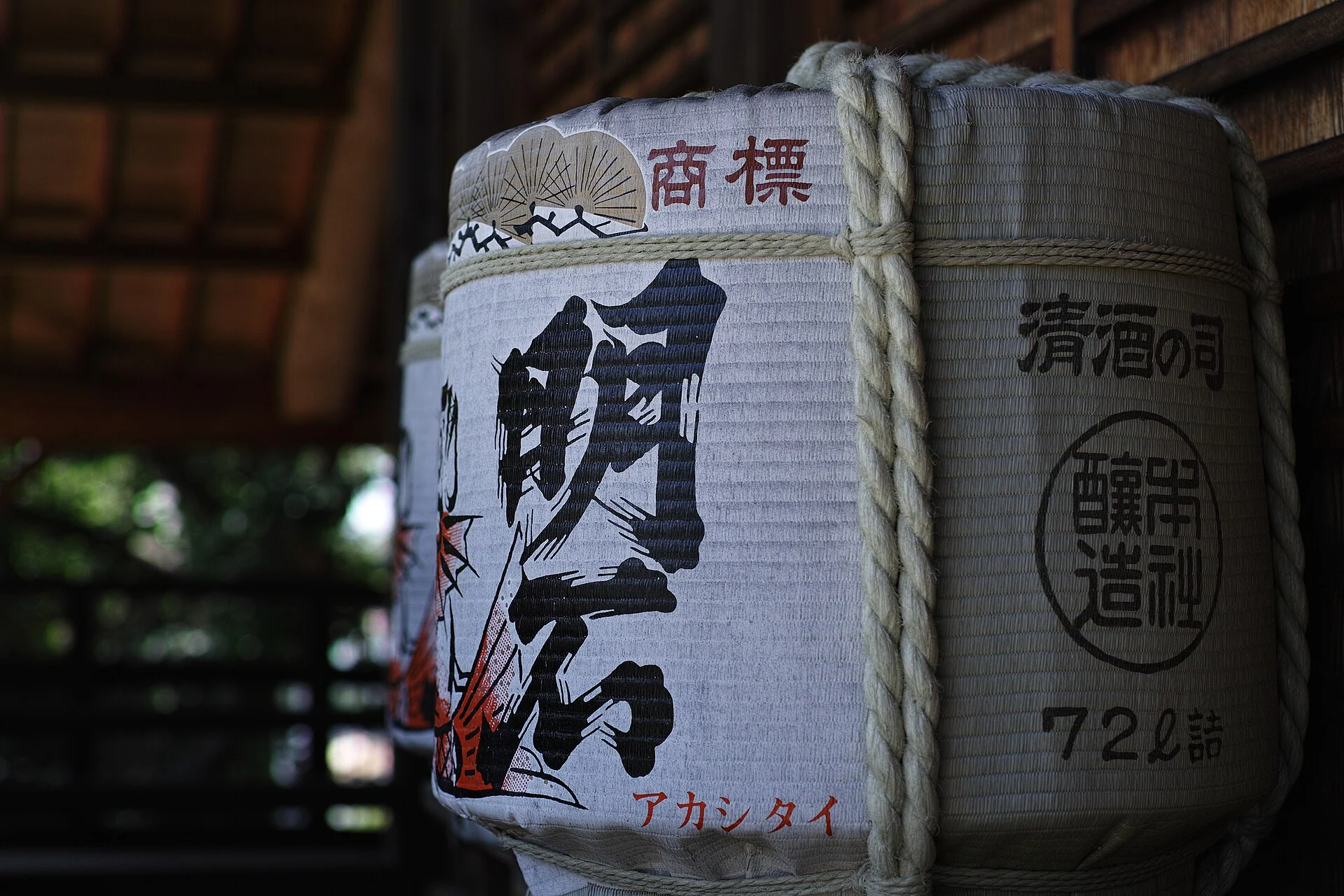
The glossary sets out casking, taru-zume, as a sequence. A wooden plug in the opening near the base is branded or stamped with the brewer's logo or name. The cask is half-filled with water and left to stand to check for leaks, then washed and drained upside down. Sake is poured in through the hole in the kagami, the hole is sealed with a label showing the brand, and a komo mat printed with the brand name and logo is wrapped around the cask and bound with cords. The finished komo-kamuri daru, or komo-wrapped cask, marks the stage called hon-ni-zukuri, full preparation for shipping. A cask labelled directly without the mat is called kari-maki, provisionally wrapped, or hadaka, bare.
Komo making grew up beside the breweries, as one of Japan's rice straw crafts. Kishimoto Kichiji Syouten, founded in 1900 in Tsukaguchi, Amagasaki, began by buying komonawa, straw rope, from local farmers, printing sake brand labels on the straw and delivering finished barrels to breweries, and komonawa production became a winter industry for farming households in the area. The company states that around ten komodaru makers worked in the Amagasaki and Kobe area about 25 years ago, that only three remain in Japan, and that it produces most of the decorative barrels offered at shrines. The Amagasaki tourism bureau puts Tsukaguchi's share of the komodaru used in Japan at about 70 per cent.
THE KAZARIDARU OF MEIJI JINGU AND THE KAGAMI BIRAKI CEREMONY
Meiji Jingu in Tokyo enshrines Emperor Meiji (1852 to 1912) and Empress Shoken (1849 to 1914). Each year members of the Meiji Jingu Nationwide Sake Brewers Association offer the shrine straw-covered decorative barrels, together with bottled sake, as a mark of respect for the enshrined pair. The Japan Tourism Agency text links the custom to the Meiji period, during which the emperor encouraged the technological development of many domestic industries, sake brewing among them. The shrine also displays barrels of wine. The emperor enjoyed Western food and French wine in particular, and in 2006 several Burgundy wineries gave Meiji Jingu barrels of wine in his memory. Burgundy has continued to offer wine to the shrine every year.
A full komodaru is opened in kagami biraki. Breweries traditionally called the barrel lid the kagami, or mirror, and the ceremony's name means opening the mirror. Highlighting Japan describes the lid being broken with a wooden mallet and everyone present sharing the sake inside. The barrels used are the 72 litre size. Nippon.com reported that the ceremony is becoming rarer, while Kishimoto Kichiji Syouten reports that orders from overseas customers have risen significantly in recent years. Kiku Masamune's Taru Sake range, stored in barrels and sold in bottles, sells better in eastern Japan, especially Tokyo, than in Kansai, where it is brewed.
SAKE BARREL FORMS AT HENSHIN, THE WESTIN JAKARTA

Henshin is a Nikkei restaurant and rooftop bar on floors 67 to 69 of The Westin Jakarta, opened in 2017. Silverfox Studios designed all three floors of the restaurant and bar, as well as the arrival tunnel. The name Henshin means transformation, and the restaurant's chef, Hajime Kasuga, is a third-generation Japanese Peruvian. Two Japanese references are part of the interior. The first is a large bingata pattern on the level 69 ceiling. The second is a set of translucent, blue-lit forms of sake barrels.
The barrel forms connect Henshin to the history traced above. The komodaru began as a working cask: Yoshino cedar staves, seven bamboo hoops and a printed straw mat, made to carry sake by sea from the breweries of Nada and Itami to Edo in about ten days. The kazaridaru offered at shrines such as Meiji Jingu keep that outline but are empty, and many decorative barrels are now built around foam cores. At Henshin the sake barrel appears as a translucent, blue-lit form.
SOURCES
- Japan Tourism Agency Sake Barrels (Meiji Jingu), Multilingual Commentary Database
- Japan Tourism Agency Barrels of Consecrated Wine (Meiji Jingu), Multilingual Commentary Database
- Government of Japan, Highlighting Japan Enjoying Japanese Sake, Nihonshu
- Nippon.com Barrels of Fun: Preserving the Nada Sake Taste and Tradition
- Nara Prefecture History of Yoshino Wood
- Society for Nada Sake Research Glossary of Sake: Taru (barrel, cask)
- Society for Nada Sake Research Glossary of Sake: Taru-zume sagyo (casking)
- Society for Nada Sake Research Glossary of Sake: Taru-zake (cask sake)
- Kansai Tourism Amagasaki Inspired by the Komodaru
- Nikkei Messe Exhibitor Information: Kishimoto Kichiji Syouten