HOW A CLAY OVEN USED FROM ARMENIA TO KASHMIR BECAME THE CENTRE OF NORTH INDIAN RESTAURANT COOKING

The tandoor is a cylindrical clay oven heated by a charcoal fire, used to bake flatbreads against its inner walls and to roast skewered meat in its core. Britannica describes it as shaped like a large urn, at least one metre tall and often sunk into the ground up to its neck, with inner walls that can reach 480°C. The same oven, under related names, is used across West and Central Asia: the tonir of Armenia, where UNESCO inscribed lavash baking as intangible cultural heritage in 2014, and the tandyr or tanūr named in a 2016 UNESCO inscription shared by Azerbaijan, Iran, Kazakhstan, Kyrgyzstan and Türkiye. In North India the tandoor baked naan centuries before restaurants made it famous. Tandoori chicken is attributed by Britannica to Kundan Lal Gujral, a cook from Punjab who opened a restaurant in Delhi after 1947.
WHAT IS A TANDOOR AND HOW DOES IT COOK?
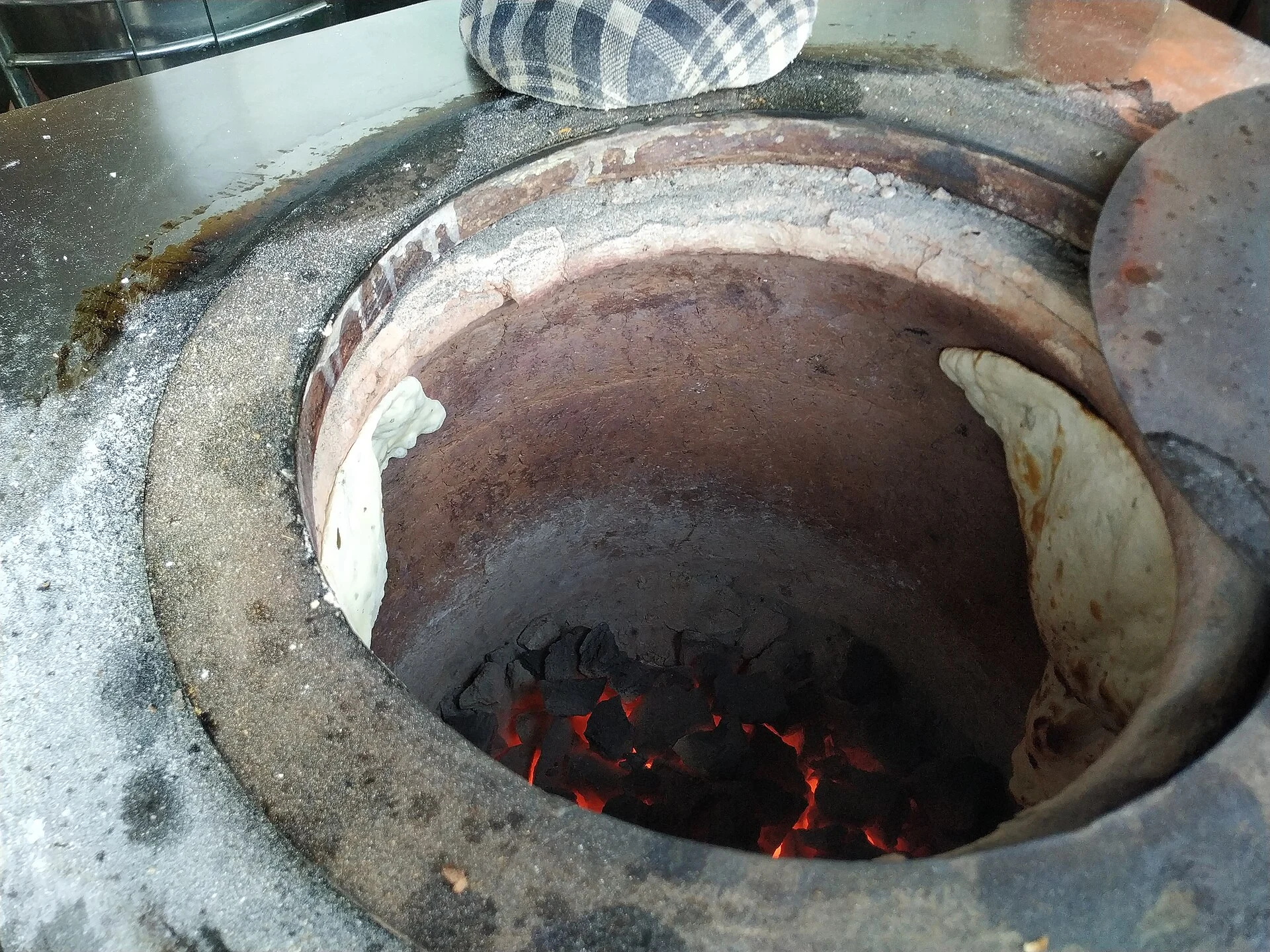
A tandoor is built of clay and fired with charcoal. According to Britannica, the fire is lit and left to burn for hours to heat the oven before cooking begins. Meat for the tandoor is usually marinated in yogurt and spices, threaded onto long skewers and hung vertically inside the oven. A natural colouring called tandoori rang gives the meat its orange-red colour. Leavened wheat breads such as naan are pressed by hand against the hot inner wall, where they bake in several minutes and brown in spots. A popular dish of the method is tandoori murgh, a whole chicken cooked in the oven.
Britannica's entry on tandoori chicken lists yogurt as its base and a spice blend called tandoori masala, which typically includes cayenne pepper, garlic, ginger, onion and garam masala. Red chilli powder or the milder Kashmiri chilli powder is added for colour, sometimes with turmeric and paprika, and the chicken is often served on the bone. Bread is baked directly on the oven wall. In Armenia, UNESCO records, lavash dough is rolled thin, stretched over an oval cushion and slapped against the wall of the clay oven, then pulled off after 30 seconds to a minute.
WHERE DID THE TANDOOR COME FROM?
The name of the oven records its route. The Federal, an Indian news publication, traces tandoor to the Persian tanūr, which it derives from tinūru, a word for oven in Akkadian, the ancient language of Mesopotamia. The same word passed into Arabic as tannūr, into Central Asia as tandir and into India as tandoor. Britannica states that tandoori cooking is believed to have originated in Persia and that versions of it are found across Central Asia. The Federal links the oven's arrival in India to migrations from Central Asia, and quotes the cookbook author Julie Sahni, who calls this kind of cooking synonymous with a nomadic lifestyle.
Clay ovens in South Asia are older than the word. The Federal reports that the food historian K. T. Achaya, in his 1994 book Indian Food, described mud-plastered ovens at Kalibangan in Rajasthan, a site of the Indus civilisation, as closely resembling present-day tandoors. Writing in Slate in 2013, the science journalist Andrew Lawler described tandoori-style ovens as often found at Indus sites, from a civilisation that peaked between 2500 and 1800 BC, and noted evidence of domesticated chickens at Harappa.
Lawler presents the cooking of those chickens in such ovens as likely, not proven. His report centres on Farmana, a settlement about two hours' drive west of Delhi that prospered in the late third millennium BC, where the dig was directed by the archaeologist Vasant Shinde of Pune University. There, Arunima Kashyap analysed residues from cooking pots and from human teeth, and at Harappa cow teeth carried traces of ginger and turmeric dated to 2500 to 2200 BC. Shinde told Lawler that the Indus people introduced many South Asian traditions, and that these included tandoori chicken. That is his interpretation of the evidence, not a recorded recipe.
TONIR, TANDYR AND TANUR: THE CLAY OVEN ACROSS WEST AND CENTRAL ASIA

Armenia's version of the oven is the tonir. UNESCO's inscription of lavash in 2014 describes the bread as an integral part of Armenian cuisine, made from wheat flour and water and baked in a traditional conical clay oven. A small group of women usually prepares it together, with young girls helping and taking on more of the work as they gain experience. Men make the cushions used to stretch the dough and build the ovens, and pass those skills to apprentices. Lavash is rolled around cheese, greens or meat, can be kept for up to six months, and at weddings is laid on the shoulders of the newlyweds.
Older beliefs about the tonir survive in Armenian tradition. The local guide Tatevik Arshakyan told The Federal that in pagan times the tonir symbolised the sun, and that families who could not afford an animal sacrifice offered lavash instead. The Federal reports that the tonir was central to Armenian homes by the eighteenth century and that many fell out of use in the twentieth as stoves replaced them. Hrachya Aghajanyan, who owns a site in the village of Tsaghkunk in Sevan Municipality, says it holds two original tonirs from the eleventh century.
Beyond Armenia, a 2016 UNESCO inscription covers flatbread making and sharing in Azerbaijan, Iran, Kazakhstan, Kyrgyzstan and Türkiye. The breads, named as lavash, katyrma, jupka and yufka, are baked in a tandyr or tanūr, described as an earth or stone oven built into the ground, as well as on a metal plate called a sāj or in a cauldron. Baking involves at least three people, often members of one family, each with a set role, and in rural areas neighbours join in. Skills pass within families and from master to apprentice, and the bread is shared at weddings, births, funerals and holidays.
NAAN, KULCHA AND THE TANDOOR IN NORTH INDIA AND KASHMIR

Naan takes its name from the Persian nān, meaning bread. The Federal identifies the earliest documented reference in India in the writing of the thirteenth-century Sufi poet Amir Khusrau, who mentions naan-e-tunuk and naan-e-tanuri, the second named for the oven. According to the same report, naan came to North India with the Delhi Sultanate, whose royal encampments used tandoors to bake bread for warriors, and was popularised by the Mughals. Under Mughal patronage the oven also produced sheermal and kulcha, and the court of Akbar is credited with a golden naan brushed with ghee and saffron.
In Kashmir the tandoor became the oven of the neighbourhood baker. Greater Kashmir records the local belief that it came to Kashmir from Iran, and that it became part of Kashmiri culture during the Pathan era. It remains central to bakeries run by the Kander community, whose bakers, called kandur, produce breads including tchachvor, lawasa, kulcha, sheermal and routh. Village Square, a publication on rural India, reports that tandoors are used in bakeries across Kashmir to bake t'chot, the local bread. Both reports name one village in the north of the valley as a centre for making these ovens.
HOW IS A TANDOOR MADE?

That village is Palhalan, in Baramulla district of north Kashmir, which Village Square describes as a major supplier of tandoors to the rest of the valley. Many of its families work in the trade, and the report describes digging the clay as the hardest part of the job: it is taken from meadows about three feet below the surface, which requires government permission. The clay is dried in the sun, crushed to powder, mixed with sand and water and kneaded with the feet until smooth. The oven is then built up in three stages, a base ring, a middle ring and an upper ring.
Building a tandoor in Palhalan takes about eight days, according to Village Square, followed by another eight days of drying in the sun or by the heat of burning wood. Greater Kashmir names the potters who make them as Kralls, and the tools used to form the clay rings and shape the neck as the tathwand and the kreed. Tandoors were once exchanged by barter, but are now sold for cash, and falling returns have reduced the number of artisans. The families told Village Square that the craft is dying, though they intend to continue it.
MOTI MAHAL, KUNDAN LAL GUJRAL AND THE STORY OF TANDOORI CHICKEN
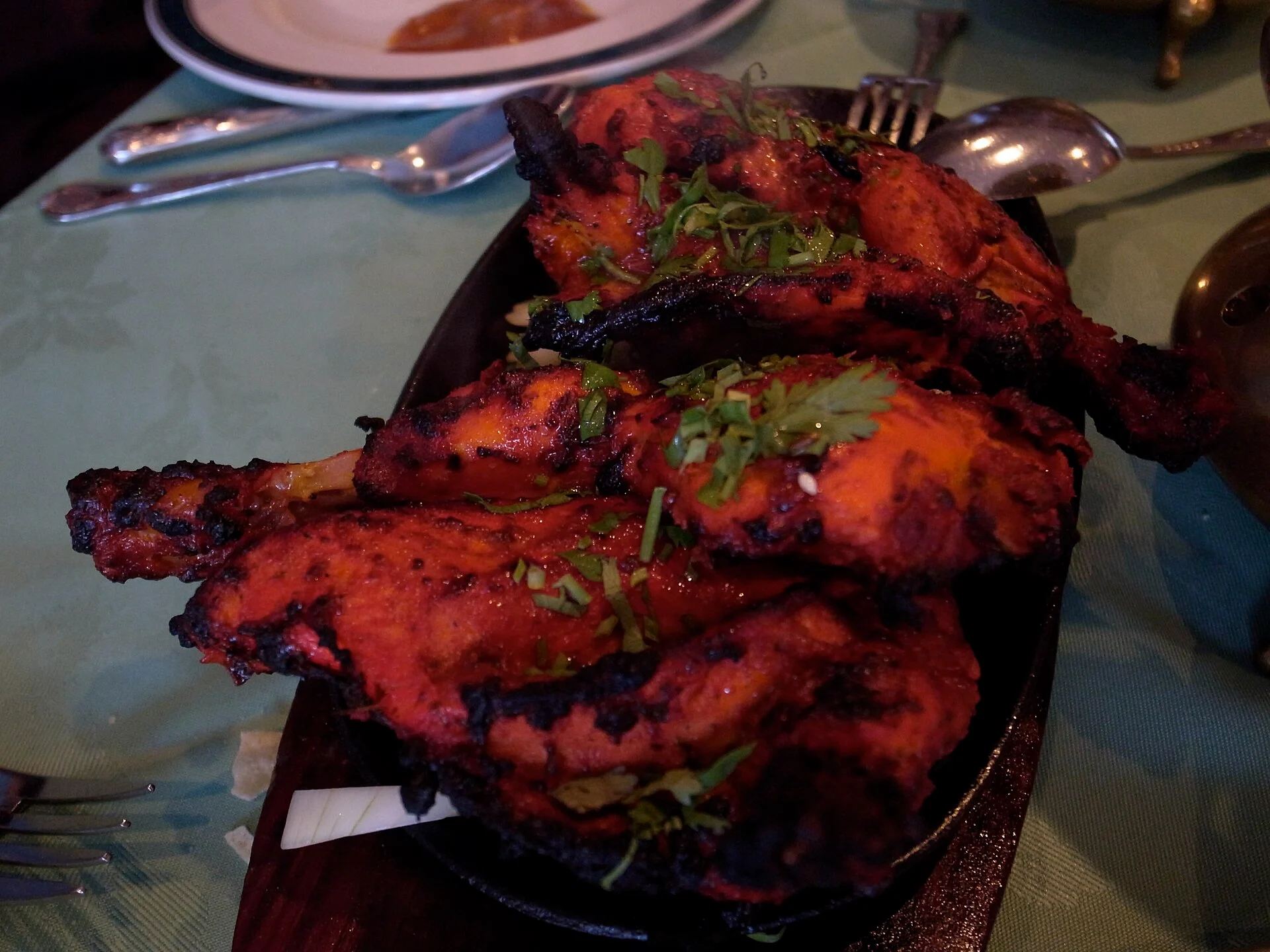
Britannica attributes tandoori chicken to Kundan Lal Gujral, from Punjab, who moved to Delhi in 1947 and opened a restaurant there. NPR, reporting from New Delhi in 2024, names the restaurant as Moti Mahal, meaning Pearl Palace, and says it was founded by Gujral and Kundan Lal Jaggi, both cooks from Peshawar. Gujral's grandson Monish Gujral says his grandfather was already running a Moti Mahal in Peshawar in 1920. NPR found residents of Peshawar who remember a restaurant owned by a Kundan Lal, but notes that it is unclear which Kundan Lal they mean, and that the founders may have worked for a man named Mukhi Singh.
Butter chicken, tandoori chicken in a sauce of tomato, cream, butter and spices, is claimed by both families. The Gujral family says Kundan Lal Gujral made a gravy to keep unsold tandoori chicken from drying out. Jaggi's grandson says his grandfather used a butter and tomato sauce to stretch tandoori chicken for unexpected guests. The Gujral family took the dispute to court in January 2024. The food historian Pushpesh Pant told NPR that no single person invented the dish, and that it was probably made in several places at once. The writer Madhur Jaffrey, who ate at Moti Mahal as a young teenager, says it was not served when the restaurant first opened.
Britannica records that tandoori chicken quickly became popular across South Asia, the Middle East and Western countries. In London, Gaylord opened on Mortimer Street in 1966 serving the Mughlai food of northern India, and according to The Caterer it was believed to have had the first tandoor oven in the UK, imported from India. Gaylord closed in June 2019 after more than 50 years. NPR compares the butter chicken dispute with that over chicken tikka masala, a British dish whose own invention is also contested.
TRIDENT, NARIMAN POINT ON MARINE DRIVE

Trident, Nariman Point stands on Marine Drive in South Mumbai, facing the Arabian Sea. The 35-storey hotel opened on 7 April 1973 as the Oberoi-Sheraton, and was the tallest building in South Asia until 1980. It was renamed Trident in 2008 under The Oberoi Group. It opened seven years after Gaylord installed its imported tandoor in London, by which time tandoor dishes were served in formal restaurant dining rooms in both Delhi and London, and tandoori chicken, as Britannica records, had quickly become popular across South Asia and in Western countries.
Silverfox Studios refurbished the hotel's arrival reception, lobby lounge, Ness Bar, ballroom and event spaces, a project completed in 2025 under a concept titled "Luxury Lifestyle". Ness Bar is on level 1, with views over Marine Drive and the sea. These are public rooms of the same kind as those through which tandoori cooking first reached a wider audience: the dining room of Moti Mahal in Delhi, and that of Gaylord in London, whose tandoor The Caterer reports was believed to be the first in the UK.
SOURCES
- Britannica Tandoor
- Britannica Tandoori chicken
- UNESCO Intangible Cultural Heritage Lavash, the preparation, meaning and appearance of traditional bread as an expression of culture in Armenia
- UNESCO Intangible Cultural Heritage Flatbread making and sharing culture: Lavash, Katyrma, Jupka, Yufka
- Slate The Mystery of Curry
- The Federal How Persian tandoors or clay ovens connect India and Armenia across civilisations
- Greater Kashmir Our Cultural Heritage in Clay
- Village Square Crafting a traditional tandoor
- NPR Who cooked up butter chicken? A court seeks the answer
- The Caterer Azure Hospitality to launch new venture on site of Gaylord restaurant