THE DROUGHT-TOLERANT DESERT TREE OF ARABIA AND THE THAR, DECLARED THE UAE'S NATIONAL TREE IN 2008
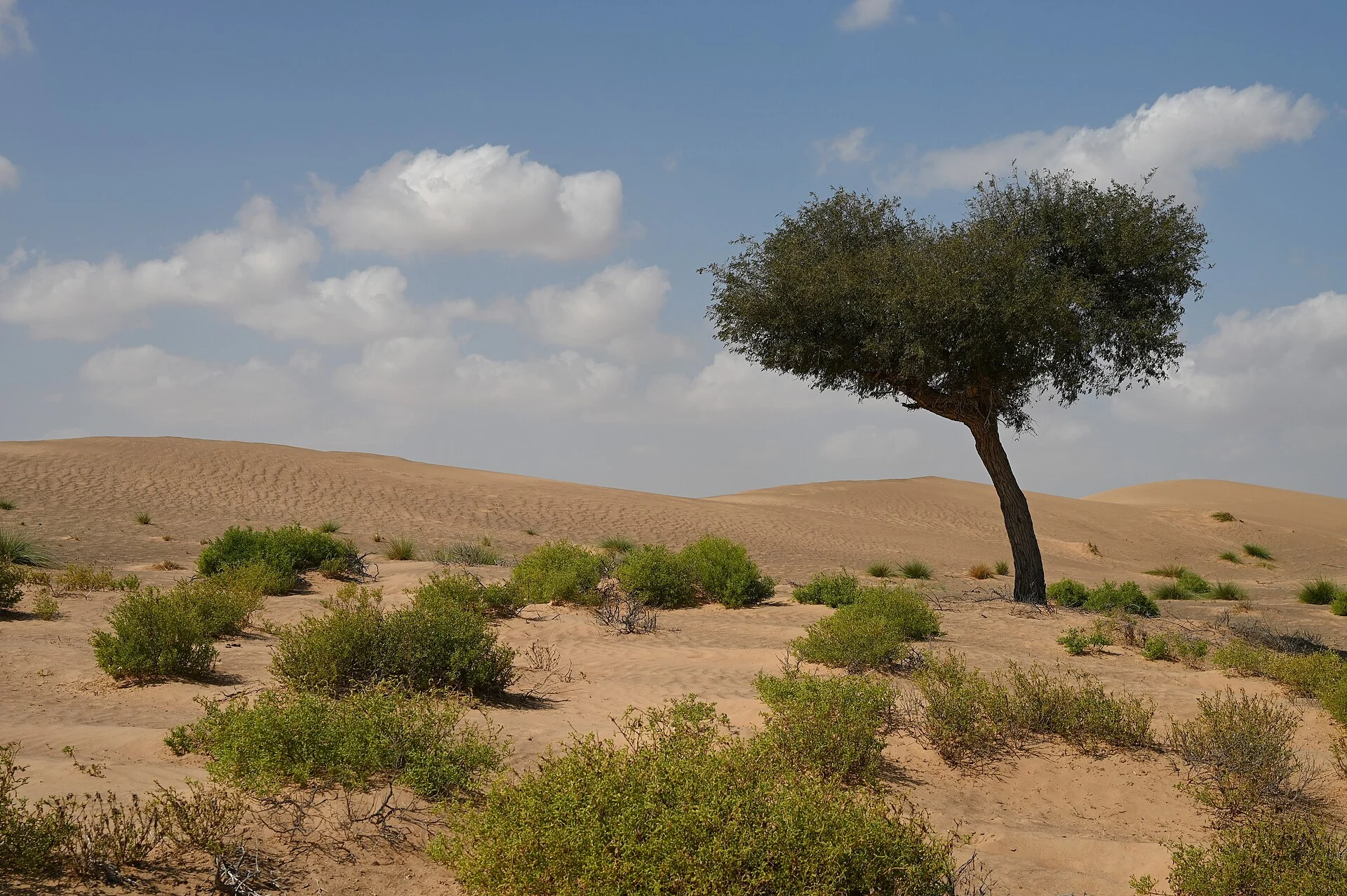
The ghaf tree (Prosopis cineraria) is a thorny, drought-tolerant, nearly evergreen tree of the legume family that grows across the deserts of Western Asia, the Arabian Peninsula and the Indian subcontinent. The United Arab Emirates declared it the national tree in 2008, and in India, where it is called khejri, it is the state tree of Rajasthan. The ghaf stays green through summers above 50°C because a long taproot reaches groundwater far below the surface, and as a legume it fixes nitrogen, enriching the sandy soil around it. For centuries its leaves and pods fed camels, goats and people, its wood supplied fuel and building timber, and its canopy gave shade in open desert. Abu Dhabi's Environment Agency gives its average lifespan as up to 120 years.
WHAT IS THE GHAF TREE?
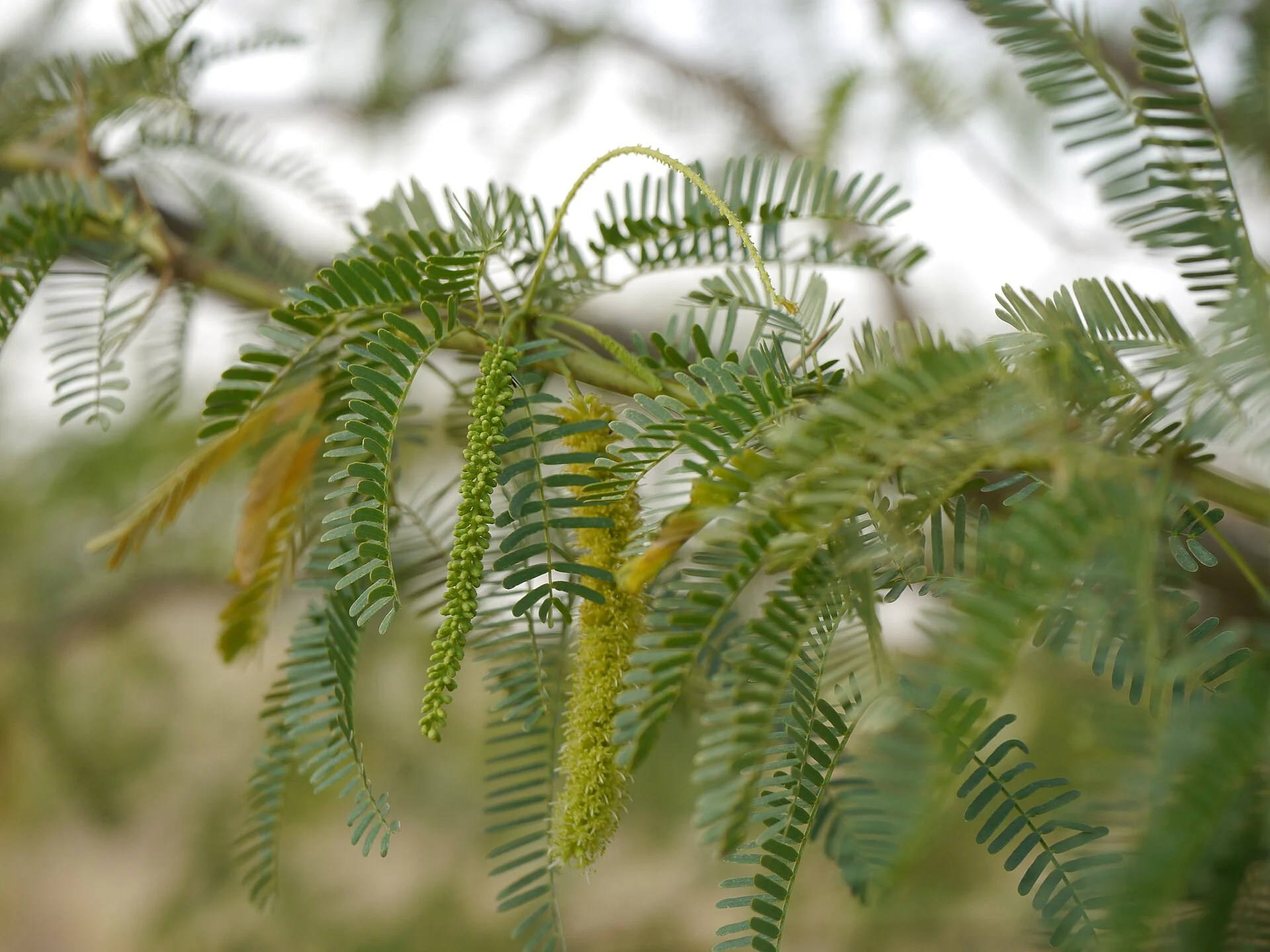
The ghaf belongs to the family Fabaceae, subfamily Mimosoideae, which places it among the legumes alongside the acacias. A 2022 review in Frontiers in Sustainability counts 44 species in the genus Prosopis: three native to Asia, one to Africa and the rest to the Americas. Prosopis cineraria is one of the three Asian species. The World Agroforestry tree database describes a tree up to 6.5 m tall with grey bark and scattered, straight, conical prickles. Feedipedia, the animal feed database developed with the Food and Agriculture Organization of the United Nations, notes that the thick, deeply fissured bark is ash grey, which gives the species its name, cineraria. Left alone, the tree has an open crown; regular lopping gives it a rounded shape.
Its leaves carry one to three pairs of pinnae, each with 7 to 14 pairs of small, greyish, oval leaflets 4 to 15 mm long. Yellow flowers appear between March and May in spike-like racemes 5 to 13 cm long and are pollinated by insects. Slender pods 8 to 19 cm long ripen from June to August, each holding 10 to 15 brown seeds. In Arabic the tree takes a different name at each stage of growth: Gulf News reported in 2007 that a sapling is called haddeb, a young tree nashwa, and only a large adult ghaf. A dense grove of the trees is called an oud.
HOW DOES THE GHAF TREE SURVIVE IN THE DESERT?
The ghaf is a phreatophyte, a plant that draws its water from groundwater rather than relying on rain. Its taproot is the reason it stays green in summer, and published figures for its depth vary widely. The World Agroforestry database records a taproot of more than 3 m, and Feedipedia gives up to 20 m. Reports from the UAE cite around 30 m, and the 2022 Frontiers review states that the taproot can penetrate up to 35 m vertically. The same dependence explains the tree's main weakness. Gulf News reported in 2007 that when the underground pools the roots reach are depleted, the trees die.
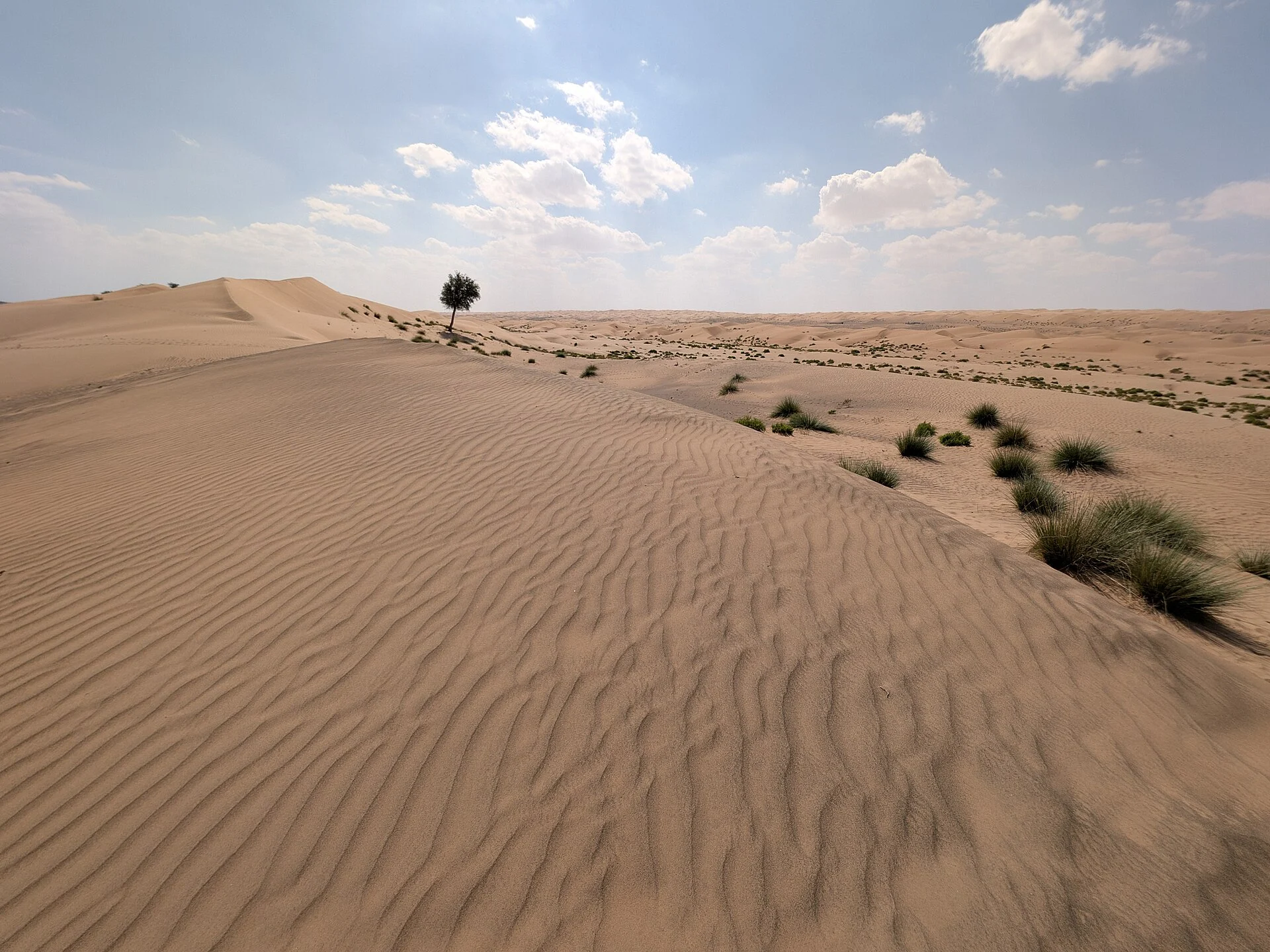
As a legume, the ghaf fixes atmospheric nitrogen, and its fallen leaves add organic matter to poor sandy soil. Feedipedia reports that in drier areas the yields of crops and grasses growing beneath its canopy were nearly doubled, and that chickpea grew well within 14 m of the trunk. Its roots hold loose sand in place, which is why the tree is planted to stabilise sand dunes. In Oman's Sharqiya region, the botanist Kevin Brown found during fieldwork from 1986 to 1990 that the tree copes with shifting dunes by growing vegetatively up through the accumulating sand, forming clumps of stems.
WHERE DOES THE GHAF TREE GROW?
Feedipedia places the species' origin in the Thar Desert of India and Pakistan, from where it spread south to Tamil Nadu, east to West Bengal and west to Afghanistan and Iran. The World Agroforestry database lists it as native to Afghanistan, India, Iran, Pakistan and Sri Lanka. Within India it grows in the dry parts of Rajasthan, Gujarat, Punjab, Delhi and Madhya Pradesh. It occurs from sea level up to about 600 m and is rare in hilly country, where growth is stunted and fruiting poor. Abu Dhabi's Environment Agency gives its overall range as Western Asia, the Arabian Peninsula and the Indian subcontinent.
Sources describe its status in Arabia differently. Feedipedia refers to isolated populations in Oman, Yemen, the UAE and Saudi Arabia, while the World Agroforestry database lists the UAE as a country where the tree has been planted. Abu Dhabi's Environment Agency and Gulf News treat it as indigenous. In Oman, Brown's doctoral research at Durham University, completed in 1991, described P. cineraria as native and recorded large relic woodlands made up almost entirely of the one species in the sandy deserts of the Sharqiya. He found that some of these woodlands had been degraded by overexploitation and that natural regeneration was largely absent.
FODDER, FOOD AND MEDICINE: HOW WAS THE GHAF USED?
In the Emirates the ghaf supported Bedouin life. Gulf News reported in 2007 that the tree provided fuel, shelter, medicine and food, and in 2018 that camel camps were traditionally set up in ghaf groves, which gave shelter in summer. Emirati families pruned the trees in winter with hand tools, using methods passed down through generations. Children are also named after the tree; the 2007 report cites the names Gafan, Gafa and Bu Hadoub. ICBA notes that before the oil boom people ate young ghaf leaves and pods in salads or with rice, and that bees forage on the flowers to make a honey regarded as a delicacy in the UAE.
As fodder, the tree is browsed or lopped several times a year for camels, cattle, sheep, goats, horses and donkeys. Feedipedia gives a yield of about 45 kg of dry leaf fodder a year from a moderate-sized tree, with about 14 per cent crude protein in the leaves, while the pods contain about 20 per cent protein and 24 per cent sugars. The hard wood is used for poles, houses, boat frames and tool handles, and the World Agroforestry database rates it as excellent firewood. Folk medicine across its range uses the bark for asthma, bronchitis and dysentery, and in the UAE, ICBA records traditional remedies for cataracts, dyspepsia and toothache. The agroforestry database notes that claimed uses against snakebite and scorpion stings have not been proven.
KHEJRI: THE GHAF TREE IN RAJASTHAN
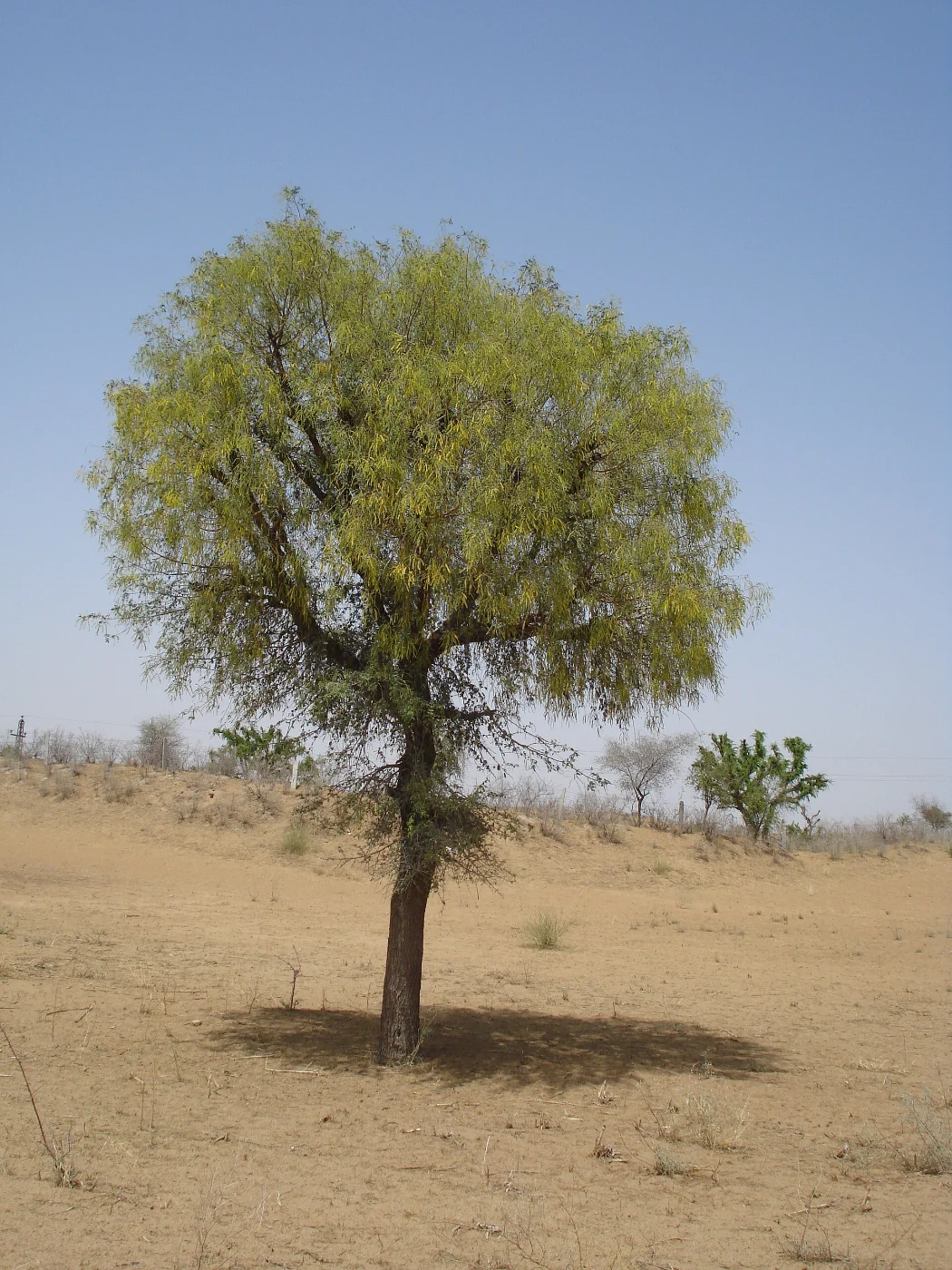
In India the same species is called khejri or khejra, or jant and janti in parts of Rajasthan, and it is the state tree of Rajasthan. Saraswati Bishnoi, a botanist and professor at the University of Bikaner, writing for the Indian heritage resource Sahapedia, describes it as a cornerstone species of the Thar Desert and records its honorific titles: kalpavriksha of the desert, king of the desert and wonder tree. The leaves used for fodder are loong, the green unripe pods are sangri or sangar, and the dried mature pods are kho-kha.
The khejri also has a religious role. The Bishnoi community honours and worships the tree, and in some districts of Rajasthan it is a symbol of Krishna, with green twigs worshipped at home on Janmashtami. Its wood has been used since the Vedic period to kindle the sacred fire for yajna rituals. Khejri forms most of the tree cover in oran and gochar, the sacred groves and common pastures attached to villages. The tree also appears in Sanskrit epic: according to the Mahabharata, the Pandava brothers hid their weapons in a khejri during their exile, and the worship of the tree is known as sampuja.
HOW DID THE GHAF BECOME THE UAE'S NATIONAL TREE?
The tree's place in Emirati life shows in place names: oud, the Arabic word for a dense ghaf grove, survives in the name of the Dubai district of Oud Metha. Legal protection came before national status. Federal Law No. 24 of 1999 prohibits cutting, uprooting or illegally collecting wild plants, and by 2007 cutting down a ghaf was illegal, while uprooting and transplanting one required permission. In the same period the tree was in decline. Gulf News reported in 2007 that ghaf trees were disappearing from the landscape because of development, groundwater extraction, overgrazing, the cutting of branches for firewood and rising temperatures.
From 1 January 2006 the WWF project office in the UAE ran a conservation plan for the tree that aimed to create a protected area and train local rangers to patrol it. Its Save the Ghaf campaign asked for the ghaf to be declared the national tree, arguing that the status could curb its decline; by May 2007 the online petition had 2,633 signatures and was due to be presented to the Ministry of Environment and Water. The ghaf was declared the national tree of the UAE in 2008 for its cultural and traditional significance.
PROTECTING THE GHAF TREE TODAY
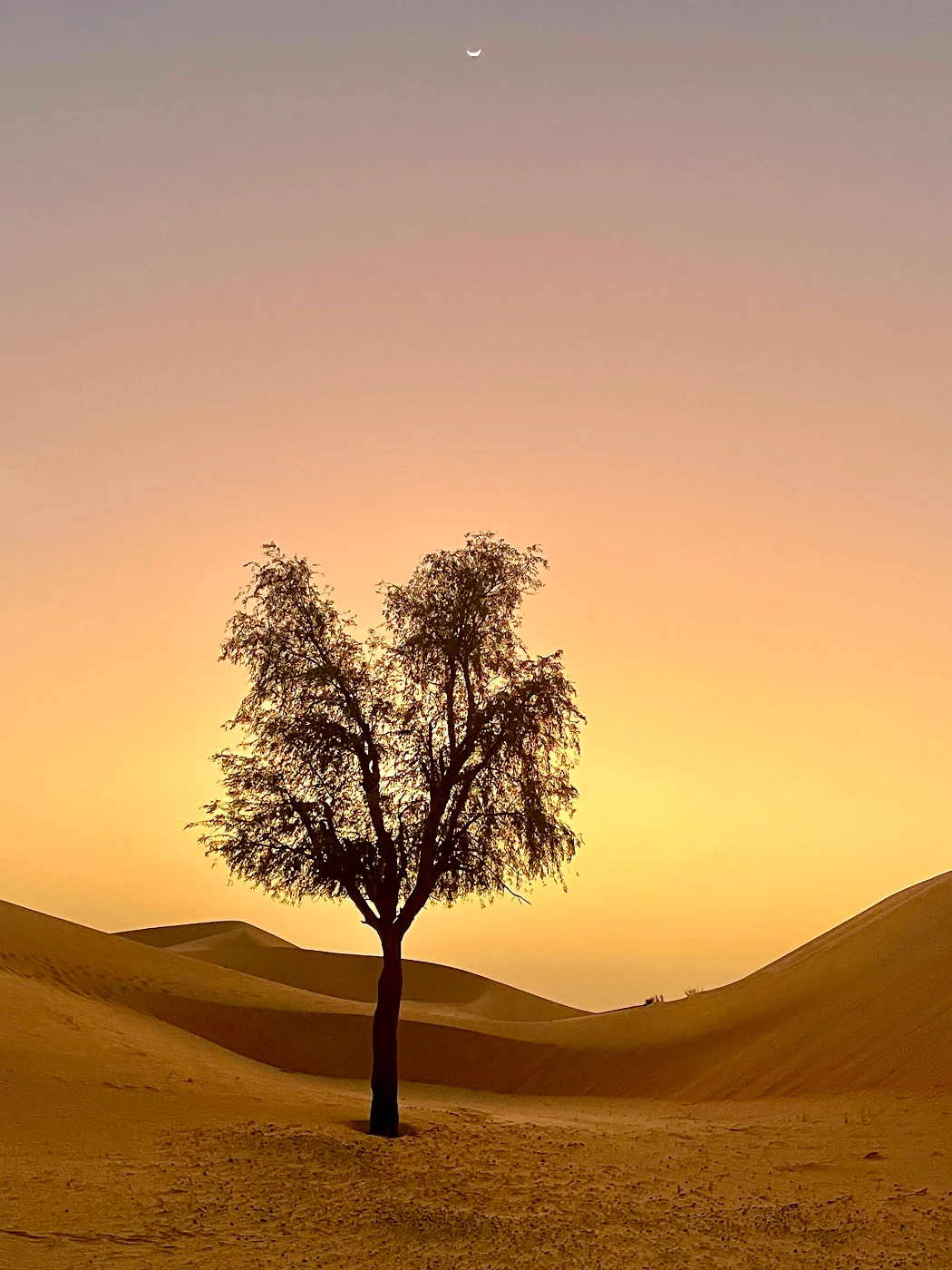
The Environment Agency Abu Dhabi (EAD) lists habitat loss from urbanisation and infrastructure, together with overgrazing, as the main threats to the ghaf. ICBA adds a growing camel population, the lowering of water tables beyond the reach of the roots, pollution and global warming. EAD applies strict measures against the felling of local trees, with particular attention to the ghaf, and its nursery stores the seed of 58 native wild species, ghaf among them. In 2021 the agency began tagging old trees: about 100,000 ghaf and samar trees are thought to grow in the emirate, and the first phase covered 1,500 ghaf, each located from satellite and aerial images and given a serial-numbered tag.
Research has focused on the tree's value against desertification. ICBA studied 82 trees within a single square kilometre in 2001 and 2002, measuring 25 traits of crowns, leaves, flowers, pods and seeds, and found wide variation even within that small area. In a 2016 to 2017 trial of desert planting, ghaf seedlings survived and grew better than neem and Ziziphus. The UAE social enterprise Goumbook began its Give a Ghaf planting programme in 2010, and in 2019 EAD planted 600 ghaf at Al Faya as a windbreak and wildlife habitat. Al Ain Municipality runs seasonal pruning campaigns using approved methods, intended in part to stop unnecessary felling.
THE GHAF, THE DUNES AND THE SPA AT MANDARIN ORIENTAL JUMEIRA, DUBAI

The ghaf is a tree of sandy desert. Its roots hold loose sand in place, it is planted to fix dunes in arid land, and in Oman's Sharqiya it forms woodland among the dunes, growing up through the sand as it accumulates around the trunk. The curved, ridged forms of those dunes are the reference for The Spa at Mandarin Oriental Jumeira, Dubai, which Silverfox Studios completed in 2019 to a concept called DesertScape, drawn from the shapes of sand dunes.
The spa has nine treatment rooms with full-height windows facing the beach and the Gulf, together with a VIP suite and a hammam suite. The DesertScape concept is carried into the vitality room, where a circular dark mosaic pool sits within curved walls of stratified marble beneath a rippled, cove-lit ceiling. The grain of the marble runs continuously from surface to surface. Seating takes the form of linen cocoon pods. The curves, layers and ripples of these surfaces follow the curved and ridged dune forms on which the concept is based.
SOURCES
- Environment Agency Abu Dhabi Ghaf Tree
- Frontiers in Sustainability Eco-luxury: Making sustainable drugs and cosmetics with Prosopis cineraria natural extracts (2022)
- Feedipedia (INRAE, CIRAD, AFZ and FAO) Prosopis (Prosopis cineraria)
- World Agroforestry (ICRAF) Agroforestry Database: Prosopis cineraria
- Durham University Kevin Brown, Biology of Prosopis cineraria (Leguminosae) in the Sultanate of Oman (1991)
- International Center for Biosaline Agriculture Scientists see untapped potential in UAE's national tree
- Sahapedia Saraswati Bishnoi, Khejri: A Wonder Tree of the Thar
- Gulf News Retaining Nature: Save The Ghaf (2007)
- Gulf News Al Ain Municipality launches Ghaf pruning drive (2018)
- Gulf News How Abu Dhabi tags and monitors old native trees to ensure their protection (2021)