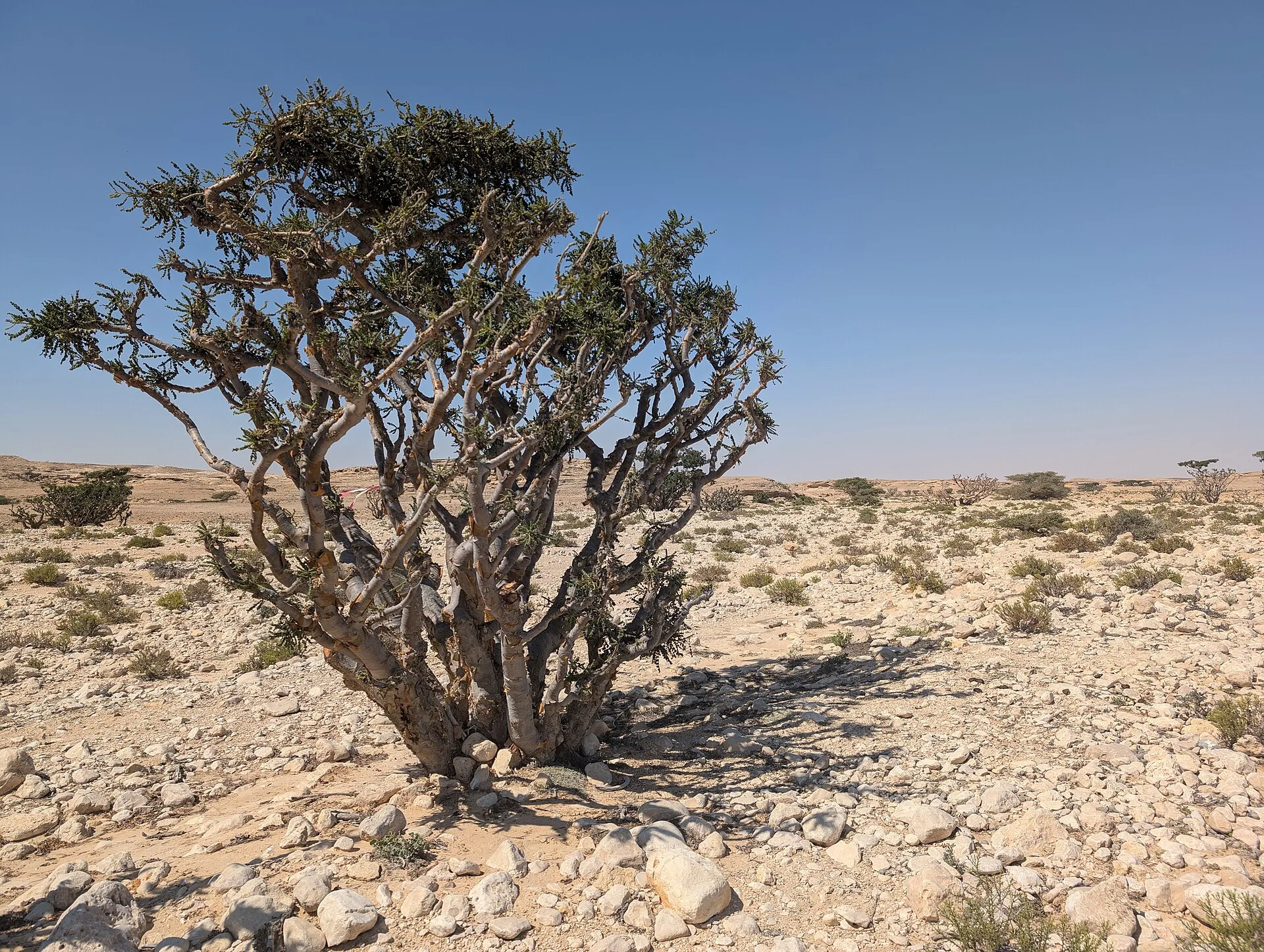
WIND SORTS, LIFTS AND PILES SAND INTO THE RIDGES, CRESCENTS AND STARS OF THE ARABIAN DESERT
Sand dunes form when wind moves loose grains across the ground and then drops them, so that sand gathers into mounds that grow, steepen and travel downwind. The shape a dune takes depends on how much sand is available and on whether the wind blows from one direction, from two or from several. Geologists group the results into a small number of types of sand dunes: crescentic, linear, star, dome and parabolic. The Rub' al Khali, the Empty Quarter of southern Arabia, holds the largest area of continuous sand in the world and contains several of these forms at once, from parallel ridges tens of kilometres long to star dunes built on top of them and crescent-shaped megadunes up to 170 metres high at Liwa in the United Arab Emirates.
HOW DO SAND DUNES FORM?
Sand starts to move only when the wind near the ground passes a threshold speed, and that threshold rises with grain size. Britannica gives a wind of 12 km per hour, measured at 10 metres, as enough to move grains 0.2 millimetres across, while grains of 0.6 millimetres need 21 km per hour. The quantity carried rises steeply with wind speed: about 13 grams of sand an hour at 10 km per hour, 274 grams at 20 km per hour and 1,179 grams at 30 km per hour. Most desert sand is therefore probably moved by unusually strong winds rather than by moderate breezes. The main mode of transport is saltation, in which grains bounce along the surface in a series of short leaps. Coarser grains creep along the surface instead, kept in motion partly by the impact of the saltating grains. Saltating sand bounces more readily off hard ground than soft, so more sand crosses pebbly surfaces than smooth or soft ones.
A dune begins where a slight hollow or a smoother patch of ground reduces the amount of sand the wind can carry, leaving a small patch of sand behind. If that patch grows large enough, it traps more. As the mound builds, its downwind slope steepens until the airflow can no longer follow it and separates from the surface, leaving a sheltered zone where sand settles. That slope reaches the angle of repose of dry sand, about 32 degrees, and sand then slides down it. This steep lee side is the slip face. In this state the whole dune advances, losing sand from its windward side and gaining it on the slip face. Britannica records rates of 30 metres a year in Peru, 25 metres in California and 20 to 100 metres in Egypt's Kharga Depression, with smaller dunes moving fastest because less sand has to shift to carry them forward.
SAND RIPPLES: THE SMALLEST PATTERN IN THE DESERT
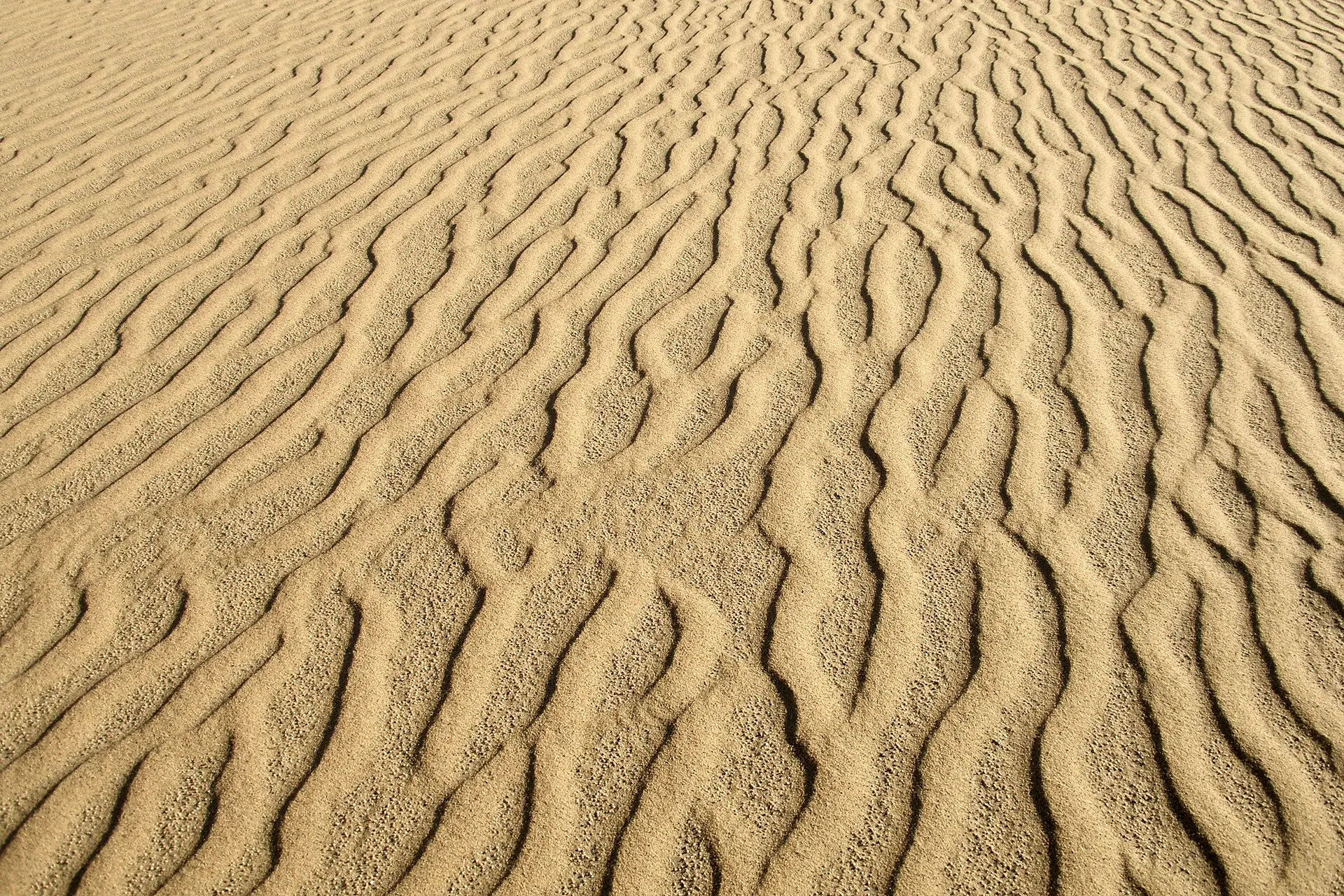
The smallest regular form on a dune is the wind ripple. Robert S. Anderson, an earth scientist at the University of California, Santa Cruz, explains in Scientific American that saltating grains strike the surface at a shallow angle, around 10 degrees, and knock other grains loose, most of which travel only a few millimetres. Grains are eroded from the upwind side of any small bump and settle in the sheltered zone behind it, so the bump grows and a train of crests develops. The crests line up roughly at right angles to the wind, are typically about 10 centimetres apart and stand only a few millimetres above the troughs. Each ripple has a gentle upwind face and a steeper downwind face, and the pattern migrates slowly downwind. Stronger winds flatten the angle at which grains land, which lengthens the sheltered zone behind each crest and so widens the spacing.
The pattern organises itself rather than being imposed by the wind, and it is never perfectly regular: crests split and end. Ripples also sit at the bottom of a hierarchy. Britannica describes desert sand as arranged in distinct size classes, in which large dunes are covered by smaller dunes and those in turn by ripples. Most ripples are only a few centimetres apart, but in very coarse sand mega-ripples can be spaced almost as far apart as small dunes.
THE TYPES OF SAND DUNES
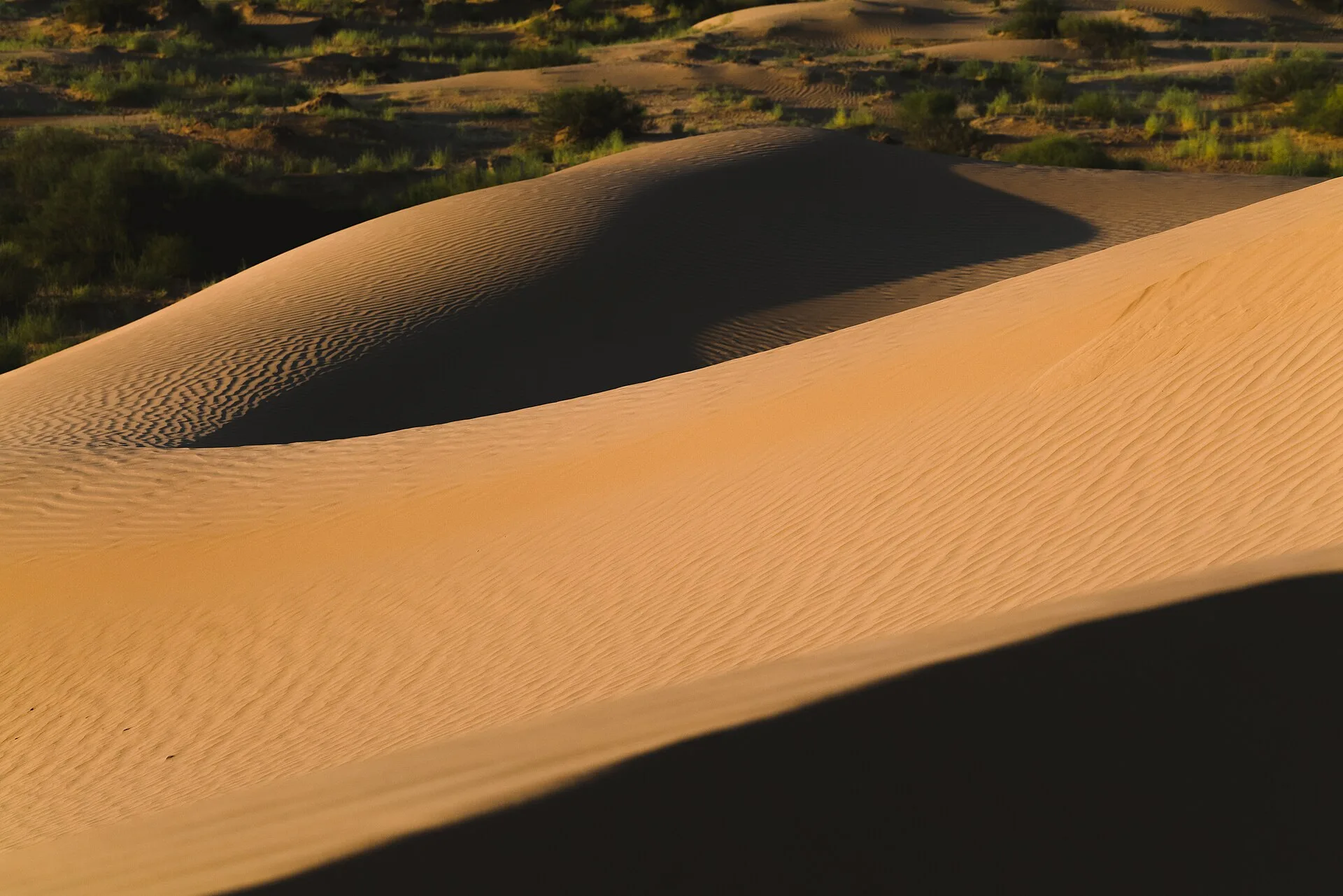
The US Geological Survey defines five basic dune types. Crescentic dunes are the most common on Earth and on Mars. They are wider than they are long, carry their slip face on the concave side and form where the wind blows mainly from one direction. They can move fast: a group in China's Ningxia province advanced more than 100 metres a year between 1954 and 1959. The isolated form is the barchan, with its horns pointing downwind. Britannica gives barchans a height of 9 to 30 metres, a base width of about 370 metres and migration rates of roughly 1 to 100 metres a year. The name comes from Turkistan and was introduced into scientific writing by the naturalist Alexander von Middendorf in 1881.
Linear dunes are straight or slightly sinuous ridges, much longer than they are wide, that can exceed 160 kilometres. Many form under winds from two directions, with their long axes following the net direction of sand movement. Star dunes are pyramid-shaped mounds with three or more arms radiating from a central peak. They form where winds blow from several directions and grow upwards rather than sideways; in the Badain Jaran Desert of China they reach up to 500 metres. Dome dunes are rare low mounds without slip faces, and parabolic dunes are U-shaped, with long trailing arms anchored by vegetation. Any type can also be simple, compound (with smaller dunes of the same type on top) or complex (combining two or more types), and the USGS notes that compound and complex dunes suggest that wind strength or direction has changed over time.
THE RUB' AL KHALI: ARABIA'S EMPTY QUARTER
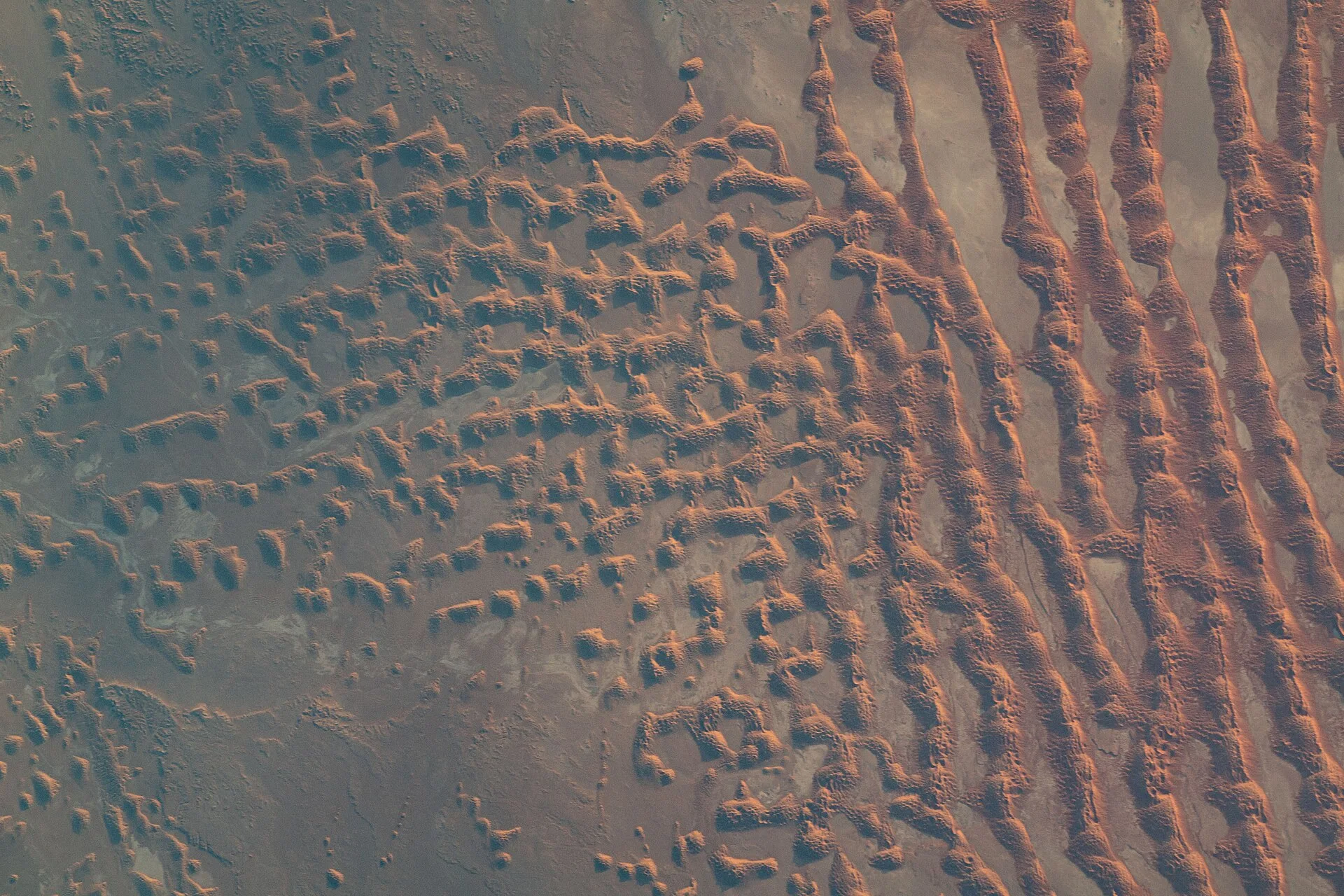
Britannica describes the Rub' al Khali as a structural basin of about 650,000 square kilometres, lying mainly in south-eastern Saudi Arabia with smaller portions in Yemen, Oman and the United Arab Emirates. It occupies more than a quarter of Saudi Arabia and is the largest area of continuous sand in the world. The ground rises to about 610 metres in the west, where the sand is fine and soft, and falls to about 180 metres in the east, where dunes alternate with sabkhas (salt flats) and sand sheets. It is one of the driest regions on Earth and is virtually uninhabited. Giant dunes in the sand sea sometimes exceed 200 metres in height.
The desert has not always been this dry. NASA's Earth Observatory notes that geological and archaeological evidence points to cooler, wetter climates in the past: exposed lake-bed sediments, scattered stone tools and fossils of hippopotamus, water buffalo and long-horned cattle. The dunes are also not uniform across the basin. A 2013 study in the journal Aeolian Research by M.A. Al-Masrahy and N.P. Mountney, using satellite imagery, found that dune type, size and orientation change systematically from the centre of the sand sea towards its edges. Large, complex compound bedforms in the interior give way to smaller, simpler dunes at the margins, which the authors attribute to declining sand supply and a reduced capacity of the wind to move sand there.
LINEAR AND STAR DUNES OF THE EMPTY QUARTER
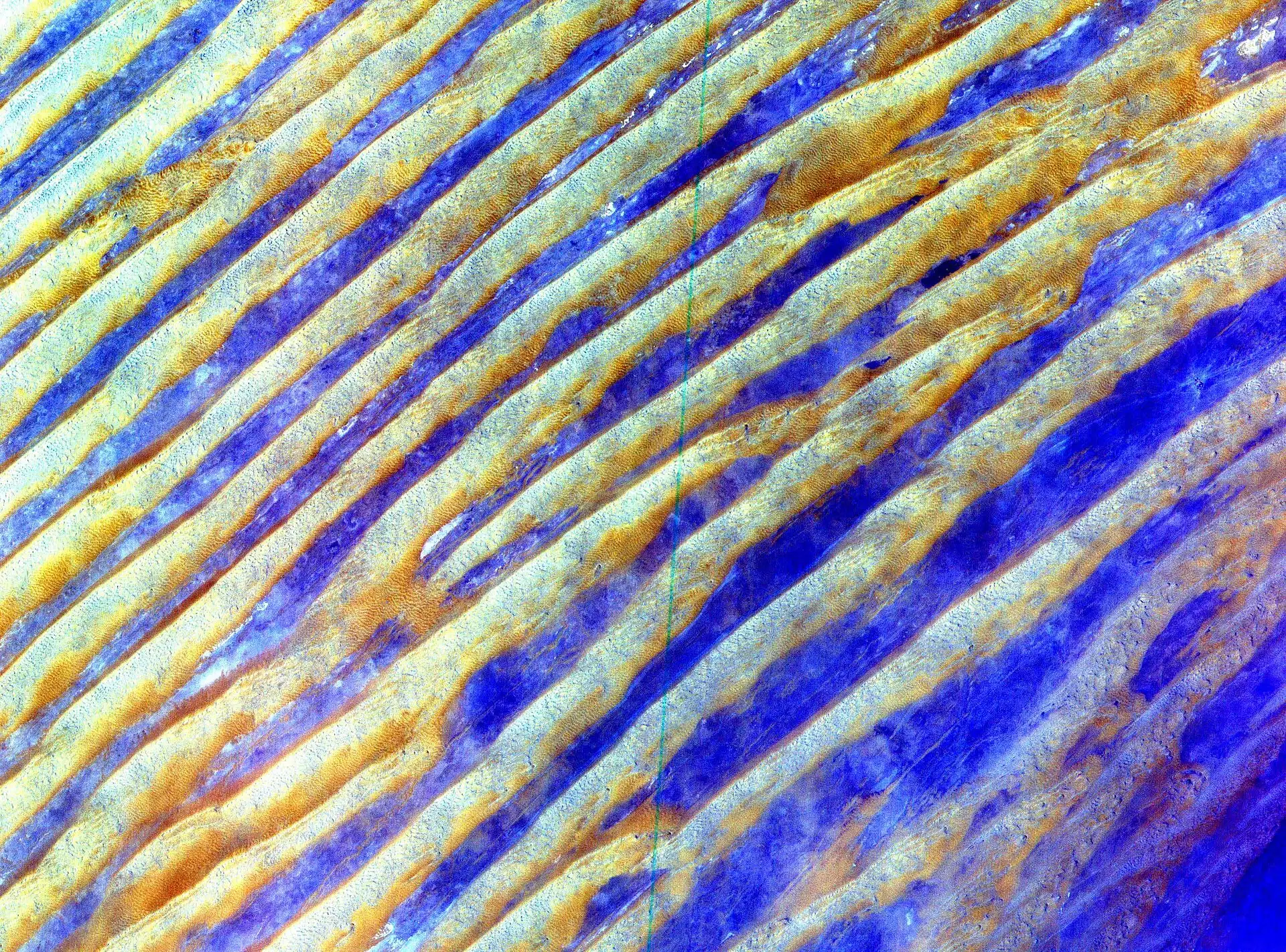
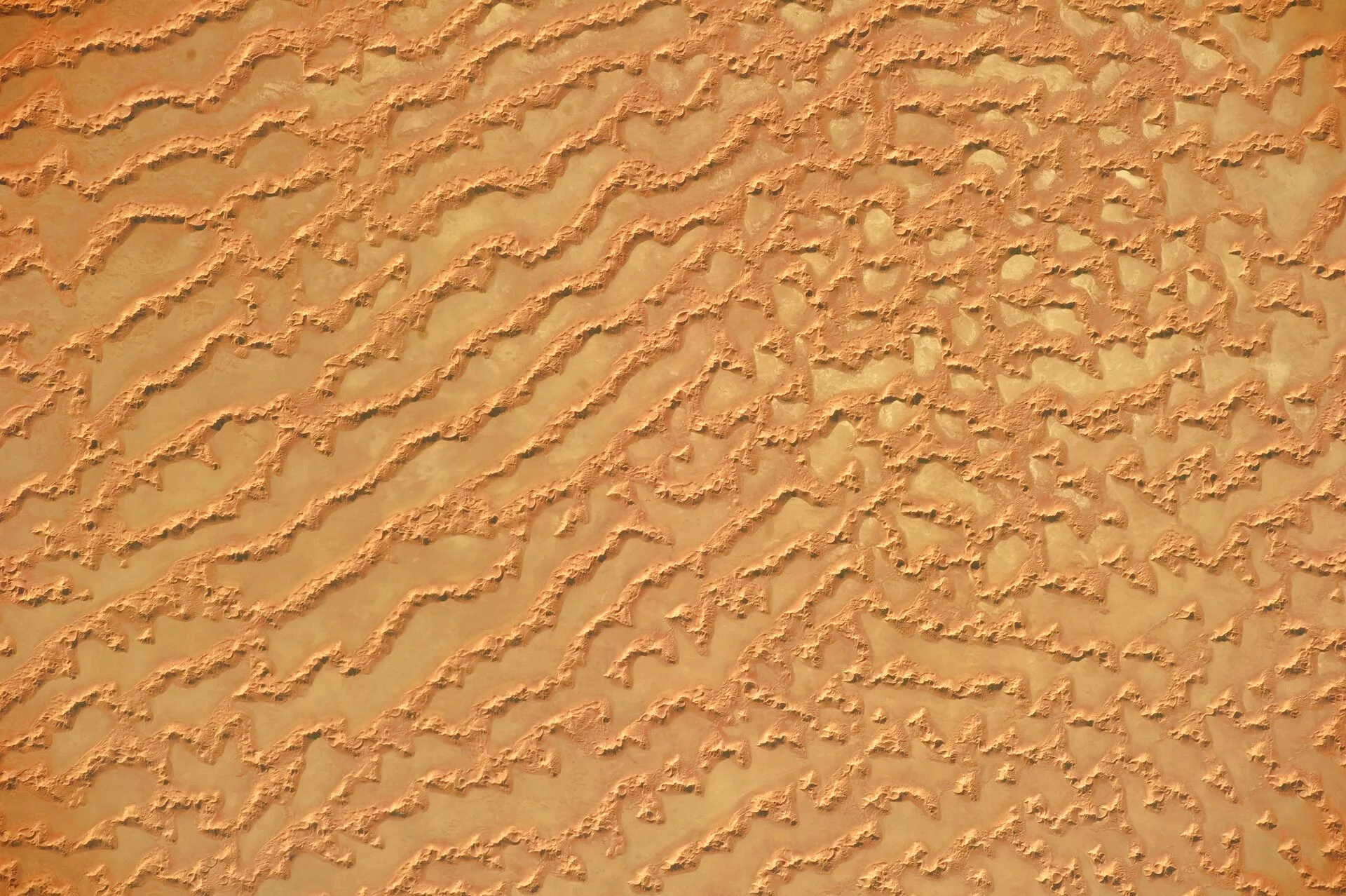
A photograph taken from the International Space Station on 13 April 2023 shows how these forms combine in south-eastern Saudi Arabia. Evenly spaced linear dunes, generated by strong prevailing winds, run in nearly straight lines from north-west to south-east and continue for 34 kilometres within the frame. Elsewhere in the Rub' al Khali, according to NASA, linear dunes grow up to 75 kilometres long. Numerous star dunes rise from the crests of these ridges, higher and steeper than the linear dune bodies beneath them. NASA notes that such complex systems are common in large sand seas because so much sand is available.
On the south-eastern margin of the sand sea in Oman, an earlier astronaut photograph from May 2011 shows large reddish-brown linear dunes alternating with interdune sabkhas, with smaller crescent-shaped barchans formed on top of them. Towards the north-east and east the linear dunes break up into isolated large star dunes. NASA links the main dune pattern to the shamal, the north-westerly wind that originates in Iraq, and the secondary barchans and star dunes to south-westerly winds during the monsoon season. The break-up of linear dunes into star dunes is, in NASA's words, likely the result of interacting wind patterns and changes in sand supply.
LIWA AND THE MEGADUNES OF THE UNITED ARAB EMIRATES
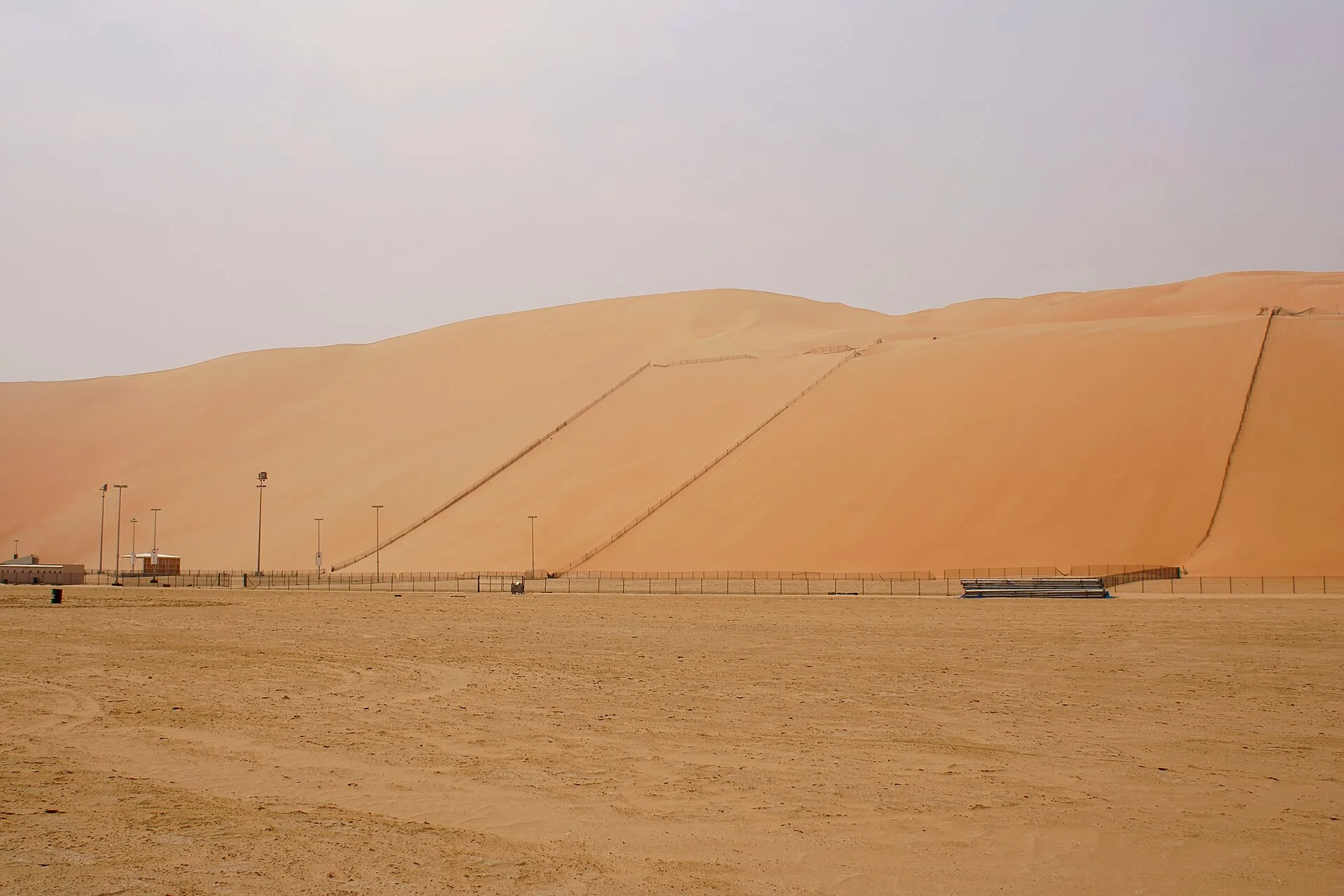
In the Al Liwa region of the north-eastern Rub' al Khali, in the United Arab Emirates, the dominant forms are megadunes. Britannica calls such features compound dunes, mega-dunes or draa: very large dunes that are usually covered by a secondary pattern of smaller dunes, which is in turn covered by ripples. A 1993 study by J.M. Pugh, K.W. Glennie and B.P.J. Williams of the University of Aberdeen, presented to the American Association of Petroleum Geologists, describes the Liwa landscape as compound crescentic draa up to 170 metres high, separated by roughly circular inland sabkhas. The sand is a mix of fine and coarse grains with a strong carbonate component. The draa migrate very slowly to the south-south-east, while the smaller dunes of the sand sea to the north, which extends almost to the coast, move south faster.
The sabkhas between the draa are crusted with evaporite minerals and are often underlain by the sloping layers of former slip faces, which record the same south-south-east transport. The water table controls conditions in these interdune flats. The authors also note that the flooding of the Gulf cut off the sand supply from the north, and that coastal areas have since been deflated, or scoured by wind, down to the water table.
THE SPA AT MANDARIN ORIENTAL JUMEIRA, DUBAI

The Spa at Mandarin Oriental Jumeira, Dubai, designed by Silverfox Studios and completed in 2019, is built around a concept called DesertScape, which draws on the curved, ridged form of desert dunes. The spa has nine treatment rooms with full-height windows to the beach and the Gulf, and a combined VIP and hammam suite. In the relaxation lounge, guests sit in cocoon-shaped linen seating pods.
Two of the patterns wind leaves in a dune are the ripples on its surface and, inside it, the sloping layers laid down by successive slip faces. The vitality room carries both forms in its materials. A circular pool lined in dark mosaic is surrounded by curved, stratified marble walls, and the ceiling above it is rippled and lit from a concealed cove. Throughout the spa, the marble is laid so that its grain runs in a continuous line.
SOURCES
- US Geological Survey Types of Dunes
- Britannica Sand dune: Winds, formation and migration
- Britannica Sand dune: Dune and sheet patterns
- Britannica Barchan
- Britannica Rub' al-Khali
- Scientific American Why do regular, wavelike sand ripples form?
- NASA Earth Observatory Linear and Star Dunes
- NASA Earth Observatory Ar Rub' al Khali Sand Sea, Arabian Peninsula
- White Rose Research Online, University of Leeds Remote sensing of spatial variability in aeolian dune and interdune morphology in the Rub' Al-Khali, Saudi Arabia
- AAPG Search and Discovery Three-Dimensional Modeling of an Aeolian Dune/Interdune System