TWO OTTOMAN BEDESTENS, SIXTY-ONE STREETS AND THE HANS AROUND THEM
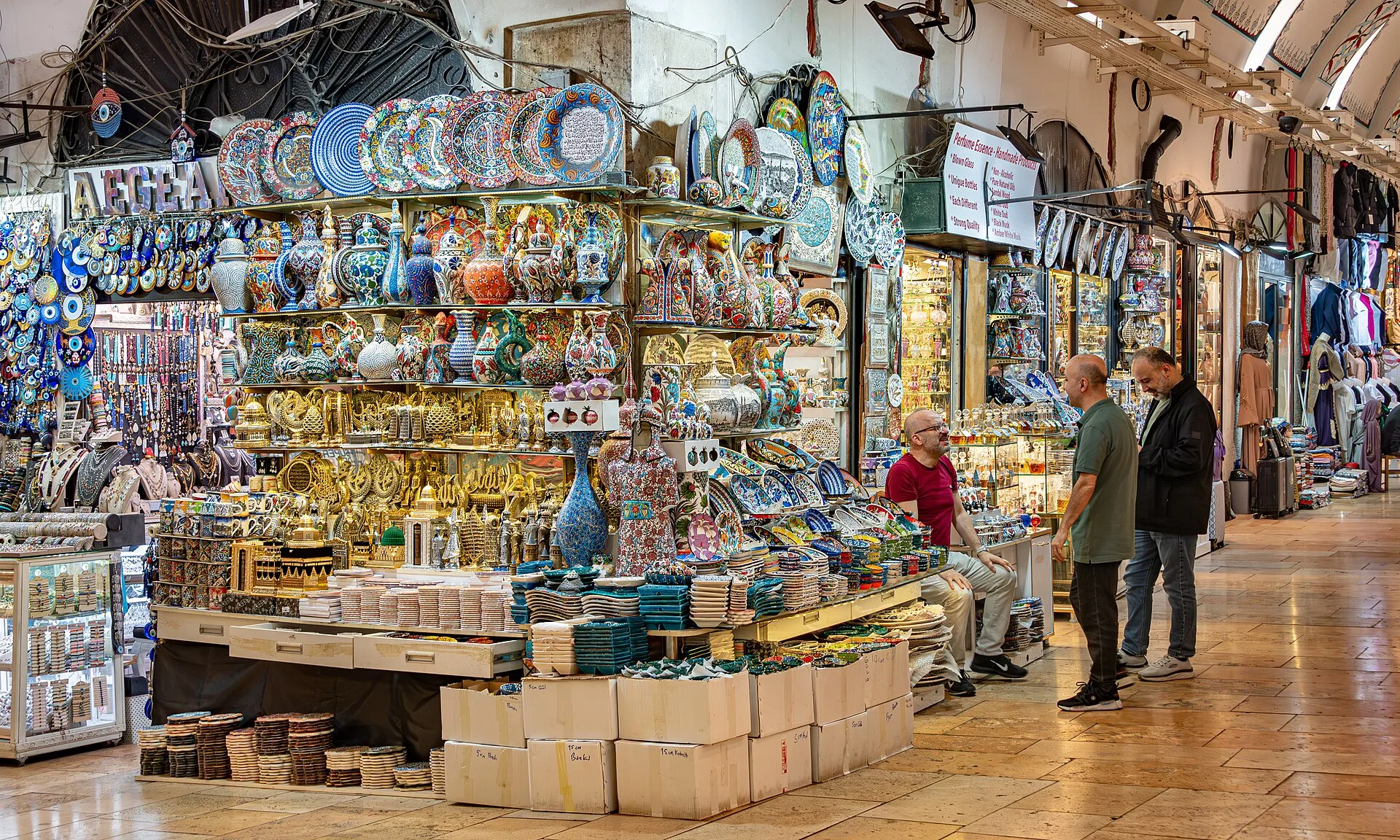
The Grand Bazaar of Istanbul, known in Turkish as Kapalıçarşı (the Covered Bazaar) or Büyük Çarşı, lies between the Beyazıt and Nuruosmaniye mosques. It was not built as a single complex. According to Semavi Eyice's entry in the TDV İslâm Ansiklopedisi, it grew around two bedestens, masonry halls for valuable goods, as hans and streets of shops gathered around them and their roofs were gradually vaulted. A 2022 survey of the Grand Bazaar by İnci Dilaveroğlu and Nuran Kara Pilehvarian counts 61 covered streets and 21 gates, and measures about 45,000 square metres inside the gates.
WHAT IS A BEDESTEN? THE CEVAHIR BEDESTEN OF MEHMED II
A bedesten was the core of the bazaar district in Ottoman cities, a building where valuable goods were stored and sold. Eyice traces the word to bezzâzistan or bezistan, from the Arabic bezzâz, a cloth seller, and lists what bedestens sold: jewels, precious stones, weapons, decorated horse gear and fine fabrics. The Istanbul hall, the Cevahir Bedesten, has carried several names: Bezzâzistan, Bedestân-ı Atîk (the Old Bedesten), Büyük Bedesten and İç Bedesten (the Inner Bedesten). Cevâhir means jewels. Mehmed II had it built as an endowment to fund his charitable foundations, and the chroniclers Tursun Bey, Kritovulos and Dukas report that the first core of the bazaar formed right after 1453.
Eight massive piers divide the interior into fifteen equal bays, each covered by a dome. The walls are solid masonry with few, high windows and iron shutters, and iron-clad doors open on all four sides. Merchants kept valuables, cash boxes, documents, ledgers and guild records inside, where they were safer than in the wooden shops around it. Above one gate is a stone eagle relief reused from the Byzantine period; Eyice notes that it does not prove the building itself is Byzantine. Mehmed II's Turkish endowment deed describes the Bezzâzistan with 118 sanduka (chests) and, together with the shops attached to it, 849 shop doors.
THE SANDAL BEDESTEN AND THE QUESTION OF ITS DATE
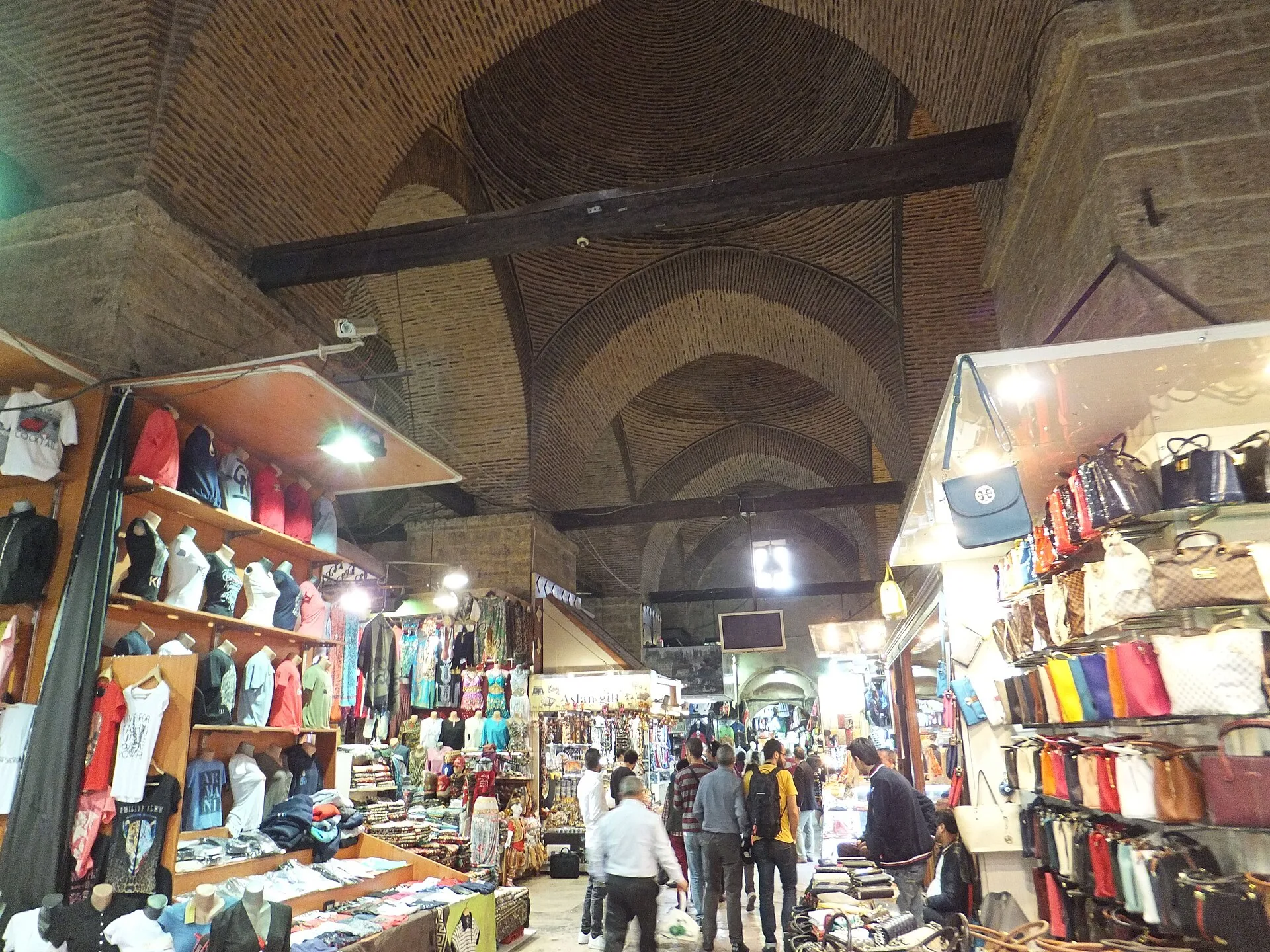
The second hall, the Sandal Bedesten, also called Bedestân-ı Cedîd or Yeni Bedesten (the New Bedesten), has more bays than the first. Twelve massive piers divide it into twenty equal bays, each covered by a brick dome. Its name comes from sandal, a striped or patterned fabric imported from India, and it served as a centre for valuable textiles: Evliya Çelebi and Du Loir both record cloth being sold there. For many years it was later used as the auction hall of the Istanbul Municipality. Its east door opens towards the Nuruosmaniye Mosque.
The building's date is disputed. It does not appear in Mehmed II's endowment deed of 877 (1472 to 1473), but according to Ekrem Hakkı Ayverdi it is listed in the deed of 883 (1478 to 1479), and Evliya Çelebi attributes it to Mehmed II. Efdaleddin Tekiner proposed a later date, possibly under Süleyman I. Eyice's two entries reflect the uncertainty: his article on bedestens places it probably in the reign of Süleyman (1520 to 1566), while his article on the bazaar states that a date under Mehmed II is generally accepted. Dilaveroğlu and Pilehvarian also describe the attribution to Mehmed II as the dominant view.
HOW DID THE GRAND BAZAAR IN ISTANBUL GROW INTO A COVERED MARKET?

Nilufer Saglar Onay, writing in the World Journal of Social Sciences and Humanities in 2017, describes the bazaar as unplanned and developed over time, with new streets of shops forming between the two bedestens until the whole area was given over to commerce. Dilaveroğlu and Pilehvarian date the earliest streets around both halls to the fifteenth century and note that those between the bedestens form a grid, while the streets west of the Cevahir Bedesten are more organic. Onay identifies three zones: a core for storing valuables around the old bedesten, a ring where valuable goods were produced and sold, and an outer zone for everyday goods.
The early streets had wooden roofs or awnings over wooden shops. Eyice describes the traditional shop front with two shutters: the lower one opened outward to form a display counter, and the upper one was raised and hung from its ends as an awning, shading goods and buyers from sun and rain. In August 1702 Sultan Mustafa II sent a decree banning wooden shops and houses and requiring masonry construction. From then on the street tops were gradually covered with barrel vaults, and the bazaar became a covered market.
GUILDS AND THE TRADES BEHIND THE STREET NAMES
The bazaar's merchants and craftsmen belonged to the esnaf, the Ottoman guilds. Ahmet Kal'a's entry on the esnaf in the TDV İslâm Ansiklopedisi sets out their organisation. Each guild's board included a şeyh at its head, a role taken over by the kethüda from the eighteenth century; a kethüda who handled administration and disputes; a yiğitbaşı who oversaw discipline, apprentice training and the guild fund; and an işçibaşı who handled technical matters and inspected output so that substandard goods did not reach the market. Members advanced from apprentice (çırak) to journeyman (kalfa) and master (usta), and at the ceremony for a new master the yiğitbaşı tied a şed sash on him.
Two senior masters, the ehl-i hibre, arbitrated disputes and helped set prices according to standard and quality, while the state fixed prices through the narh, repricing staple foods often and other goods less frequently. Hoarding and overpricing of staples were severely punished. From the middle of the seventeenth century, gedik rights, privileges of a monopoly type, developed within the system. Kal'a records that the gedik and guild system was formally abolished in 1913, after the Istanbul Chamber of Commerce had been founded in 1879.
The street names preserve the trades. Dilaveroğlu and Pilehvarian give Kalpakçılar (calpac sellers), Kuyumcular (jewellers), Aynacılar (mirror sellers) and Fesçiler (fez sellers) as examples of streets named after artisan groups. Eyice records Yağlıkçılar (towel merchants), Çadırcılar (tent makers), Yorgancılar (quilt makers), Halıcılar (carpet dealers) and Kürkçüler (furriers), and notes that cloth merchants (bezzazlar), cap makers and tailors (terziler) occupied the original area around the Cevahir Bedesten. The booksellers, the sahaflar, kept a street next to the inner bedesten until 1894.
THE 1894 RESTORATION OF THE GRAND BAZAAR AND ITS GATES
After an earthquake in 1894, Sultan Abdülhamid II ordered repairs that lasted eighteen months. The work narrowed the bazaar's boundaries and left about half of its hans outside: Sarnıçlı, Paçavracı and Ali Paşa hans entirely, and Yolgeçen Han in part. The vault over Çadırcılar was left open, and the Kürkçüler and Çadırcılar gates were moved outward. The booksellers moved out of the bazaar to Tesbihçiler, beside the Beyazıt Mosque. Dilaveroğlu and Pilehvarian note that Kalpakçılar was probably widened during the repairs.
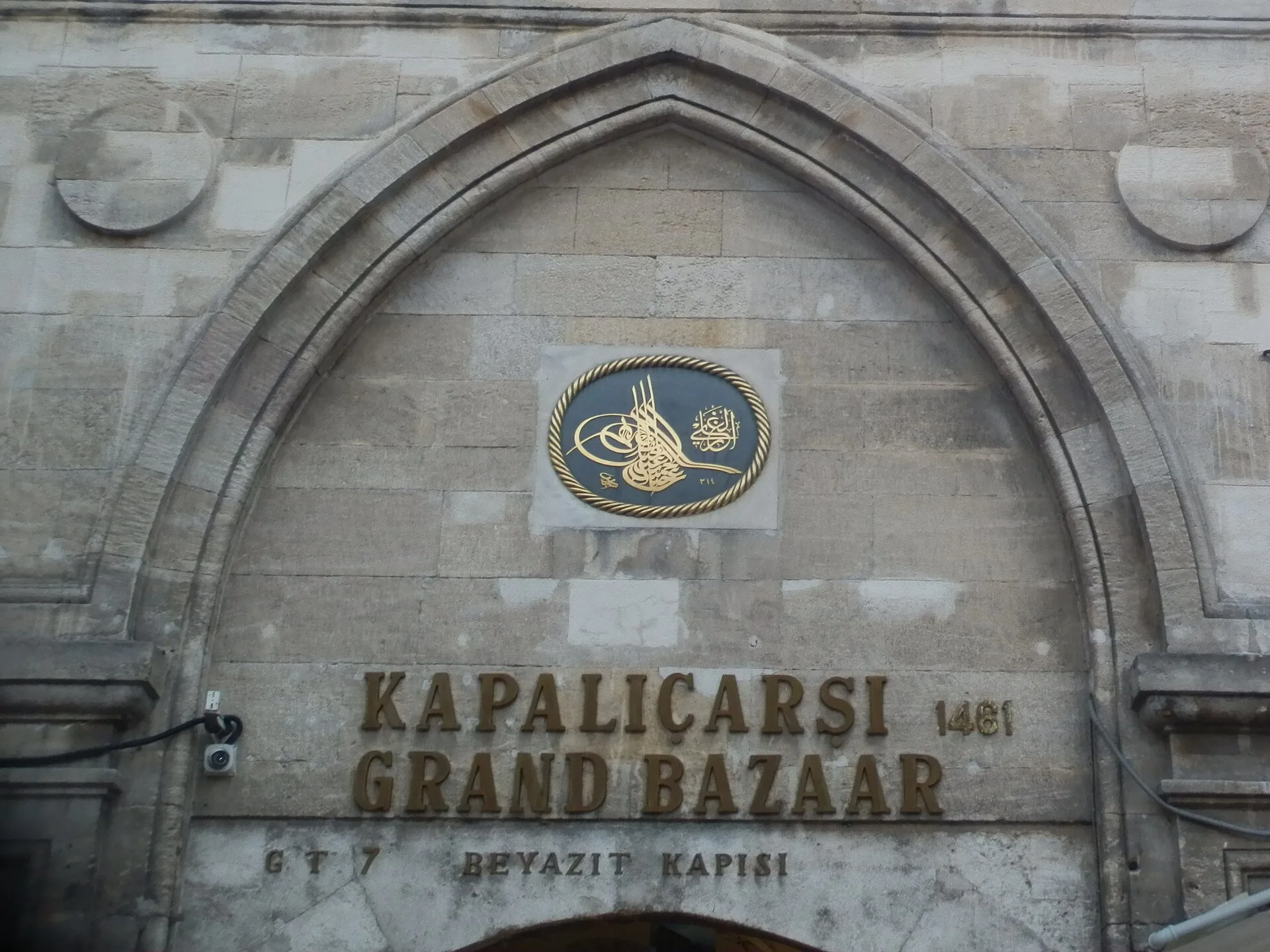
Two new gates were built at the ends of the old Kalpakçılar street. The Nuruosmaniye gate has a muqarnas canopy, a pointed arch and an Ottoman coat of arms, with a two-line repair inscription by the calligrapher Sâmi Efendi; the plainer Beyazıt gate carries an inscription by Sâmi Efendi with the tughra of Abdülhamid II. Today a brass tughra plate sits in the spandrel of the Beyazıt gate's pointed arch, and brass letters read "Kapalıçarşı, Grand Bazaar, 1461, Gate 7"; the Nuruosmaniye gate is marked Gate 1. The Beyazıt opening is 3.64 metres high and 3 metres wide, set in a 9 metre wall raised to hide the barrel vault behind it, and it closes with iron folding doors of two leaves on each side. Of the 21 gates in their survey, Dilaveroğlu and Pilehvarian rank Beyazıt, Nuruosmaniye and Çarşı Kapı as the most important, and describe Çarşı Kapı as the most elaborate, used as the symbol of the bazaar.
THE HANS AROUND THE BAZAAR: ZINCIRLI HAN AND BÜYÜK VALIDE HAN

Hans, courtyard buildings for merchants, storage and workshops, surround the two bedestens. Eyice cites a list by Çelik Gülersoy of about thirty hans, among them Çuhacı, Cebeci, Sorguçlu, Yolgeçen, Kızlarağası and Zincirli. A document of 1886 to 1887 cited by Efdaleddin Tekiner, whose source Eyice notes is uncited, counts 24 hans together with 4,399 shops and 2,195 rooms and cells. A group of hans is still reached only from inside the bazaar, including Zincirli Han, Astarcı, the Büyük and Küçük Safran, Evliya, Sarraf, Mercanağa, Rabia, Kuyumcular and Yarımtaş.
The largest trade han in Istanbul, according to Eyice, is the Büyük Vâlide Hanı, built for Kösem Sultan, mother of Murad IV, to generate income for her endowments, chiefly the Çinili Mosque in Üsküdar. It stands on Çakmakçılar Yokuşu, the slope rising from Sultanhamam to Beyazıt, and its rear reaches the Uzunçarşı area of the bazaar. Its three courtyards follow the sloping ground: a small triangular first court, a nearly square second court of 63 by 66 metres with a mosque at its centre, and a rectangular third court with stables in the basement. Eyice counts 210 rooms, barrel vaulted on the ground floor and domed above, each with a hearth and cupboard niches.
The French traveller Thévenot visited in 1652 and described cheap rooms and storage, with bedding, carpets and cushions supplied to each guest. Iranians later lived in the han in large numbers, and Eyice credits them with producing the first illustrated religious books and prints in Istanbul there. The Büyük Yeni Han, whose lower corner faces the Vâlide Hanı, was built for Mustafa III; its TDV entry suggests that work ran from 1761 to 1763. It has three storeys and two inner courtyards, was used for a long time by money changers, and housed the Emniyet Sandığı savings bank in its upper rooms from 1868 to 1927.
WHAT IS SOLD AT ISTANBUL'S GRAND BAZAAR TODAY?

Eyice describes Kalpakçılar as now filled mainly with shops selling new jewellery and gold, and Çadırcılar, once a market for scrap dealers and coppersmiths, as having turned to antiques and tourist goods. Inside the Cevahir Bedesten, glass-fronted shops were built over the historic cabinets from the 1960s. Onay describes the typical shop as a back studio for craftsmen with a front display area, and notes that production still continues at the back of many shops and hans. She names the bazaar, together with Sultanahmet and Hagia Sophia, as the most important tourist attraction of the city.
The GoTürkiye tourism site recommends the bazaar for handmade carpets, gold and silver jewellery and precious stones, Turkish coffee and coffee sets, İznik-style ceramics, local spices and Turkish desserts. Its shopping guide notes that Uzunçarşı Street climbs a gentle slope from Eminönü by the sea to the bazaar. Conservation work continues: Dilaveroğlu and Pilehvarian record that analyses and reports were prepared in 2010, that a preliminary restoration project for Kapalıçarşı and its surroundings was approved in stages in 2014 and 2015, and that restoration work was under way when they wrote in 2022.
BAZAAR AT MANDARIN ORIENTAL SHENZHEN

Silverfox Studios completed the interior design of Bazaar at Mandarin Oriental Shenzhen in 2022. The restaurant is arranged around open kitchen stations, together with a bakery and a bar lounge. At the open dim sum station, bamboo steamers are set out under a cylindrical stainless hood; the history of the basket is covered in The Bamboo Steamer. Another station is a raw bar, and a further area is given to grill seating. The Istanbul bazaar grouped its trades street by street, from the jewellers of Kalpakçılar to the carpet dealers of Halıcılar; Bazaar groups its kitchen into stations.
The grill seating sits beneath a steel frame with gear-wheel forms. The room itself is built in timber post and beam under a slatted timber ceiling, the seating includes rattan armchairs, and the restaurant has city views. In Istanbul, the Cevahir Bedesten is roofed with fifteen domes on eight piers, the Sandal Bedesten with twenty brick domes and the bazaar streets with masonry barrel vaults; Bazaar uses timber for its frame and ceiling and steel for the frame over the grill seating.
SOURCES
- TDV İslâm Ansiklopedisi Semavi Eyice, Büyük Çarşı (İstanbul)
- TDV İslâm Ansiklopedisi Semavi Eyice, Bedesten
- TDV İslâm Ansiklopedisi Semavi Eyice, Büyük Vâlide Hanı
- TDV İslâm Ansiklopedisi Büyük Yeni Han
- TDV İslâm Ansiklopedisi Ahmet Kal'a, Esnaf
- Art-Sanat İnci Dilaveroğlu and Nuran Kara Pilehvarian, A Review of the Streets and Gates of İstanbul Grand Bazaar (2022)
- World Journal of Social Sciences and Humanities Nilufer Saglar Onay, Changing Shopping Spaces in Istanbul (2017)
- GoTürkiye Best Places for Shopping in İstanbul
- GoTürkiye 10 Best Souvenirs to Buy from İstanbul