BHELPURI STALLS, GANESH IMMERSIONS AND THE HILL ABOVE MARINE DRIVE
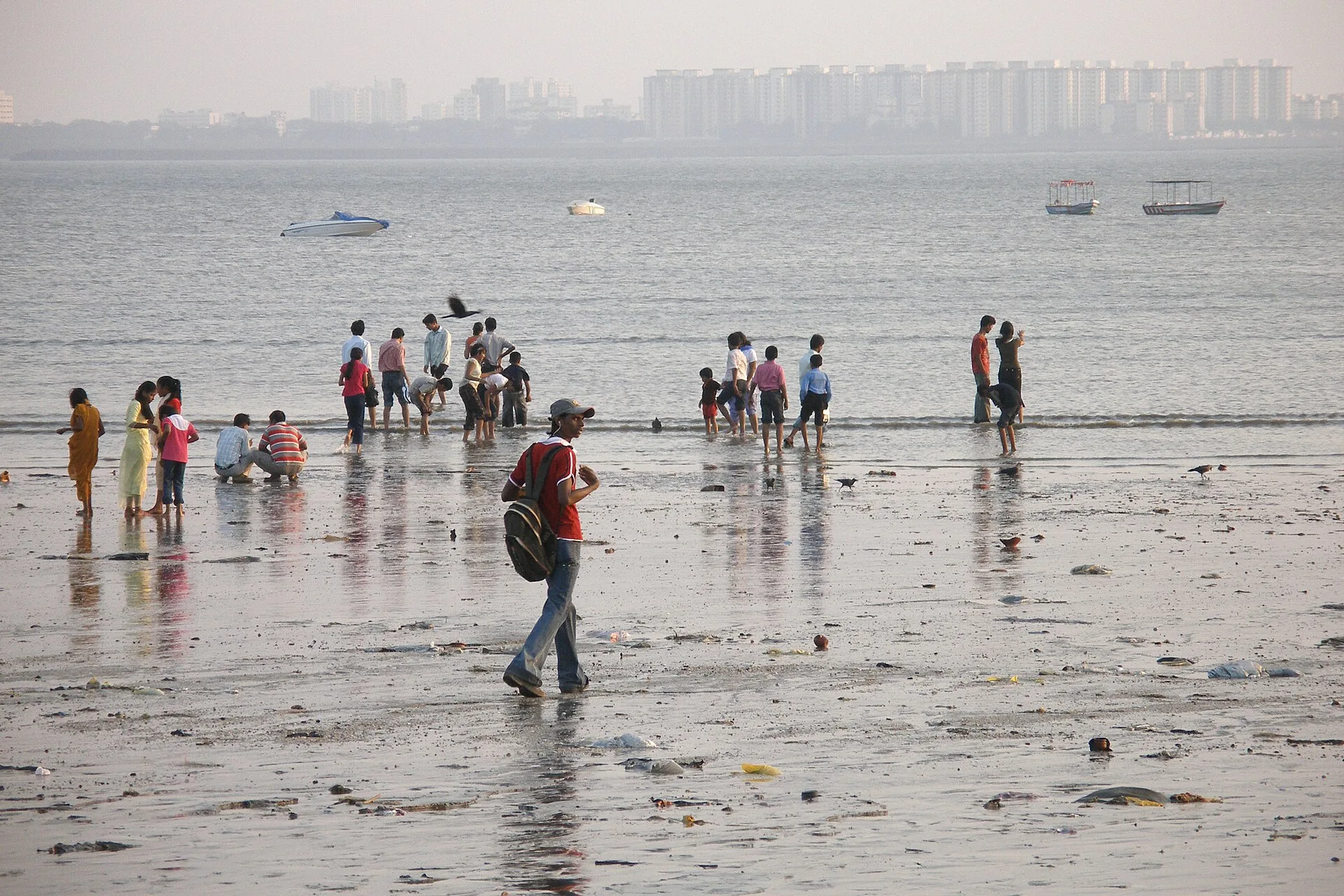
Chowpatty Beach, also known as Girgaum Chowpatty, is the strip of sand at the northern end of Marine Drive in South Mumbai. The Brihanmumbai Municipal Corporation (BMC) calls it perhaps the most famous beach in Mumbai City and the only beach in central Mumbai, set at the foot of Malabar Hill. Maharashtra Tourism describes it as a popular beach famed for its bhel puri. The beach carries three overlapping identities: an evening food ground with chaat and pav bhaji, a sea immersion point for Ganesh idols, including the Lalbaugcha Raja, at the close of Ganeshotsav, and the foot of Malabar Hill, with the Babulnath and Walkeshwar temples above it. Wilson College, in a building completed in 1889, stands opposite the beach on Chowpatty Seaface Road.
WHERE IS CHOWPATTY BEACH IN MUMBAI?

Chowpatty Beach lies where Marine Drive ends in the north. Maharashtra Tourism places the beach at the northern end of the seafront road and describes that road as the link between Nariman Point at its southern tip and Babulnath and Malabar Hill at its northern tip, with many restaurants along the stretch. The BMC notes that Marine Drive is built over reclaimed land, a history covered in our article on how Mumbai built its Art Deco seafront. Incredible India, the national tourism portal, refers to the road by its popular name, the Queen's Necklace, and lists Girgaum Chowpatty with Juhu Beach among the city's sandy shores on the Arabian Sea.
The BMC's tourism listing recommends Chowpatty for a view of the city and of the Queen's Necklace, and says the beach is frequented by Mumbai's residents and by tourists alike. It describes a mixed crowd: courting couples, families visiting for fun and games, and senior citizens taking their evening walk in the sea air. The same listing returns to Chowpatty when it describes the city's other beach food scenes. Of Juhu, it says that, like Marine Drive's Chowpatty, Juhu's own "Chowpatty" is a vendor's delight with innumerable food counters. Incredible India makes the same pairing, grouping Juhu Beach, Chowpatty and Girgaum Chowpatty together as places noted for their scenic beauty and their street food.
WHAT TO EAT AT CHOWPATTY BEACH: BHELPURI, PAV BHAJI AND KULFI

Bhel puri is the dish Chowpatty Beach is famed for. Maharashtra Tourism's Mumbai City guide identifies the beach by it, describing bhel puri simply as local fast food. Incredible India describes the snack as an irresistibly crunchy mix of puffed rice, sev, peanuts, fresh vegetables and chutneys, in which each bite offers a new combination of tastes. The portal's recommendations for the Chowpatty beaches extend beyond bhel puri to pav bhaji, pani puri and sev puri, the dishes that make up the offer on the sand.
Pav bhaji is the other dish the portal ties to the beach. Incredible India describes it as a spicy vegetable curry served on buttery toasted bread, and names the Chowpatty beaches alongside Crawford Market and Ghatkopar Khau Galli as places to find it. The portal's Mumbai page closes its description of an evening by the sea at Juhu Beach and Chowpatty with local delicacies topped with kulfi. Vada pav, a potato fritter served in a soft bread roll, which Incredible India describes as a roadside fast food dish from Maharashtra, often described as an Indian-style burger, belongs to other parts of the city: the portal lists Crawford Market, Ghatkopar Khau Galli and Dadar as its addresses rather than the beach.
GANESHOTSAV AT CHOWPATTY BEACH

Ganesh Chaturthi, or Ganeshotsav, is a ten-day festival observed in the lunar month of Bhadrapada, which falls in August and September. Incredible India describes huge clay idols of Ganesha installed in public pandals across Mumbai and the closing rite, Ganesh Visarjan, in which each idol is taken in procession to water and immersed, accompanied by thousands of people, music and dance. Ganesha is known as Modakpriya for his love of modak, and the traditional ukadiche modak, made of rice flour, coconut and jaggery and then steamed, is offered as prasad. In 2024 the festival began on 7 September and closed on Anant Chaturdashi, 17 September, according to the Press Trust of India (PTI).
Incredible India traces several of Mumbai's large public celebrations to community groups. It describes the Lalbaugcha Raja as a community-organised festival rather than a shrine, founded in 1934 and reportedly visited by more than 1.5 million people a day. It dates the Chinchpokli Sarvajnik Utsav Mandal to 1920 and the Andhericha Raja to 1966, when it was founded by workers of Tata Special Steel and Excel Industries. In September 2026 the Deccan Chronicle reported that the Lalbaugcha Raja's immersion drew thousands of devotees to Girgaon Chowpatty, some standing waist-deep in the sea, as boats and rafts operated by members of the Koli community carried the idol out to deep water.
HOW THE GANESH IMMERSION AT CHOWPATTY BEACH IS ORGANISED
Girgaon Chowpatty is one of several sea immersion points used by the city. On Anant Chaturdashi in 2024, PTI reported that devotees filled the main road leading to Girgaon beach, and listed Girgaon among 69 natural water bodies used for immersion, together with Dadar, Juhu, Marve and Aksa beaches. The same report counted 204 artificial ponds set up across Mumbai, with a QR code system directing people to the nearest one. That year the Lalbaugcha Raja reached the main road at around 12:45 pm, heading towards Bharatmata junction before returning to the Shroff building junction for pushpa vrushti, a shower of flowers.
The BMC runs the civic side of the operation. For the 2024 immersions, PTI reported that the corporation deployed more than 12,000 officials and staff, set up 71 control rooms for processions and 192 across its administrative divisions, and posted 761 lifeguards, 48 speed boats and 66 observation towers along the city's beaches. Drones covered the key immersion sites, with Girgaon Chowpatty named first among them, followed by Dadar, Bandra, Juhu, Versova, Powai Lake and Madh Island. Two years later the Deccan Chronicle cited BMC figures of 1,99,185 idols immersed across Mumbai during the 2026 festival, with Dadar and Juhu also drawing large crowds.
BABULNATH TEMPLE ABOVE CHOWPATTY
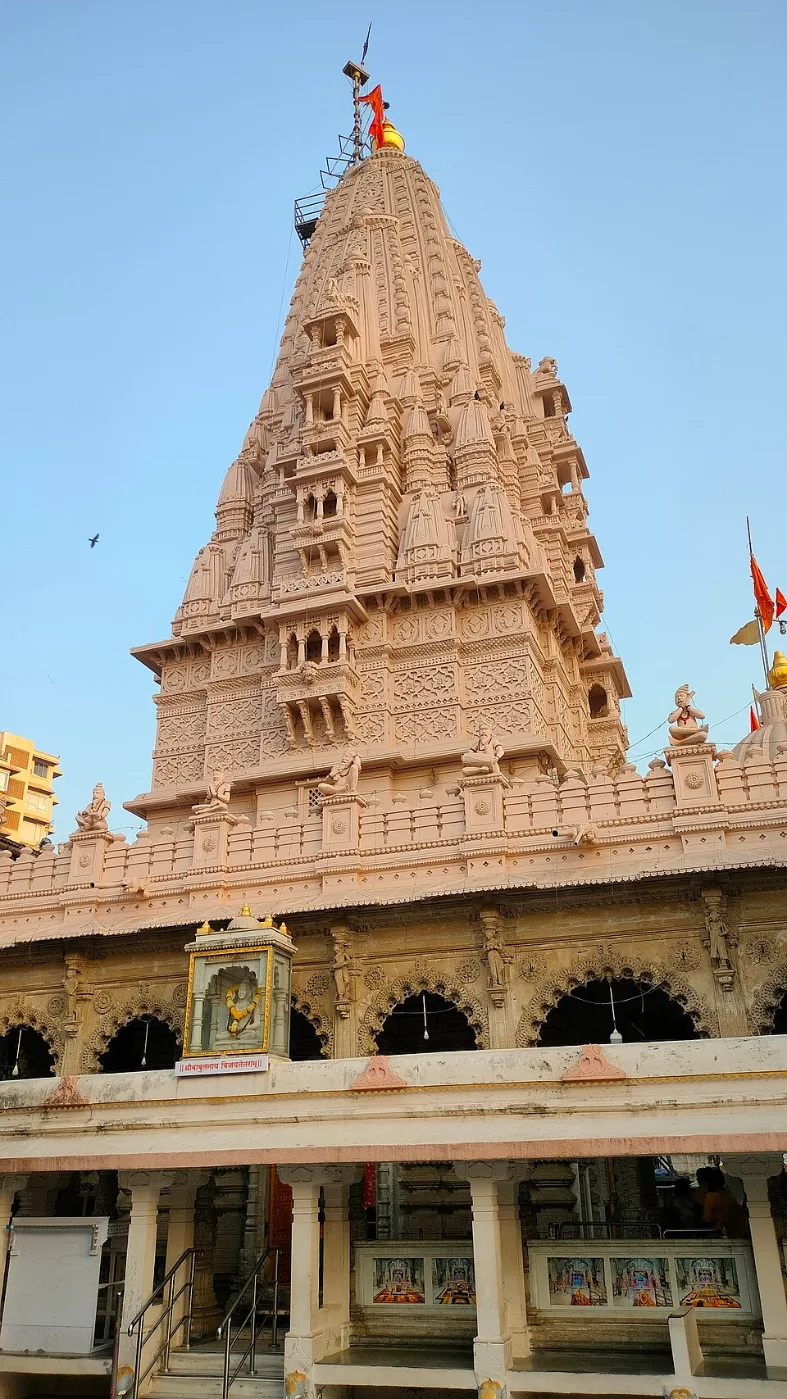
Babulnath Temple, dedicated to Shiva, stands on a hillock at the northern end of Marine Drive, the point Maharashtra Tourism names alongside Malabar Hill as the road's northern tip. The Mumbai Legacy Project, a heritage series published by the BMC, records that devotees reach it by a flight of 108 steps, a number held sacred in Hinduism. Its account of the origins is presented as attribution rather than settled fact: some trace the temple to the discovery of a black lingam around 1780 by a Marathi carpenter, who built a modest shrine on the spot. According to the same account, the temple is called Babulnath, or Babul's Lord, in recognition of that discoverer and founder.
The larger temple followed in the nineteenth century. The Mumbai Legacy Project records that a member of the Bhatia community took on a new and more expansive temple project in 1836, funded largely by Gujarati trading communities and completed around 1840. It is built in the Gujarat-nagari style, in three parts: the garbhagriha that houses the lingam, the sabha mandap and the gudh mandap. A tall spire was added in 1900, and the two deepstambhas were built in 1908 by Oza Mulji Asharam of Morvi. A restoration in 2016 covered the carvings and murals and added air conditioning and lifts. The temple draws its largest crowds during Shivaratri and Shravani Somvaar.
MALABAR HILL AND THE WALKESHWAR TEMPLE

Malabar Hill rises above the beach. The BMC describes it as a tiny hillock, the highest point in downtown Mumbai and the city's most coveted residential area, home to corporate leaders and figures from the entertainment business. Incredible India names Malabar Hill, together with Cuffe Parade, among the city's affluent neighbourhoods, and recommends the Hanging Gardens atop the hill for their greenery. The portal pairs them with Kamala Nehru Park, which it notes for its viewpoint and a play structure for children. The BMC's listing adds that the hill is home to the Walkeshwar Temple, founded by the Silhara kings and rebuilt in 1715.
The Mumbai Legacy Project gives the temple's story in more detail. It records a local legend in which Rama, waiting for Lakshmana to return, shaped a Shiva lingam from the sand on the shore. The sand idol was called ValukeIshwar, or Lord made of sand, a name that evolved into Walkeshwar. The same account states that the temple was erected by the Shilahara kings in the tenth century and that in 1127 Lakshman Prabhu, a Gowd Saraswat Brahman at the Shilahara court in Thane, built the first Walkeshwar Temple. In 1715 the temple was renewed under Rama Kamath, a leader of the Shenvi community. It is built of cut stone masonry, with a tall dome, a sanctuary, a sabhamandap and a stone Nandi facing the sanctuary door.
WILSON COLLEGE ON CHOWPATTY SEAFACE
Wilson College stands opposite the beach. The college was founded in 1832 by the Scottish missionary Rev. John Wilson, about 25 years before the University of Mumbai, to which it is affiliated. Wilson reached Mumbai in 1829, and he and his wife Margaret Wilson began by studying the local language, Marathi. The college traces its descent from a school in Girgaum that went through several relocations and changes of name, and it names the Ambroli English School as its direct forerunner. The collegiate section from which the college grew started in 1836, and on 14 December 1861, as the Free General Assembly's Institution, it became the first privately owned, non-government institution affiliated to the University of Mumbai. It describes itself as one of the oldest educational institutions in India.
The building that faces the beach was completed in 1889. According to the college, it was designed by John Adams in the domestic Victorian Gothic style and stands opposite Girgaon Chowpatty, and it is listed as a Grade III heritage structure in the city. The college gives its address as Chowpatty Seaface Road. Its west-facing verandahs, set behind sandstone arches on the ground floor, face the sea and shield the classrooms from rain and sun, and the deep first-floor verandahs overlook Girgaum Chowpatty. The college also records teakwood trusses in the first-floor classrooms, a roof of Mangalore tiles, Minton tile flooring on the verandahs, a timber staircase whose handrail carries a multi-foil circular panel that Adams used in several of his buildings, and an assembly hall with a stained glass window bearing the college crest.
TRIDENT, NARIMAN POINT ON MARINE DRIVE

Chowpatty Beach marks the northern end of Marine Drive, the seafront road built over reclaimed land that Incredible India calls the Queen's Necklace. Trident, Nariman Point stands on Marine Drive in South Mumbai, facing the Arabian Sea, the same water that meets the sand at Chowpatty. The 35-storey hotel opened on 7 April 1973 as the Oberoi-Sheraton and was renamed Trident in 2008 under The Oberoi Group, the company whose history is traced in our article on how M.S. Oberoi built an Indian hotel company.
Silverfox Studios refurbished the interiors of the hotel's arrival reception, lobby lounge, Ness Bar, ballroom and event spaces, in a project completed in 2025 under a "Luxury Lifestyle" concept. Ness Bar is on L1, with views over Marine Drive and the sea. Marine Drive is the same seafront road that, according to Maharashtra Tourism, runs from Nariman Point at its southern tip to Babulnath and Malabar Hill at its northern tip, with Chowpatty Beach, its bhel puri stalls and its Ganesh immersions at the northern end and Wilson College across the road from the sand.
SOURCES
- Maharashtra Tourism Mumbai City
- Brihanmumbai Municipal Corporation Mumbai Tourist Spots
- Incredible India Mumbai's Culinary Tapestry: A Gastronomic Odyssey
- Incredible India Mumbai the city that never sleeps
- Incredible India Experiencing the Essence of Ganesh Chaturthi in Mumbai
- PTI via The Week Ganesh idol immersion processions begin as devotees bid farewell to their favourite deity
- Deccan Chronicle Maharashtra: Lalbaugcha Raja Immersion Marks End Of 21-Hour Procession
- Mumbai Legacy Project, BMC D Ward: Babulnath Temple
- Mumbai Legacy Project, BMC D Ward: Walkeshwar Temple
- Wilson College About Us