CANALS, STONE BRIDGES AND MERCHANT HOUSES OF THE YANGTZE DELTA

The Jiangnan water towns are old market towns of the Yangtze delta in Jiangsu, Zhejiang and Shanghai, built along rivers and canals that served as their main streets. Zhouzhuang, Tongli and Luzhi lie near Suzhou, Wuzhen, Xitang and Nanxun are in Zhejiang, and Zhujiajiao is in Shanghai's Qingpu District. Their stone bridges, riverside houses and merchants' halls survive largely from the Ming, Qing and early Republican periods, and four of the towns were placed on China's UNESCO Tentative List in 2008. Their histories follow the trade in grain, cloth and silk that moved by boat through the delta, and the merchant families who grew rich from it.
WHAT ARE THE JIANGNAN WATER TOWNS ON UNESCO'S TENTATIVE LIST?
On 28 March 2008 China's State Administration of Cultural Heritage submitted "The Ancient Waterfront Towns in the South of Yangtze River" to UNESCO's Tentative List, under reference 5328. The entry covers four towns: Zhouzhuang in Kunshan and Luzhi in Wu County, both in Jiangsu, and Wuzhen in Tongxiang and Xitang in Jiashan County, both in Zhejiang. It is proposed under criteria (ii), (iv) and (v): for the towns' water-based economies, for their Ming, Qing and early Republican architecture and layouts, and as representative Jiangnan waterfront settlements. Tongli, Nanxun and Zhujiajiao, often visited alongside them, are not part of the entry.
The nomination describes all four as towns whose trade ran on water, with staple food, cotton and textiles, handicrafts and aquatic products moving between town and countryside by boat. It records settlement traces far older than the towns, including Liangzhu-era sites at Zhouzhuang and the Tanjiawan site at Wuzhen, dated to about 7,000 years ago. The text sets the towns apart from Pingyao and Lijiang as places that are half urban and half rural, and from Venice as Chinese-style water villages. It also notes that, unlike Pingyao, Lijiang and the villages of southern Anhui, they sit in the developed Yangtze delta rather than in remote country.
HOW ARE JIANGNAN WATER TOWNS LAID OUT ALONG THE CANALS?
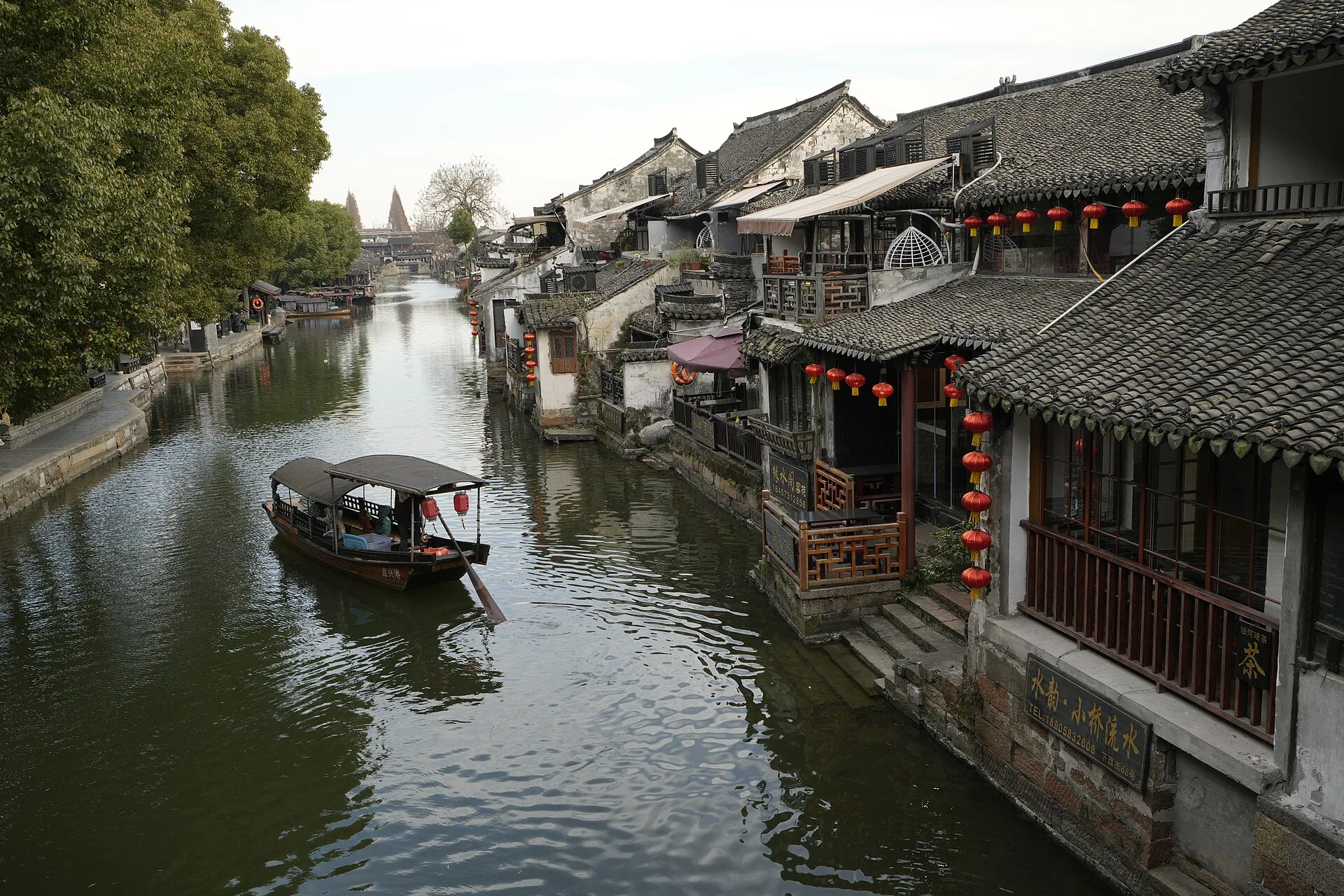
The towns sit within the network of rivers, lakes and canals of the Yangtze delta, the region of Jiangnan cuisine, and the largest of these waterways is the Grand Canal. Britannica gives the canal a length of about 1,800 km, the longest constructed waterway in the world, and describes its southern section, the Jiangnan Yunhe, running some 320 km via Suzhou to Hangzhou. Successive regimes used the canal to move surplus grain from the Yangtze and Huai valleys to the northern capitals. The UNESCO entry places Zhouzhuang east of the Grand Canal, and Lonely Planet places both Wuzhen and Nanxun on its route.
Inside the towns, rivers took the place of roads. The UNESCO text describes Zhouzhuang's streets linked by bridges across its rivers, with riverside galleries, pavilions, revetment steps and arcades over the streets. In Wuzhen the rivers run alongside the streets, with households aligned along the banks. Xitang's houses face a street at the front and back onto a river at the rear, and its buildings, with black tiles and whitewashed walls, line both. Families there built roofed corridors along the water to shelter traders from sun and rain; Lonely Planet records the longest of these langpeng at 1.3 km. Xitang also has 122 lanes, the narrowest of which, Shipi Lane, is 80 cm wide at its tightest point.
ZHOUZHUANG: THE TWIN BRIDGES AND THE SHEN FAMILY
Zhouzhuang was founded in 1086, according to the UNESCO nomination, and is encircled by the Jishui River. Smithsonian dates its Chengxu Taoist Temple to 1086 to 1093 and counts about 60 original brick archways and 100 original courtyards in the town. Rich merchants settled there and built large houses around spacious courtyards. The nomination names Shen Wansan and his son, who moved to Zhouzhuang from Nanxun and, by its account, became the richest family south of the Yangtze through water trade. Lonely Planet counts 14 stone bridges in the town, dating from the Yuan to the Qing dynasties, and lists braised pork shank, wansan ti, as its known dish.
The best known of these crossings is the Twin Bridge, also called the Key Bridge. Shide Bridge is a stone arch bridge 16 m long and 3 m wide; Yongan Bridge is a stone beam bridge 13.3 m long and 2.4 m wide. One opening is round and the other square, which is why, China Daily reports, the pair is likened to an ancient key. The bridges were first built in the Wanli reign of the Ming dynasty (1573 to 1619), renovated in 1765 and rebuilt in 1843. China Daily also records that the painter Chen Yifei, formerly of the Shanghai Canvas and Sculpture Workshop, came to sketch Zhouzhuang in 1984, travelling by boat because the road from Kunshan was unfinished. Lonely Planet credits Chen (1946 to 2005) and his images of the town with its fame.
TONGLI AND LUZHI: ISLETS, GARDENS AND OLD BRIDGES
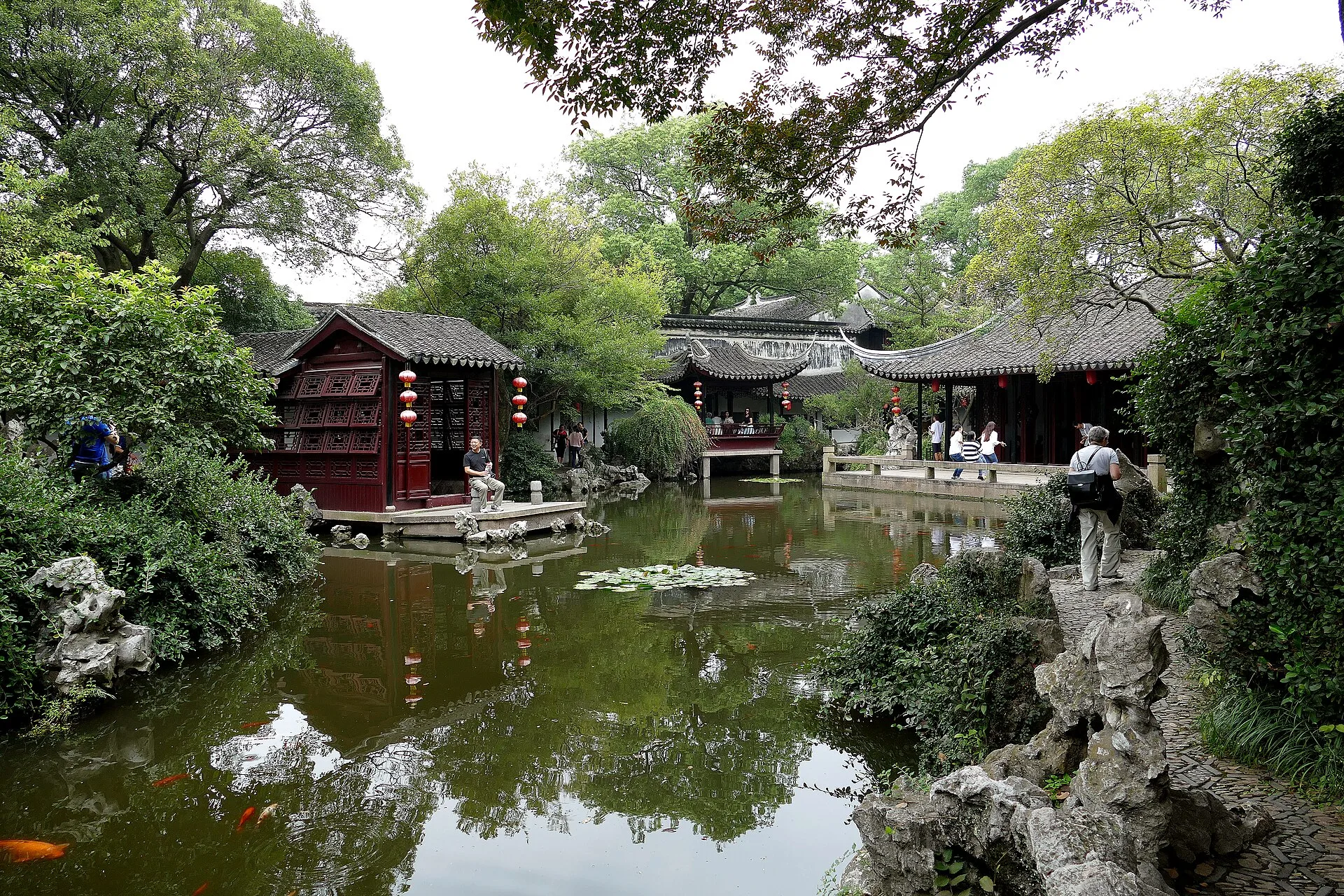
Tongli, 18 km south-east of Suzhou, dates to the Song dynasty, though many of its surviving mansions are Ming or Qing. Frommer's describes the old town as seven islets surrounded by five lakes, fed by about 15 canals and joined by more than 40 arched stone bridges. Brides were traditionally carried in sedan chairs over three of them, Taiping Bridge, Jili Bridge and Changqing Bridge. Gengle Tang, the largest residence, belonged to the Ming nobleman Zhu Xiang and has three main courtyards and 41 rooms. Tuisi Yuan was built in 1886 by a dismissed court official, with residences to the west, meeting rooms in the centre and a landscaped garden to the east. As the Retreat and Reflection Garden, it is one of the nine gardens UNESCO lists as the Classical Gardens of Suzhou.
Luzhi covers 54 hectares, and the UNESCO entry describes five rivers, the Dongshi, Xishi, Zhongshi, Nanshi and Xihui, forming a water system shaped like a Chinese character, with west, middle and east markets. Its bridges span many centuries: Fengyang and Guangji from the 9th century, Zhongmei from the 11th, Dongmei from the 15th and Jinyang from the 17th. Baosheng Temple dates to the early 6th century, and the traditional dress of Luzhi's women is on China's first national list of intangible heritage. Smithsonian notes that the town was once a small village called Puli, links that name to the recluse poet Lu Guimeng, and records its nickname, the Museum of Chinese Ancient Bridges.
WUZHEN AND XITANG: THE WATER TOWNS OF NORTHERN ZHEJIANG
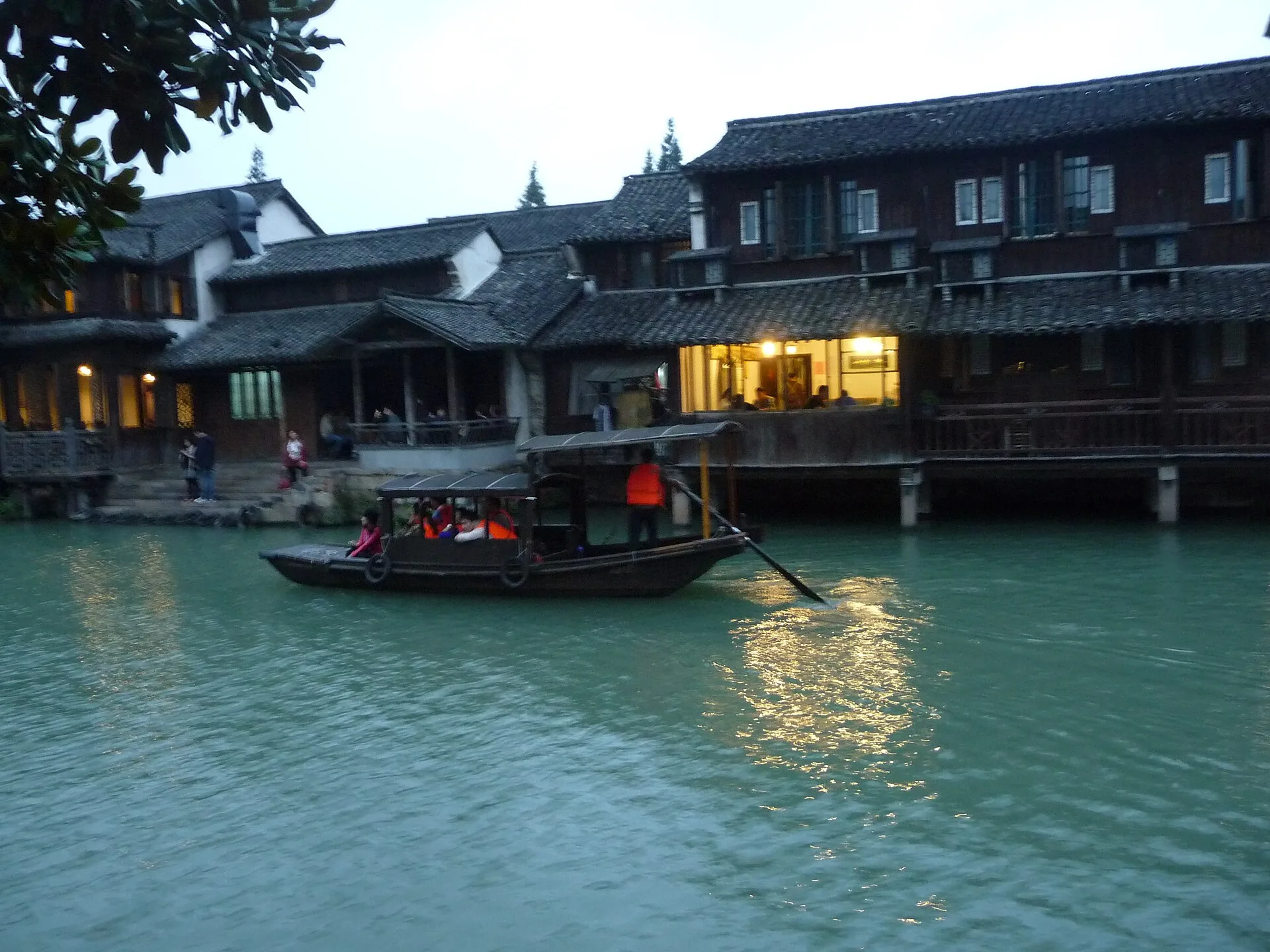
Wuzhen lies on the Shi River system in Tongxiang. The UNESCO entry says its trade grew after the Southern Song made Hangzhou its capital, that it was known for silk, and that by the Ming and Qing periods it had more than 10,000 households. Eighteen bridges built in those two dynasties cross its rivers, and the former residence of the novelist Mao Dun, who grew up in the town, is among its listed sites. Lonely Planet divides Wuzhen by its waterways into north, south, east and west sections and dates much of its architecture to the late Qing and early Republican periods. Smithsonian records a renovation that began in 1999 and finished in 2013, and says about half of the town's buildings are standing structures from its past.
Xitang, in Jiashan County, began as a village in the Tang dynasty and became a town under the Song, according to the nomination. The old town covers about 24 hectares with some 110,000 square metres of buildings, 63 per cent of the town's total. Rivers divide it into six sections joined by bridges, and its 122 lanes run between them. About 7,000 residents live in its 1.01 square kilometres, and the nomination calls it a living ancient town. Smithsonian places Xitang about an hour's drive from Shanghai and records about 1.5 million visitors a year to Wuzhen.
NANXUN AND THE SILK WEALTH OF THE JIANGNAN WATER TOWNS
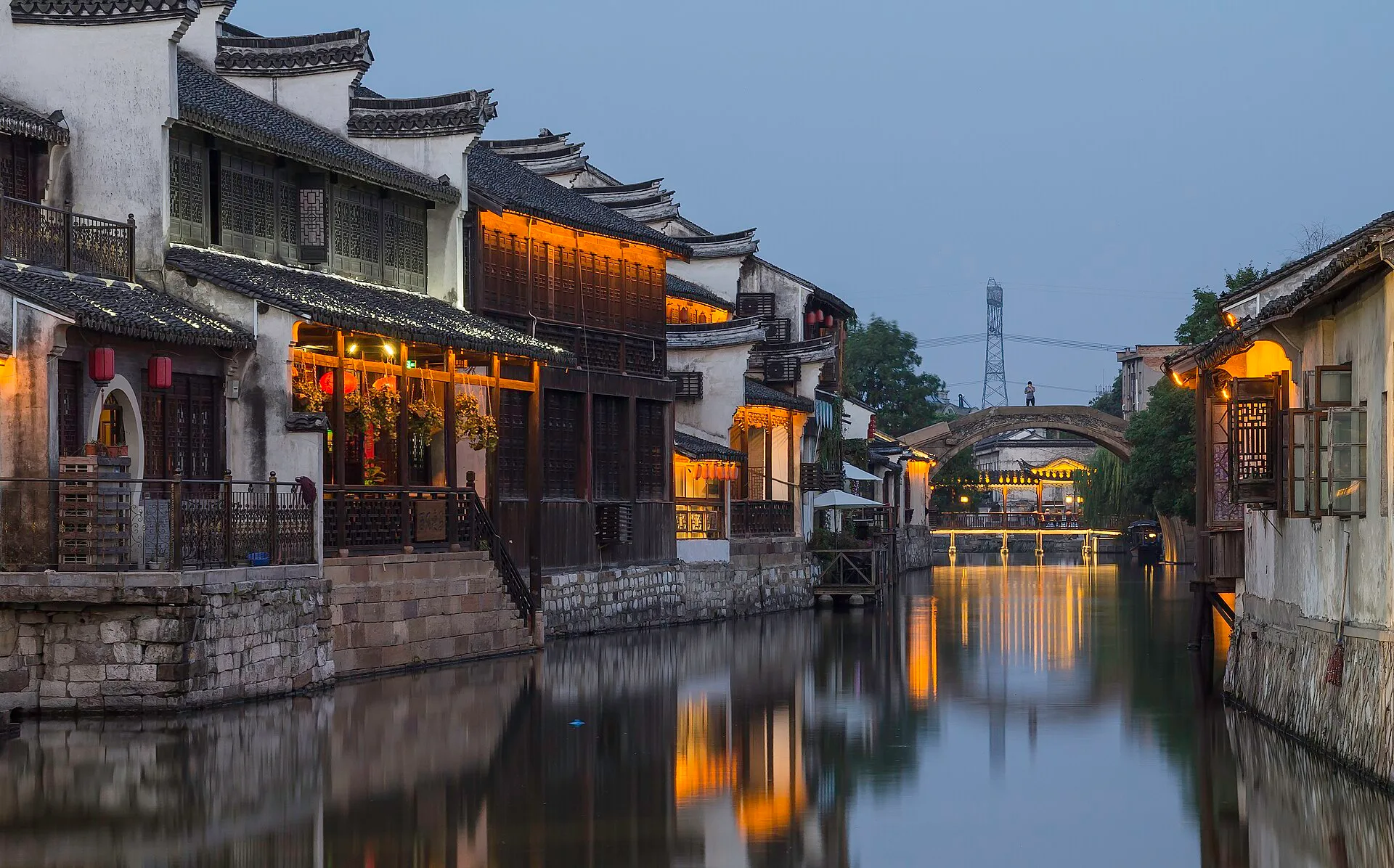
Nanxun lies at the southern edge of Lake Tai on the boundary between Jiangsu and Zhejiang, within Zhejiang. Frommer's traces a village on the site to AD 746 and dates the town's formal establishment to around 1252, under the Southern Song. It reached its height in the Ming and Qing dynasties, when, Lonely Planet notes, it was a centre of silk production and a trading post on the Grand Canal. Frommer's says the early wealth came from silk, followed by rice and salt, and records a 19th-century nickname for the town's 100 richest residents that began with four elephants and eight bulls.
Several of the merchant houses survive. Liu Yong (1826 to 1899) made his fortune in cotton, silk, salt and property, and in 1885 built Xiao Lian Zhuang, the Little Lotus Villa, as a private garden around a large lotus pond, with a two-storey red-brick Western-style house used as a retreat for the women of the family. His grandson Liu Chenggan built the Jiaye Tang Library on the adjoining plot in 1920; it reportedly held up to 600,000 volumes, and after 1949 its remaining books and building passed to the Zhejiang Library. Zhang Shiming, grandson of one of the town's four richest men, built a 4,000 square metre residence in 1905 with a Chinese front and a Western rear, including a ballroom with a French mosaic floor. Lonely Planet notes its coloured glass imported from France.
ZHUJIAJIAO: THE JIANGNAN WATER TOWN WITHIN SHANGHAI

Zhujiajiao, in Qingpu District, is reached from downtown Shanghai by public transport. Smithsonian dates it to about 1,700 years ago and describes it as a former rice market town, and Lonely Planet says it prospered on the rice and cloth brought in by boat from the surrounding countryside and counts 36 ancient bridges. The town's official site records that it flourished in the Ming and Qing dynasties with eight major industries and more than twenty guilds, with Dongdajie as its busiest commercial street. In 1991 the Shanghai government named it one of four famous historical and cultural towns, and the official site calls it the best-preserved ancient water town in the Shanghai area.
Its largest crossing is Fangsheng Bridge over the Caogang River. It was first built in 1571, the fifth year of the Longqing reign of the Ming dynasty, with funds from the monk Xingchao of Cimen Temple; Structurae dates the present structure to a rebuild completed in 1812. The five-arch stone bridge is about 70 m long and 7.4 m high, with a central span of 13 m flanked by spans of 8.8 m and 6.2 m. Its Dragon Gate stones carry eight dragons chasing a pearl, and four stone lions sit on the balustrade columns. The official site describes it as the largest, longest and tallest five-arch stone bridge in the Shanghai area. It became a county-level protected relic in 1959 and a municipal one in 1987.
THOMPSON SHANGHAI EXPO ON THE HUANGPU

Thompson Shanghai Expo opened in October 2025 as Thompson's first hotel in Asia Pacific, with 254 rooms, and Silverfox Studios carried out its full interior design scope, covering both the public rooms and the guestrooms. Zhujiajiao's canals, its 36 bridges and the five-arch Fangsheng Bridge of 1571 lie in Qingpu District; the hotel stands elsewhere in Shanghai, on the former Expo 2010 site, facing the Huangpu River. Its design avoids literal pavilion imagery drawn from the site's Expo 2010 history.
The interiors are organised as buildings within buildings: each public room and each guestroom type is treated as its own structure, with its own ceiling and its own materials. The Fishermen's Pavilion, the hotel's all-day dining restaurant, occupies levels 19 to 20 and is set as penthouse pavilions facing the river and the Expo grounds. The riverside galleries and pavilions that the UNESCO nomination records at Zhouzhuang stand at the water's edge; the hotel's pavilions sit at penthouse level above the Huangpu.
SOURCES
- UNESCO World Heritage Centre The Ancient Waterfront Towns in the South of Yangtze River
- UNESCO World Heritage Centre Classical Gardens of Suzhou
- Britannica Grand Canal
- Smithsonian Magazine Explore China's Ancient Water Towns
- Lonely Planet Eastern China's water towns
- Frommer's Nanxun
- Frommer's Tongli
- China Daily Twin Bridge
- Zhujiajiao Ancient Town Fangsheng Bridge
- Structurae Fang Sheng Bridge