

THE LARGEST WORLD EXPO ON RECORD, AND THE FEW BUILDINGS BUILT TO OUTLAST IT

Expo 2010 Shanghai ran from 1 May to 31 October 2010 under the theme "Better City, Better Life". According to the Bureau International des Expositions (BIE), the body that governs World Expos, it drew 73,085,000 visitors, beating the previous record of about 64 million set at Expo 1970 in Osaka, and its 246 participating countries and international organisations were the most for any World Expo. The site covered 523 hectares on both banks of the Huangpu River, the largest in the event's history. Few of its buildings were permanent. Those that stayed now house the China Art Museum, the Power Station of Art and the Mercedes-Benz Arena. The United Arab Emirates pavilion was taken apart and rebuilt in Abu Dhabi, and part of the grounds is being turned into a culture park that keeps four of the national pavilions.
WHAT WAS EXPO 2010 SHANGHAI
Expo 2010 was an international registered exhibition organised by the government of the People's Republic of China, and the first World Expo held in China. China was elected host at the BIE's 132nd General Assembly in December 2002, and the Expo's registration was approved at the 138th General Assembly on 1 December 2005. Its official designation was Expo Shanghai 2010, and its mascot was Haibao, whose name combines the Chinese characters for sea and treasure. The BIE notes that Haibao's shape was based on the character for person, placing people at the centre of the theme. The Expo closed after 185 days, and its busiest single day was 16 October 2010, when 1.03 million visits were recorded.
Of the participants, 79 countries designed and built their own pavilions. The rest customised space within regional clusters. Shuttle buses, boats and metro lines moved visitors around the site and between the Puxi and Pudong sides of the river. The building programme extended beyond the Expo grounds: the BIE lists a new runway and terminal at Hongqiao Airport, a high-speed rail link to Hangzhou, a metro system that became the world's longest, and the redeveloped Bund promenade among the infrastructure delivered around the Expo.
WHAT DID BETTER CITY, BETTER LIFE MEAN
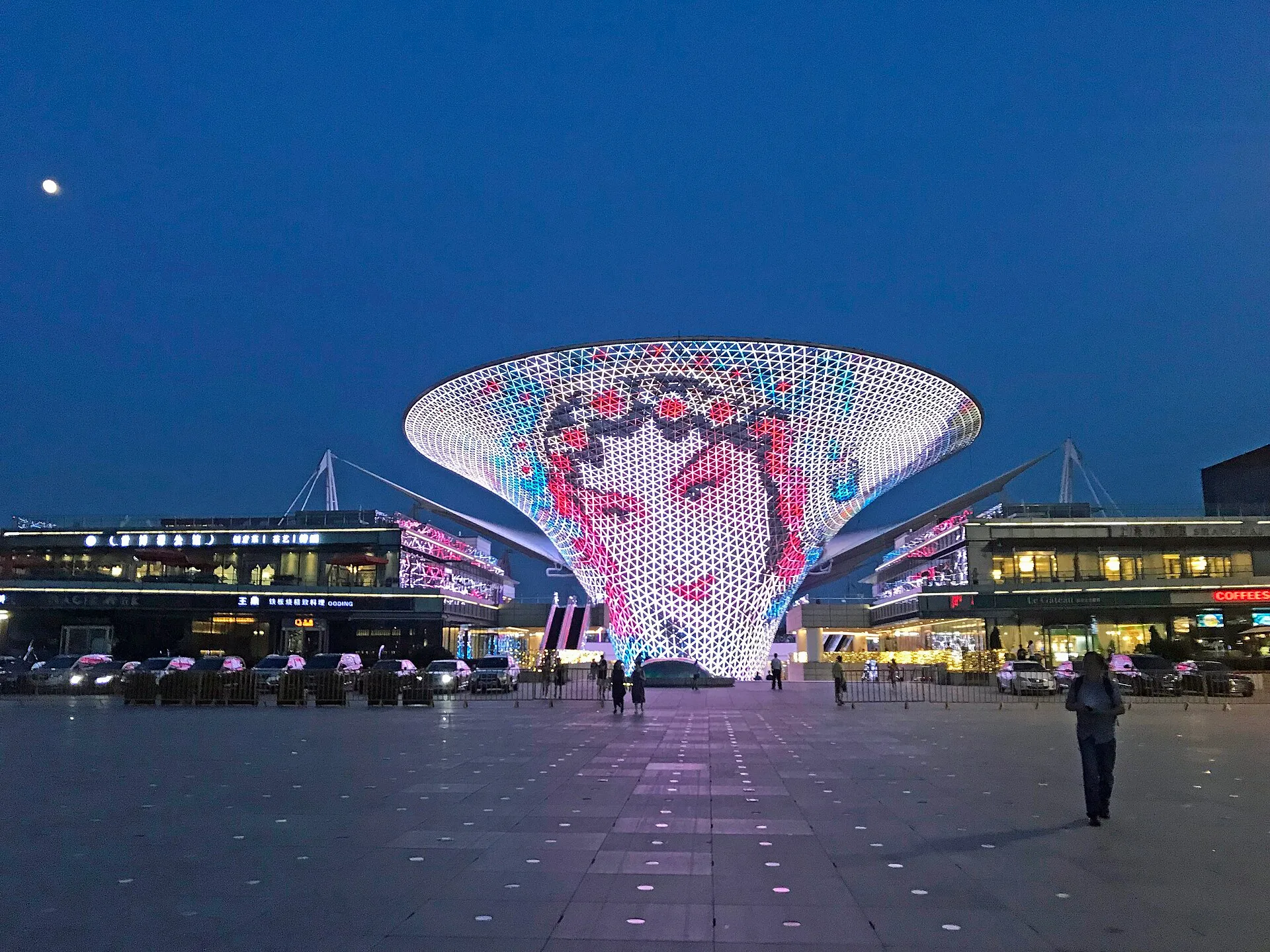
The theme framed the Expo around urban problems: how people of different backgrounds live together, sustainability, security, hygiene and mobility. In 2010, the BIE notes, more than one in two people lived in a city, and Shanghai had an urban population of 23 million. The Urban Best Practices Area showcased 80 examples of solutions from cities around the world, and the site was planned as a low-carbon development with rainwater collection and solar panels. The Theme Pavilion carried a green wall of 5,000 square metres, then the largest in the world, and the Expo Axis had a 65,000-square-metre membrane roof, also described as the world's largest.
The theme produced two lasting documents. The Shanghai Declaration, issued on the closing day, set out a roadmap for sustainable urban development and proposed a World Cities Day on 31 October each year. BIE Member States approved the declaration in 2012, the United Nations General Assembly adopted World Cities Day the following year, and the first edition was hosted in Shanghai in 2014. The Shanghai Manual, a practical guide to sustainable urban development compiled by the United Nations, China's Ministry of Housing and Urban-Rural Development, the Shanghai Municipal Government and the BIE, was updated in a second edition in 2016.
WHERE WAS THE SHANGHAI EXPO SITE
The Expo was built between the Nanpu and Lupu bridges in central Shanghai, on both banks of the Huangpu River, on land largely occupied by shipyards and ageing factories. The river divided the site between the Pudong side to the east and the Puxi side to the west. The BIE compares the 523-hectare site to the area of about 1,000 football pitches. Because the land was industrial, some venues were converted from existing structures rather than built new: a former steel mill became a sculpture garden, and the Nanshi Power Plant was converted into a theme pavilion, the Pavilion of the Future.
The plan for the site after the Expo was set before it opened. China Daily reported in April 2010 that, under BIE rules and the Shanghai Expo plan, all foreign pavilions were to be dismantled after the event unless an exception was made. Five structures were to stay as permanent landmarks: the China Pavilion, the Theme Pavilion, the Expo Cultural Centre, the Expo Centre and Expo Boulevard. The same report said the United Arab Emirates pavilion would be dismantled and rebuilt on Saadiyat Island in Abu Dhabi as a cultural centre.
THE PAVILIONS THAT DEFINED EXPO 2010

The China Pavilion, known as the Oriental Crown, was the Expo's centrepiece. Designed by the architect He Jingtang, it has 160,000 square metres of floor space, and its bright red form is based on dougong, the wooden bracket sets of traditional Chinese buildings. Xinhua reported that it received more than 10 million visitors during the Expo. It stayed open after the event closed, receiving more than 5.7 million visitors between 1 December 2010 and 31 May 2011, and reopened again from 12 July to 9 October 2011. The BIE notes that it was one of the few structures designed to be permanent.
The United Kingdom Pavilion was designed by Heatherwick Studio and became known as the Seed Cathedral. Its structure was pierced by 60,000 acrylic rods, each 7.5 metres long, with 250,000 seeds embedded in their tips, a design inspired by the Millennium Seed Bank at Kew Gardens, one of the largest plant conservation programmes in the world. It won the Expo's gold medal for pavilion design from more than 200 entries and received over seven million visitors. Other national exhibits drew crowds in their own right: Denmark shipped the Little Mermaid statue 8,248 kilometres from Copenhagen, and about 5.6 million people saw it in six months, against about one million visitors a year at its usual site. Israel's pavilion displayed two pages of Albert Einstein's original manuscript on general relativity, including the equation E=mc², France's featured 20 Nao robots performing a synchronised dance, and Spain's centred on Miguelin, a 6.5-metre animated baby.
WHAT HAPPENED TO THE PAVILIONS AFTER THE EXPO

The China Pavilion became the new home of the Shanghai Art Museum, founded in 1956 and one of the oldest art museums in China. Until 2012 the museum occupied the former racing club building on People's Square. After remodelling and a change of name, it opened to the public in the former pavilion on 1 October 2012 as the China Art Museum, focused on modern and contemporary Chinese art. It stands at 205 Shangnan Road in Pudong. The Expo's other converted building opened on the same day: the former Pavilion of the Future reopened as the Power Station of Art, the first state-run museum in mainland China dedicated to contemporary art.
The Power Station of Art covers 41,000 square metres, with 15,000 square metres of exhibition space and an internal height of 27 metres, and its 165-metre chimney is used as a separate exhibition space. The museum hosts the Shanghai Biennale. The World Expo Cultural Centre was replaced by the Mercedes-Benz Arena, with a capacity of 18,000. Of the foreign pavilions, the BIE records that the M21 contemporary art museum now occupies the former France Pavilion. In its account of the Expo's legacy, the BIE also points to the West Bund Cultural Corridor, a 9.4-square-kilometre stretch along the Huangpu with more than 20 cultural institutions, including the Power Station of Art and the World Expo Museum.
One national pavilion was rebuilt abroad. The UAE Pavilion, designed by Foster + Partners, was clad in gold-coloured stainless steel plates in an undulating form based on sand dunes, with louvres letting indirect light into the interior, and its exhibits covered how society in the UAE adapted to its climate and moved into modernity. After the Expo, Chinese contractors dismantled it under Foster + Partners' instruction and shipped it to Abu Dhabi in 60 containers, where it was reassembled on Saadiyat Island. The National reported in October 2011 that the rebuilt pavilion would host Abu Dhabi Art from 16 to 19 November that year, with events split between the pavilion and Manarat Al Saadiyat opposite.
THE FORMER EXPO SITE TODAY
The World Expo Museum opened on 1 May 2017 as a museum dedicated to the history of World Expos. Its design, City in Celebration by the East China Architectural Design and Research Institute, was chosen in 2012 from bids by nine firms. It stands at 818 Mengzi Road, on the former Expo site on the north bank of the Huangpu, and is served by a station of the same name on Metro Line 13. It covers about 46,550 square metres, with eight permanent exhibition halls covering the history and themes of World Expos, Specialised Expos, Horticultural Expos and the Triennale di Milano, three temporary halls, a documentation and research centre and a collection warehouse.
Beyond the museum, the BIE describes a two-square-kilometre area being transformed into the Expo Culture Park, which includes an opera house and integrates the former pavilions of France, Russia, Luxembourg and Italy. Together with the China Pavilion, the Mercedes-Benz Arena and the Power Station of Art, they make up the Expo buildings the BIE lists as reused on the site. The China Art Museum, in the former China Pavilion, is reached from China Art Museum station on Metro Line 8.
THOMPSON SHANGHAI EXPO AND THE IDEA OF THE PAVILION

Thompson Shanghai Expo opened in October 2025 as Thompson's first hotel in Asia Pacific, with 254 rooms and full-scope interiors by Silverfox Studios. It stands on the former Expo 2010 site facing the Huangpu River. The design avoids literal pavilion imagery. Instead, it takes the free-standing Expo pavilion as an interior device that the team calls "buildings within buildings": each public room and guestroom type is its own defined structure, with its own ceiling and materials. The idea is clearest in Fishermen's Pavilion on levels 19 to 20, the hotel's all-day dining restaurant, which is designed as a series of penthouse pavilion structures facing the river and the old Expo grounds.
SOURCES
- Bureau International des Expositions Expo 2010 Shanghai
- Bureau International des Expositions 5 things you might not know about Expo 2010 Shanghai
- Bureau International des Expositions World Expo Museum
- Heatherwick Studio UK Pavilion, Shanghai, China (2010)
- Xinhua, via USC Center on Public Diplomacy China Pavilion to reopen to visitors
- China Daily, via USC Center on Public Diplomacy Will they stay or will they go?
- ICOM UK Interview with Ning Li, Deputy Director of the Collection Department, China Art Museum, Shanghai
- Shanghai Municipal People's Government China Art Museum, Shanghai
- Duke Kunshan University Shanghai Power Station of Art
- The National UAE pavilion's reassembly on Saadiyat Island


