NINE UNESCO GARDENS FROM SONG POETS TO QING ROCK MASTERS
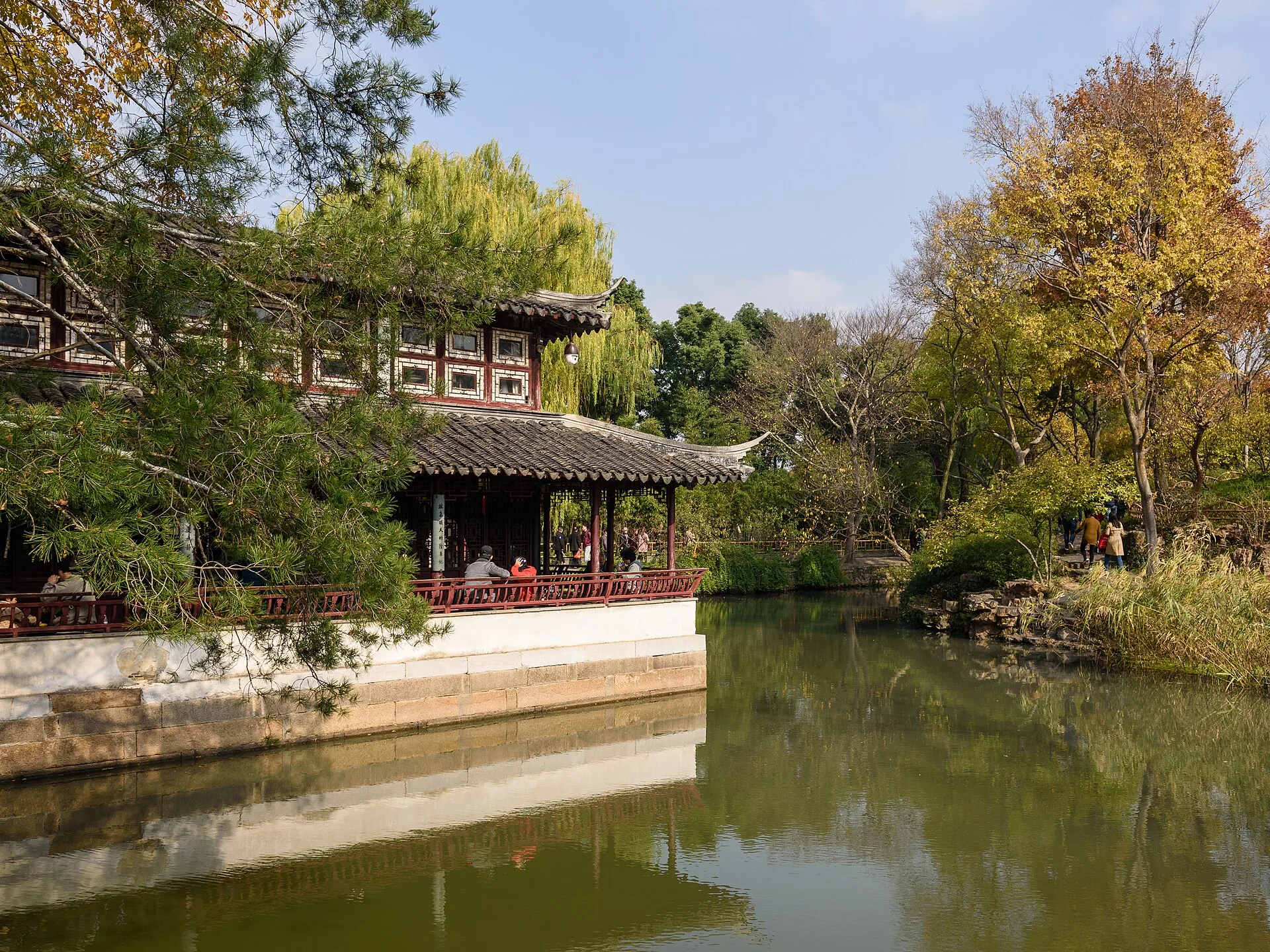
Suzhou gardens are the private walled gardens of Suzhou, a city west of Shanghai that the Metropolitan Museum of Art describes as the leading cultural and economic centre of the Ming dynasty. UNESCO lists nine of them as the Classical Gardens of Suzhou and dates the surviving examples from the 11th to the 19th century. Each was laid out within the limited space of a single residence and composed of water, stone, plants and buildings of literary and poetic significance. The nine range from the Canglang Pavilion, built for a Northern Song poet, to the Humble Administrator's Garden of a retired Ming inspector, and share a vocabulary of pavilions, walkways, rockeries, lattice windows and borrowed views that Ji Cheng set down in Yuan Ye.
WHAT ARE THE CLASSICAL GARDENS OF SUZHOU?
Suzhou was founded in 514 BC as the capital of the Wu Kingdom, according to the 1997 evaluation by ICOMOS, the advisory body that assesses cultural World Heritage nominations; the UNESCO listing places the founding in the 6th century BCE. Private gardens began to appear in the city around the 4th century and reached their peak in the 18th century. ICOMOS records that garden building was most intensive from the 16th to the 18th century, when as many as two hundred gardens stood within the city walls and Suzhou was known as an "Earthly Paradise". More than 50 survive. UNESCO describes the nine listed gardens as the finest examples of the "Mountain and Water" garden, and notes that their design draws on the freehand style of traditional Chinese landscape painting.
The World Heritage Committee inscribed the Classical Gardens of Suzhou in 1997, at its 21st session, with four gardens: the Humble Administrator's Garden, the Lingering Garden, the Garden of the Master of the Nets and the Mountain Villa with Embracing Beauty. Five more were nominated on 6 January 1999, and ICOMOS recommended the extension in September 2000: the Canglang Pavilion, the Lion Grove Garden, the Garden of Cultivation, the Couple's Garden Retreat and the Retreat and Reflection Garden. All nine are managed by the Suzhou Municipal Garden and Landscape Administration Bureau, through its heritage supervision department, monitoring and conservation centre and site offices. The city's conservation agency was established in 1949, and the State Council lists the gardens as State Priority Protected Sites.
WHO BUILT THE SUZHOU GARDENS?
The Met's educators' guide to its Chinese garden court links Suzhou's gardens to the scholar-gentlemen, or literati, who emerged as an elite class during the Song dynasty (960 to 1279) and were typically selected through the civil service examinations. Many held official posts, but the guide notes that most of their income came from landholdings rather than government stipends. Suzhou's temperate climate and its agricultural and commercial wealth encouraged this class to build, and the number of private gardens in the city grew steadily after the 12th century. Under the Yuan dynasty many literati in the region found official posts hard to obtain or unappealing, and devoted themselves instead to self-cultivation and the arts within their gardens.
The owners named in the UNESCO evaluations follow this pattern. In the late 12th century Shi Zhengzhi, a deputy minister, called his Suzhou house "The Fisherman's Retreat"; Song Zongyuan took up the idea in the late 18th century when he created the Garden of the Master of the Nets. The Humble Administrator's Garden was built by a retired Ming imperial inspector, the Lingering Garden was the work of a high imperial official, and the Mountain Villa with Embracing Beauty belonged to a royal academician, Shen Shixing. ICOMOS notes that Ji Cheng and Wen Zhengheng, two great masters of Chinese landscape gardening, were natives of Suzhou.
CANGLANG PAVILION AND THE LION GROVE GARDEN

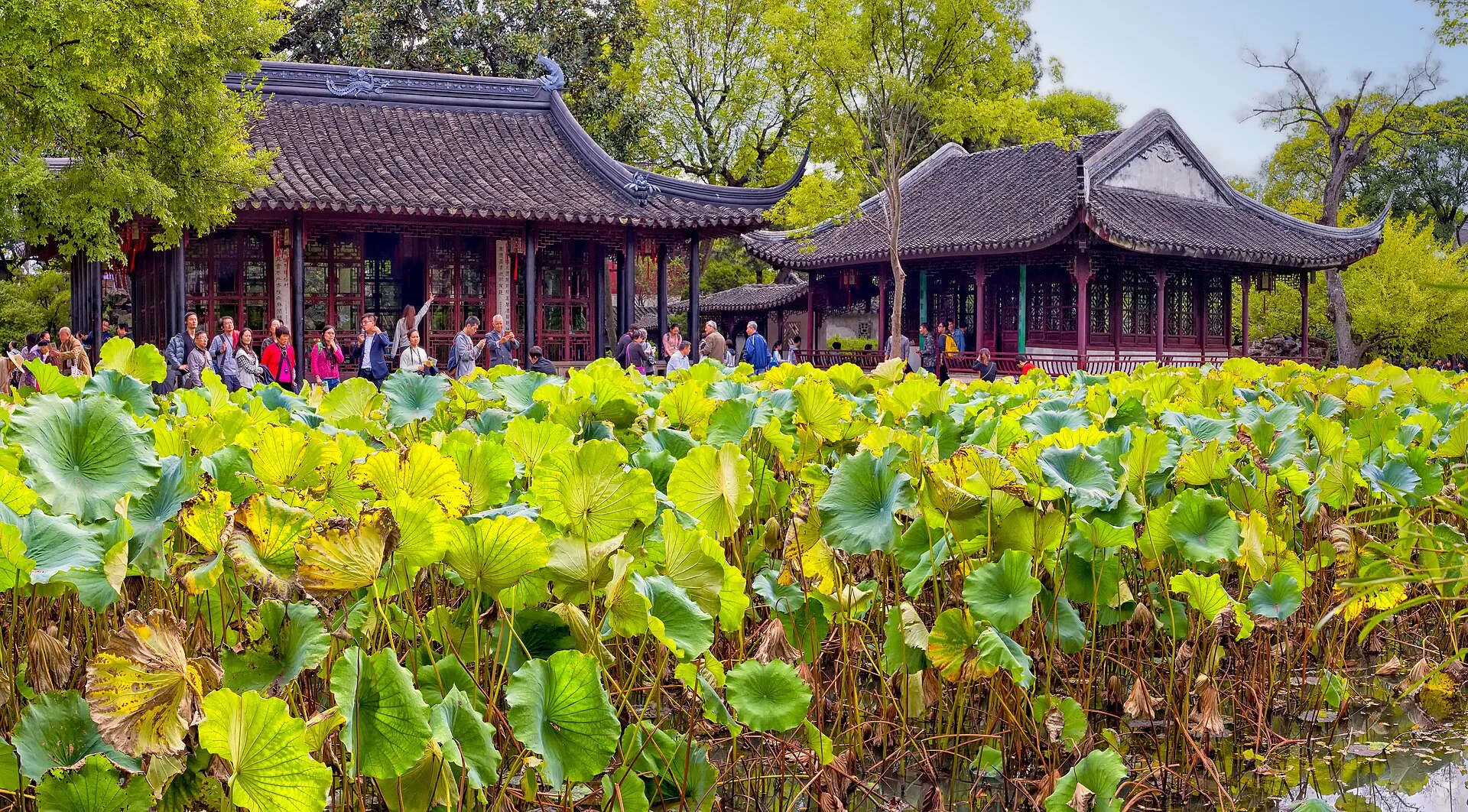
UNESCO identifies the Canglang Pavilion as the earliest of the nine gardens. According to the ICOMOS evaluation of the 2000 extension, it was built in the early 11th century on the order of the Northern Song poet Su Sunqin, on the site of an earlier garden. It became a temple under the Yuan and Ming dynasties and was repeatedly restored. The garden has a range of man-made hills in its interior and waterscapes outside: a square pavilion stands on top of one of the hills, and a double corridor running alongside the canal to the north passes through more than a hundred latticed windows, linking the garden with the water beyond its walls.
The Lion Grove Garden began as a Buddhist foundation. ICOMOS records that it was created in 1342, under the Yuan dynasty, by Zen disciples of Abbot Tianni as the Budhi Orthodox Monastery, and that its name comes from its rock formations and its bamboo forest. The garden was separated from the temple in the 17th century and bought by an industrialist in 1918. Its layout is a series of man-made mountains of craggy, irregular rock with buildings arranged around a lake, together with an artificial waterfall falling over steep cliffs.
HOW THE HUMBLE ADMINISTRATOR'S GARDEN WAS BUILT
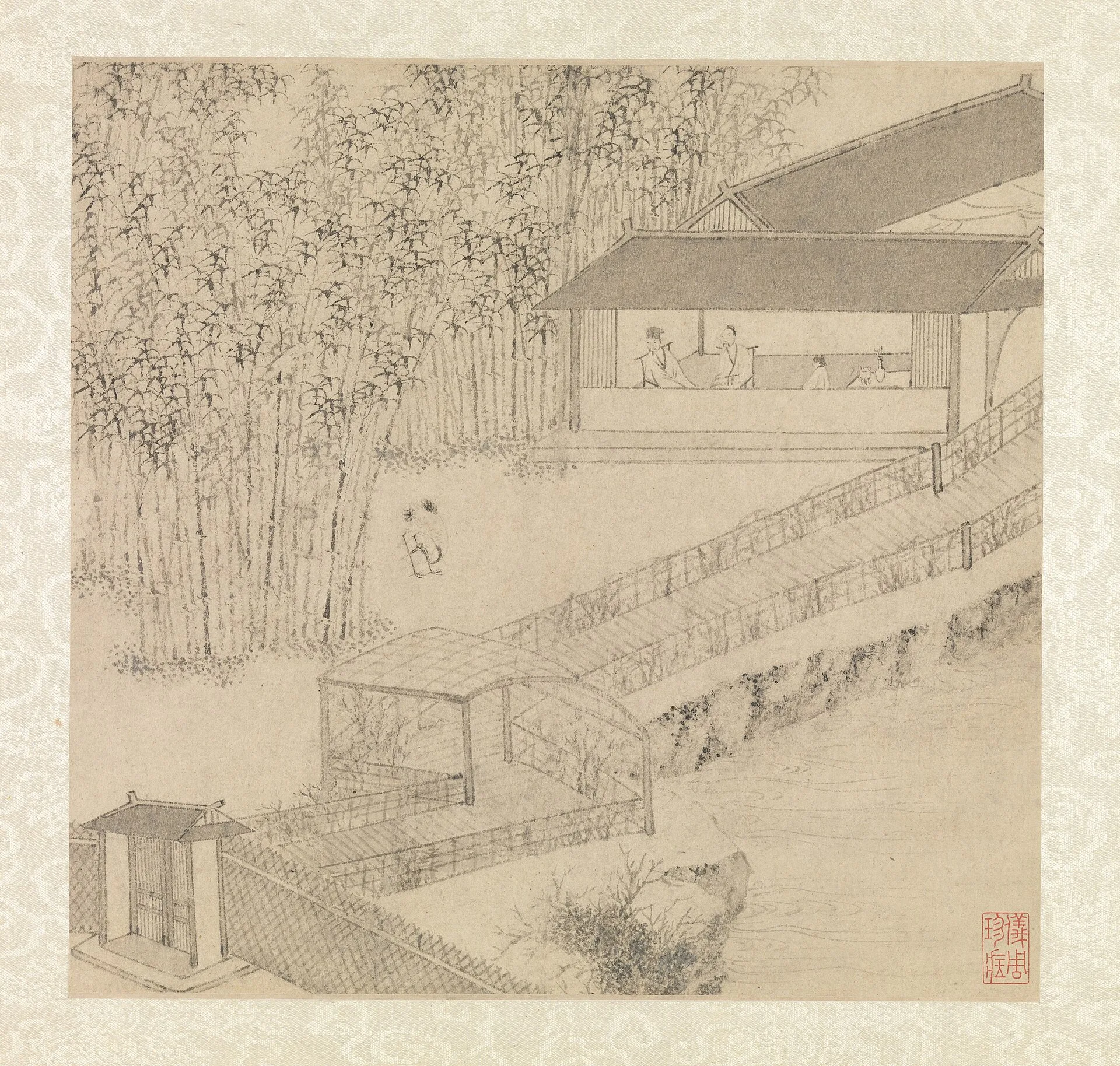
The site of the Humble Administrator's Garden had been home to Suzhou notables since the 2nd century AD. The present garden was built by Wang Xianchen, a Ming imperial inspector, after he retired in 1509; the Met's catalogue describes him as a censor active from about 1500 to 1535 and places the garden on the site of an ancient temple. The Met records the garden under its Chinese name, Zhuozheng Yuan, translated there as the Garden of the Inept Administrator. It covers 51,959 square metres, about one fifth of it lake, and was declared a Cultural Relic of National Importance in 1961.
ICOMOS describes three parts. The central section recreates the scenery of the Lower Yangtze, with hills crowned by pavilions; buildings in the western section overlook the lake and are reflected in it; and the eastern section has hills of pine and bamboo encircled by streams. The garden holds forty stelae and more than a hundred inscriptions. The painter Wen Zhengming (1470 to 1559) returned to Suzhou in 1527 and was given a studio in the garden. In 1535 he painted an album of thirty-one views of it, and in 1551, aged eighty-one, a second album of eight leaves in ink on paper, each paired with a poem. That second album entered the Metropolitan Museum of Art as a gift of Douglas Dillon in 1979.
THE LINGERING GARDEN, MASTER OF THE NETS AND MOUNTAIN VILLA
The Lingering Garden dates from the end of the 16th century and was the work of Xu Taishi, a high imperial official. Its present name was given in 1873 by the Zheng family as a tribute to earlier owners, the Liu family, because the Chinese word for "lingering" resembles their name. Buildings occupy about a third of its 23,310 square metres. A winding path leads to a central area of hills and water encircled by buildings, with the Cloud-Capped Peak, a limestone rock 6.5 metres high, to the north east. The western section offers a contrast: rolling earthen hills planted with maples.
The Garden of the Master of the Nets covers about 5,400 square metres. Its south gateway is flanked by large carved stone blocks that indicated the owner's court rank, the house is arranged around four courts, and its central pool is encircled by a covered walkway, with pavilions and studios beyond. The Mountain Villa with Embracing Beauty, which probably dates from the end of the 16th century, is the smallest of the four original gardens at about 2,180 square metres. Its limestone mountain, the work of the Qing master Gu Yuliang (1764 to 1830), covers less than 500 square metres yet rises in peaks of up to 7 metres, with caves, ravines and stone houses, a pavilion on the summit and two more at its foot.
WHAT ARE TAIHU ROCKS IN SUZHOU GARDENS?
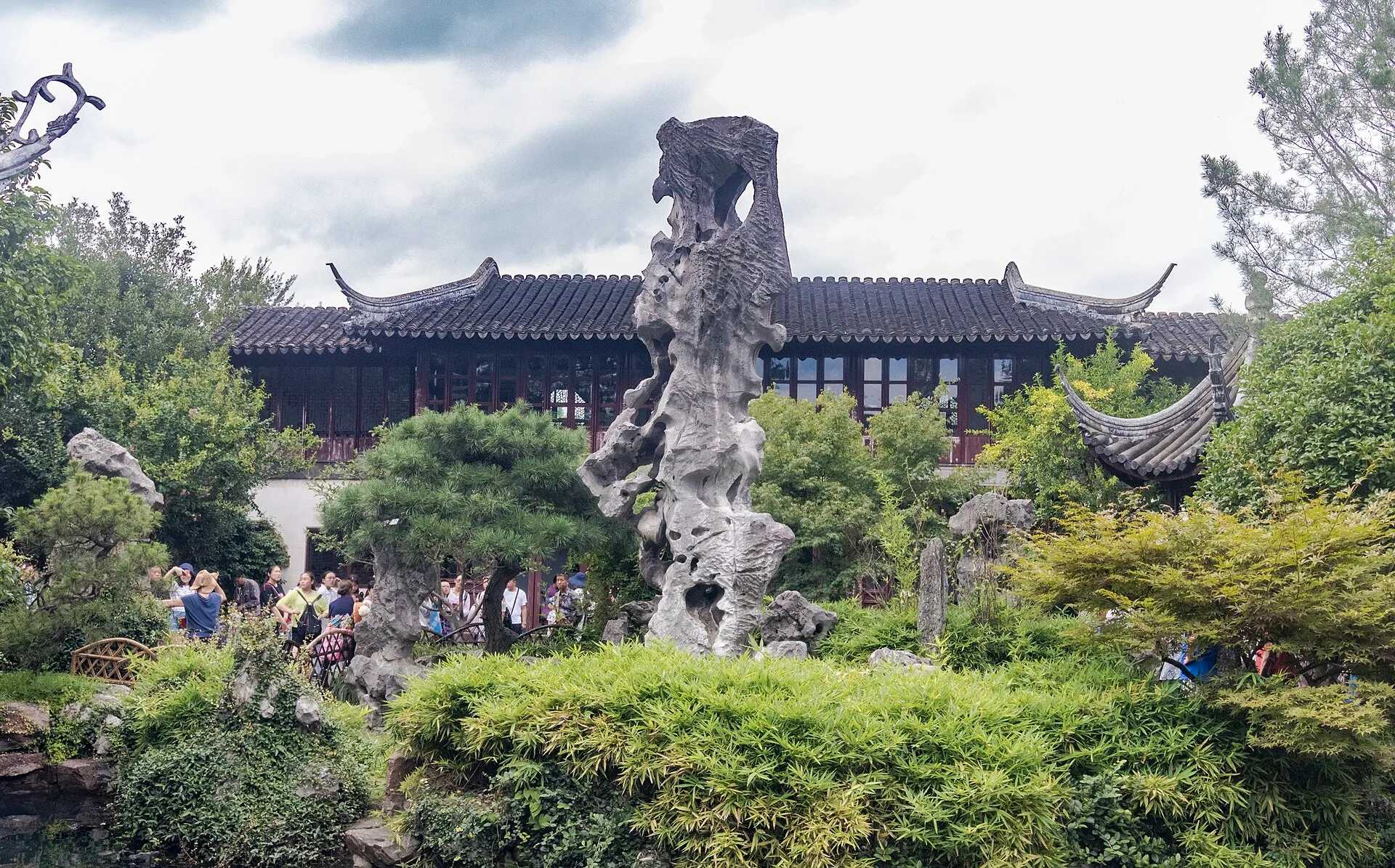
Taihu rocks are limestone stones first sourced from Lake Tai in the Lower Yangzi River Delta near Shanghai, which gave them their name, according to the Cleveland Museum of Art. The Art Newspaper describes them as naturally eroded limestone, with holes of different sizes created by centuries of water flow, and reports a rock yard on the lake shore near Wuxi where buyers still choose stones. Collectors value them for their holes, surface textures and sculptural forms, and they were displayed both as garden sculptures and as miniature mountains on scholars' desks. In the Met's garden court the rocks act as focal points, forming peaks, a grotto and planting beds.
By the Tang dynasty three criteria for judging such rocks had been identified, the Met's guide states: leanness (shou), perforations (tou) and surface texture (zhou). The Cleveland Museum of Art dates the peak of their appreciation to the 11th century. It recounts that the scholar-official Mi Fu bowed before a large garden stone and addressed it as "Elder Brother Rock", and that Emperor Huizong, who reigned from 1101 to 1126, named the stones in his palace gardens and painted one in a work that survives.
JI CHENG'S YUAN YE AND THE BORROWED VIEW
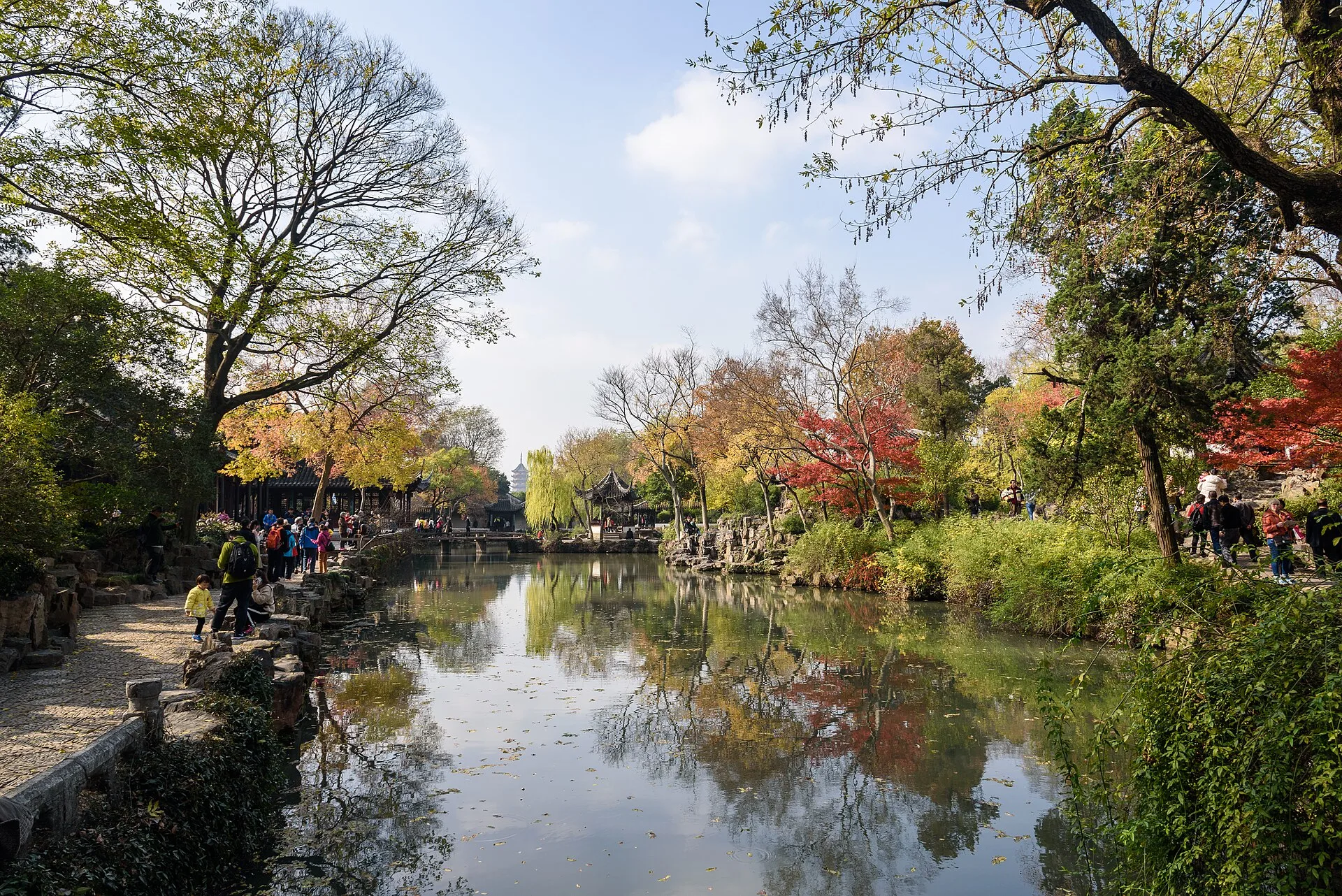
Ji Cheng, born in 1582, was a garden designer and landscape painter. The Met describes his Yuan Ye, completed in 1634, as the earliest extant Ming treatise on Chinese architecture and garden design. Among its instructions is the advice to "take the whitened wall as the painting paper, and paint it with rocks". Ji Cheng ranked borrowed views among the most important elements in garden design: scenery drawn into the garden from near and far, from above and below, and in each season. Terraces, doorways and pavilions were placed to frame vistas for the visitor to stop and contemplate, and covered walkways guided visitors to the most interesting views while sheltering them from rain and sun.
Lattice windows apply the same idea at a smaller scale. The Met's garden court has white walls pierced by windows of low-fired ceramic tiles in lattice patterns, each different, with designs found in Yuan Ye. Plants or rocks placed behind them suggest further vistas even where the space behind is minimal. The court itself, the Astor Chinese Garden Court, is modelled on a Ming scholar's courtyard in the Garden of the Master of the Fishing Nets, a gift of the Vincent Astor Foundation in 1981. The Met's guide records that Chinese craftsmen built it in 1980 with traditional tools and methods, using fifty columns of rare nan wood and floor and ceiling tiles from a former imperial kiln outside Suzhou reopened for the project.
THOMPSON SHANGHAI EXPO: PAVILIONS ON THE HUANGPU

Thompson Shanghai Expo opened in October 2025 as Thompson's first hotel in Asia Pacific, with 254 rooms, and Silverfox Studios carried out the full scope of its interiors. The hotel stands on the former Expo 2010 site, facing the Huangpu. The interiors avoid literal pavilion imagery. The scheme is organised instead as "buildings within buildings": each public room and each guestroom type is its own structure, with its own ceiling and its own materials. On levels 19 and 20, the Fishermen's Pavilion, the all-day dining restaurant, is set as penthouse pavilions facing the river and the Expo grounds.
The Suzhou gardens are likewise composed of separate structures rather than one building. The Garden of the Master of the Nets sets pavilions and studios around a pool ringed by a covered walkway, the Lingering Garden encloses its central hills and water with buildings, and the Canglang Pavilion places a square pavilion on a hill above its corridors. Ji Cheng's borrowed view draws scenery from beyond the boundary of the garden into it, with pavilions and terraces placed to frame what lies outside. At Thompson Shanghai Expo, the Fishermen's Pavilion faces the Huangpu and the former Expo grounds.
SOURCES
- UNESCO World Heritage Centre Classical Gardens of Suzhou
- UNESCO World Heritage Centre Classical Gardens of Suzhou: documents
- ICOMOS Advisory Body Evaluation: The Classical Gardens of Suzhou (1997)
- ICOMOS Advisory Body Evaluation: The Classical Gardens of Suzhou, extension (2000)
- The Metropolitan Museum of Art The Chinese Garden: Nature in the Chinese Garden (educators' resource)
- The Metropolitan Museum of Art A Piece of Peace
- The Metropolitan Museum of Art Wen Zhengming, Garden of the Inept Administrator (Zhuozheng Yuan)
- Cleveland Museum of Art Gift of a Lake Tai Stone
- The Art Newspaper Why a six-ton scholar's rock is making its way from China to Texas