FIVE PHASES, IMPERIAL YELLOW, CINNABAR, WEDDING DRESS AND NEW YEAR RED
The red and gold Chinese palette has several distinct sources. Yellow was reserved for the emperor in Qing ceramics and textiles, and on court robes it was worked alongside gold thread. The red of carved lacquer came from cinnabar, a mercury sulphide, and red is also the colour of Chinese weddings and the New Year, where it is tied to luck. Behind the imperial rules lies wuxing, the Five Phases theory that correlated the phases with colours, directions and seasons. Catalogues at the Metropolitan Museum of Art and the Victoria and Albert Museum record how these conventions appear on porcelain, embroidery and bridal shoes, and the Forbidden City in Beijing shows them applied to architecture, with crimson walls under roofs of yellow glazed tile.
HOW DOES WUXING ASSIGN COLOURS IN CHINESE THOUGHT?
Britannica describes wuxing, the Five Phases, as a principle used to explain change in Chinese history, philosophy and medicine. The five are earth, wood, metal, fire and water, which were believed to overcome and succeed one another in an unchanging cycle. Wuxing began as a moral theory associated with Zisi, the grandson of Confucius, and with Mencius. Zou Yan, a sage-alchemist of the 3rd century BCE, developed it into a cosmological system and was the first to link it to dynastic history.
The theory dominated the intellectual world of the Han dynasty (206 BCE to 220 CE), and Neo-Confucian philosophers of the Song dynasty (960 to 1279) returned to it, reinterpreting the phases as the Five Virtues. The phases were correlated with the cardinal directions, the seasons, musical tones, bodily organs and colours. The Metropolitan Museum of Art's catalogue entry for a Kangxi-period vase notes that yellow is associated with earth in Chinese culture. The Beijing tourism board's guide to the Palace Museum applies the same correlations to the roofs of the imperial palace, where black is associated with water and green with wood, and it explains two departures from the palace's yellow roofs on that basis.
WHY WAS YELLOW THE EMPEROR'S COLOUR, AND WHERE DOES GOLD FIT?

The Met's vase in meiping shape, a Jingdezhen ware piece of the Kangxi period (1662 to 1722), is porcelain with incised decoration under a yellow glaze. Its catalogue text states that yellow has often been reserved for the use of the emperor in ceramics and textiles. Other members of the imperial family were assigned other colours, such as white or green, depending on their rank. A plain yellow glaze was therefore a statement of rank as much as a choice of decoration, and the same vessel shape in another colour could signal a different place in the imperial household. The rule extended from porcelain to dress, where yellow silk was combined with gold.
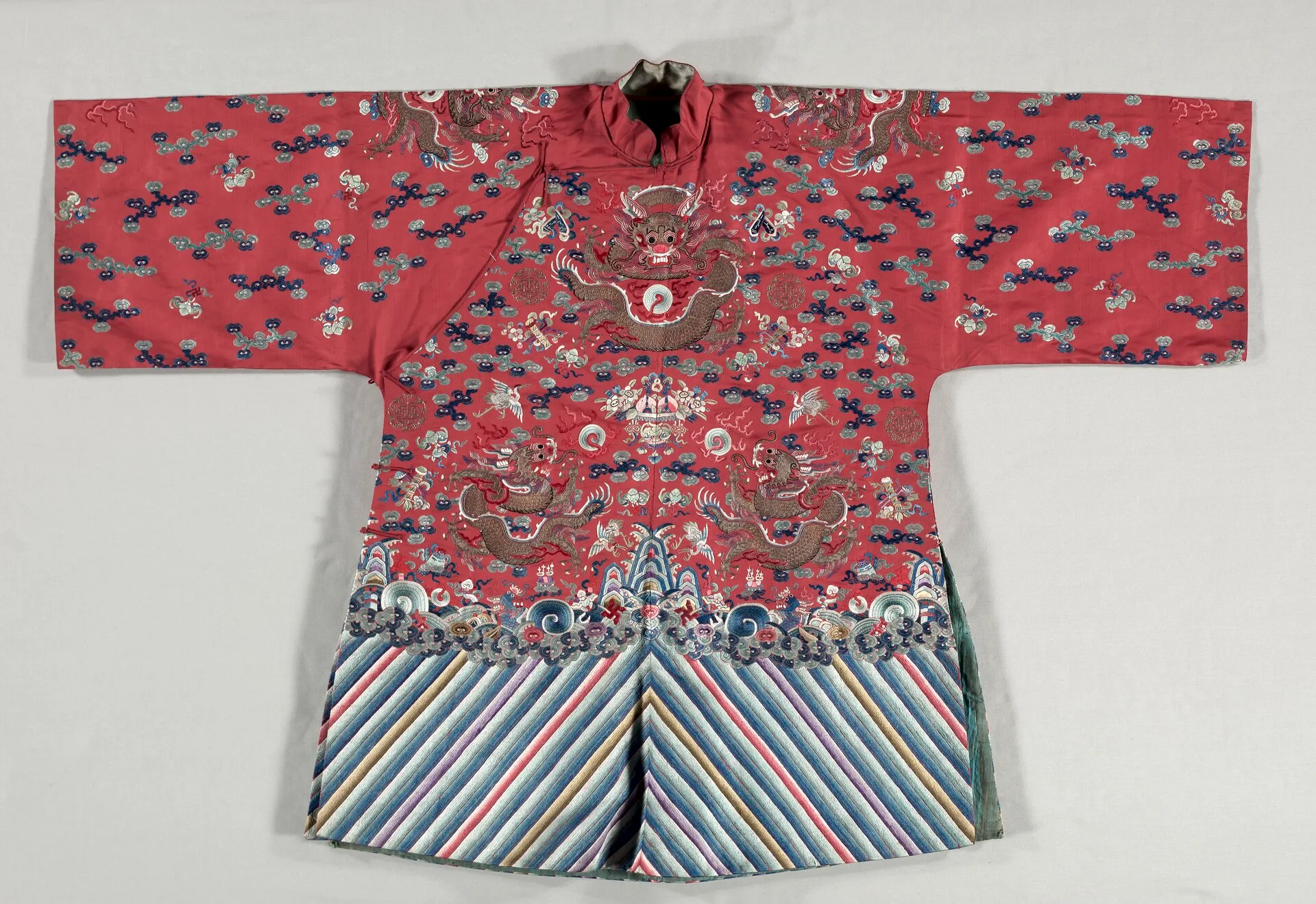
A dragon robe at the Victoria and Albert Museum, made in the Tongzhi period (1862 to 1874), is woven silk embroidered with silk and gold threads in couched work and satin stitch. It looks bright yellow, but the museum notes that it is entirely embroidered on blue silk. Five-clawed dragons appear on the back, the front and the shoulders. The V&A records that certain shades of yellow were restricted to the exclusive use of the emperor and his immediate family, and that an emperor's robe would most likely also carry the twelve imperial insignia. The museum adds that this particular robe may never have been worn by an emperor.
CRIMSON WALLS AND YELLOW ROOFS AT THE FORBIDDEN CITY
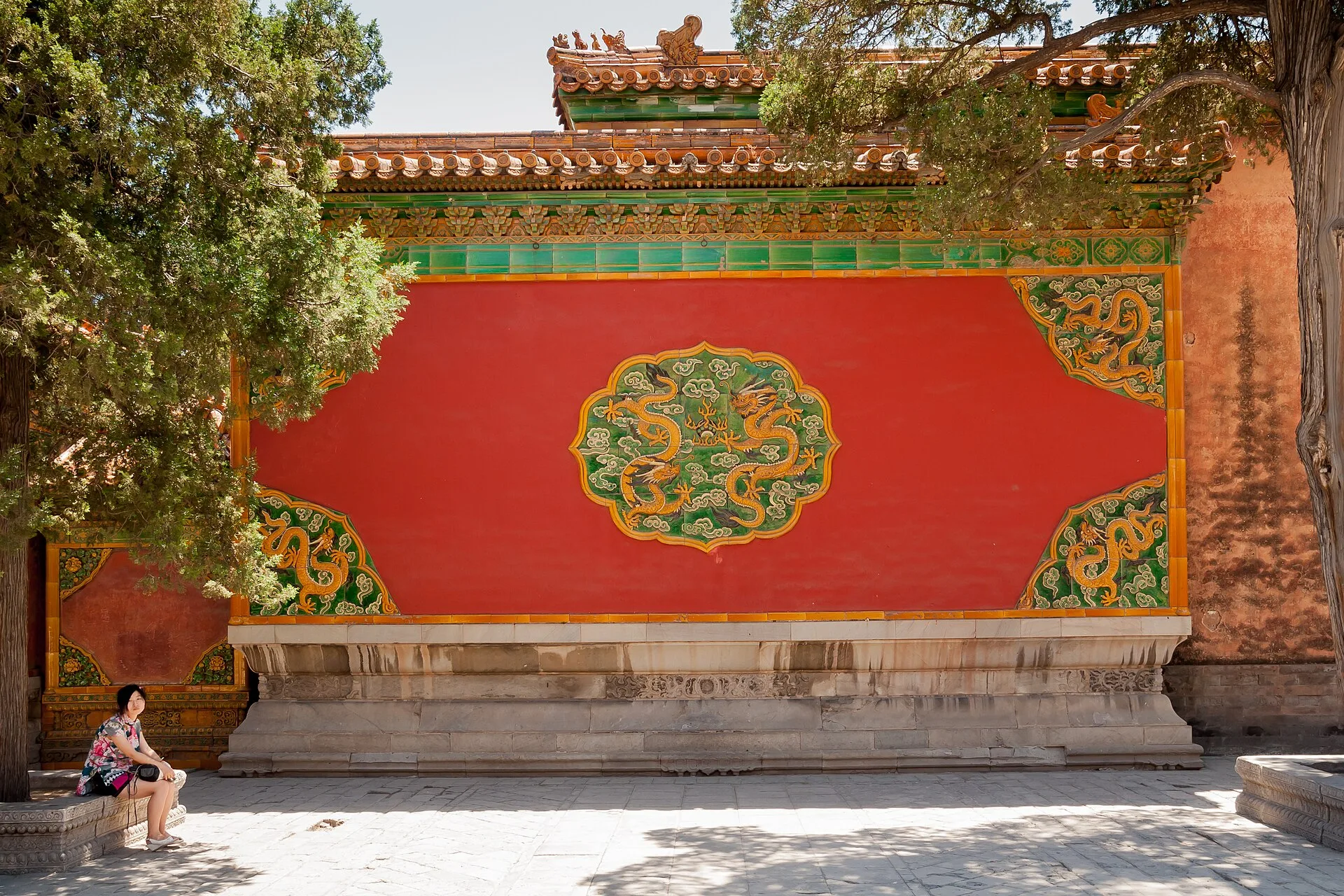
The palace in Beijing became the imperial seat after Yongle, the third emperor of the Ming dynasty, decided in 1421 to transfer his court from Nanjing. The evaluation that ICOMOS prepared for UNESCO in 1987 describes the palace as the supreme seat of power for five centuries, records that its living quarters numbered 9,000 rooms and that its buildings cover 15 hectares, and calls it "the Forbidden, or the Crimson, City". The same evaluation identifies the crimson walls as the feature that distinguished the Forbidden City. Its construction, layout and court life are covered in our article on the Forbidden City; the colour scheme is the concern here.
The Beijing tourism board's guide to the Palace Museum states that yellow is the colour of the emperor, and that almost all roofs in the Forbidden City therefore bear yellow glazed tiles. The exceptions follow the Five Phases. The library at the Pavilion of Literary Profundity had black tiles because black was associated with water, and so with fire prevention. The Crown Prince's residences have green tiles because green was associated with wood, and so with growth. Crimson walls and yellow roofs were the rule for the imperial complex, and the black and green roofs mark the two building types the guide singles out as exceptions to it.
CINNABAR: THE PIGMENT BEHIND RED AND GOLD CHINESE LACQUER

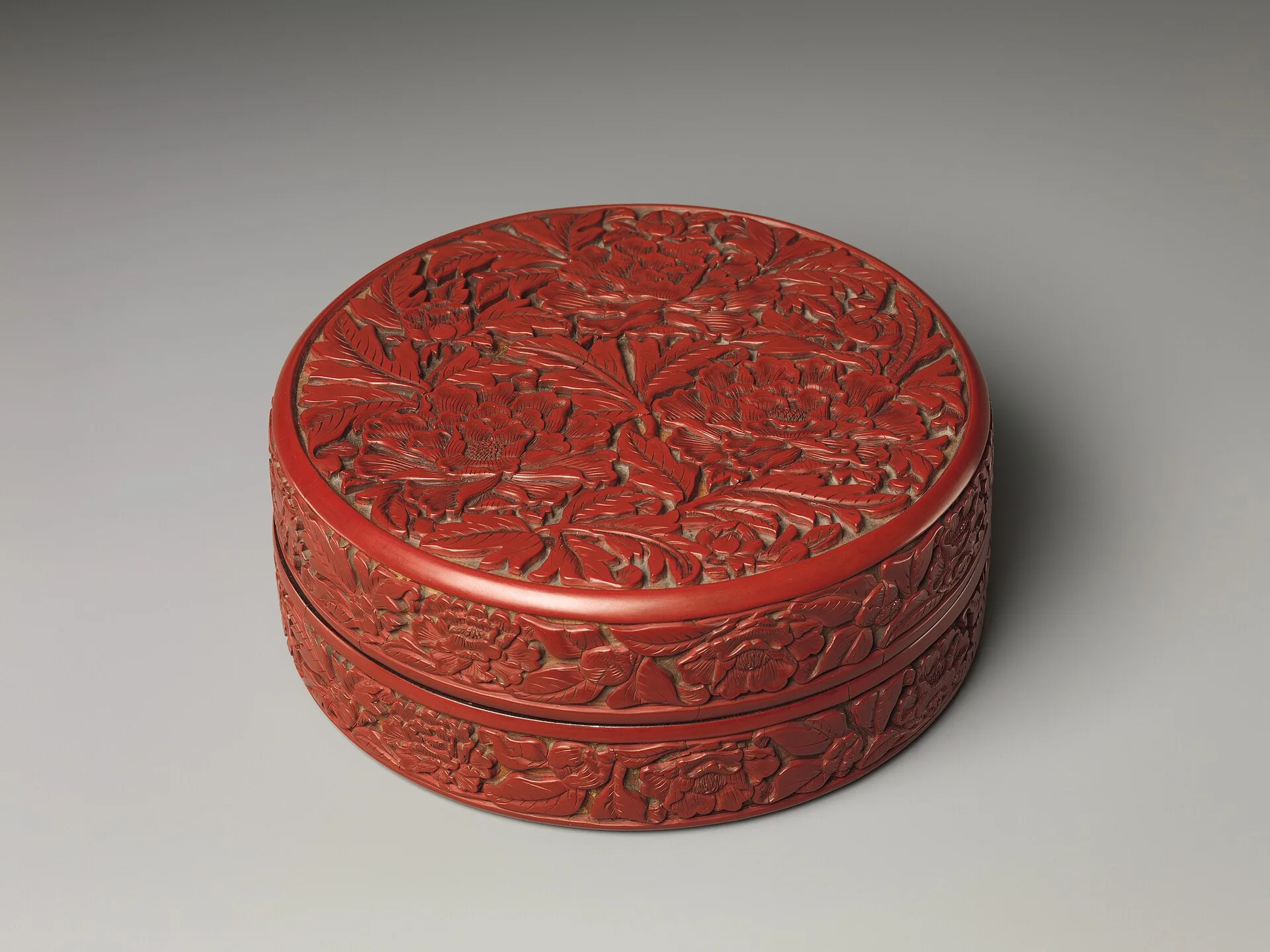
The red of Chinese carved lacquer has a mineral source. In 2009 the Metropolitan Museum of Art staged Cinnabar: The Chinese Art of Carved Lacquer, which ran from 6 August 2009 to 21 February 2010 and showed about fifty examples, with significant loans from the Florence and Herbert Irving Collection. The museum explained that carved lacquer is often called cinnabar lacquer, a reference to the powdered mercury sulphide used as its primary colourant, and that red is its predominant colour. Lacquer itself was known in China in the late Neolithic period, about 5000 to 2000 BC, and was an important medium from the sixth century BC to the second century AD.
Carved lacquer appeared in the twelfth century. Craftsmen applied multiple layers to a base, often thirty or thirty-five and at times up to two hundred, drying each in turn, and then carved the hardened lacquer rather than the wood beneath. Early pieces placed yellow and green layers among the red. In a related technique described by the Met, a red ground was carved with thin lines filled with gold, gold powder or tinted lacquer, setting red and gold on one surface. The wider history of the craft, from Han workshops to European imitations, is covered in our article on Chinese lacquerware.
RED AND GOLD CHINESE WEDDING DRESS AND DOUBLE HAPPINESS
The V&A holds a pair of bridal court shoes made in Hong Kong by the Sun Sun Shoes Factory between 1940 and 1970. Its catalogue states that red is the primary colour for traditional Chinese wedding ceremonies, and that the shoes would have been worn with a matching jacket and skirt known as hong gua, or red gown. The uppers are satin-weave silk embroidered with silk and metallic threads, showing a dragon and a phoenix chasing a pearl. The metallic couching is heavily padded, so that the design stands out in relief, with the metal thread set directly on the red silk ground.
The same record explains how such dress was used. Traditional bridal outfits are still worn for rituals before parents and ancestors and at wedding banquets, even though white wedding dresses are now popular. Brides once embroidered their own wedding shoes and textiles, a skill that showed their ability; later, ready-made wedding clothing was often sent by the groom's family, and such outfits were frequently rented. The V&A suggests that heeled shoes like this pair may be a modern version of the flat embroidered slippers that brides once wore, made by a commercial factory rather than by the bride herself.
A second V&A object shows the double happiness character in use. A 19th-century woman's robe, woven in silk tapestry, the technique known as kesi and described in our article on Chinese tapestry, might have been worn for a wedding. Lotus plants with pink flowers are scattered over its ground, and between them are red characters meaning double happiness, which the museum calls a suitable decoration for a marriage garment. The ground pattern is worked in gold on mauve, the outer edge is bordered with black and gold thread, and the robe is lined with yellow silk.
RED AT CHINESE NEW YEAR: COUPLETS, FU AND RED ENVELOPES
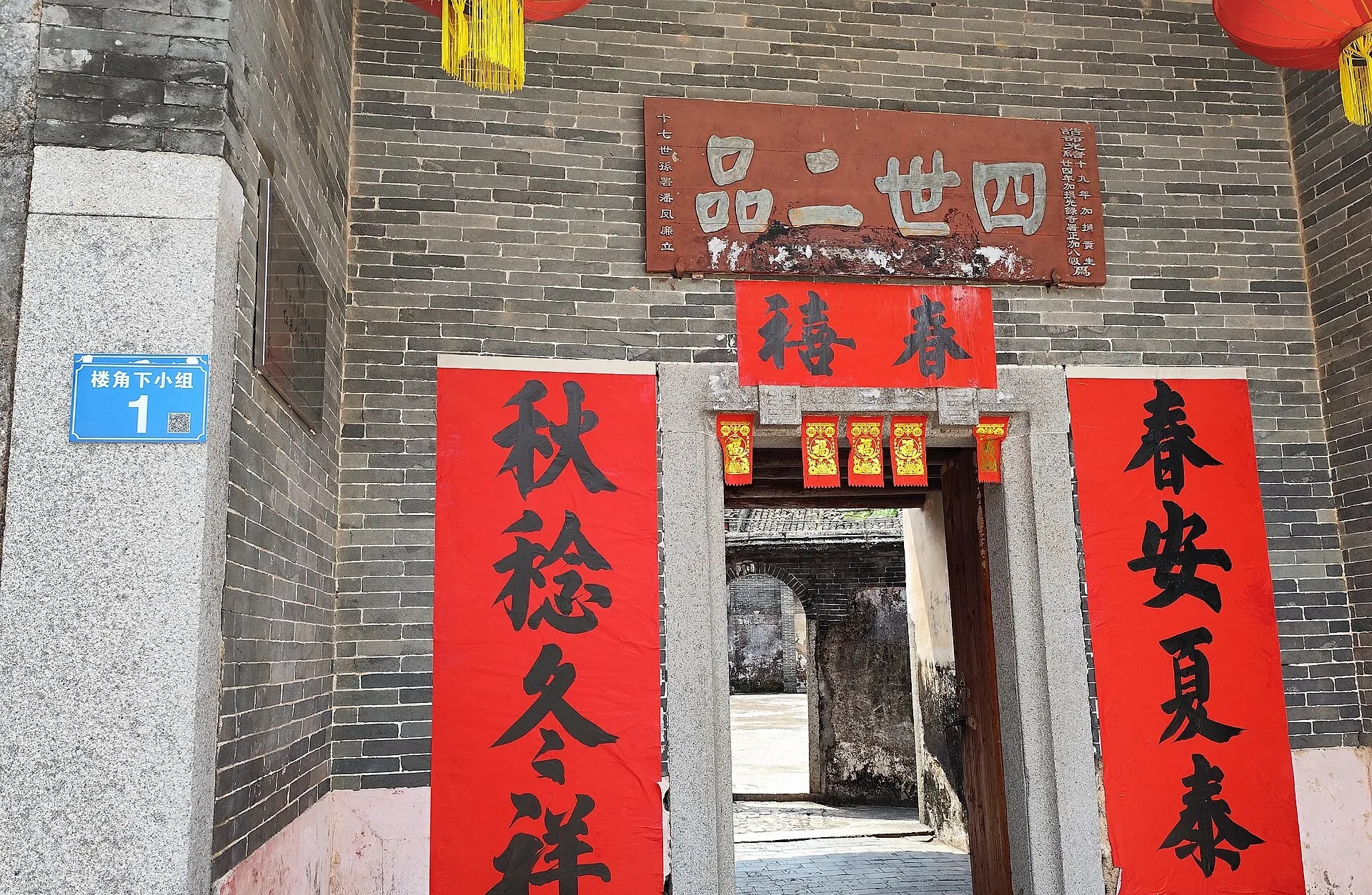
The Shanghai Municipal People's Government's guide to Chinese New Year's Eve describes spring couplets as poetic verse pairs expressing good wishes for the year ahead, and says families select and display red couplets on their doors. The character fu, for blessing, is pasted on doors to invite good fortune, often upside down, because the word for upside down, dao, sounds the same as the word for arrive. Elders give money in red envelopes, called yasuiqian, to younger family members. The guide recounts a well-known legend of a monster called sui that would emerge on New Year's Eve to harm sleeping children, and says the money originally protected children; today the envelopes convey affection and good wishes.
In Hong Kong the same customs carry Cantonese names. The Hong Kong Tourism Board notes that it is customary for elders, bosses and married people to give lai see, red envelopes filled with lucky money. Many people buy new or red clothing for the festival, which the board says symbolises fresh beginnings, luck and positivity. Malls and shopping streets are decorated for the season, and on Lee Tung Avenue in Wan Chai red lanterns line the street. Visitors to the Chinese New Year Race Day at Sha Tin Racecourse, held on the third day of the New Year, are advised by the board to wear red for luck.
GRAND IMPERIAL COURT AT MGM MACAU: RED AND GOLD VITRINES

Grand Imperial Court is a Chinese fine dining restaurant at MGM Macau, a Silverfox Studios interior design project completed in 2024. An automated sliding entry opens onto a display wall for Moutai, made up of floating, lit jewel-box vitrines in red and gold that hold rare vintage bottles. Red and gold appear together on carved lacquer with gold-filled lines and on the padded metallic embroidery of red bridal shoes. At Grand Imperial Court the same two colours are used for the vitrines of the entrance display wall.
The restaurant's private suites are themed on sapphire, emerald, ruby and gold, and they are fitted with custom hand-crafted tapestries. Gold, one of the four themes, also runs through the objects traced above: as thread couched onto a Tongzhi-period dragon robe, as gold-filled lines on red lacquer and as the gold ground pattern of a 19th-century marriage robe. Tapestry appears in that history too, in the kesi silk tapestry of the V&A's wedding robe. At Grand Imperial Court, hand-crafted tapestry and a gold theme are both present in the private suites, alongside the red and gold of the vitrines at the entrance.
SOURCES
- Britannica Wuxing
- The Metropolitan Museum of Art Vase in meiping shape, Kangxi period
- Victoria and Albert Museum Dragon robe, Tongzhi period, 1862 to 1874
- ICOMOS / UNESCO World Heritage Centre Advisory Body Evaluation: The Imperial Palace of the Ming and Qing Dynasties (1987)
- Visit Beijing The Palace Museum
- The Metropolitan Museum of Art Cinnabar: The Chinese Art of Carved Lacquer
- Victoria and Albert Museum Pair of shoes, Sun Sun Shoes Factory, Hong Kong, 1940 to 1970
- Victoria and Albert Museum Robe, China, 19th century
- Shanghai Municipal People's Government Chinese New Year's Eve
- Hong Kong Tourism Board The Ultimate Guide to Chinese New Year in Hong Kong