MUDAN FROM TANG LUOYANG TO QING PORCELAIN AND EMBROIDERY

The peony in Chinese art is above all the tree peony, mudan, a woody shrub that Henan's provincial government says has been cultivated in the city of Luoyang for more than 1,600 years. Tang poets wrote of the whole capital stirred by its blooms, and the flower acquired the name huawang, king of flowers. In the Song dynasty the scholar Ouyang Xiu catalogued the peonies of Luoyang in a treatise of three chapters. A Yuan painter set tree peonies in full bloom on a hanging scroll nearly one and a half metres tall, potters at Jingdezhen painted scrolling peonies in cobalt blue, and Qing workshops placed the flower in overglaze enamels on porcelain and in silk thread on satin and velvet. Museum records tie the motif to wishes for wealth, honour and prosperity, and Luoyang has held a peony festival every year since 1983.
WHY THE PEONY IS THE KING OF FLOWERS IN CHINESE ART
The name mudan came relatively late. Sixth Tone, citing the Hanyu Da Cidian dictionary, reports that the plant was grouped in antiquity under shaoyao, the herbaceous peonies, and was later distinguished as mu shaoyao, the woody peony, before mudan became its universal name. Its standing rose under the Tang dynasty (618 to 907), when it became an icon of Tang prosperity. The poet Liu Yuxi (772 to 842) wrote that only the peony had a colour able to captivate the whole nation, a sight that stirred the entire capital, and Bai Juyi wrote that when it bloomed the whole city would go mad with longing. According to Henan's provincial government, systematic planting techniques were in use by the Tang and Song dynasties, when many famous peony gardens were built.
Luoyang's claim on the flower is also explained by a folk tale. In the version retold by Sixth Tone, the Tang empress Wu Zetian (624 to 705) ordered every flower in the imperial garden at Chang'an, present-day Xi'an, to bloom at once during a winter banquet. All obeyed except the peony, and the empress had the plants uprooted and sent to Luoyang. In the story the exile became a coronation: the peony flourished in the city's loess soil and eventually earned the name huawang, king of flowers. Henan's provincial government describes Luoyang, an imperial capital under 13 dynasties, as the earliest site of peony cultivation, and lists poems, paintings, calligraphy, legends and cuisine among the places the flower appears in Chinese culture.
OUYANG XIU AND THE PEONIES OF LUOYANG

The first systematic account of the city's flowers came from Ouyang Xiu (1007 to 1072), the Song historian, writer and poet. His Luoyang mudan ji, an account of the peonies of Luoyang, is divided into three chapters, as summarised by the Chinese literature reference ChinaKnowledge.de. The first, Huapin xu, describes where 24 types of peony grow and why those of Luoyang are of extraordinary quality. The second, Hua shiming, gives the names, colours and individual features of each type. The third, Fengsu ji, records local customs: people of all social ranks in Luoyang cultivated and admired the flowers, cut blooms were preserved for presentation as gifts, and the chapter gives advice on propagation, irrigation and feeding.
Ouyang also recorded when the flowers opened. Sixth Tone quotes his observation that the flowers of Luoyang take the Grain Rain, guyu, as their cue to bloom; the solar term falls around 20 April, the period when Luoyang's peonies peak. His treatise was the first of a series of peony books. ChinaKnowledge.de lists eight later works, among them a second account of the peonies of Luoyang by Zhou Shihou, completed in 1082. Other Song titles include Zhang Bangji's Chenzhou mudan ji, Lu You's Tianpeng mudan ji and Qiu Daoyuan's Mudan rongru zhi. Xue Fengxiang wrote on the subject in the Ming dynasty, and Yu Pengnian compiled the Caozhou mudan pu in the Qing.
WHAT DOES THE PEONY MEAN IN CHINESE ART?

Painters made the flower a subject in its own right. The Cleveland Museum of Art holds a Yuan dynasty hanging scroll titled Peonies, dated to the late 1200s and painted in ink and colour on silk. The painting measures 145.5 by 88.3 centimetres and shows tree peony shrubs in full bloom in several colours. The museum notes that peony paintings were popular from the Southern Song period to the Ming dynasty and suggests that a scroll of this size may have hung in a reception hall to convey good wishes for wealth and prosperity. Paintings of this kind belong to the flower side of the Chinese bird-and-flower painting tradition.
On objects, the peony was often paired with other motifs to spell out a wish. The Asian Art Museum of San Francisco reads several Qing pieces this way in its gallery texts. On an octagonal plate of the Kangxi reign (1662 to 1722), peony and white magnolia convey the wish that a noble house be blessed with wealth and honour. A teacup and dish of the Yongzheng reign (1723 to 1735), titled Gongming fugui, fame and wealth, show a rooster among peony blossoms and rocks, read as a wish for official rank and honours. A malachite snuff bottle of about 1800 to 1900 is titled Fugui mantang, wealth fills the hall, and on a glass snuff bottle of about 1850 to 1900, peonies and butterflies represent an accumulation of blessings and prosperity.
PEONY SCROLLS ON CHINESE BLUE AND WHITE PORCELAIN
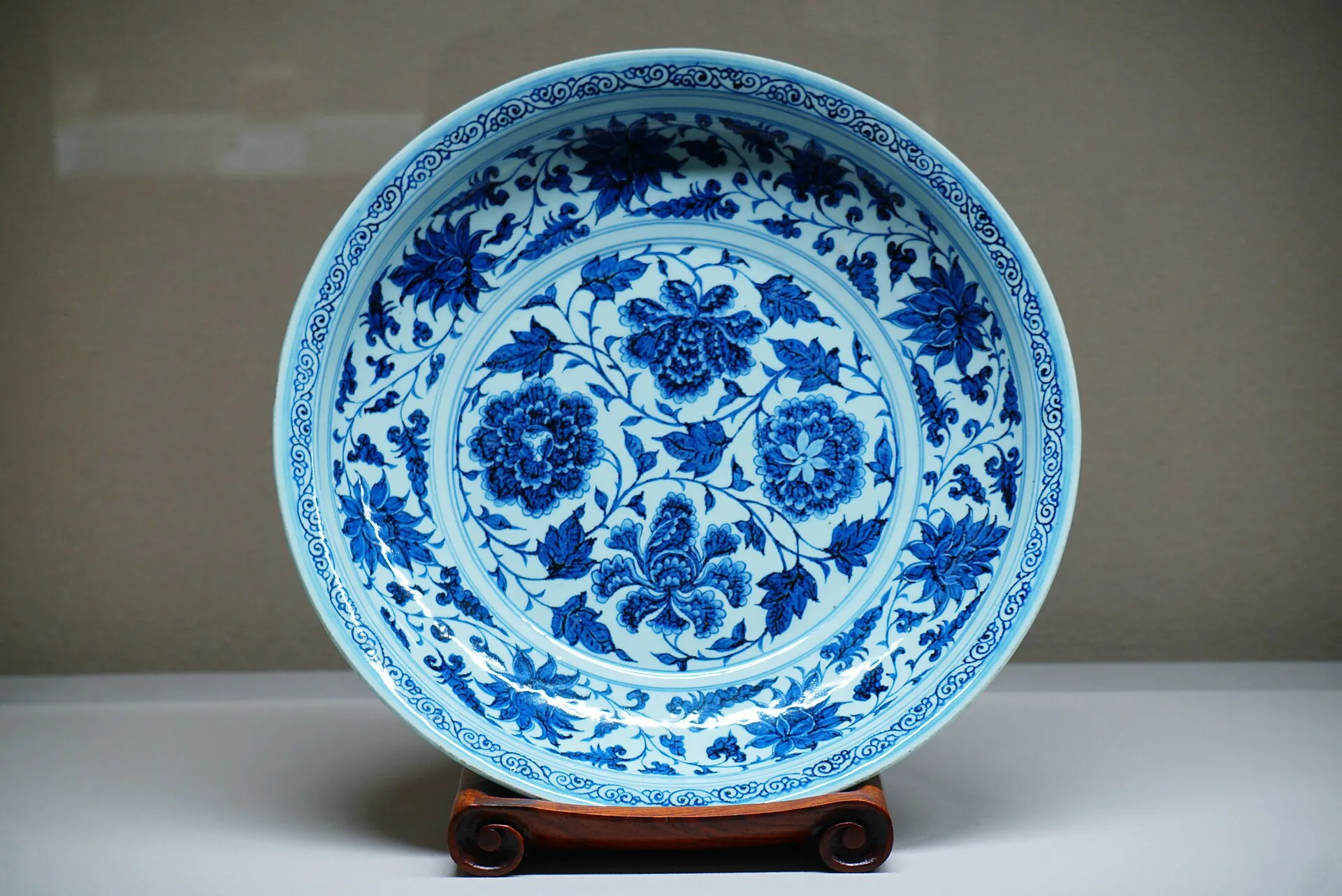
At Jingdezhen in Jiangxi province, potters of the Yuan dynasty (1271 to 1368) painted the peony in cobalt blue under a transparent glaze. A bottle in the Metropolitan Museum of Art, dated to the mid-14th century and 44.5 centimetres high, carries scrolling peonies around its centre, which the museum says derive from longstanding Chinese traditions. The other bands of decoration come from further afield. The patterns on the neck parallel the cloud-collar designs often found in textiles and clothing in China and the Islamic world, and the stylised lotus petals around the base allude to imagery found in Indo-Himalayan art.
The motif continued under the Ming. A bowl in the Victoria and Albert Museum, made at Jingdezhen in the reign of the Xuande emperor (1426 to 1435), is painted on the exterior with peony scrolls and a stylised lotus petal border, with a stylised floral motif inside. Its base carries a six-character reign mark, Da Ming Xuande nian zhi, made in the reign of the Xuande emperor of the great Ming. The museum describes Jingdezhen as the main centre for blue and white porcelain in China, with workshops that filled very large imperial orders, and states that the mark, materials and finish suggest this bowl was made under such an order. Imperial wares were reserved for the imperial household and for use as tributary gifts.
PEONIES IN FAMILLE ROSE ENAMEL AND CHINESE EMBROIDERY

Under the Qing, the peony was also painted in overglaze enamels, applied on top of the glaze rather than beneath it like cobalt. The V&A holds a bowl made at Jingdezhen in the Yongzheng period (1723 to 1735) and painted in overglaze enamels in the famille rose palette. On the outside a tree peony grows among rocks; on the inside are three small blossoms of prunus. The base carries the reign mark Da Qing Yongzheng nian zhi in underglaze blue, made in the Yongzheng period of the great Qing dynasty. The same reign produced the rooster and peony teacup and dish titled Gongming fugui in the Asian Art Museum of San Francisco.
In Chinese embroidery the flower could carry a more specific message. A dress length of dark blue silk velvet in the V&A, made in China around 1900, is embroidered in coloured silk threads with butterflies, flowers and fruit, in a variation of smooth satin and knot stitches. The museum states that its motifs show it was made for a young woman's robe or gown: peonies are associated with girls of noble and admirable character, and the single white peony indicates the youth, wit and beauty of the intended wearer. A scroll of embroidered silk satin in the same collection, dated 1894, shows a red-crested crane on a tree stump with flowering peonies below, the crane associated with a long life and the peony with royalty.
THE LUOYANG PEONY CULTURE FESTIVAL TODAY

Luoyang has held its peony festival every year since 1983. Henan's provincial government reported that the 40th China Luoyang Peony Culture Festival ran until 23 April 2023, with the flower viewing period lasting until 5 May. The festival falls around Grain Rain, the solar term that Ouyang Xiu tied to the opening of Luoyang's peonies in the 11th century. The provincial government lists the peony's meanings as wealth, auspiciousness, happiness and prosperity, and gives the flower's nickname as the king of flowers.
The city's largest collection is the National Peony Garden, also called the National Peony Gene Bank, which the provincial government says holds 1,365 varieties of peony in nine colours and ten flower shapes. Ouyang Xiu's first chapter described 24 types, so the garden's count is more than fifty times the number in the Song treatise. Cultivation extends well beyond the garden: by the government's figures, peonies are planted across more than 77,000 mu of the city, and 33,000 people work in the peony industry.
EMBROIDERY, SILK AND HARBOUR LIGHT AT MAN WAH
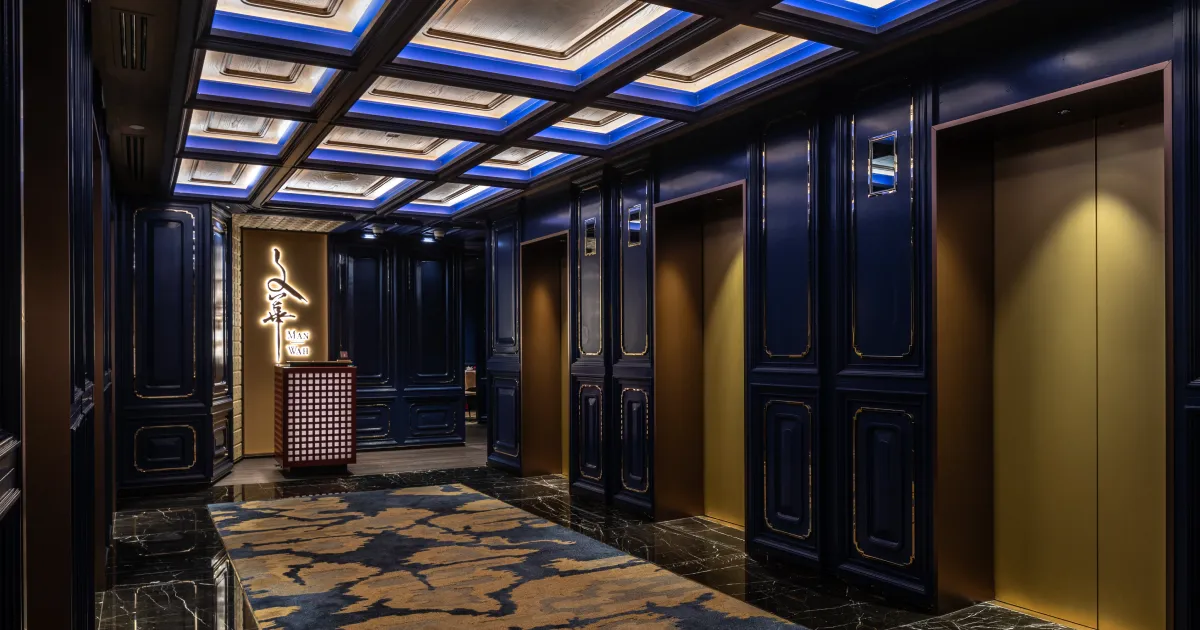
Man Wah is the Cantonese restaurant on the 25th floor of Mandarin Oriental, Hong Kong, and holds One MICHELIN Star. Its 2021 interior redesign interprets the Hong Kong skyline and Victoria Harbour seen from the restaurant's windows, with references to the hotel's heritage. The lanterns reinterpret the original Man Wah lanterns as clustered brass cages with embroidered pleated shades. Embroidery, the technique of the Qing dress length and the 1894 scroll in the V&A, appears again in an embroidered dragon and floral artwork set on a navy wall panel.
Navy panelling with gold trim lines the room, and the floor is a bespoke blue and gold carpet in silk with hand-carved patterning that evokes light on the harbour. Silk is also the ground of the Yuan dynasty Peonies scroll in Cleveland, painted in ink and colour in the late 1200s, and of the 1894 satin scroll embroidered with a crane and flowering peonies. Cobalt blue on white porcelain was the scheme of Jingdezhen's peony scrolls, from the Yuan bottle in the Met to the Xuande bowl in the V&A; at Man Wah, blue is paired with gold in both the panelling and the carpet.
SOURCES
- Sixth Tone Inside the Linguistic and Cultural Rebellion of the 'Mudan'
- People's Government of Henan Province In Pics: Enjoy the Blossoming Peony Flowers in Luoyang, Central China's Henan
- ChinaKnowledge.de Luoyang mudan ji
- Cleveland Museum of Art Peonies
- Asian Art Museum of San Francisco Chinese gallery object labels (CHN17)
- The Metropolitan Museum of Art Bottle with Peony Scroll
- Victoria and Albert Museum Bowl, Jingdezhen, 1426 to 1435
- Victoria and Albert Museum Bowl, famille rose, 1723 to 1735
- Victoria and Albert Museum Dress length, about 1900
- Victoria and Albert Museum Scroll, embroidered silk satin, 1894