FOUR REGIONAL SILK EMBROIDERY SCHOOLS, EACH SHAPED BY ITS OWN CITY, MARKET AND PATRONS

The Four Great Embroideries of China are the regional schools of silk embroidery named after their home provinces: Su embroidery from Suzhou in Jiangsu, Xiang embroidery from Changsha in Hunan, Yue embroidery from Guangdong and Shu embroidery from Chengdu in Sichuan. Britannica describes the Suzhou school as one of the four most famous in China, alongside those centred in Hunan, Guangdong and Sichuan. All four were entered in 2006 in the first batch of China's national list of intangible cultural heritage, under traditional fine arts, as items VII-18 to VII-21. Suzhou's work was shaped by literati painting and a commercial embroidery trade, Changsha's by a blended stitch developed to reproduce shading, Guangdong's by gold thread and an export market, and Chengdu's by a silk industry that was under government control by the late Han.
SU EMBROIDERY: SUZHOU, LITERATI PAINTING AND THE DOUBLE-SIDED SILK PICTURE
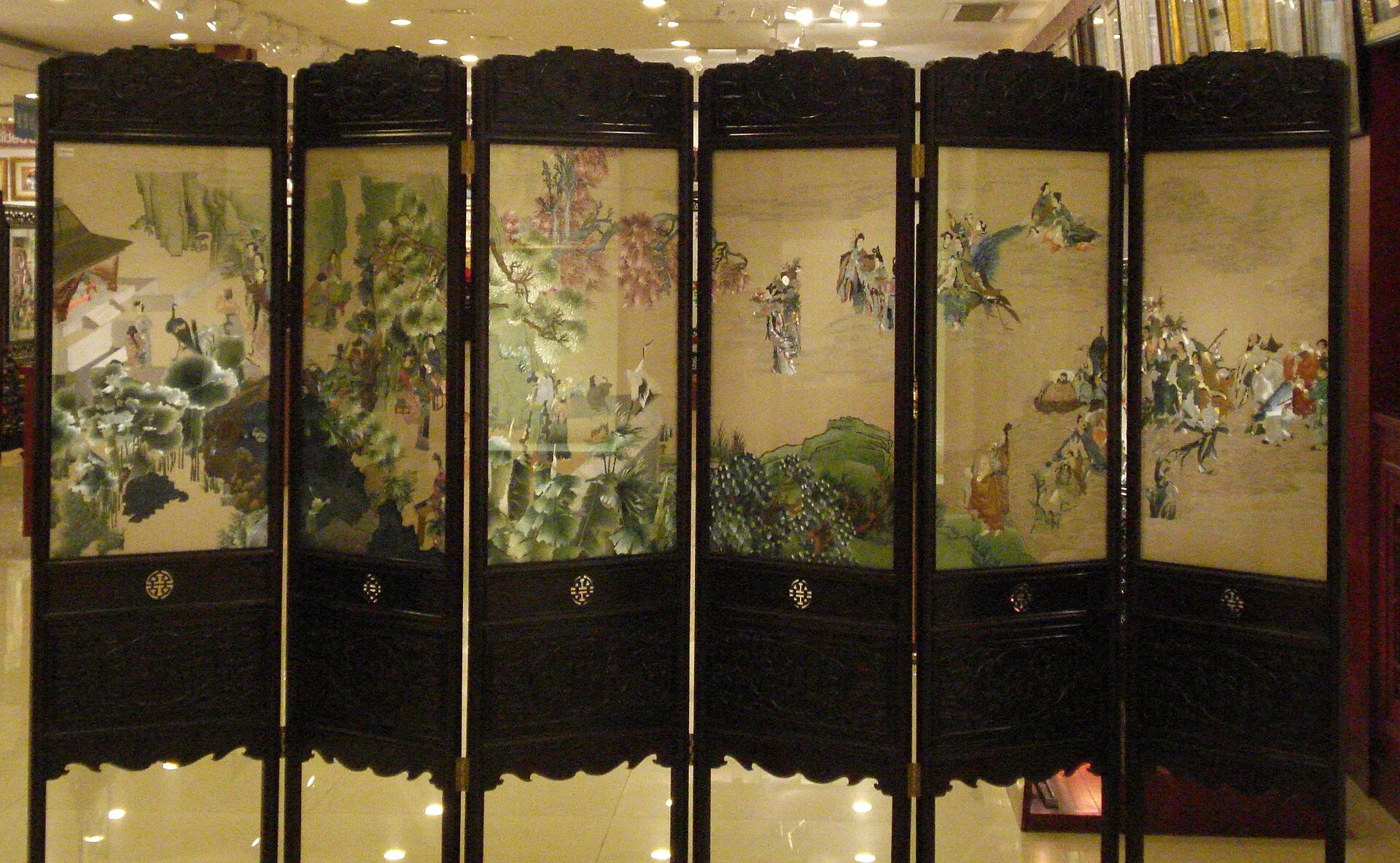
Su embroidery takes its name from Suzhou and was once practised across the city and its surrounding countryside. Its exact origins are unknown. Britannica notes that embroidered book covers unearthed at Suzhou date from the Five Dynasties period in the 10th century, and that the school probably goes back to the Han dynasty. China's national heritage register traces its development through surviving pieces from the Song dynasty onward. A Yuan dynasty fragment already uses nine stitches, and Ming dynasty embroiderers often worked from literati paintings, which gave the school its fine and elegant style. In the Qing dynasty Su embroidery became a commercial industry and Suzhou was known as an embroidery market. During the Daoguang reign a Suzhou woman, Ding Pei, wrote the Xiu Pu, the first specialist treatise on embroidery in China.
Two 20th-century innovations widened the repertoire. In the late Qing and early Republican period Shen Shou developed realistic embroidery (fangzhen xiu), and in the 1930s Yang Shouyu created random stitch embroidery (luanzhen xiu), which extended the subjects the school could depict. The Suzhou Embroidery Research Institute, founded in the 1950s, trained embroiderers and developed new stitches from traditional ones. According to Britannica, the school uses many types of stitch and thread to portray flowers, goldfish, cats and dragons realistically. Some Suzhou pieces are double-sided: the Textile Research Centre in Leiden notes that the motifs on each face can differ and that the fine threads are hidden in the cloth, so it can be unclear which side is the front.
XIANG EMBROIDERY: HUNAN'S PAINTERLY STYLE AND ITS MAWANGDUI ROOTS

Xiang embroidery's early history is documented through archaeology. In 1972 Han Tomb 1 at Mawangdui in Changsha yielded embroidered silks including Xin Qi and longevity-pattern pieces, which the national heritage register cites as evidence that embroidery in Hunan is more than 2,000 years old. According to the Hunan Museum, Tomb 1 held 19 pieces of Xin Qi embroidery on damask: three separate lengths, 10 intact garments and six fragmentary gowns. One is a padded gown 155 centimetres long with a crossed collar, which the museum identifies as a casual robe worn by Xin Zhui in cold weather. The long-tailed bird in the pattern appears to be a swallow, a migratory bird whose fixed seasonal return the museum links to the name Xin Qi.
The modern style took shape in the late Qing dynasty. The embroiderer Li Yihui (1854 to 1928) pioneered the blended stitch (canzhen), which renders light and shade and gradual changes of colour. In 1898 Hu Lianxian opened the first Xiang embroidery shop, Wu Caixia, at Simenkou in Changsha, and passed the method on to apprentices. In 1933 an embroidered portrait of President Roosevelt made by Changsha's Jinhua shop was shown at the Century of Progress International Exposition in Chicago, which brought the school attention abroad. After 1949 Yu Zhenhui (1913 to 1984) perfected the hair stitch (maozhen), used for the fur of lions and tigers, which the register describes as unique among the four schools. Xiang embroidery now has five major categories and 72 stitch types, and its double-sided work can show entirely different images on each face. At its peak the industry employed nearly 100,000 people.
YUE EMBROIDERY: CANTONESE COLOUR, GOLD THREAD AND THE EXPORT TRADE
Yue embroidery is the embroidery of Guangdong, and it has two branches on the national register: Guang embroidery, practised in Guangzhou and its historic counties of Nanhai, Panyu and Shunde, and Chao embroidery from Chaozhou. The register gives it a history of more than a thousand years. Its founding record is a Tang dynasty text, the Duyang Zabian by Su E, which describes Lu Meiniang, a young woman from Nanhai who could embroider the seven scrolls of the Lotus Sutra on a single chi of silk. Chao embroidery was already practised in the Tang dynasty and had formed its own style by the Ming. Its subjects include dragons and phoenixes, flowers, birds and animals, aquatic creatures and figures, and its products served as everyday articles, ritual objects, display pieces and decoration for opera costumes.
The techniques fall into four types: silk floss embroidery, the oldest and most completely transmitted; gold and silver thread embroidery; thread embroidery; and bead embroidery, developed only in recent decades. Gold and silver thread work alone has seven categories and more than 60 stitches, among them flat, braided, wrapped, raised and padded stitches and appliqué. Chao embroidery uses five methods and more than 200 stitches, and its padded gold technique gives the dragons of works such as the Nine-Dragon Screen their raised, lifelike form. The register describes the school's stitches as varied and evenly spaced, with the direction of the thread used to show texture, and its colour as rich, with close attention to light and shadow.
Guangdong embroidery also reached Europe through trade. The V&A identifies a type of fringed, embroidered silk shawl, often called the mantón de Manila or Manila shawl, that Chinese embroiderers made, or Chinese traders sold through Manila, for export to Seville. The museum's example, made in Guangdong between 1880 and 1920, is black silk crêpe embroidered in white silk satin stitch with plum blossom, peonies, chrysanthemums and butterflies. The shawls later became popular across Europe and are associated with flamenco, although neither the shawl nor its long fringe belonged to Chinese dress traditions.
SHU EMBROIDERY: SICHUAN'S CODIFIED CATALOGUE OF STITCHES
Shu embroidery, also called Chuan embroidery, comes from the folk tradition of western Sichuan; both names refer to the province. The western Sichuan plain produced large amounts of silk in antiquity, and the national register cites the Records of the Grand Historian for Shu's trade in silk and hemp textiles with Yong, the Qin capital, during the Spring and Autumn period. By the Western and Eastern Jin dynasties embroidery was a recognised local product, and in the late Han and Three Kingdoms period its production was controlled by the government. After the Sui and Tang dynasties, Silk Road trade sharply increased demand for woven and embroidered goods, and Shu embroidery expanded to its historical peak. By the Ming and Qing dynasties professional workshops had appeared, and around 1925 Chengdu alone had more than 1,000 embroidery workers and over 60 shops.
The school is defined by its stitch catalogue, which the register records as 12 major categories and 122 types. Embroiderers use loose silk thread on locally woven satins, traditionally red and green. The register describes the stitching as precise and neat and the colour as elegant, and notes the school's strength in fine images of flowers, birds, insects and fish as well as large landscapes. Its style, shaped by the geography, customs and art of the region, is summed up as rigorous and delicate, glossy and smooth, sparse in composition and bright in colour.
COURT PATRONAGE: IMPERIAL SILK AND THE EMBROIDERER WHO WORKED FOR CIXI

Suzhou was one of three cities supplying the Qing court with its finest silk. Under the Qing, the finest silks produced at the imperial factories in Nanjing, Suzhou and Hangzhou were sent to the court in Beijing to be tailored and finished, and patterns for court textiles were made with silk tapestry (kesi), brocading, embroidery and couching. A Jiaqing-period semiformal court robe for an imperial consort at the Saint Louis Art Museum, woven in silk tapestry with metallic thread, shows the imperial vocabulary these workshops served: nine five-clawed dragons chasing pearls and five symbols of imperial authority.
The best-documented link between Su embroidery and the court is Shen Shou (1874 to 1921), born Shen Yunzhi in Wu County, Suzhou. For the seventieth birthday of the Empress Dowager Cixi she and her husband embroidered a scene of the Eight Immortals offering birthday wishes. Cixi presented them with the characters fu (good fortune) and shou (longevity), and Shen Yunzhi took Shou as her name. She later directed a training institute for women embroiderers and set up embroidery schools in Suzhou, Beijing, Tianjin and Nantong. In 1915 her embroidered portrait of Jesus won a first-class prize at the Panama exposition in the United States. Her methods are recorded in the Xueyi Xiupu, an eight-chapter treatise drawing on 40 years of practice, which she dictated and Zhang Jian wrote down.
WHERE TO SEE CHINESE REGIONAL EMBROIDERY TODAY
Changsha holds the archaeological record: the Hunan Museum keeps the Mawangdui finds, including the Xin Qi gown from Han Tomb 1. The city also has the Hunan Xiang Embroidery Museum, established with 7.8 million yuan allocated by the Hunan provincial government in 1998. Major Xiang pieces are held outside Hunan as well. Liao Jiahui's embroidered portrait of the mother of Wu Peifu, made in the late Qing or early Republican period, is in the Shanghai Museum, and the Xiang embroidered cover laid over Sun Yat-sen's coffin at his interment ceremony is in the National Palace Museum in Taipei.
In Suzhou, the Suzhou Embroidery Research Institute has trained embroiderers since the 1950s, and in Changsha the Hunan Xiang Embroidery Research Institute has operated since 1979, when the provincial embroidery factory was converted. Shu embroidery is safeguarded by the Chengdu Intangible Cultural Heritage Protection Centre, and Shen Shou's realistic embroidery is continued in Nantong, where she settled, as Nantong fangzhen embroidery.
EMBROIDERY AND HARBOUR LIGHT AT MAN WAH, MANDARIN ORIENTAL HONG KONG

Man Wah is the Cantonese restaurant on the 25th floor of Mandarin Oriental Hong Kong, redesigned by Silverfox Studios in 2021. The design interprets the Hong Kong skyline and Victoria Harbour seen from the restaurant's windows, with references to the hotel's heritage. Embroidery appears in two places. The lanterns reinterpret the original Man Wah lanterns, using clustered brass cage forms that hold embroidered pleated shades. An embroidered artwork of a dragon and flowers is set on a navy wall panel.
The colour scheme is navy and gold. The walls are lined in navy panelling with gold trim, and a bespoke blue and gold carpet mixes silk with hand-carved patterning to evoke light on the harbour. Man Wah holds One MICHELIN Star.
SOURCES
- China Intangible Cultural Heritage Network Su embroidery (VII-18)
- China Intangible Cultural Heritage Network Xiang embroidery (VII-19)
- China Intangible Cultural Heritage Network Yue embroidery, Guang embroidery (VII-20)
- China Intangible Cultural Heritage Network Shu embroidery (VII-21)
- Encyclopaedia Britannica Suzhou embroidery
- Textile Research Centre, Leiden Suzhou embroidery
- Hunan Museum Damask gown with Xin Qi embroidery, Mawangdui Han Tomb 1
- Victoria and Albert Museum Shawl, Guangdong, 1880 to 1920 (FE.29-1983)
- Saint Louis Art Museum Chinese Silk Textiles of the Ming and Qing Dynasties
- Chinese Social Sciences Net Nantong fangzhen embroidery