A COMMERCIAL PRINT TRADE THAT SOLD EDO'S THEATRES, COURTESANS AND LANDSCAPES TO A MASS MARKET

Ukiyo-e, usually translated as "pictures of the floating world", was one of the major art genres of Japan's Tokugawa period (1603 to 1867). It began in painting, but its defining medium was the woodblock print, produced in quantity and sold to the townspeople of Edo, now Tokyo, and other cities. Each print was the work of four specialists: a publisher who commissioned it, a designer who drew it, a carver who cut the blocks and a printer who pulled the impressions. Prints of courtesans and kabuki actors were the core of the trade, and in the 19th century Hokusai and Hiroshige made landscape a major subject. Production was large: about 8,000 impressions are estimated to have been printed of Hokusai's Under the Wave off Kanagawa, first published in 1831. After Japan reopened its ports to Western trade in 1853, ukiyo-e prints travelled to Europe, where they influenced Impressionist and Post-Impressionist painters.
WHAT DOES UKIYO-E MEAN? THE FLOATING WORLD OF EDO
The word ukiyo originally expressed the Buddhist idea that life is transitory. In the Edo period a homophone was substituted, the character meaning "to float" in place of the one meaning "transitory", and the term came to describe an attitude of enjoying life while it lasts. The word ukiyo-e first appears in literature in the early 1680s. Because the genre was centred on Edo, it was also called edo-e or azuma-e, while Osaka and Kyoto produced their own prints, mostly portraits of local kabuki actors.
The floating world had a physical location. The Tokugawa shogunate divided society into warriors, farmers, artisans and merchants, with merchants at the bottom, and set aside walled districts in the major cities for brothels, teahouses and theatres. Inside them, all classes mingled, and money and style dominated. The chōnin, the merchants and artisans of the towns, had economic power but little social standing, and spent their wealth on pleasure. Edo's Yoshiwara quarter and the kabuki theatre supplied the subjects. Kabuki had been introduced in Kyoto at the beginning of the 17th century by a female performer named Okuni; the government banned women from the stage in 1629 and boys in 1652. The three main subjects of ukiyo-e became beautiful women (bijinga), actor portraits (yakusha-e) and erotic pictures (shunga).
FROM BOOK ILLUSTRATION TO FULL-COLOUR NISHIKI-E

Woodblock printing was used in Japan from at least the eighth century, mainly to reproduce Buddhist scriptures and other texts, and until the 18th century printing was largely a means of reproducing writing. Commercial book publishing first flourished in Osaka and Kyoto in the early 1600s and moved to Edo after a major fire in 1657. Hishikawa Moronobu (died 1694) is generally regarded as the first master of ukiyo-e; in the preface to Tsukinami no asobi (1683) he claimed to have invented the style. His works include a set of twelve prints, Scenes of Yoshiwara.
Prints separated from books in stages. Around 1700 single-sheet prints became dominant in Edo, printed in black sumi ink and sometimes coloured by hand. Okumura Masanobu made the move from single-colour to two-colour printing. In 1765 Suzuki Harunobu produced polychrome prints using numerous blocks, first for extravagant picture calendars. These full-colour prints were called nishiki-e, or "brocade pictures". The last quarter of the 18th century is regarded as the golden age of the print, when Torii Kiyonaga, Kitagawa Utamaro, Katsukawa Shunshō and Tōshūsai Sharaku were working. For the first time, artists were responding directly to the interests of the general public.
HOW UKIYO-E PRINTS WERE MADE: PUBLISHER, DESIGNER, CARVER AND PRINTER
The publisher, or hanmoto, was at the centre of the system. He planned the print, commissioned the designer's brush drawing, generally decided how many impressions would be made, and often chose the number of colours and even the subject. The designer (eshi) supplied a brush drawing, and the carver (horishi) and printer (surishi) turned it into a product. Leading designers did not cut or print their own work: Hiroshige, for example, worked through skilled craftsmen and visited the studio to supervise and approve colours.
The drawing was pasted face down onto a block of cherry wood, chosen because it is exceptionally hard. The carver cut along the brushed lines, destroying the original drawing, and cleared the non-printing areas to leave the key block. Each colour was then cut on a separate block and inked separately. Commercial prints of the 1850s and 1860s might use around a dozen colours, while privately commissioned prints could use 30 colours, requiring around 15 separate blocks. Two notches, the kagi at the corner and the hikitsuki along the long edge, kept each sheet in register. The printer brushed pigment and rice paste (nori) onto the block, laid paper made from kōzo (paper mulberry) and sized with dōsa, and rubbed the back with a baren, usually printing lighter colours first.
THE GREAT WAVE: HOW MANY PRINTS WERE MADE AND WHY THE BLUE MATTERED

Katsushika Hokusai's Under the Wave off Kanagawa, known as the Great Wave, was published by Nishimuraya Yohachi, a publisher recognised for a high standard of carving and printing, and was among the first prints in Japan to use Prussian blue. This synthetic pigment resisted fading, unlike the indigo and dayflower blue used by earlier printmakers, and reached Japan through imports from China and the Netherlands, the country's only trading partners in the 1830s. Experts estimate that about 8,000 impressions of the design were printed, and most are likely to have been lost: the British Museum holds three and the Metropolitan Museum of Art four.
Repeated printing wore the blocks down, and that damage now allows researchers to place surviving impressions in sequence. The key block wore most, with breaks appearing in the title cartouche, the outline of Mount Fuji and one of the waves. Very late printings used two replacement blocks for the light blue sea and the yellow boats, and four impressions with pink boats are thought to be the last of all. A letter dated 1836 shows that Nishimuraya was in financial difficulty in the mid-1830s, and one British Museum scientist suggests the blocks may have been sold on or recut more cheaply.
UTAMARO, HOKUSAI AND HIROSHIGE
Kitagawa Utamaro (1753 to 1806) is known above all for his portraits of women. Around 1791 he stopped designing book illustrations and concentrated on half-length portraits of single women, rather than the group scenes favoured by other ukiyo-e artists, in series such as Ten Physiognomies of Women and The Seven Beauties of the Gay Quarters. In 1804, at the height of his success, he published prints depicting the wife and concubines of the military ruler Toyotomi Hideyoshi, was accused of insulting Hideyoshi's dignity and was sentenced to 50 days in handcuffs. The experience ended his career as an artist.
In the 19th century the subjects widened to landscapes, birds and flowers, and warriors, and Hokusai (1760 to 1849) and Utagawa Hiroshige (1797 to 1858) became the leading landscape designers. Hokusai's Thirty-six Views of Mount Fuji, which includes the Great Wave, is regarded as the high point of the Japanese landscape print. Hiroshige, one of the last great ukiyo-e masters, produced series including The Fifty-three Stations of the Tōkaidō and One Hundred Famous Views of Edo, and was known for bokashi, a technique of blending pigment on the block with water and a brush to print graduated colour. After the Meiji Restoration of 1868, photography and lithography ended the genre's period of innovation.
HOW UKIYO-E PRINTS REACHED EUROPE

Ukiyo-e reached Europe both as art and as packaging. Japanese ports reopened to Western trade in 1853, and fans, kimonos, lacquers, bronzes and silks were arriving in England and France before Japan took a pavilion at the 1867 World's Fair. After 1868, interest in ukiyo-e declined in Japan; many prints were exported and others were used as wrapping paper. Monet is said to have first seen Japanese prints used as wrapping paper in a Dutch spice shop, and James McNeill Whistler reportedly discovered them in a Chinese tearoom near London Bridge.
Degas adopted elongated formats, asymmetrical compositions, aerial perspective and empty space. Mary Cassatt studied Utamaro's prints of women and, after a large ukiyo-e exhibition at the École des Beaux-Arts in Paris in 1890, made a set of ten colour etchings. Toulouse-Lautrec drew on the colours, contours and expressions of kabuki prints for his posters. Gauguin adapted Japanese woodcut techniques at a time when lithography was the usual choice for artists' prints. The Impressionists and Post-Impressionists were the first in the West to recognise Hiroshige's landscapes, and the wider exchange became known as Japonisme.
A COLLECTOR'S UKIYO-E AT THE AUBREY, MANDARIN ORIENTAL HONG KONG

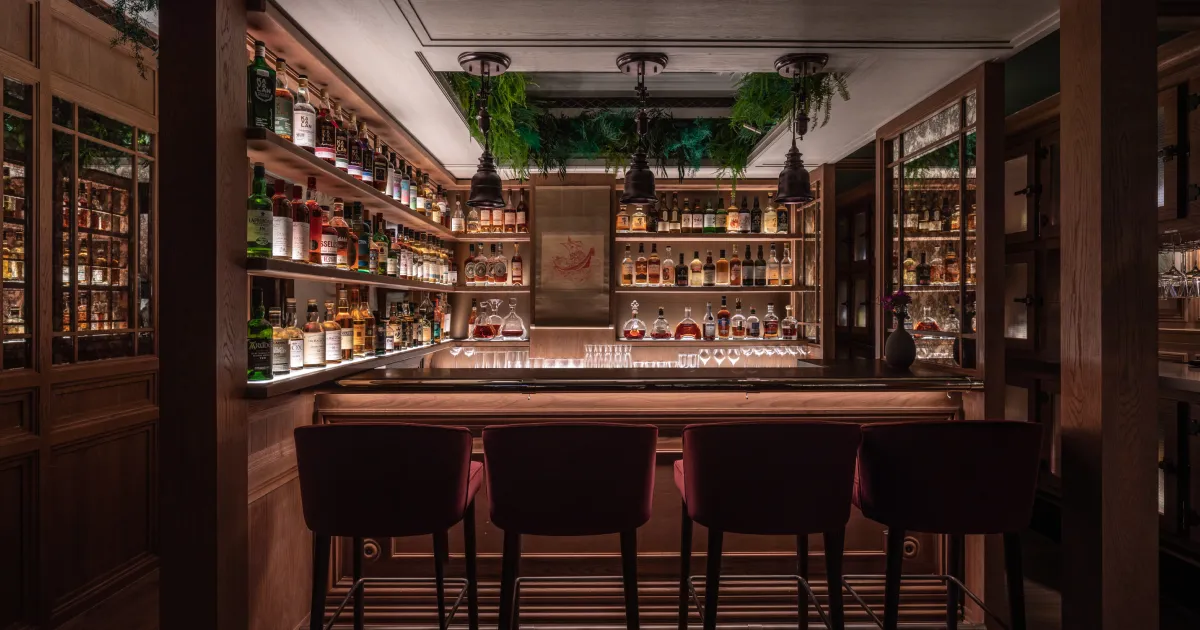
The Aubrey is a Japanese izakaya and bar on the top floor of Mandarin Oriental Hong Kong, designed by Silverfox Studios and completed in 2021. It is named after the illustrator Aubrey Beardsley, and its concept is the manor of an eccentric English gentleman whose obsession with all things Japanese shapes every element. The design draws on Japonisme and on ukiyo-e motifs: Mount Fuji, the pagoda, torii gates and crashing waves. Mount Fuji and a breaking wave are also the main subjects of Hokusai's Great Wave.
The interior is arranged as a collector's house. Dark timber panelling forms the backdrop for gilded picture frames and gallery walls, and a curio lounge holds bespoke display cabinetry filled with objets d'art.
SOURCES
- The Metropolitan Museum of Art Art of the Pleasure Quarters and the Ukiyo-e Style
- The Metropolitan Museum of Art Woodblock Prints in the Ukiyo-e Style
- The Metropolitan Museum of Art Japonisme
- British Museum How to make a woodblock print like Hiroshige
- British Museum The Great Wave: spot the difference
- JAANUS, Japanese Architecture and Art Net Users System ukiyo-e
- Britannica Ukiyo-e
- Britannica Utamaro
- Britannica Hiroshige
- Britannica Hokusai