A POPULAR THEATRE OF THE EDO PERIOD BUILT AROUND STAR ACTORS, STAGE MACHINERY AND BOLD VISUAL CONVENTIONS

Kabuki is a Japanese popular drama with singing and dancing, performed in a highly stylised manner, and today it is performed entirely by men. It began in Kyoto in 1603 and became the popular theatre of the Edo period, playing mainly to townspeople and drawing much of its material from everyday life. Its defining features are physical and visual: stylised acting types, male actors who specialise in women's roles, bold make-up, a raised walkway that runs through the audience, and stage machinery including revolving stages and trapdoors. Britannica notes that the term originally suggested the unorthodox and shocking character of the art form; the characters now used to write it signify song, dance and skill. UNESCO inscribed kabuki on its Representative List of the Intangible Cultural Heritage of Humanity in 2008, and its main home is the Kabuki-za in Tokyo's Ginza district, known in Japanese as the temple of kabuki.
WHERE KABUKI CAME FROM: IZUMO NO OKUNI AND THE 1629 BAN
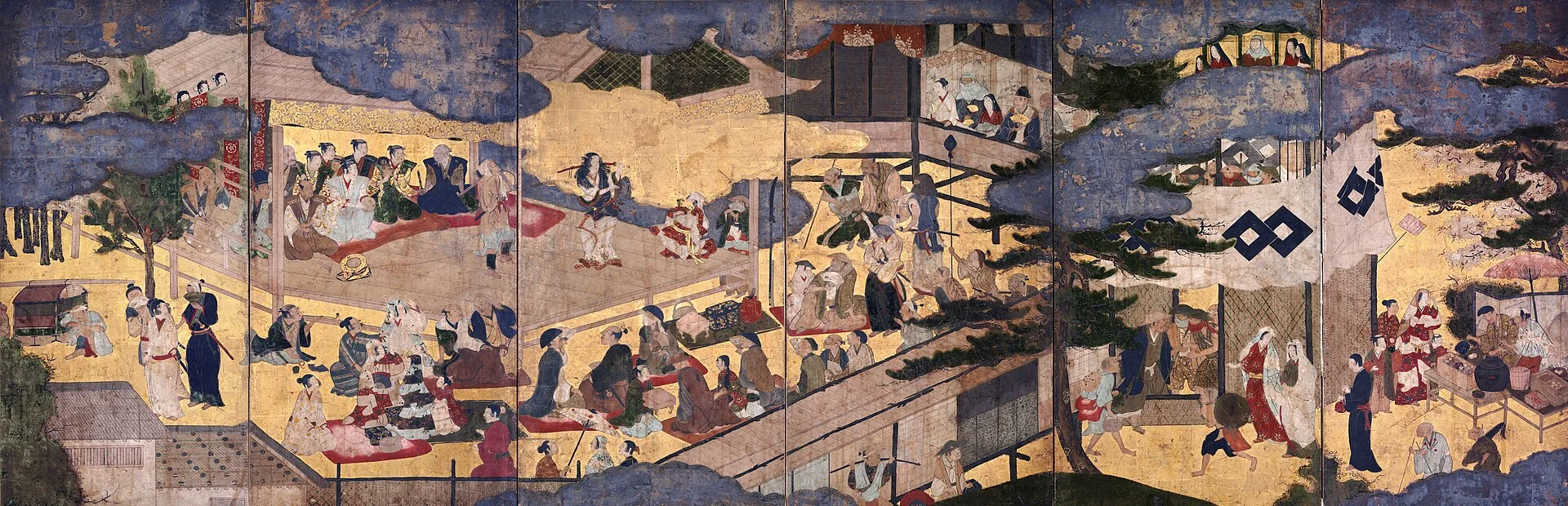
The founding of kabuki is credited to Izumo no Okuni, a dancer who is said to have been an attendant at the Grand Shrine of Izumo. Britannica cautions that very little about her life can be confirmed. In 1603 she led a troupe of female dancers in a performance of dances and light sketches on a temporary stage in the dry bed of the Kamo River in Kyoto. The style broke sharply with the slow, deliberate movement of Noh, and Okuni dressed as a young man for certain dances. Her company's dance dramas became known as Okuni kabuki and spread across Japan, and other all-female troupes formed. Nobles often sponsored these groups, but the performances were aimed at ordinary townspeople and took their themes from daily life.
Women's kabuki stayed popular until 1629, when the shogun Tokugawa Iemitsu banned women from performing on the grounds that the dances were harmful to public morals; the dancers also supplemented their income through prostitution. The ban remained in force until the Meiji Restoration in 1868. Boys and young men then took the female roles, as they did in Elizabethan theatre, until the shogun banned young male performers in 1652, again on moral grounds. Older male performers took over the female roles from that point. UNESCO notes that kabuki was originally performed by both men and women, that over time only men performed, and that the all-male tradition continues today.
ONNAGATA, ARAGOTO AND WAGOTO: KABUKI'S ROLE TYPES

UNESCO identifies three major role types in kabuki. Onnagata are male actors who specialise in women's roles, a specialism that exists because of the 17th-century bans. Aragoto, the rough style, and wagoto, the soft style, are the two principal ways of playing male roles. Both developed at almost the same time, in the Genroku era (1688 to 1704), but in different cities: aragoto in Edo, which is modern Tokyo, and wagoto in Kyoto. Britannica describes aragoto as focused on the rash actions of historical heroes, in contrast to the gentler wagoto that emerged in Kyoto.
Aragoto was created by the actor Ichikawa Danjūrō I (1660 to 1704) for bombastic fighting plays, and it remains the speciality of the Ichikawa family. Its heroes are bold, idealised warriors with exaggerated, sometimes magical, powers and uncomplicated, childlike natures. Their faces are marked with red, blue and black lines. Britannica identifies Sukeroku (1713), by Tsuuchi Jihei II, as the play that blends the rough and gentle styles most successfully. UNESCO lists the mie, a pose the actor holds to establish a character, among kabuki's characteristic techniques, alongside its make-up and stage devices.
THE KABUKI STAGE: HANAMICHI, REVOLVING STAGES AND TRAPDOORS

The hanamichi, meaning 'flower passage', is a runway that leads from the back of the auditorium to the stage, passing through the audience at about the height of the spectators' heads. Britannica notes that the name suggests it was once used to present flowers and gifts to actors, and that it has been an integral part of kabuki since the 18th century. It is used for climactic scenes, including spectacular entrances and exits, processions and battles, and it can stand for a location such as a forest, a mountain road, an inlet of water or a ceremonial path to a palace. Some plays add a narrower second hanamichi on the opposite side of the theatre. The walkway also has its own trapdoor for ghosts and supernatural beings, called the suppon, or snapping turtle, because the actor's head emerges first.
Kabuki's stage machinery predates its European equivalents. A paper by Uzuhiko Tsuboi for the Japan Society of Mechanical Engineers dates the first revolving stages in Japan to between 1715 and 1735, and records that in 1758 Namiki Shōzō, at the Kado-za in Osaka, cut a circular section from the stage floor and turned it during performances so that scenes could change without a curtain. The paper identifies a revolving stage installed in Munich in 1896 as the first comparable mechanism in Europe, and describes the Konpira theatre in Kotohira, built in 1835, as the oldest and largest surviving theatre of its type in Japan. As at the Kado-za, its revolving stage was turned by stagehands working in the naraku, the space below the stage. Nippon.com notes that the naraku takes its name from a Buddhist term for hell, because the space is deep and dark.
KUMADORI: HOW KABUKI MAKE-UP SIGNALS CHARACTER
UNESCO singles out kabuki's distinctive make-up, keshō, as recognisable even to people unfamiliar with the art form. Its boldest form is kumadori, the coloured lines painted on the faces of heroes, villains and demons, as on the aragoto warrior whose face Britannica describes as marked in red, blue and black. The British Museum notes that adult kabuki actors apply their own make-up, a skill acquired over several years, and that designs vary in complexity according to a character's nature, age and status.
Colour carries meaning. According to the British Museum, red denotes heroism, blue represents villains and brown is used for demonic characters. Kumadori designs are also recorded as oshiguma, impressions of an actor's painted face taken on silk, a practice the museum dates to the mid-19th century. Its collection includes a signed and sealed oshiguma of the make-up worn by the actors Ichikawa Ennosuke II and Ichikawa Danshirō III in a performance of Renjishi, created in December 1945 or January 1947.
KABUKI ACTOR PRINTS: FROM TORII KIYONOBU TO SHARAKU

Edo's woodblock publishers produced prints of named kabuki actors in specific roles. A British Museum example by Torii Kiyonobu II, dated about 1733 to 1738, shows the actors Ogino Sawanojō and Segawa Kikunojō in a play that appears to adapt an episode from the life of the ninth-century poet Ono no Komachi. It is an urushi-e, coloured by hand and finished with ink, glue and metal dust to imitate lacquer, and it was published in Edo.
Tōshūsai Sharaku's actor portraits date only from 1794 and 1795. His print of Ōtani Oniji III as Yakko Edobei (1794), in the Metropolitan Museum of Art, shows the actor in the role of a samurai's manservant, printed in ink and colour with white mica. The museum notes that Sharaku captured both the qualities of kabuki characters and the personalities of the actors who played them.
THE KABUKI-ZA AND KABUKI TODAY

The Kabuki-za in Ginza first opened in 1889 as a three-storey building with a Western-style exterior and a Japanese interior. Its exterior was rebuilt in a Japanese palatial style in 1911, and the building was destroyed in 1921 by a fire caused by an electrical fault. A reinforced concrete replacement by Okada Shin'ichirō, delayed by fires after the Great Kantō Earthquake of 1923, opened in 1924. Air raids destroyed much of it in 1945, and a faithful reconstruction designed by Yoshida Isoya, completed in 1951, served for about 60 years.
The current theatre, the fifth, reopened on 2 April 2013 after three years of work. It was designed by Kengo Kuma with Mitsubishi Jisho Sekkei as part of a development that includes the 29-storey Kabukiza Tower. The stage keeps the width and height of its predecessor, with a revolving stage 18.2 metres in diameter and a hanamichi of the same length. The space beneath the stage was deepened to 16.4 metres, and a fourth trapdoor was added to the traditional three, known as matsu, take and ume, to speed up scene changes. The theatre seats 1,808 across three floors, with a further 96 single-act seats on the fourth floor.
NETSU: A ROBATA KITCHEN DESIGNED AS A KABUKI THEATRE

Netsu at Mandarin Oriental Jumeira Dubai is a Japanese robata restaurant by chef Ross Shonhan, designed by Silverfox Studios and completed in 2019. It is designed as a double-height kabuki theatre. The robata grill is the central stage, and guests watch the kitchen from several levels; the upper level is a bar and DJ lounge overlooking the show kitchen. Outside, horizontal recessed lighting references the tiers of theatre seating.
A raised walkway runs from the back-of-house kitchen to the central kitchen, recalling the hanamichi, the bridge a kabuki performer uses to enter the stage through the audience. In kabuki, the hanamichi carries the spectacular entrances and exits, played at close range at about the height of the spectators' heads. The columns and a large wall carry 1950s-style kabuki poster graphics, drawing on kabuki's long association with printed images of its actors, from the hand-coloured prints of Torii Kiyonobu II to Sharaku's portraits.
SOURCES
- Britannica Kabuki
- Britannica Okuni: Japanese dancer, founder of Kabuki
- Britannica Aragoto: Kabuki acting style
- Britannica Hanamichi: Japanese theatre
- UNESCO Intangible Cultural Heritage Kabuki theatre
- Japan Society of Mechanical Engineers Historical Development of Revolving Stages of Theaters Invented in Japan
- Nippon.com A New Era for Kabuki
- British Museum Oshiguma impression of kabuki make-up, Ichikawa Ennosuke II and Ichikawa Danshiro III
- British Museum Print by Torii Kiyonobu II, kabuki actors Ogino Sawanojo and Segawa Kikunojo
- The Metropolitan Museum of Art Kabuki Actor Ōtani Oniji III as Yakko Edobei