A CARDAMOM-SPICED COFFEE WHOSE SERVING RULES DEFINE HOW OMANIS RECEIVE A GUEST
Omani kahwa is the coffee offered to visitors in homes, offices and gatherings across the Sultanate of Oman. It is made from lightly roasted beans brewed with cardamom, often finished with saffron or rosewater, poured from a dallah into small handleless cups called finjan, and served with dates or halwa. The coffee is bitter, and the way it is offered follows rules passed down within families: who is served first, how full the cup should be, which hand holds the pot and how a guest signals that they have had enough. In 2015 UNESCO inscribed "Arabic coffee, a symbol of generosity" on its Representative List of the Intangible Cultural Heritage of Humanity, following a joint nomination by Oman, Saudi Arabia, the United Arab Emirates and Qatar. The same four states secured a second listing that year for the majlis, the reception space where much of that coffee is poured.
WHAT IS OMANI KAHWA AND HOW IS IT MADE
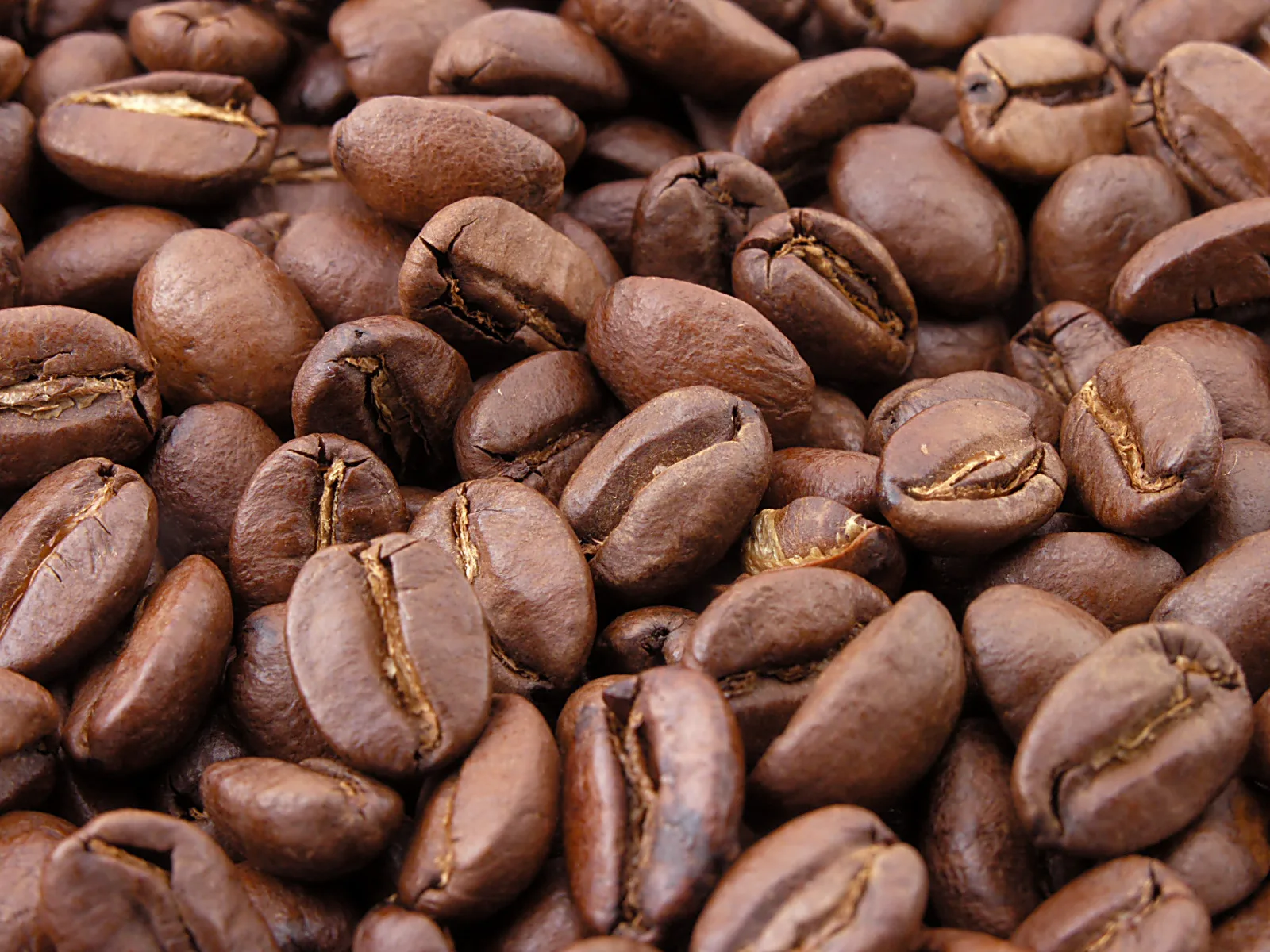
The traditional method, as recorded by the Smithsonian Center for Folklife and Cultural Heritage, starts with green coffee beans lightly roasted in a pan over an open fire and ground with a mortar and pestle. The powder is mixed with boiling water in the dallah, and cardamom, rosewater and saffron are added. Depending on the region, cloves and cinnamon may also go in. UNESCO's description of Arabic coffee across the four nominating states follows the same sequence: beans selected and lightly roasted in a shallow pan, pounded in a copper mortar, brewed in a large copper pot and then transferred to a smaller pot for pouring. Traditionally all of this is done in front of the guests.
The commercial trade now handles much of this work. The Oman Observer reports that agents import coffee beans from several countries in 20 kg and 40 kg packages. At one coffee shop in Rustaq, unroasted beans are roasted in local machines, taking around 40 minutes for every 25 kg, and then cooled with fans. The coffee is ground on request, with cardamom and clove added. At home the ground coffee is added to boiling water and left to simmer, a pinch of saffron or a little rosewater is added to taste, and the brew is strained into a clean dallah. Because kahwa is very bitter, it is served with something sweet.
WHERE ARABIC COFFEE CAME FROM
Kahwa belongs to a coffee tradition that began in the south of the Arabian Peninsula. According to the Victoria and Albert Museum, the stimulating effect of coffee is thought to have been discovered in north-east Ethiopia, and cultivation of the plant first spread in the Arab world. The earliest credible evidence of coffee drinking dates to the mid-15th century, in Sufi monasteries in Yemen. From Yemen, coffee spread to Italy and the rest of Europe, and later to Indonesia and the Americas.
As the habit spread, so did the equipment. The V&A holds a glazed fritware coffee pot made in Kütahya in Ottoman Turkey around 1725, with a pear-shaped body, angular spout and painted decoration copying textile designs. In the Gulf, the equipment was shaped by Bedouin life. Abu Dhabi's Department of Culture and Tourism records that Bedouin households once brewed over a simple fireplace dug into the ground, later replaced by the kuwar, a clay pit stove lined with pebbles and stone plates. The full set of coffee tools, known as the ma'ameel, includes the tawa, a wide circular roasting pan, the mihmas, a long stirring spoon, and the mehbash, iron tongs for spreading coals and embers.
THE DALLAH AND THE FINJAN

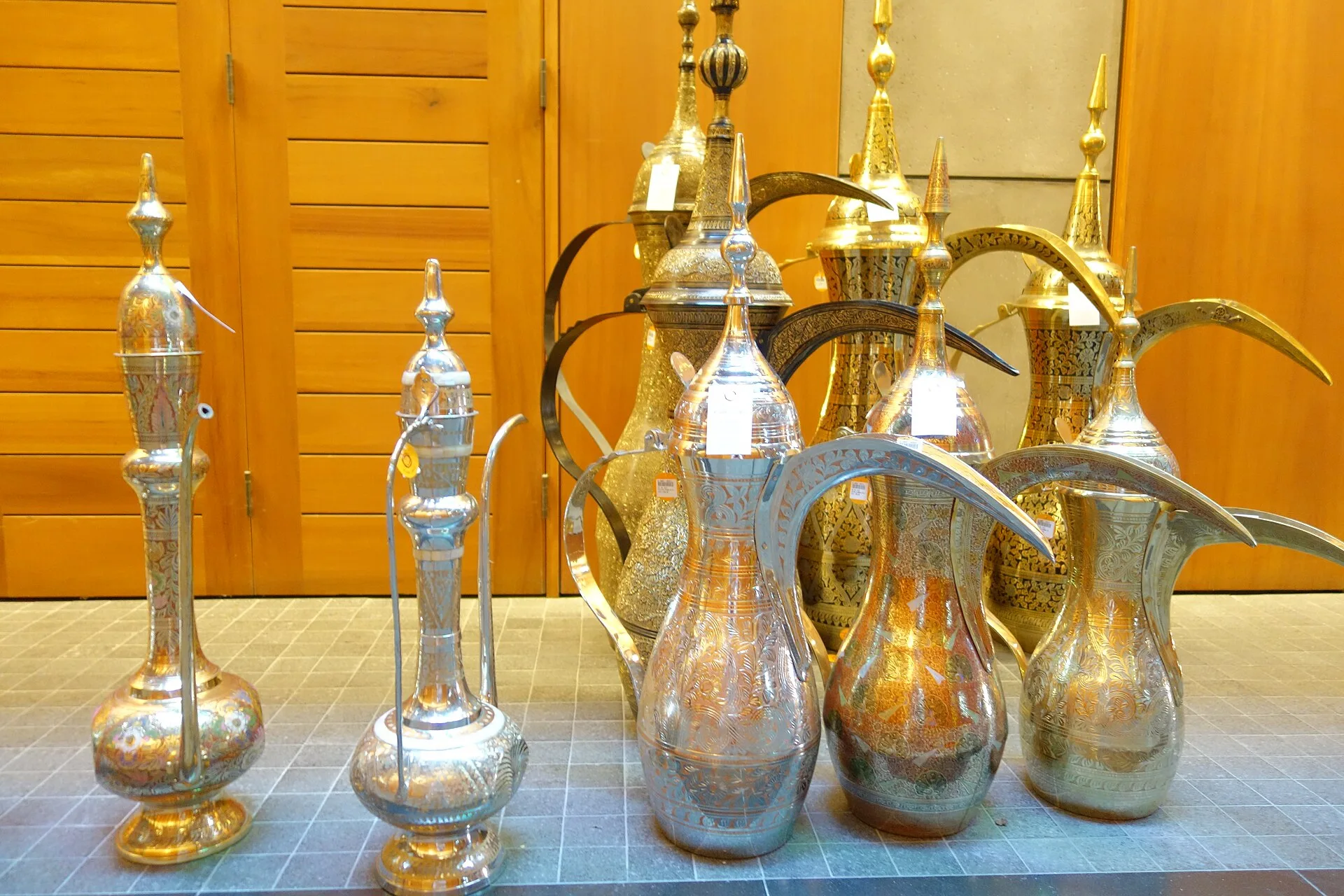
The dallah is the coffee pot that defines Arabic coffee service, and it is used in more than one size. Abu Dhabi's heritage records describe three: the large dallat al-khumrah for boiling the coffee with cardamom, the medium dallat al-talgeemah for filtering, and the small dallat al-mazalah for serving. The coffee is drunk from the finjan, a small cup without a handle, and it is poured in small measures so that the cup can be refilled. When the Smithsonian Folklife Festival staged its Oman programme, the first Festival programme devoted to a Muslim country, the Omani government presented two hand-formed dallahs to the Smithsonian. The Smithsonian notes that metalsmithing in copper, silver and gold has long been important to Oman's economy, that silversmiths and coppersmiths keep permanent workshops in the souks of the interior oasis towns, and that Nizwa is known for its copperwork and dallahs.
In Oman the dallah is also a product of the country's metalworking tradition. The National Museum of Oman describes the dallah as one of Oman's most important cultural icons and identifies the silver suq of Nizwa, in the ad-Dakhiliyah Governorate, as a centre of its production. The museum holds a silver Nizwa-style pot, the Dallah Nazwaniyyah, made in 1974 by Khalfan bin Rashid as-Sabahi and inscribed with his initials and the completion date on its base. The style is recognisable by its very narrow waist, arched handle and long, strongly curved spout, decorated with arabesque and geometric designs. Nizwa coffee pot makers use the same patterns and techniques as the suq's jewellers and khanjar (dagger) makers.
HOW KAHWA IS SERVED: THE ETIQUETTE OF THE CUP

Serving kahwa follows a fixed technique. The host holds the dallah in the left hand and the finjan in the right, the cup resting on the palm and gripped between thumb, forefinger and middle finger, according to the Oman Observer. Abu Dhabi's heritage guide describes the same grip, with the thumb of the pouring hand pointing up. The guest takes the cup with the right hand and returns it the same way. The most important or oldest guest is served first, and a cup with any crack or chip is never used. A guest who is offered kahwa is not expected to refuse it, and once they have finished they keep hold of the empty cup until the host returns to collect it.
The cup is filled only about a quarter full, sometimes up to half, and never to the brim. The host keeps refilling until the guest signals that they have had enough, sometimes urging one more cup in the guest's honour. UNESCO notes that guests are expected to drink at least one cup and no more than three. Accounts differ on the final gesture. The Oman Observer's guide says a guest gently shakes the cup to show they want no more, while the Smithsonian's account of Omani coffee describes the same shake as a request for another cup. The Oman Observer's guide to preparation allows the coffee to be served from either a dallah or a thermos flask, after it has been left to settle for about ten minutes.
WHY KAHWA IS SERVED WITH DATES AND HALWA
Dates are the standard accompaniment because their sweetness offsets the bitterness of the coffee. The date palm carries its own cultural weight in the region: in December 2019 UNESCO inscribed "Date palm, knowledge, skills, traditions and practices" on the Representative List, after a nomination submitted by 14 states including Oman. The listing covers the farming of the palm, from planting, irrigating and pruning to pollinating and harvesting, as well as date trading and the crafts made from different parts of the tree.
Halwa is the other standard pairing, and the Times of Oman describes it as offered to guests as a symbol of welcome. Its main ingredients are ghee, tapioca flour and water, flavoured with cardamom and chopped nuts, with some versions adding rosewater or saffron, a spice originally brought to Oman from Iran and the Indian subcontinent. Dates were the traditional sweetener, although many makers now use sugar. The Oman Observer's guide lists halwa, dates and fruit as the usual partners for kahwa, chosen because the coffee is so bitter, and dried fruit and nuts are also common.
UNESCO RECOGNITION AND THE MAJLIS
UNESCO's listing describes serving Arabic coffee as an important aspect of hospitality in Arab societies and a ceremonial act of generosity. It names the main bearers of the tradition as sheikhs and tribal heads who serve coffee in their meeting spaces, elderly Bedouin men and women, and the owners of coffee shops. Knowledge is passed on within families through observation and practice, and young family members accompany their elders to market to learn how to choose the best beans. The element was inscribed at the tenth session of the Intergovernmental Committee in 2015.
The majlis was inscribed the same year, as "Majlis, a cultural and social space", on the nomination of the same four states. Abu Dhabi's heritage records place the kuwar stove in a nook of the majlis, in homes and in tents, beside a container for firewood and a place for the person preparing the coffee, so that the coffee is made in front of the guests in the way UNESCO describes. UNESCO adds that men and women from all parts of society make and drink Arabic coffee, especially at home, and the Oman Observer notes that many Omanis drink kahwa every day, with or without guests.
THE RESTAURANTS AT MANDARIN ORIENTAL, MUSCAT

Mandarin Oriental, Muscat opened on 3 June 2024 on the Shatti Al-Qurum coastline, and Silverfox Studios designed its food and beverage outlets: Rawya, The Pool Bar, Essenza, Essenza Bar and The Mandarin Cake Shop.
Rawya, described as an elegant European café with subtle Eastern accents, is planned for breakfast, lunch and dinner, with zones that change character through the day. Its entrance holds a juice bar and bakery. The Mandarin Cake Shop is fitted with carved lattice screens and a pastry counter.
SOURCES
- UNESCO Intangible Cultural Heritage Arabic coffee, a symbol of generosity
- UNESCO Intangible Cultural Heritage Majlis, a cultural and social space (Oman, Qatar, Saudi Arabia and United Arab Emirates)
- UNESCO Intangible Cultural Heritage Decision of the Intergovernmental Committee: 14.COM 10.b.3 (Date palm)
- Smithsonian Center for Folklife and Cultural Heritage Object Oriented: The Omani Coffee Pots, Symbols of Heritage and Hospitality
- National Museum of Oman Nazwa-Style Coffee Pot (Dallah Nazwaniyyah)
- Victoria and Albert Museum Coffee pot, Kütahya, about 1725
- Abu Dhabi Culture Gahwa, Arabic Coffee
- Oman Observer Omani Kahwa: A pot of Oman’s hospitality
- Oman Observer How to make, serve and drink kahwa
- Times of Oman We Love Oman: Savour the flavours of Oman