HOW JAPANESE MIGRANTS IN PERU BUILT A CUISINE FROM TWO FOOD CULTURES

Nikkei cuisine is the cooking that developed when Japanese immigrants in Peru applied Japanese technique to Peruvian ingredients. It began with labourers who arrived on the Sakura Maru in 1899 and could not find the produce they knew from home, and it grew through the 20th century in family kitchens, small eating houses, cevicherías and a handful of Lima restaurants. The Japanese-Peruvian kitchen gave Peru the tiradito, changed how ceviche is prepared and popularised octopus, which had once been returned to the sea. In June 2025 Maido, Mitsuharu Tsumura's Nikkei restaurant in Lima, was named The World's Best Restaurant by The World's 50 Best Restaurants, and Nikkei cooking is now served from Los Angeles and Barcelona to Jakarta.
WHAT DOES NIKKEI MEAN?
Nikkei is the Japanese term for emigrants from Japan and their descendants living abroad. PromPerú, Peru's national promotion agency, glosses it as "far from Japan". Strictly, as the Asociación Peruano Japonesa notes, Nikkei cuisine could describe anything cooked by people of Japanese descent outside Japan, but in practice the term has become synonymous with Peruvian-Japanese cooking. The association describes that cooking as the result of an encounter and dialogue between two cultures, and Tsumura has told the Lima newspaper El Comercio that defining it is like defining the community itself.
The culinary use of the word is recent. According to an account by the Asociación Peruano Japonesa, published through the Discover Nikkei project, the Peruvian poet Rodolfo Hinostroza gave the cuisine its name in the 1980s after eating a dish prepared by the Lima chef Humberto Sato. Cooks still disagree on when it started. PromPerú cites Sato dating it to the 1960s and crediting the cook Minoru Kunigami, while Tsumura and the writer Josefina Barrón, in their book Nikkei es Perú, describe a first stage beginning around 1950. Tsumura has also argued that the cuisine began with ceviche, not with maki rolls.
JAPANESE MIGRATION TO PERU AND THE SAKURA MARU

According to JICA, Japan's international cooperation agency, Peru was the first Latin American country with which Japan established diplomatic relations. The first group of 790 Japanese immigrants sailed from Yokohama on the Sakura Maru and arrived at the port of Callao on 3 April 1899. Most were farmers contracted to sugar haciendas on the Peruvian coast. JICA records that close to 18,000 immigrants had arrived by the time contract labour ended in 1923, and almost 33,000 had come before the Second World War. One prefecture dominated: Peru's Congress has put the share of Japanese descendants born in Peru with Okinawan roots at 70%.
The Second World War broke up much of the community. Peru chose to deport Japanese residents to the United States rather than intern them itself, and the Densho encyclopedia records that nearly 1,800 Japanese from Peru were held in American camps, starting with 141 men shipped from Callao on the Etolin in April 1942. No more than 80 were allowed back into Peru. After the war a further 2,615 immigrants arrived, according to JICA, which now puts the Japanese and Nikkei population of Peru at around 200,000.
HOW JAPANESE TECHNIQUE MET PERUVIAN INGREDIENTS
Nikkei cooking started as substitution. Japanese immigrants could not buy the ingredients they cooked with at home, so they used what Peru offered: yellow chilli (ají amarillo), rocoto, lemons, octopus and pisco, according to PromPerú. Japanese vegetables had to be grown in Peru before a fuller repertoire was possible. Sato recalled that there was no wasabi, so cooks grated ginger or bought powdered mustard instead, and that shoyu did not come from Japan and had to be made locally by trial and error. Andina records that Japanese seasonings such as hondashi (a bonito-based stock), sake and mirin entered Peruvian kitchens. In Sato's childhood, he recalled, octopus was not eaten in Lima, and crab even less.
Barrón and Tsumura divide the cuisine's development into three stages. In the first, from around 1950, Japanese immigrants cooked Peruvian food in diners and small businesses. The cook Sato credits as the starting point, Minoru Kunigami (1918 to 2004), founded La Buena Muerte in the 1950s, whose menu included a tempura silverside sandwich and a kamaboko tamale. The second stage came in the 1970s, when Nobuyuki Matsuhisa and Toshiro Konishi arrived in Peru and opened Matsuei in Lima. The third stage brought maki and Nikkei sushi to a wider Lima public, with fillings such as smoked trout, quinoa and lomo saltado, and the Asociación Peruano Japonesa counts the acebichado maki among the innovations of Nikkei cooking.
CEVICHE, TIRADITO AND LECHE DE TIGRE
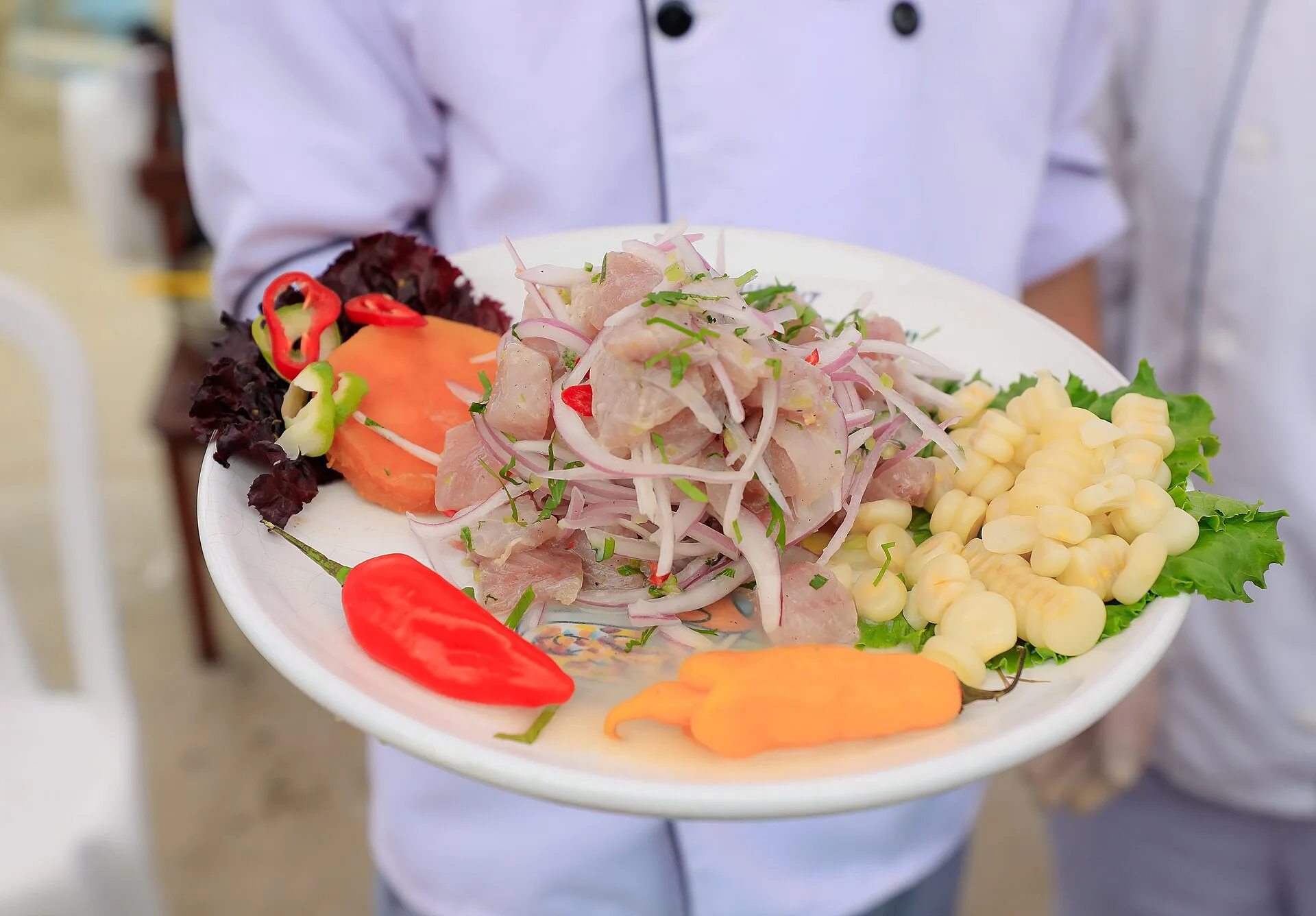
Ceviche is far older than the Japanese presence in Peru. National Geographic reports that early versions were probably eaten on Peru's northern coast around 3,000 years ago, and Peru's state news agency Andina notes that the first forms used fish marinated in the juice of tumbo, a native fruit. Onions and citrus arrived only after 1492. In 2023 UNESCO added the practices around ceviche to its Representative List of the Intangible Cultural Heritage of Humanity, describing uncooked fish cured in citrus juice and seasoned with chilli and salt, made at home or sold in cevicherías.
Tsumura has said that fish in Lima was once left in lime juice for 12 to 24 hours. Nikkei cooks, used to sashimi, mixed the fish with the marinade and served it straight away so that it stayed raw. Sato remembered ceviche made at eight in the morning still being sold at three in the afternoon, whereas today it is made to order. Tsumura also says that one of the first cevicherías in Lima was opened by Nikkei people.
Andina credits the Japanese contribution with giving rise to tiradito, thin slices of raw fish handled with the technique Japanese cooks used for sushi. PromPerú describes the dish as combining the sashimi cut with the marinade of ceviche, the lime-based liquid known as leche de tigre, or tiger's milk. Andina lists the kai clásico, a mix of scallop, pejerrey, clam and octopus in leche de tigre, among the dishes that show the fusion.
THE CHEFS WHO DEFINED NIKKEI COOKING
Humberto Sato (1940 to 2018), of the Lima restaurant Costanera 700, is described by Andina as the pioneer of Nikkei cuisine. He recalled a time when Japanese cooks in Lima had to improvise many of their own ingredients. Rosita Yimura, the daughter of Japanese immigrants who reached Peru in 1935, created octopus in olive sauce; before her dish, PromPerú notes, octopus was returned to the sea because it was not part of any Peruvian dish. Toshiro Konishi arrived in Peru with Matsuhisa in the 1970s. PromPerú names Hajime Kasuga, Rafael and Toshi Matsufuji, Diego Oka and Yaquir Sato among the chefs of the third stage, which brought maki and sushi to a wider public.
Mitsuharu Tsumura trained in the United States and then in Osaka, worked briefly at the Sheraton in Lima and opened Maido in 2009, aged 28. He has said he considered closing it early on. Maido entered The World's 50 Best Restaurants in 2015 and has appeared every year since, has topped Latin America's 50 Best four times, ranked No.5 in 2024 and was named No.1 at the ceremony in Turin on 19 June 2025. Its tasting menu of more than ten dishes uses ingredients from the Andes, the Amazon and Peru's northern coast, including squid ramen with Amazonian chorizo and sea snails with yellow chilli foam.
HOW NIKKEI CUISINE WENT GLOBAL

Nobuyuki Matsuhisa was about 24 when he moved to Lima with his wife, Yoko, after a regular customer offered to back a restaurant there. He stayed about three years, until the restaurant closed, and began adding Peruvian ingredients to Japanese dishes. In 1987 he opened Matsuhisa in Beverly Hills, which National Geographic identifies as one of the first restaurants to serve ceviche and tiradito. A later partnership with Robert De Niro produced the Nobu brand, which now has more than 70 restaurants and 19 hotels across five continents.
Spain followed a different route. In 2011 Ferran Adrià predicted that Nikkei would be the Peruvian cuisine that worked best abroad, and his brother Albert Adrià opened Pakta in Barcelona, which earned a Michelin star in 2014. In Madrid, Luis Arévalo opened Kena. National Geographic notes that ceviche only reached Europe this century, and that diners already familiar with sushi and sashimi accepted raw fish in citrus more readily. The Asociación Peruano Japonesa's account of the period also records Tsumura's dish for Madrid Fusión 2015, combining squid, tiger's milk and nori, which he described as Japanese in appearance and Peruvian in flavour.
HENSHIN AND NIKKEI DINING IN JAKARTA

Henshin is a Japanese-Peruvian (Nikkei) restaurant and rooftop bar on floors 67 to 69 of The Westin Jakarta. It opened in 2017, and Silverfox Studios designed all three floors and the arrival tunnel. The name means transformation in Japanese. The kitchen is led by Chef Hajime Kasuga, a third-generation Japanese Peruvian. Kasuga is also one of the chefs PromPerú names in the third stage of Nikkei cooking described by Barrón and Tsumura, the stage in which maki and sushi reached a wider public.
Two design references point to the Japanese side of Nikkei history. The first is Okinawan bingata cloth: a large bingata pattern covers the ceiling of level 69. Okinawa is the prefecture where around 70% of Japanese Peruvians have their roots, according to Peru's Congress. The second is a display of translucent, blue-lit sake barrel forms. Sake is one of the Japanese ingredients, alongside mirin and hondashi, that Andina lists among the contributions Japanese immigrants made to Peruvian kitchens.
SOURCES
- PromPerú, Peru.info Fusion and taste, discover Nikkei cuisine
- Discover Nikkei, Asociación Peruano Japonesa Cocina Nikkei
- Congress of the Republic of Peru Parlamentarios de Okinawa visitaron Congreso
- JICA Comunidad Nikkei en el Perú
- Densho Encyclopedia Japanese Latin Americans
- Andina Peru-Japan: fusion gastronomy celebrates 120 years of friendship
- National Geographic Ceviche: the surprising history behind Peru's raw fish dish
- UNESCO Intangible Cultural Heritage Practices and meanings associated with the preparation and consumption of ceviche
- The World's 50 Best Restaurants Maido takes No.1 at The World's 50 Best Restaurants 2025
- CBS News Los Angeles Meet Nobu Matsuhisa, the man behind the world-famous Nobu restaurant chain