HOW JAPANESE PRINTS, OBJECTS AND DEALERS CHANGED EUROPEAN PAINTING AND DESIGN FROM THE 1850S TO 1900

Japonisme, also written Japonism in English, is the influence of Japanese art and design on European art in the second half of the nineteenth century. The French critic Philippe Burty coined the word in 1872. The craze followed the reopening of Japanese ports to Western trade in 1853, after which fans, kimonos, lacquers, bronzes and silks arrived in England and France in quantity. Ukiyo-e woodblock prints had the greatest effect on painting: Whistler, Monet, Degas, Cassatt, Van Gogh and Toulouse-Lautrec all collected or borrowed from them. In design, the imports shaped the metalwork of Christopher Dresser and the business of the Paris dealer Siegfried Bing, who opened his galleries to modern artists in 1895.
HOW JAPAN'S OPENING BROUGHT JAPANESE ART TO EUROPE

From 1639, after expelling most foreigners, Japan limited foreign trade to Dutch and Chinese ships holding special charters, according to the US Office of the Historian. On 8 July 1853 Commodore Matthew Perry led four ships into Tokyo Bay with a letter from the US president. The Treaty of Kanagawa, signed on 31 March 1854, opened the ports of Shimoda and Hakodate to American ships for refuelling and provisions and allowed the United States to appoint consuls there, but it did not guarantee trade. Townsend Harris, who arrived at Shimoda in 1856, secured the first true commercial treaty in 1858. Western pressure weakened the Tokugawa shogunate until the Meiji Restoration of 1868.
Japanese goods reached European audiences within a decade. In London, Sir Rutherford Alcock's collection was shown at the International Exhibition of 1862, which the Victoria and Albert Museum identifies as the point when Japanese art first gained wide public attention. In Paris, the Metropolitan Museum of Art notes that shiploads of Japanese goods were already arriving before Japan took a pavilion at the World's Fair of 1867, the first formal exhibition of Japanese arts and crafts that Parisians saw. The art historian Gabriel Weisberg, writing for France's National Institute of Art History (INHA), dates growing interest to after the 1867 fair and the real enthusiasm to the Paris Exposition Universelle of 1878.
HOW DID EUROPEAN ARTISTS DISCOVER JAPANESE PRINTS?
The best-known origin story of Japonisme concerns the French printmaker Félix Bracquemond (1833 to 1914). He is said to have found woodcuts from Katsushika Hokusai's Manga being used as packing material for imported porcelain in 1856. The Princeton University Art Museum repeats the story in its entry for Bracquemond's etched portrait of the novelist Edmond de Goncourt (1882), presenting it as something said rather than documented. What is documented is that Bracquemond was one of the earliest collectors of Japanese prints and decorative arts in France, and a leader of the French etching revival of the 1860s, which promoted etching as an original art form.
Similar stories attach to other painters. The Met reports that, it is said, James McNeill Whistler discovered Japanese prints in a Chinese tearoom near London Bridge, and that Claude Monet first found them used as wrapping paper in a spice shop in Holland. In each version the prints arrive as commercial goods rather than as art. In Japan, ukiyo-e prints took their subjects from 'the floating world', and the Met credits them with transforming Impressionist and Post-Impressionist art by showing that simple, everyday subjects could be presented decoratively.
WHO COINED THE TERM JAPONISME? BURTY, BING AND HAYASHI

Philippe Burty (1830 to 1890) was an art critic, collector and inspector at the Beaux-Arts. According to his INHA entry, he began collecting Asian works in 1863 and coined japonisme in 1872, developing it in a series of that title in La Renaissance littéraire et artistique. His collection was auctioned after his death: the sale at the Hôtel Drouot in March 1891 offered 3,016 pieces and was organised by Siegfried Bing, who divided the lots into 24 categories. Burty also formed close ties with the Japanese dealer Hayashi Tadamasa (1853 to 1906).
Bing (1838 to 1905) came from a family with stores in Hamburg and Paris and was trained in the making and marketing of porcelain. Weisberg describes him as becoming the foremost promoter of Japanese art in Paris around the 1878 Exposition Universelle. He travelled to Japan in 1880 to 1881 to meet collectors and dealers, and kept stock in shops on the rue de Provence, rue Bleue, rue de la Paix and rue Chauchat. From 1888 to 1891 he published Le Japon artistique, a monthly that ran to 36 issues in French, English and German. At the 1900 World's Fair he replaced Hayashi, who was ill, on an official commission.
WHISTLER, THE PRINCESS FROM THE LAND OF PORCELAIN AND THE PEACOCK ROOM

In the mid-1860s Whistler painted a series of costume pictures showing Western models in Asian dress, surrounded by Chinese and Japanese objects from his own collections. The best known is La Princesse du pays de la porcelaine (The Princess from the Land of Porcelain), which the Freer Gallery of Art dates to 1863 to 1865; it is signed and dated 1864. The model was Christina Spartali, a young woman of Greek descent, shown in a kimono and holding a fan. The Freer describes it as a demonstration of a new ideal of beauty rather than a portrait, drawn from ukiyo-e prints and the elongated figures on Chinese porcelain. It was exhibited at the Salon of 1865.
The painting led to the Peacock Room. Frederick Leyland (1831 to 1892) of London bought it and, after acquiring a new house in 1875, hung it over the mantelpiece of his dining room, which he intended as a porcelain room for his collection of Chinese blue-and-white. Whistler suggested changes to the room's colour scheme, and his work became Harmony in Blue and Gold: The Peacock Room. After Leyland's death in 1892 it passed to Sir William Burrell, who sold it to Charles Lang Freer in 1903. Freer's collection went to the Smithsonian under a deed signed in 1906, and the painting still hangs over the mantel in the Peacock Room at the Freer Gallery of Art.
MONET'S LA JAPONAISE, DEGAS AND JAPONISME IN PARIS PAINTING

Claude Monet's La Japonaise (1876), now in the Museum of Fine Arts, Boston, shows his first wife, Camille, in an elaborately embroidered kimono. Monet owned several Japanese theatrical costumes, and Camille seems to have posed in one of them. He painted her as a blonde parisienne, although she was naturally dark-haired, and surrounded her with sixteen paper fans; the folding fan in her hand is red, white and blue, the colours of the French flag. The painting was shown at the second Impressionist exhibition in 1876 under the title Japonerie. Reviews divided almost equally: one conservative critic called the figure a 'great doll', while Émile Zola found it 'prodigious in colour and in strangeness'.
Edgar Degas took a different approach. According to the Met, Degas and his friend James Tissot were among the earliest collectors of Japanese art in France, but Degas, unlike Tissot, avoided staging japoneries, pictures of models in kimonos surrounded by conspicuous Asian props. He took formal devices from the prints instead: elongated formats, asymmetrical compositions and aerial perspective. The Met illustrates the approach with his Dancers in the Rehearsal Room with a Double Bass (about 1882 to 1885).
VAN GOGH'S JAPANESE PRINTS AND HIS COPIES AFTER HIROSHIGE

Vincent van Gogh bought prints from Bing. Writing to his brother Theo from Arles on 15 July 1888, he described an attic at Bing's holding a heap of 10,000 Japanese prints and calculated that at 3 sous each, 100 francs would buy a new stock of 660. The editors of his letters suggest the attic was behind Bing's branch at 22 rue de Provence. Van Gogh also recalled the exhibition of Japanese prints he had held at the café Le Tambourin, probably in February and March 1887, and wrote that all his work was based to some extent on Japanese art. Before leaving for Arles, the editors note, he had covered the walls of Theo's apartment with prints.
In 1887 Van Gogh made three paintings after Japanese prints he owned. Flowering Plum Orchard (after Hiroshige), in the Van Gogh Museum, Amsterdam, copies Hiroshige's Plum Garden in Kameido. The museum notes that he reproduced the composition accurately but made the colours much more intense, replacing the black and grey of the tree trunk in the foreground with red and blue tones, and added two orange borders with Japanese characters for a decorative and exotic effect. In the 1888 letter he also asked Theo to take Hokusai prints from Bing: 300 views of the sacred mountain and scenes of manners and customs.
CASSATT, THE 1890 EXHIBITION AND THE ROAD TO ART NOUVEAU
In the spring of 1890 Mary Cassatt visited a large exhibition of ukiyo-e prints at the École des Beaux-Arts in Paris, and afterwards made a set of ten colour etchings. The Met records that Cassatt, who said she hated conventional art, found in prints such as Utamaro's a fresh way of depicting the everyday events of women's lives, as in Maternal Caress (1890 to 1891). Henri de Toulouse-Lautrec adopted the exaggerated colours, contours and facial expressions of kabuki theatre prints for posters such as At the Moulin Rouge: La Goulue and Her Sister (1892), and Paul Gauguin adapted Japanese woodcut techniques for his own prints rather than using the lithography then common.
In design, the influence came through objects as well as prints. The V&A records that Christopher Dresser admired Japanese metalwork at the Vienna Universal Exhibition of 1873, in particular the exposed rivets and joints on Japanese vases, a device he later used himself. In 1876 to 1877 he became the first European designer to visit Japan after it opened to Western trade, and his book Japan: Its Architecture, Art and Art Manufactures (1882) helped sustain the Japonisme trend. A jardinière made by Benham & Froud to his design around 1880 has horizontal riveted bands of differently coloured metals, following Japanese technique.
Bing carried the trade in Japanese art into the new decorative style. In December 1895 he reopened his renovated galleries at 22 rue de Provence to modern artists working in all areas, commissioning furniture from Henry van de Velde in the 1890s, while Japanese art was still sold through a separate entrance on the rue Chauchat. At the Paris World's Fair of 1900 he was given the right to build his own pavilion of art nouveau on the fair grounds.
THE AUBREY: A COLLECTOR'S JAPONISME AT MANDARIN ORIENTAL HONG KONG
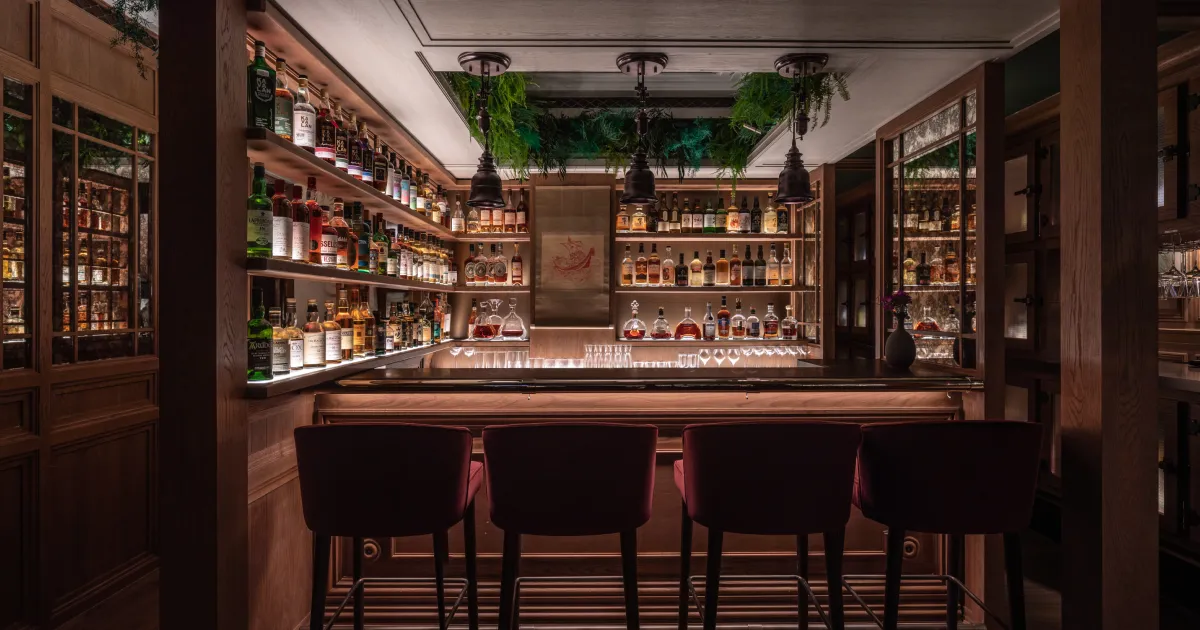
The Aubrey is a Japanese izakaya and bar on the top floor of Mandarin Oriental Hong Kong, designed by Silverfox Studios and completed in 2021. It is named after the illustrator Aubrey Beardsley, and its concept is an eccentric English gentleman's manor in which a collector's obsession with all things Japanese shapes every element. In the nineteenth century, Leyland's dining room was designed around his porcelain collection, and Whistler painted his models among the Chinese and Japanese objects he owned.
The design draws on Japonisme and on ukiyo-e motifs: Mount Fuji, a pagoda, torii gates and crashing waves. Fuji was also a subject in the prints Van Gogh sought, since the editors of his letters identify the sacred mountain in his 1888 request for Hokusai's views as Mount Fuji. The interior uses dark timber panelling, gilded picture frames and gallery walls, and a curio lounge has bespoke display cabinetry for objets d'art. Van Gogh had also displayed his own Japanese prints, at Le Tambourin in 1887, and Leyland intended his dining room as a porcelain room.
SOURCES
- Office of the Historian, US Department of State The United States and the Opening to Japan, 1853
- The Metropolitan Museum of Art Japonisme
- Victoria and Albert Museum Jardiniere, Christopher Dresser
- Princeton University Art Museum Félix Bracquemond, Edmond de Goncourt
- INHA, AGORHA Burty, Philippe
- INHA, AGORHA Bing, Siegfried
- Smithsonian National Museum of Asian Art The Princess from the Land of Porcelain (La Princesse du pays de la porcelaine)
- Museum of Fine Arts, Boston Conservation in Action: La Japonaise
- Van Gogh Museum and Huygens ING, Vincent van Gogh: The Letters Letter 640: To Theo van Gogh, Arles, 15 July 1888
- Van Gogh Museum Flowering Plum Orchard (after Hiroshige)