FROM GAUTIER AND PATER TO GODWIN, LIBERTY AND THE HOUSE BEAUTIFUL
The Aesthetic Movement was a British art and design movement that ran from about 1860 to 1900 and is summed up by the phrase "art for art's sake". The V&A describes its aim as an escape from "the ugliness and materialism of the Industrial Age", with beauty valued above moral or narrative meaning. Its central idea had been argued by Théophile Gautier in France and Walter Pater in England, its painters exhibited at the Grosvenor Gallery from 1877, and E.W. Godwin applied Japanese principles to furniture. Liberty & Co, opened on Regent Street in 1875, sold silks and Oriental goods, and sideboards and overmantels became display platforms for blue-and-white china. By 1881 it was satirised in Punch and in Gilbert and Sullivan's Patience, and in 1882 Oscar Wilde lectured in America.
WHERE DID ART FOR ART'S SAKE COME FROM?
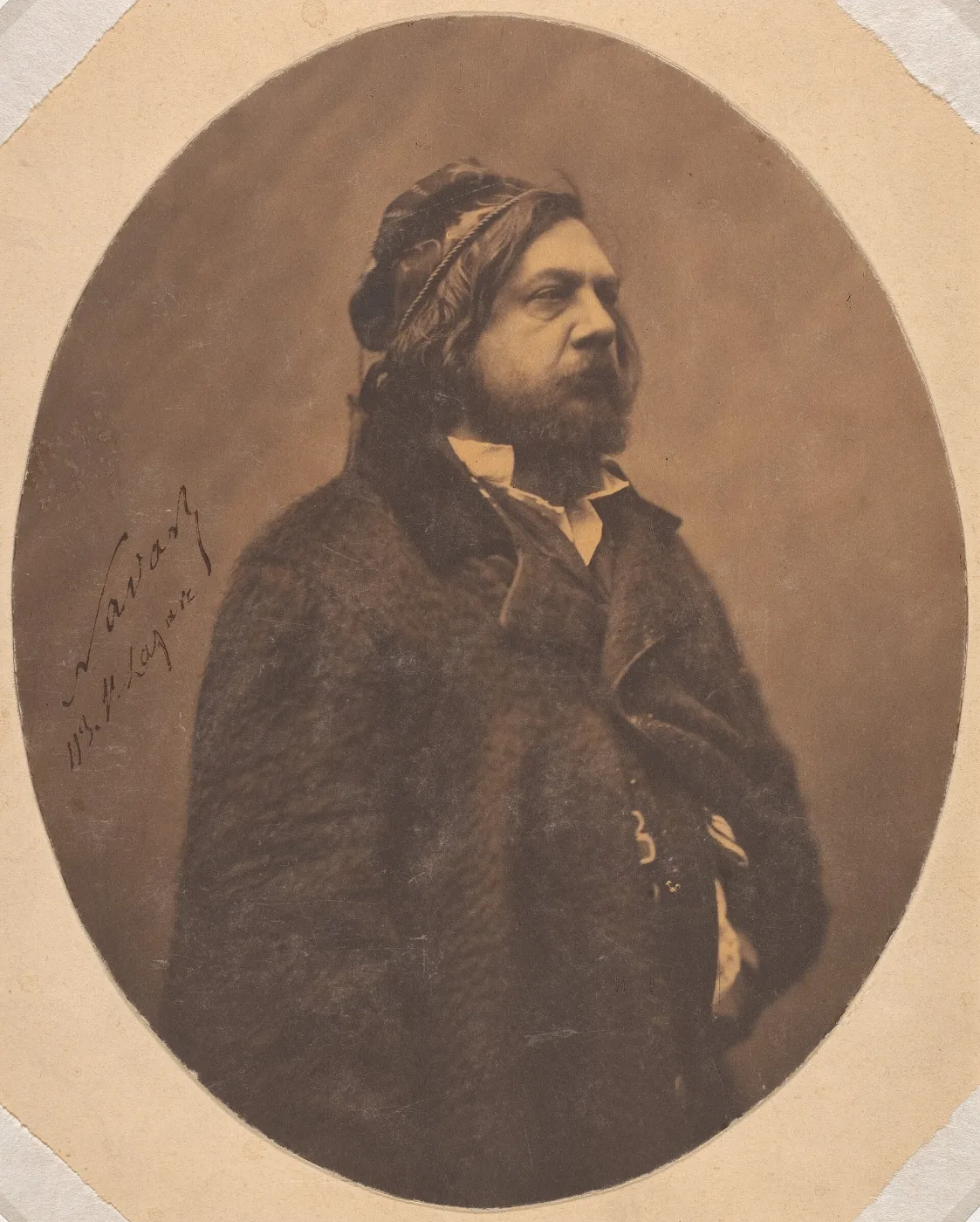
In France the doctrine of art for art's sake was championed by the poet and critic Théophile Gautier (1811 to 1872). Britannica records that Gautier turned from the doctrines of Romanticism to become an advocate of art for art's sake. Albertus, a long narrative poem about a young painter who falls into the hands of a sorcerer, was published in 1832, and its preface, together with the novel Mademoiselle de Maupin (1835), set out his views. Both works disregarded conventional morality and insisted on the sovereignty of beauty, and they caused a considerable stir in literary circles. Gautier held that the aim of the artist is to achieve perfection of form.
In England the same argument appeared in the writing of Walter Pater (1839 to 1894). Pater studied at Queen's College, Oxford, and was elected to a fellowship at Brasenose College in 1864. His essays on Leonardo da Vinci, Botticelli, Pico della Mirandola and Michelangelo were collected in 1873 as Studies in the History of the Renaissance, later called simply The Renaissance. Its concluding essay argued that "art exists for the sake of its beauty alone" and that art acknowledges neither moral standards nor utilitarian functions. Pater became the centre of a small group of admirers in Oxford, and Britannica notes that Oscar Wilde, George Moore and the aesthetes of the 1890s show continual traces of both his style and his ideas.
WHAT WAS THE AESTHETIC MOVEMENT IN BRITAIN?
The V&A dates the Aesthetic Movement in Britain to 1860 to 1900 and calls it a "cult of beauty". Its figures included the romantic bohemians Dante Gabriel Rossetti, William Morris and Edward Burne-Jones. They were joined by James McNeill Whistler, fresh from Paris with what the museum calls "dangerous" French ideas about modern painting, by the architects and designers E.W. Godwin and Christopher Dresser, and by the Olympians, painters of grand classical subjects in the circle of Frederic Leighton and G.F. Watts. Manufacturers engaged designers including Godwin, Dresser, Walter Crane and Lewis Foreman Day.
Japan shaped the movement's ornament. According to the V&A, Japan's forced opening to foreign trade in 1853 revitalised the European veneration of Japanese things, and displays at the Old Water Colour Society and the Japanese Court of the 1862 International Exhibition introduced Japanese forms to a wider audience. A Japanese inflection, featuring asymmetry, flat patterning, simplified form and elegant surface ornament, became a hallmark of the Aesthetic style in Britain. The wider European fashion for Japanese art is known as Japonism. Aesthetic wallpaper motifs were drawn from medieval, chinoiserie and Japanese sources and typically used reddish-pinks, greenish-blues and olive, as in Walter Crane's design Swan, Rush and Iris (1875).
THE GROSVENOR GALLERY AND WHISTLER V RUSKIN
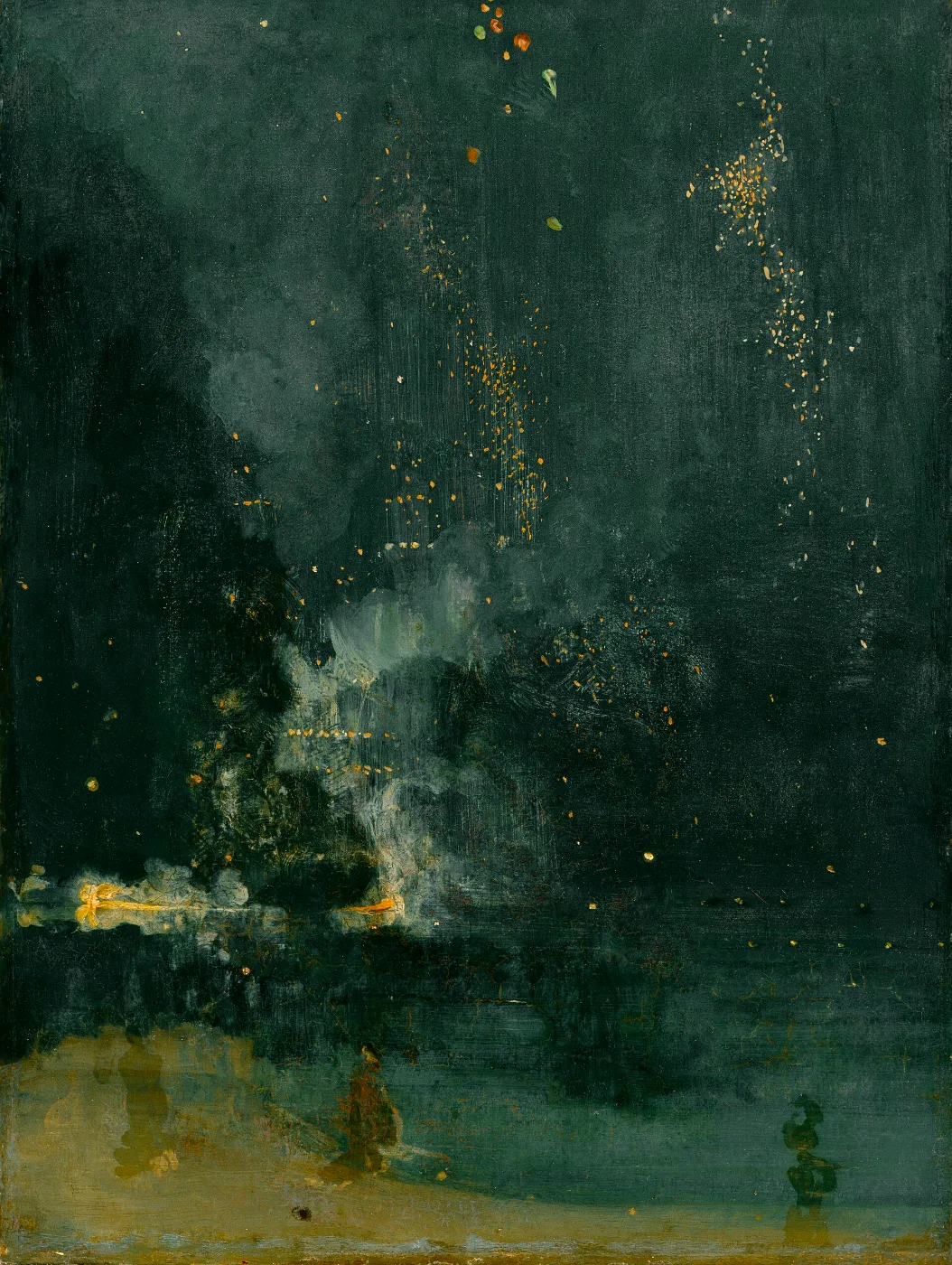
In 1877 Sir Coutts Lindsay and his wife Blanche founded the Grosvenor Gallery at 135 to 137 New Bond Street, London, as an alternative to the Royal Academy. Its inaugural exhibition opened on 1 May 1877 and included Whistler's Nocturne in Black and Gold: The Falling Rocket. The Royal Academy's own record describes the Grosvenor as a gallery devoted to the Pre-Raphaelites that became the focus of the Aesthetic Movement. In 1888 the rival New Gallery took Burne-Jones and many of the Grosvenor's other artists, and the Grosvenor Gallery closed in 1890.
John Ruskin reviewed the 1877 exhibition in letter 79 of Fors Clavigera, published that July. He wrote that he had never expected to hear a coxcomb ask two hundred guineas "for flinging a pot of paint in the public's face". Whistler sued Ruskin for libel and the case came to trial in 1878. The University of Delaware Library describes the Nocturne as radical in its nearly abstract appearance, and records that Burne-Jones testified that it could not be called a serious work of art. Whistler won, but the jury awarded him one farthing, a quarter of a penny, in damages.
E.W. GODWIN AND AESTHETIC MOVEMENT FURNITURE
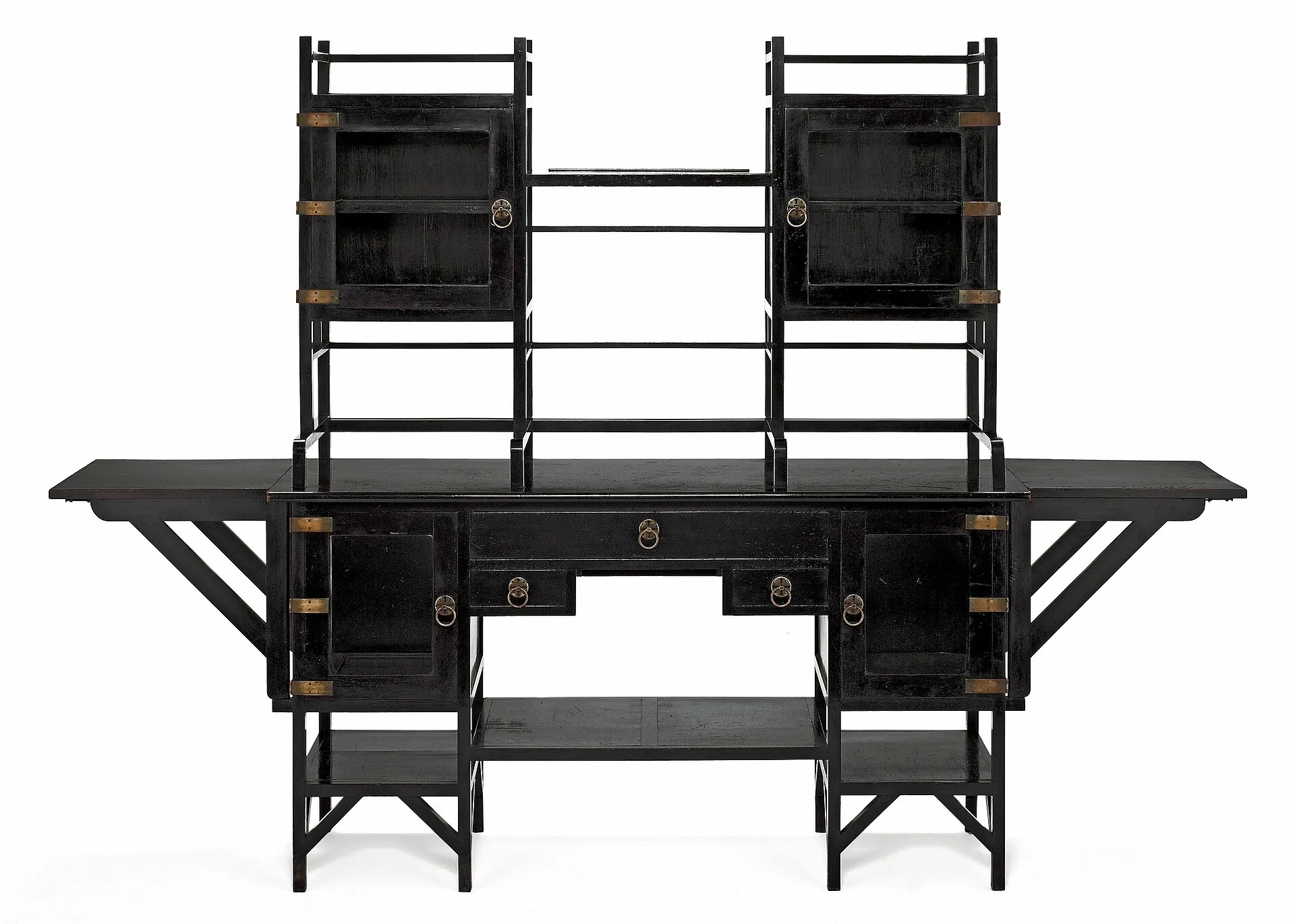
The V&A names the writers Charles Eastlake and Robert Edis, and the designers E.W. Godwin, B.J. Talbert and Christopher Dresser, as promoters of design reform in furniture. The museum singles out two finishes. Ebonising darkened wood to give it an appearance similar to ebony, and was seen to promote hygiene in furniture associated with eating and drinking. Coloured finishes were, in the museum's words, "a distinguishing characteristic of 'art' furniture". Godwin's Anglo-Japanese furniture designs in the V&A collection date from about 1875.
Godwin designed the first version of his sideboard in ebonised deal, a cheap wood, for the dining room of his own London home in 1867. The V&A example, made between 1867 and 1870 and probably by William Watt of London, is ebonised mahogany with silver-plated handles and door panels of Japanese embossed leather paper; it stands 181 cm high and 256 cm wide. At least ten versions were made between 1867 and 1888, varying in design and number of legs. The museum states that the sideboard epitomises the influence of Japanese art and design on British decorative art in the 1860s and 1870s, and that its stark geometric form and plain ebonised surfaces appealed greatly to Modernists throughout the twentieth century.
HOW LIBERTY SUPPLIED THE AESTHETIC HOME
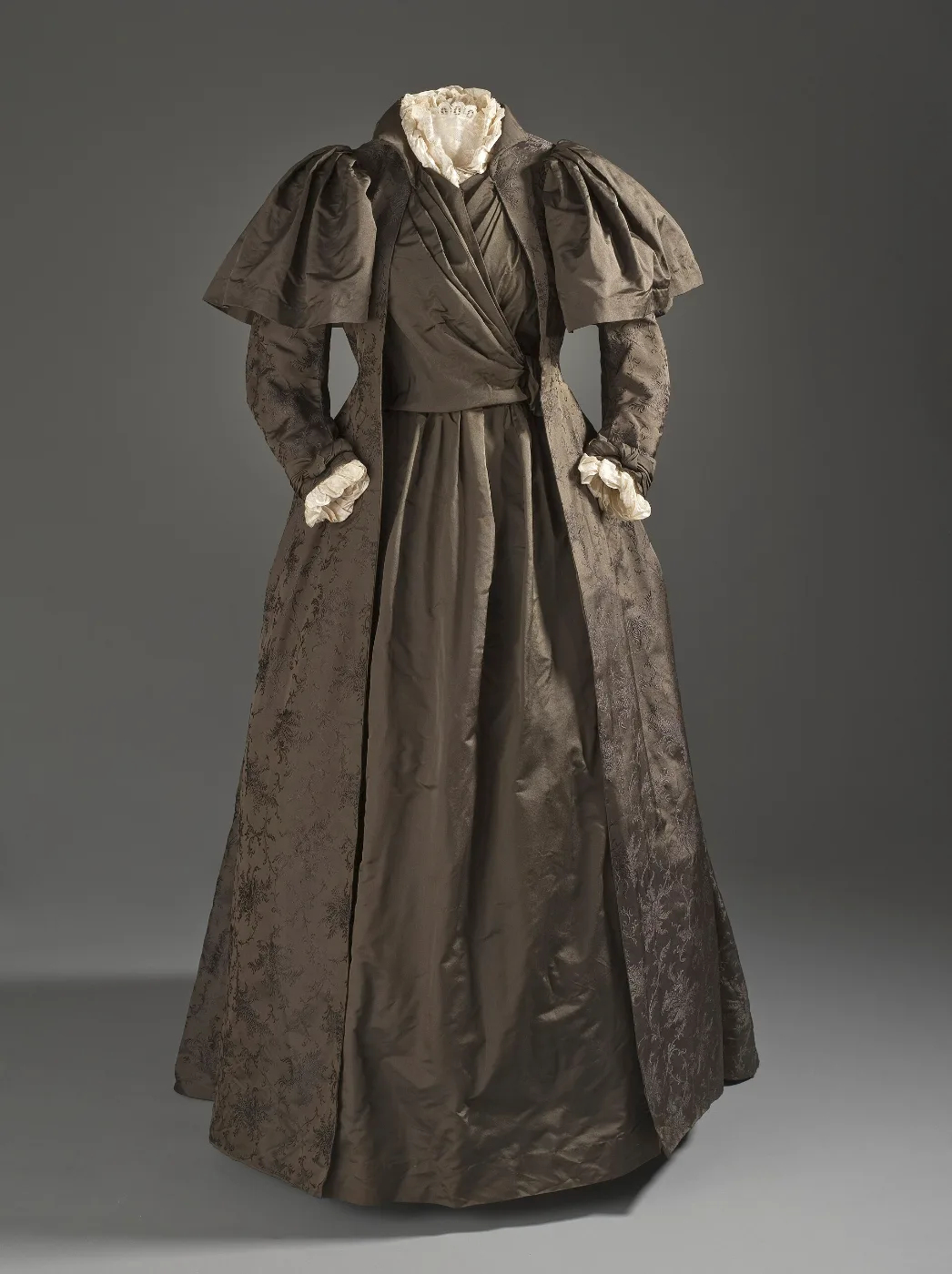
Arthur Lasenby Liberty was born on 13 August 1843 in Chesham, Buckinghamshire. From 1862 he worked at a shawl emporium at 171 to 175 Regent Street, London, rising to become head of the shop. In 1875 he took a lease on part of a shop at 218a Regent Street, which opened on 15 May 1875 as an "Oriental warehouse". The Furniture History Society records that he raised the money through his fiancée, Emma Louise Blackmore: her father, a tailor in Brook Street, and another tailor, Henry Hill of Bond Street, together provided £1,500 and acted as guarantors for a further £1,000. In 1876 Liberty acquired the other half of No. 218 to expand the business.
The V&A identifies Liberty & Co as a key retailer of Aesthetic objects and ideas, and notes that it did a huge trade in soft silks imported from India. For the Paris Universal Exhibition of 1878 Liberty showed a stand displaying furniture designed by Godwin and made by William Watt. Its studio and upholstery workshops were set up at East India House, the original 218 Regent Street premises, and in 1883 the furniture and furnishing store moved to Chesham House, 142 to 144 Regent Street, where the eighteen-year-old Leonard Wyburd became principal designer. Arthur Silver's furnishing fabric Peacock Feathers for Liberty (1887) used peacock feathers, a motif that stood for "the rare and exotic".
BLUE-AND-WHITE CHINA AND THE PEACOCK ROOM
The V&A writes that the preferred furniture types of the period, sideboards, corner and hanging cupboards and overmantels, created the display platform for "the ever-present blue-and-white china". The acquisition of a single Japanese fan for the mantelpiece marked a household as part of the Artistic vogue, and both the china and the fans were among the emblems later used to mock the Aesthetes. Frederick Richards Leyland, a wealthy Liverpool shipowner and Whistler's leading patron, had a dining room built around such a collection at his London house.
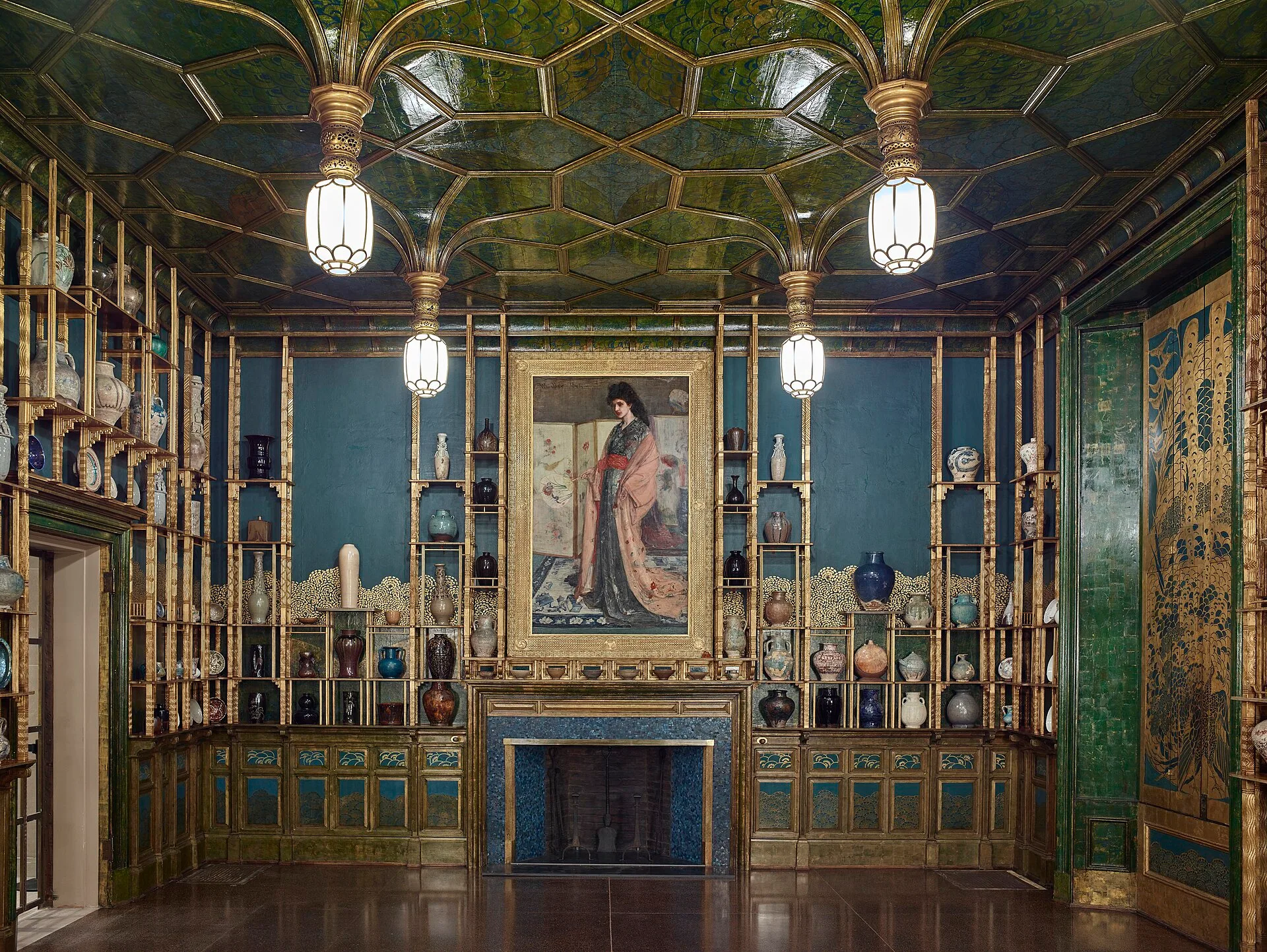
The architect Thomas Jeckyll (1827 to 1881) designed the room at 49 Prince's Gate to hold Leyland's collection of Chinese blue-and-white porcelain, mostly from the Kangxi era (1662 to 1722) of the Qing dynasty, with Whistler's painting The Princess from the Land of Porcelain in the place of honour above the fireplace. After Jeckyll fell ill, Whistler completed the room in 1876 to 1877 as Harmony in Blue and Gold: The Peacock Room. Charles Lang Freer bought it in 1904 and moved it to his house in Detroit to display his own ceramics; after Freer died in 1919 it was reinstalled at the Freer Gallery of Art, which opened to the public in 1923.
PUNCH, PATIENCE AND THE AESTHETIC MOVEMENT IN AMERICA
By the V&A's account the Aesthete emerged fully fledged in the 1870s and became the target of George du Maurier's long-running series of cartoons in Punch, begun as early as 1876. Gilbert and Sullivan's opera Patience (1881) joined in. In both, the velvet-clad Aesthetes were ridiculed for their "stained-glass attitudes", their overly precious speech and their attachment to pale lilies, sunflowers, peacock feathers, fragile blue-and-white china and Japanese fans. The image of the sunflower as an Aesthetic emblem was confirmed by Thomas Jeckyll's Japanese Pavilion at the 1876 Centennial Exhibition in Philadelphia, whose ground-level railing was composed of rows of wrought-iron sunflowers; the pavilion was re-erected at the 1878 Exposition Universelle in Paris.
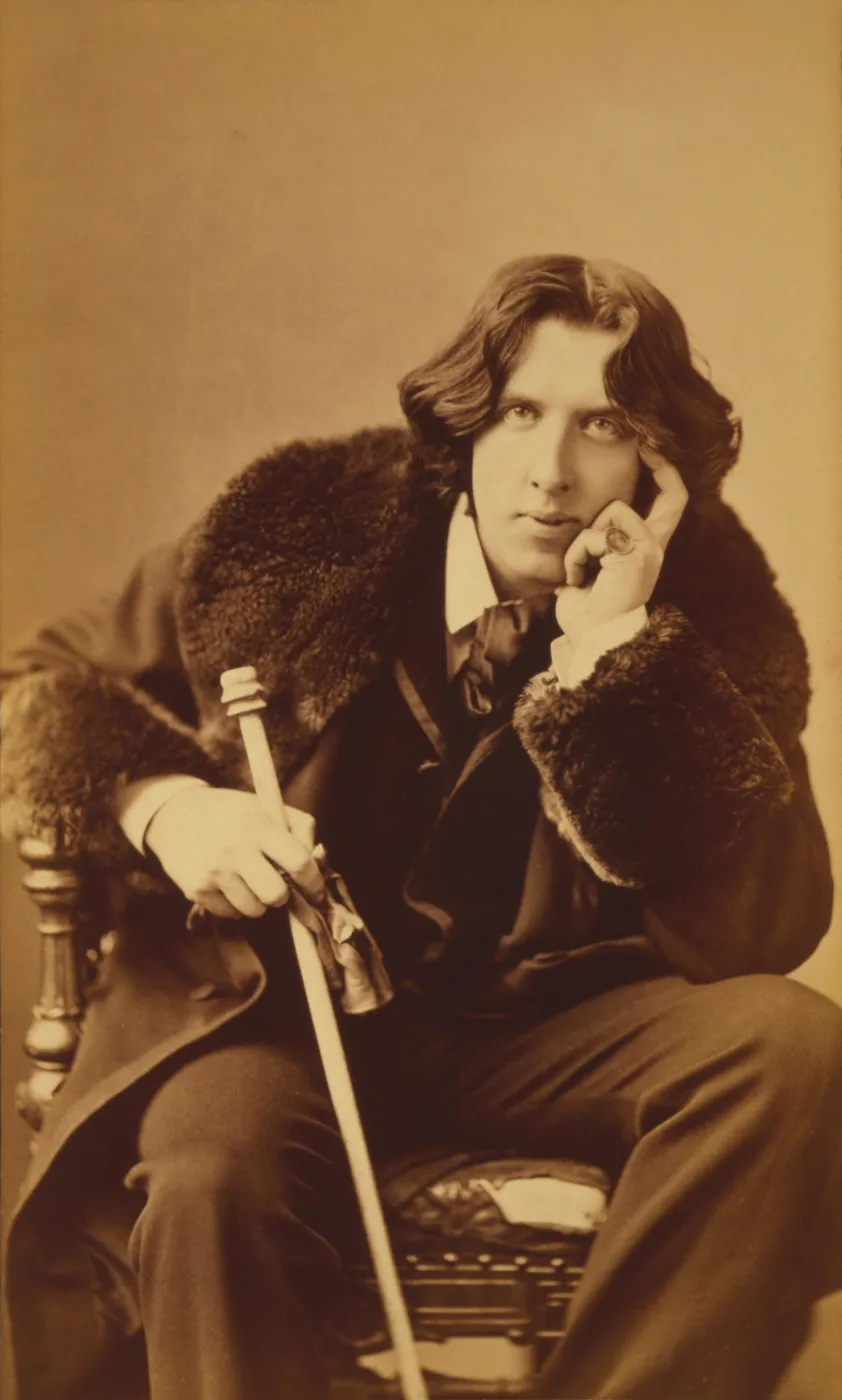
In 1882 Oscar Wilde went to America at the invitation of the producer Richard D'Oyly Carte to lecture on the English Renaissance. The Metropolitan Museum of Art notes that the lectures promoted D'Oyly Carte's production of Patience, in which aestheticism and Wilde himself were satirised. At that point Wilde had written an unproduced melodrama, Vera, and a book of verse, and was known in London as a wit and dandy. In January 1882 the New York photographer Napoleon Sarony photographed him in his lecture costume: velvet jacket and vest, silk knee breeches, and slippers with grosgrain bows. The Met records that Wilde was warmly received and had considerable social success.
Wilde had much to say about creating "The House Beautiful", a phrase used as the title of Clarence Cook's 1878 book The House Beautiful, which carried a frontispiece by Walter Crane and essays on beds, tables, stools and candlesticks. Among Wilde's advice, the V&A cites his view that stained glass can reduce the glare from a large window and fill a room with more subtle lighting. In the 1890s the illustrator Aubrey Beardsley made black-ink drawings that the V&A associates with the grotesque, the decadent and the erotic. The V&A notes that the movement's styles remained popular into the twentieth century.
THE AUBREY AT MANDARIN ORIENTAL HONG KONG
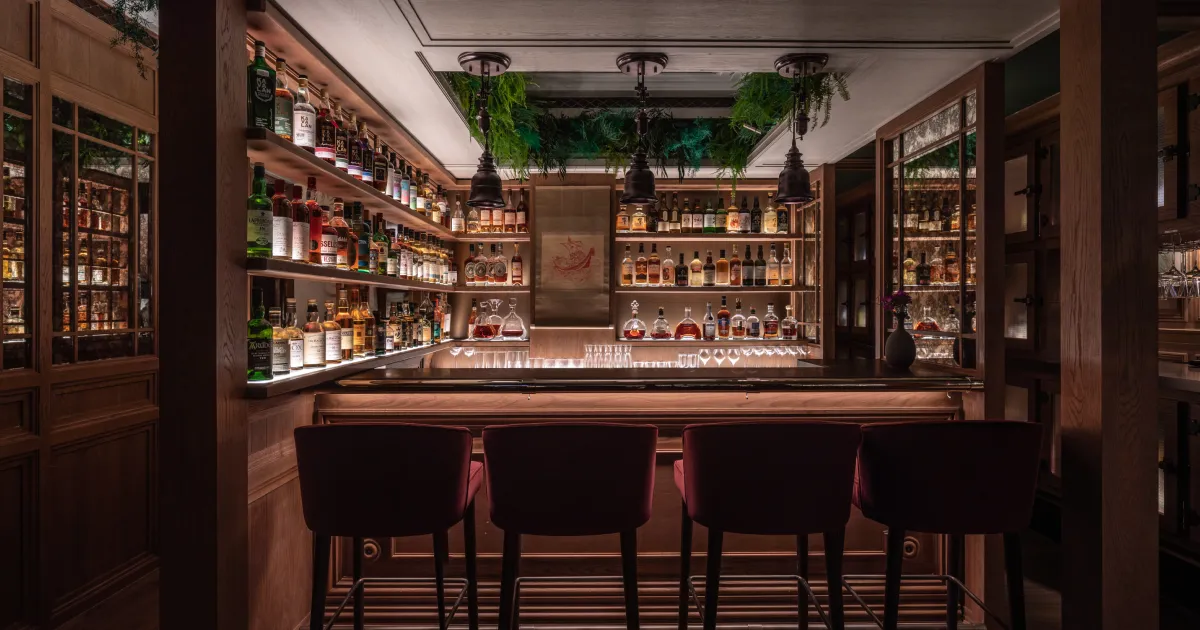
The Aubrey is a Japanese izakaya and bar on the top floor of Mandarin Oriental Hong Kong, completed by Silverfox Studios in 2021. It is named after Aubrey Beardsley, who appears in the V&A's account of the Aesthetic Movement alongside Rossetti, Morris, Whistler, Godwin and Wilde. The concept is the manor of an eccentric English gentleman, shaped by a collector's obsession with Japan. The interior uses Japonisme and ukiyo-e motifs, among them Mount Fuji, a pagoda, a torii and crashing waves.
The interior combines dark timber panelling, gilded frames and gallery walls, and the curio lounge is fitted with bespoke display cabinetry. In the Victorian Aesthetic interior, as the V&A describes it, sideboards, corner and hanging cupboards and overmantels were the display platform for blue-and-white china and Japanese fans; Godwin's sideboard set ebonised wood against silver-plated handles and Japanese embossed leather paper; and Leyland's dining room at 49 Prince's Gate was built to hold and display a single collector's Chinese porcelain.
SOURCES
- V&A An introduction to the Aesthetic Movement
- V&A Furnishing the Aesthetic home
- V&A Sideboard, Edward William Godwin
- Britannica Théophile Gautier
- Britannica Walter Pater
- Royal Academy of Arts Grosvenor Gallery
- University of Delaware Library, Museums and Press The Butterfly Goes to Court
- Furniture History Society Liberty & Co. (1875 to 2024)
- Smithsonian National Museum of Asian Art Harmony in Blue and Gold: The Peacock Room
- The Metropolitan Museum of Art Oscar Wilde, Napoleon Sarony, 1882