THE STONE HOUSE, THE SHARECROP AND THE BREAD SOUP OF RURAL TUSCANY

The Tuscan farmhouse, or casa colonica, was the home of a sharecropping family working a podere, a farm unit of a few hectares, under the contract known as mezzadria. From the 13th century to the 1960s the system set the pattern of the Tuscan countryside: houses scattered across the farmland, each podere a small mixed farm, and groups of poderi run from a central estate, the fattoria. It also set the food. Soups and salads built on stale, saltless bread, such as ribollita, pappa al pomodoro and panzanella, belong to the cucina povera of the Tuscan countryside, and the same countryside produced Chianti wine. UNESCO inscribed the Val d'Orcia, a farming landscape in the province of Siena, on the World Heritage List in 2004.
WHAT WAS THE MEZZADRIA SYSTEM IN TUSCANY?

Britannica gives mezzadria as the Italian name for métayage, a form of share tenancy involving payment of approximately half the annual output, in which the tenant family permanently occupies the land it works and the landowner usually furnishes the chief capital items. A 2018 study published by the Tuscan regional council, written by Lorenzo Ciattini and focused on the Pistoia area, dates the development of these contracts to the early 13th century, after an earlier form of agrarian contract, the livello. The landowner supplied the house, half the livestock and half the seed, and the produce of the podere was divided in half between owner and tenant.
The contract ran for a year and was tacitly renewed, and each podere had to be large enough to absorb all the labour of one household, the famiglia colonica. Inside it, Ciattini records the capoccia, who ran the farmhouse, and the massaia, who sifted the flour and kept the finest for pasta. The Region of Tuscany's study of its historic rural landscapes puts the average podere at under ten hectares and dates its phases: formation and expansion from the Middle Ages to 1765, strong expansion over woods and marshes from 1765 to 1860, and extension into the mountains from 1860 to the late 1950s. A University of Florence paper on Chianti describes mezzadria as the form of management of the Tuscan countryside for more than five centuries.
HOW DID SIENA'S MERCHANTS SHAPE THE VAL D'ORCIA?

The Val d'Orcia lies in the province of Siena. According to UNESCO, its landscape took its present form when the city state of Siena expanded in the 13th and 14th centuries and its merchants invested in farming. Under a tenure system that UNESCO describes as innovative, farmers paid half their agricultural produce to the merchants as rent. They supported settlements, built fortifications, villas and churches, and commissioned paintings by Giovanni di Paolo and Sano di Pietro. After Sienese power weakened at the end of the 16th century, the comparative poverty and marginalisation of the valley over the following four centuries preserved its traditional land use and Renaissance layout.
The inscription, made in 2004 under criteria (iv) and (vi), covers 61,187.96 hectares with a buffer zone of 5,660.08 hectares. UNESCO describes flat chalk plains from which rise almost conical hills topped by fortified settlements, including Montalcino, San Quirico d'Orcia, Castiglione d'Orcia, Rocca d'Orcia, Monticchiello and Radicofani. The area comprises small mixed farms growing grain, vines, olives, fruit and vegetables; farmhouses are listed among its built structures alongside fortifications, villas, churches and streets; and groups and avenues of cypresses mark settlements and routes. Criterion (vi) cites the painters of the Sienese School who celebrated this landscape, and UNESCO points to a painting of about 1339 by Ambrogio Lorenzetti in Siena's town hall. The Val d'Orcia Artistic, Natural and Cultural Park, run by five municipalities, was created in 1999.
WHAT DOES A TUSCAN FARMHOUSE LOOK LIKE?

The Enciclopedia Italiana entry on rural buildings, written by Carlo Santini in 1936, lists Tuscany among the Italian regions with typical case coloniche, and describes the type as a single building serving a farm divided into units sized to the working capacity of one peasant family. Such houses usually had the kitchen and storerooms on the ground floor and the bedrooms on the first floor. For each family, Santini writes, a large kitchen with an oven and a pantry and two or three bedrooms were enough. Sometimes only the pigsty, oven and henhouse stood apart, and some houses had one or two porticoes.
The Region of Tuscany's landscape study describes how these houses sat in the land. In the mezzadria areas settlement was scattered across the farms, with rural villages serving them, and in the Florentine countryside the many farmhouses and isolated villas were often grouped under a fattoria. Where several dwellings formed a corte, single-family buildings and outbuildings stood around a shared space laid out as a threshing floor, the aia, with a well. The poderi also had their own productive buildings, including mills for grain and olives and kilns, and in the late 19th century rationally designed models for rural buildings spread. In the Apennines, houses were built of exposed stone. In Chianti, the University of Florence paper links the balanced spread of farmhouses across the hills to the intensive division of the land into poderi.
THE FATTORIA: HEARTH, DOVECOTE AND VIN SANTO LOGGIA
Groups of poderi were run from a fattoria, which the regional landscape study describes as centred on a villa and its garden. Ciattini documents one, the fattoria of Spicchio at Lamporecchio, with about 70 poderi across roughly 900 hectares. Its kitchen had a large hearth with a beam of pietra serena sandstone carrying the coat of arms of the cardinal's family, and the dining room had a long oak table. The main staircase led to the upper floor and the apartments of the estate manager, the fattore, and his wife, the fattoressa. A small tower held the colombaia, the dovecote.
Grapes for vin santo were dried in a loggia, and the wine aged in the vinsantaia, a room in direct contact with the roof. Three horses were kept for transport, while the tenant families raised the cows and calves. The fattore could renew or end the sharecropping contracts and at the end of each farming year drew up each family's accounts. Ciattini describes the estate as totally self-sufficient, with the fattoressa buying only colonial goods such as coffee, spices and salt in town. The fattoria received one ham for every pig a tenant slaughtered, and the estate's own water mill ground grain each month for each family, no more than two sacks at a time.
WHAT IS CUCINA POVERA IN TUSCANY?

Visit Tuscany, the region's official tourism site, places ribollita in the tradition of cucina povera, the simple cooking of the Tuscan countryside, in which leftovers were used to make filling dishes and seasonal ingredients were the basis of every meal. The name means re-boiled or recooked: a vegetable and bean soup is thickened with stale bread and recooked the next day until it becomes thick and dense. The published recipe for four uses 750 g of cooked cannellini beans, 150 g of Tuscan cavolo nero, 250 g of Savoy cabbage, onion, garlic, carrots, celery, a potato, tomato paste, extra virgin olive oil and 200 g of stale Tuscan bread cut into thin slices.
The same site specifies that the bread for these dishes must be Tuscan: saltless, with a crunchy crust and a soft crumb. Stale, it is the base of two summer dishes. Pappa al pomodoro combines tomatoes, bread, garlic, extra virgin olive oil and basil. Panzanella needs only stale Tuscan bread, well-ripened tomatoes, onion and basil; cucumber or tuna can be added. Visit Tuscany gives other dishes similar roots: lardo di Colonnata, from a village among the marble quarries near Carrara and cured in a marble basin, was born as a poor dish that gave workers energy, and Florence's lampredotto belongs to the quinto quarto, everything normally discarded that can be recovered.
WHEN WERE THE BOUNDARIES OF CHIANTI WINE FIRST SET?
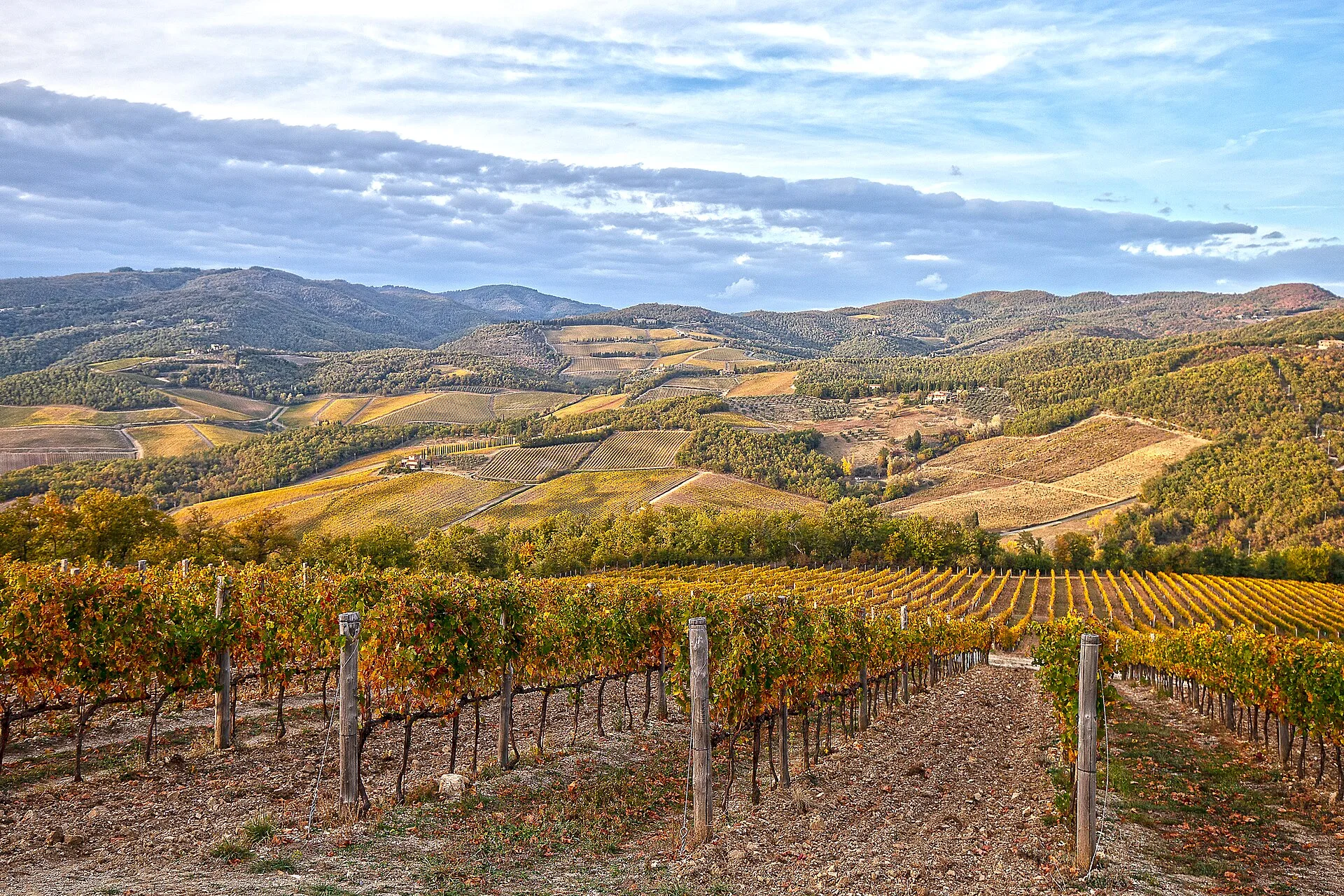
Chianti received a first geographic definition in 1716, when Cosimo III, Grand Duke of Tuscany, issued a bando titled Sopra la Dichiarazione de' Confini delle quattro Regioni Chianti, Pomino, Carmignano e Vald'Arno di Sopra, on the declaration of the boundaries of four wine regions. The paper, by Antonio Gabellini and colleagues, notes that the limits nevertheless stayed uncertain: Repetti's geographical dictionary of Tuscany, published in 1833, states that no writer or government office had yet defined them, and the present boundaries were fixed only in the 20th century. The paper also records that the communes of Radda, Gaiole and Castellina formed the Lega del Chianti, whose ancient gonfalon showed a black rooster on a gold field.
In 1924, 33 producers of the classic zone founded the Consorzio del Chianti, which took the black rooster, the Gallo Nero, as its emblem, and in 1932 a law recognised the choices the consortium had made; the paper gives its present membership as 600. Gabellini and colleagues describe the landscape as rows of vines and olives, and note that olive growing has been extended, with good results at Figline and Incisa Val d'Arno. On the Spicchio estate, Ciattini records that at the olive harvest tenants waiting at the estate's press sometimes brought bread and wine and ate bruschetta.
HOW DID THE TUSCAN FARMHOUSE LOSE ITS FARMERS?
The Region of Tuscany's landscape study dates the crisis and rapid break-up of the mezzadria system to the years from 1945 to the 1960s, and describes it as a social crisis rather than a crisis of production. Ciattini sets out the legal steps: Law 756 of 1964 abolished mezzadria while keeping existing contracts in force, and Law 203 of 1982 converted the remaining contracts into leases to direct cultivators. As poderi were abandoned, many farmhouses and villas fell empty or were converted to non-farming uses, and agro-industry and agriturismo, farm-based hospitality, developed. National rules for agriturismo were set by Law 730 of 5 December 1985 and later by Law 96 of 20 February 2006, both titled Disciplina dell'agriturismo.
In the Val d'Orcia, UNESCO lists tourism pressure, farm modernisation and soil erosion as threats, and names the gentrification of dwellings as perhaps the greatest concern for its impact on local farming communities. The system itself is now documented in museums. The Museo della Mezzadria Senese at Buonconvento, near Siena, occupies an old farm beside the medieval walls whose main structure is unchanged. Visit Tuscany describes its subject as the rural world that characterised Tuscan country life until the 1960s. Its first floor covers the landscape, the farm, threshing, the mill and the rural village; the second floor rebuilds a typical farmhouse with the objects and activities of peasant life, alongside vintage photographs, archive documents and videos on the figures of the sharecrop.
MANDARIN ORIENTAL, MUSCAT AT SHATTI AL-QURUM

Mandarin Oriental, Muscat opened on 3 June 2024 at Shatti Al-Qurum. Silverfox Studios designed the hotel's five food and beverage venues: Rawya, The Pool Bar, Essenza, Essenza Bar and The Mandarin Cake Shop. Rawya is an elegant European café with subtle Eastern accents, open from breakfast to dinner, with zones that change through the day, a format whose history is traced in the studio's article on all-day hotel dining. A juice bar and a bakery stand at the entrance to Rawya.
Bread was the base of the Tuscan farm table: the Spicchio estate's water mill ground each tenant family's grain once a month, no more than two sacks at a time, and saltless Tuscan loaves, once stale, went into ribollita, pappa al pomodoro and panzanella. The Mandarin Cake Shop is fitted with carved lattice screens and a pastry counter. Carved and turned lattice screens of the Arab world are the subject of the studio's article on the mashrabiya, the turned-wood window screen.
SOURCES
- UNESCO World Heritage Centre Val d'Orcia
- Encyclopaedia Britannica Métayage
- Consiglio regionale della Toscana Lorenzo Ciattini, La mezzadria in Toscana: con particolare riferimento al territorio pistoiese (2018)
- Regione Toscana Piano paesaggistico: I paesaggi rurali storici della Toscana
- Treccani Rurali, costruzioni, Enciclopedia Italiana (1936)
- Università di Firenze Gabellini, De Dominicis, Viciani et al., Il Chianti: dal paesaggio vegetale al vino (2022)
- Visit Tuscany Ribollita recipe
- Visit Tuscany Top 10 foods you must eat in Tuscany
- Corte costituzionale Sentenza n. 339 del 2007 on Law 96 of 2006, Disciplina dell'agriturismo
- Visit Tuscany Museo della Mezzadria of Buonconvento