

A WORD FOR A PIECE OF FURNITURE THAT BECAME A WAY OF SERVING A WHOLE ROOM
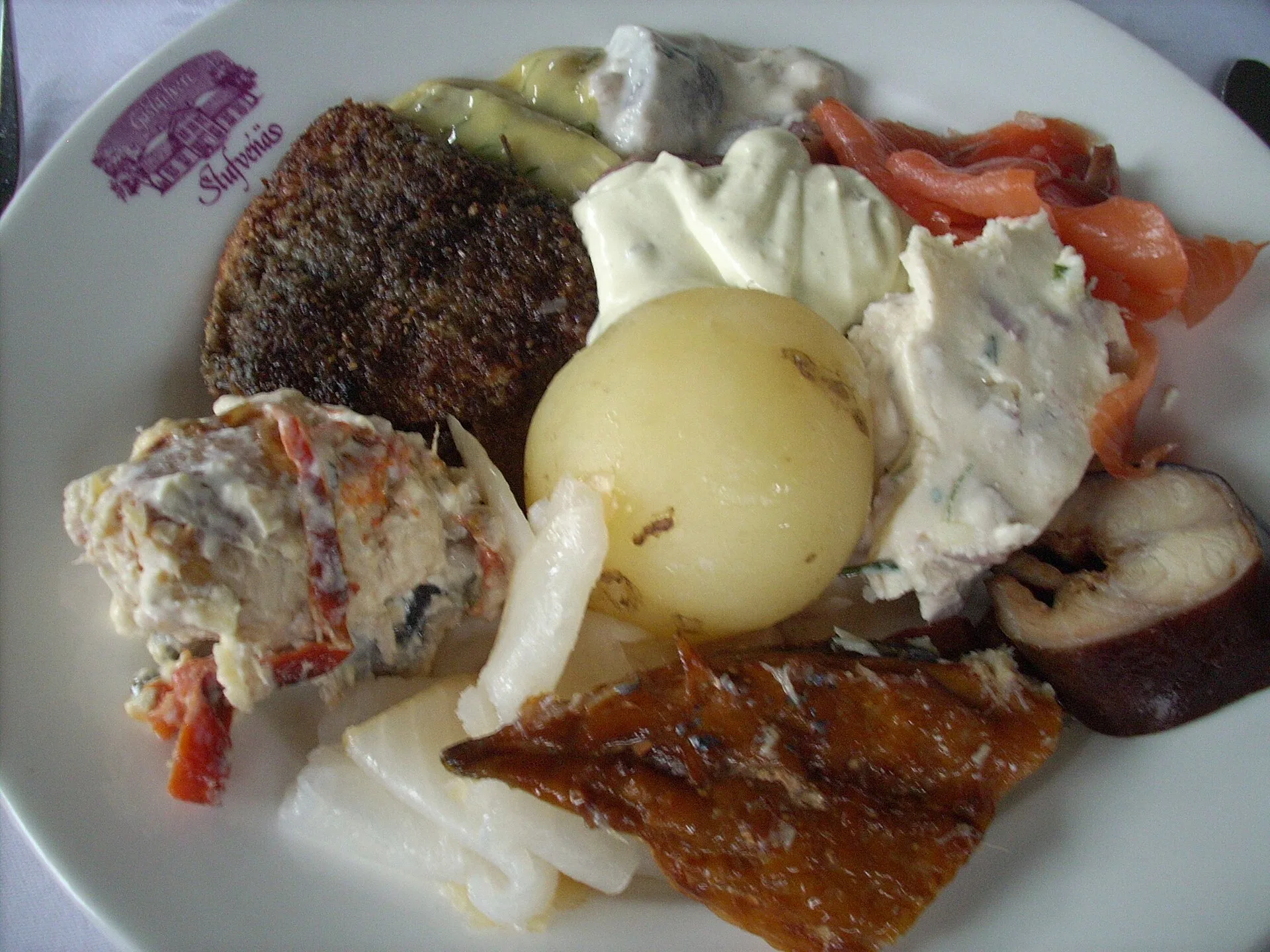
The hotel buffet is a self-service meal laid out on counters, where guests choose their own dishes and portions instead of ordering from a menu. Its history runs through three separate lines. The word comes from French dining furniture used to display and serve. The format of a long table of shared dishes, eaten in a set order, comes from the Swedish smörgåsbord, which a Swedish delegation introduced to American visitors at the 1939 New York World's Fair. The fixed-price casino buffet took shape in Las Vegas after the Second World War, at El Rancho Vegas, the first resort on what became the Strip. Each line gave the buffet a different purpose: displaying tableware, opening a festive meal, and feeding casino guests quickly and cheaply between games.
WHERE THE WORD BUFFET COMES FROM

Buffet began as a word for furniture. Merriam-Webster traces the English noun to French and, before that, to Old French, where it meant a stool, table or counter; its deeper origin is uncertain. The dictionary gives 1707 as the first known use in English, in the sense of a piece of dining room furniture, and cross-refers that sense to the sideboard. The sense most diners now know, a meal set out on a buffet or table for ready access and informal service, is listed as a further meaning of the same word.
The furniture itself has a long history. Britannica traces the sideboard to the Middle Ages, when the word described a stepped structure used to display valuable eating utensils. Until the 18th century it kept a basic table shape, sometimes with eight legs. The first major change replaced the legs with hollow storage pedestals, with drawers fitted between them. Later versions added a marble top and a brass rail at the back, which protected the wall and held up large plates, and some had a wine cooler built into the main structure. Serpentine fronts became popular in the second half of the 18th century, and in the early 19th century the sideboard became part of mass-produced dining room suites.
THE BRÄNNVINSBORD AND THE ORIGINS OF THE SMÖRGÅSBORD
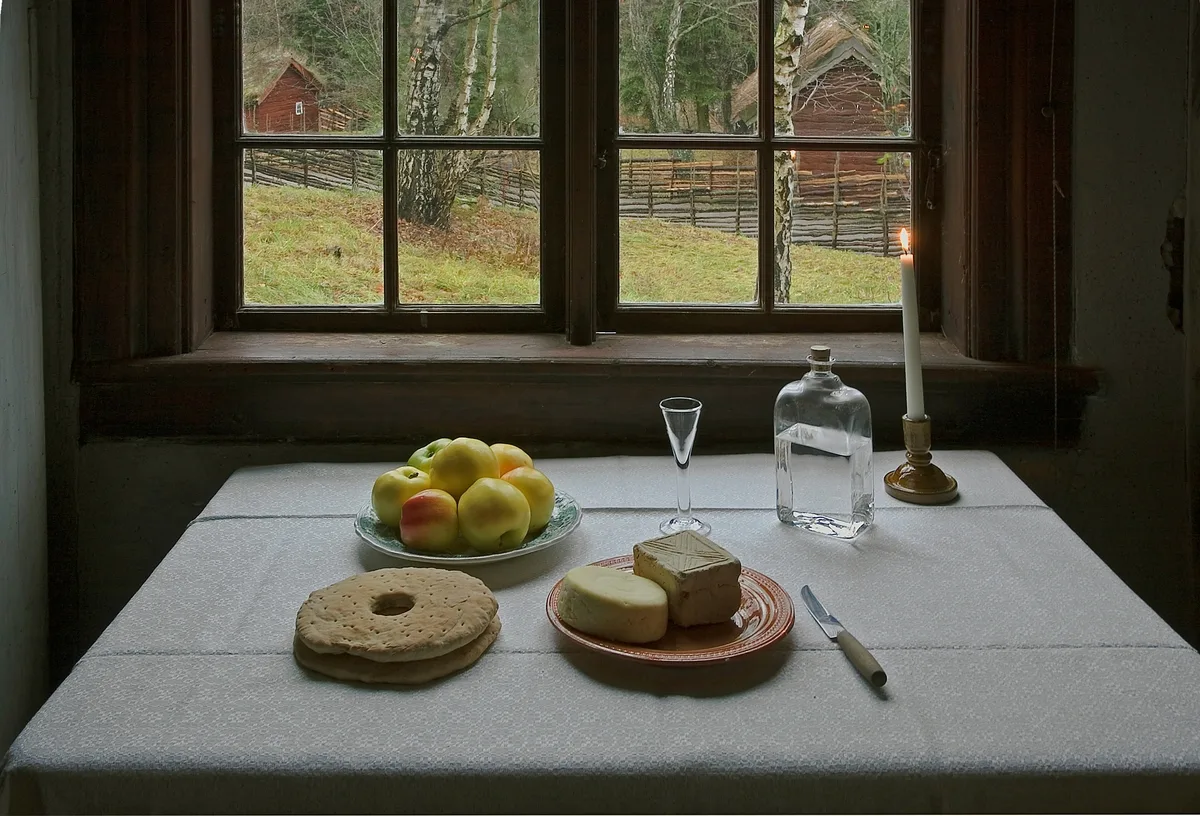
The Swedish contribution was a table of shared dishes from which guests helped themselves. Britannica notes that in the country districts of Sweden, guests contributed food to large gatherings, the dishes were set out on long tables, and diners served themselves. By the 18th century, festive meals opened with appetisers from the brännvinsbord, a table that offered aquavit, herring and other delicacies. Writing for NPR, Larissa Zimberoff reports that the meal likely traces its roots to high-society gatherings in the 1500s. Because guests travelled long distances, the early aquavit table entertained those who had arrived, mostly men, while they waited for latecomers. The food writer Johanna Kindvall, author of the book Smörgåsbord, suggests the custom may have been borrowed from Russians, who mingled over caviar, herring and vodka.
Britannica defines the smörgåsbord as a Swedish buffet of fish dishes, cheeses and hot and cold foods. A basic one, in its description, is an appetiser table of bread, butter, cheese and pickled herring. An elaborate one adds herring prepared in many ways, pâtés, cold meats, salads, gravlax, meatballs and Jansson's temptation, a potato casserole. Britannica credits Operakällaren in Stockholm with re-establishing and refining the smörgåsbord after the Second World War. NPR dates the restaurant to 1787 and notes that its holiday spread is displayed on a bronze table made for the purpose.
HOW A SMÖRGÅSBORD IS EATEN: THE ORDER OF THE JULBORD
The smörgåsbord's Christmas form is the julbord, the Christmas table. The Swedish Institute's official site, sweden.se, describes it as the Swedish Christmas smörgåsbord and places it on Christmas Eve, 24 December, the high point of the Swedish holiday. Its classic dishes include Christmas ham, pork sausage, gubbröra (an egg and anchovy mixture), herring salad, pickled herring, home-made liver pâté, vörtbröd (rye bread flavoured with wort), potatoes and lutfisk. The ham is boiled, then coated and glazed with a mixture of egg, breadcrumbs and mustard. Lutfisk is dried ling or saithe soaked in water and lye until it swells, then cooked.
The table is eaten in rounds. NPR sets out the sequence: herring and cheese first, then seafood such as gravlax, crayfish, shrimp and fish pâté, then cold cuts, ham, sausage, pâté, salad and pickles, then warm dishes including meatballs and Jansson's temptation, and finally dessert. Desserts include fudge, chocolate, marzipan, biscuits and risgrynsgröt, a rice pudding. Kindvall warns that a guest who overloads the plate early will not reach the fourth course. The format scales to large numbers: the Swedish Embassy in Washington, DC hosts an invitation-only Christmas table for 1,000 guests every December.
The menu has older roots. Sweden.se records that households historically laid the Christmas table with ham, pickled herring, jellied pig's feet, sausage, rice porridge and lutfisk, and that, with plenty of fresh food available, it was a feast for the whole household. The food was left out overnight, as the dead were believed to feast then. The site also notes that department store offerings and convenience foods have made the table more uniform, and that few people now make their own hams or sausages.
HOW THE 1939 NEW YORK WORLD'S FAIR INTRODUCED THE SMORGASBORD TO AMERICA

The New York World's Fair opened on Sunday 30 April 1939 in Flushing Meadows, Queens. According to the Library of Congress, it commemorated the 150th anniversary of George Washington's presidential inauguration in New York City, took The World of Tomorrow as its theme, and charged 75 cents for admission. On opening day, more than 8,000 visitors an hour entered through the Trylon. NPR reports that the smörgåsbord was first introduced to America by the Swedish delegation at the 1939 fair.
In English the word is usually written smorgasbord, without the vowel marks of the Swedish smörgåsbord. NPR adds that the smörgåsbord went on to become a default celebratory meal at holidays such as Mother's Day and Easter, served in hotels, train stations, restaurants and homes. In 2017 NPR interviewed Emma Bengtsson, executive chef of Aquavit in Manhattan, and its owner Hakan Swahn, in the year the restaurant celebrated its 30th anniversary; both, like Kindvall, named ham as their favourite dish on the Christmas table.
THE LAS VEGAS BUFFET AND THE MIDNIGHT CHUCK WAGON

The Las Vegas buffet is linked to El Rancho Vegas. UNLV Special Collections records that the resort, built by Thomas Hull, opened on 3 April 1941 on Highway 91, now Las Vegas Boulevard, as the first casino resort on what became the Strip. In January 1946 Herb McDonald took the job of entertainment director there, with publicity duties, at $125 a week. The Las Vegas Sun records that, while working late one night, he took cheese and cold cuts from the kitchen and set them out on the bar to make sandwiches. Gamblers walking past said they were hungry, and the resort's midnight chuck wagon buffet followed. The Sun puts its original price at $1.25. The Associated Press has described the first Las Vegas buffet as the $1 western-themed Buckaroo Buffet of cold cuts and cheese.
The origin is disputed. An Associated Press history of the buffet notes that at least three Las Vegas figures claimed to have invented it. The Las Vegas historian Jeffrey Carlson dismisses the stories that credit the El Rancho, while the historian Hal K. Rothman, in his book Neon Metropolis, credits Davie Berman, a mobster who moved from Iowa in 1944 and reportedly hired a chef to serve lox, whitefish, herring and other Jewish brunch foods on a long table. According to Michael Green, a history professor at UNLV, other casinos opened buffets so that guests could eat between gambling sessions. The AP also places the buffet against a post-war rise in food supply: genetics, chemicals and motorised equipment nearly tripled US farm production between 1948 and 2017.
FROM THE BUCKAROO BUFFET TO THE LUXURY BUFFET
Early Las Vegas buffets earned casinos little profit, but they let guests eat cheaply and quickly, which left more money and time for gambling. All-you-can-eat buffets then spread across the United States to chains such as Golden Corral and Ponderosa, which according to the food industry expert Darren Tristano later lost ground to casual dining chains such as Olive Garden and Chili's. The Strip buffets grew in range. According to the Las Vegas food tour guide Jim Higgins, the Carnival World Buffet at the Rio offered more than 300 international dishes for around $30, and the buffet at ARIA was known for Indian dishes and freshly baked naan.
The Covid-19 pandemic changed the market. The AP reported in January 2026 that many Strip buffets closed during the pandemic and did not reopen, leaving about a dozen. Carnival World closed in 2020 and became the Canteen Food Hall, and ARIA's buffet reopened as the Proper Eats Food Hall. The buffets that remain have moved upmarket. The AP lists Wynn's buffet and Bacchanal at Caesars Palace as high-end buffets with carving stations serving prime rib and smoked brisket, and the Palms A.Y.C.E. Buffet at $80, with lobster, crab legs, sushi and fresh pasta. At the top of the market, some buffets charge $175 with lobster tail, prime rib and unlimited drinks.
THE BUFFET AT THE BAY, DUBAI

The Bay at Mandarin Oriental Jumeira, Dubai, designed by Silverfox Studios and completed in 2019, has a marble buffet counter and white marble buffet stations with chalkboard menus. A timber-topped bread and pastry island sits separately under pendant lights. White brick walls rise above a geometric tiled floor, and green banquettes provide seating under a beamed timber ceiling, with steel-framed glazing. A marble-fronted bar faces the beach terrace and the sea.
SOURCES
- Merriam-Webster Buffet: definition and etymology
- Britannica Sideboard
- Britannica Smorgasbord
- NPR, via KPBS At Christmas, the Swedish smörgåsbord redefines over the top
- Sweden.se, Swedish Institute Christmas in Sweden
- Library of Congress 80 Years Later: Music from the 1939 New York World's Fair
- UNLV Special Collections and Archives El Rancho Vegas Collection
- Las Vegas Sun Strip visionary McDonald dies
- Associated Press, via WTOP After helping the US win the Cold War, the all-you-can-eat buffet is fading. Thanks, COVID
- Associated Press, via ABC News Gone are the days of the $1 buffet in Las Vegas. Now $175 buffets offer luxury dining


