THE BRIGHTON-BORN ILLUSTRATOR WHO BUILT A BLACK AND WHITE STYLE FROM JAPANESE PRINTS, LINE BLOCK PRINTING AND DECADENCE

Aubrey Beardsley (1872 to 1898) was the leading English illustrator of the 1890s and, after Oscar Wilde, the outstanding figure of the Aesthetic movement in Victorian London; critics called the movement he led in art "decadent", as Wilde's was in literature. Born in Brighton, he had a few months of evening classes at the Westminster School of Art as his only formal training, and he made nearly 1,100 drawings in a working life of about six years. His reputation rests on black ink drawings reproduced by the new line block process: illustrations for Thomas Malory's Le Morte Darthur, Wilde's Salome (1894) and the quarterly The Yellow Book, whose art editorship he lost in the Wilde scandal of 1895. He drew on Japanese woodblock prints, Greek vase painting and the Pre-Raphaelites. He had tuberculosis from childhood and died at Menton, on the French Riviera, on 16 March 1898, aged 25.
AUBREY BEARDSLEY'S EARLY LIFE IN BRIGHTON AND LONDON
Beardsley was born on 21 August 1872 in Brighton, the son of Ellen and Vincent Beardsley. His birthplace, 31 Buckingham Road, carries a plaque recording that he was born there, and Historic England listed the house at Grade II in 1999 because of its association with him. His father later lost his independent income, became a clerk and was largely absent from family life. In 1879 Beardsley was diagnosed with tuberculosis and sent to a boarding school in Sussex for his health. The following year the family moved to London and lodged at 57 Denbigh Street in Pimlico. In 1883, aged 11, he earned his first fees, for place and menu cards commissioned through a family friend.
In 1885 he returned to Brighton to board at Brighton Grammar School, where he became known as a caricaturist, although his main interests at the time were poetry and writing a play. He illustrated Book II of Virgil's Aeneid for his schoolmates in 1886 and later illustrated programmes for school productions. In January 1889 he started work as a clerk in London and spent his lunch hours reading at Jones and Evans, a bookshop on Queen Street, where he became friends with the bookseller Frederick Evans. That December he suffered his first severe lung haemorrhages, caused by tuberculosis, and he was off work for about 18 months.
BURNE-JONES, THE PEACOCK ROOM AND LE MORTE DARTHUR
Two encounters in 1891 set the direction of his work. In the summer he and his sister Mabel visited the London house of the collector Frederick Leyland at 49 Princes Gate, which contained the Peacock Room, the dining room James McNeill Whistler had decorated about 15 years earlier. The room displayed Leyland's blue and white Kangxi porcelain, and the Tate dates Beardsley's fascination with Japanese art to this visit. In the same year he showed his portfolio to the painter Edward Burne-Jones, who encouraged him to attend the Westminster School of Art. There he was taught by Fred Brown.
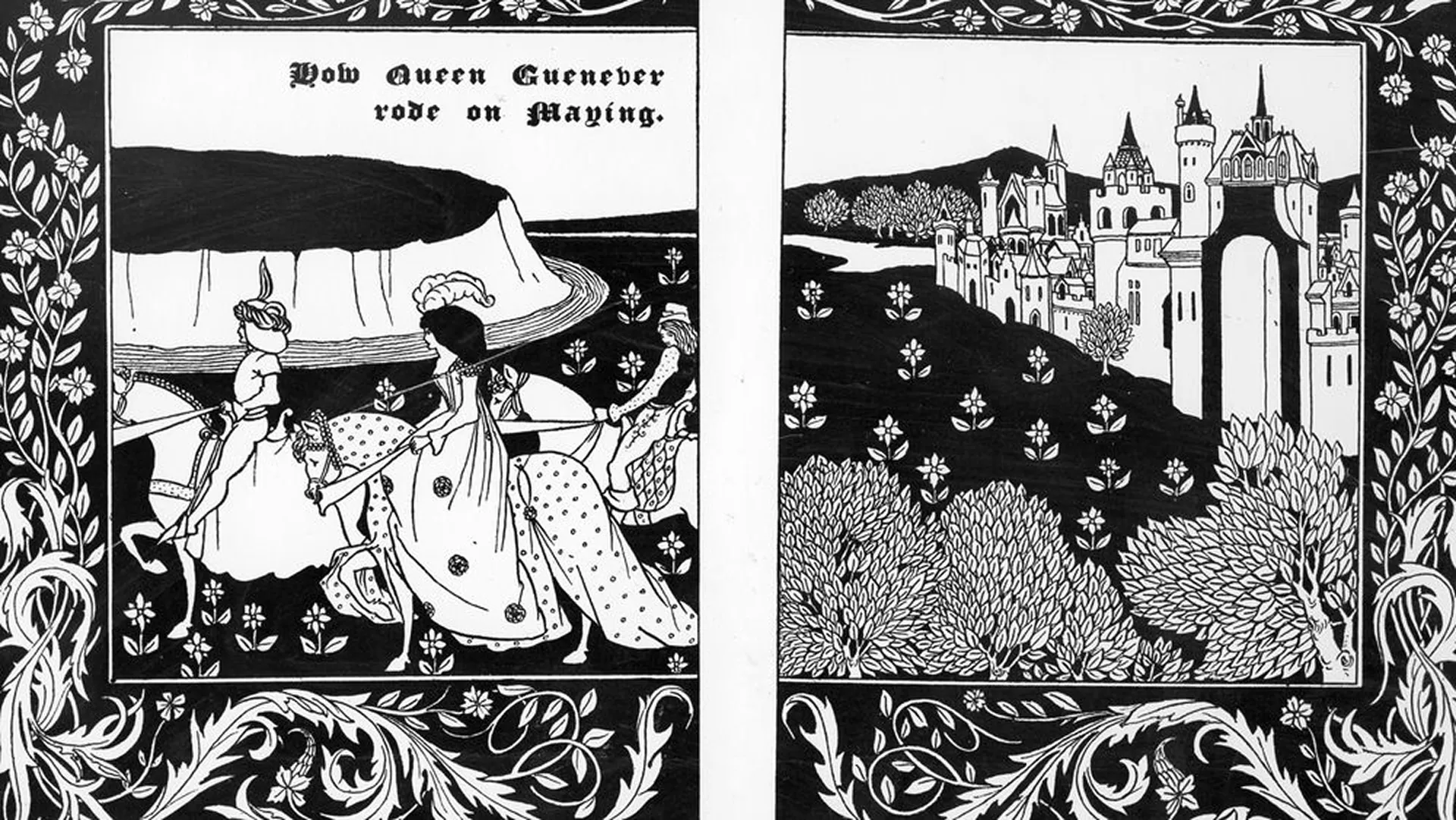
Early in 1892 Frederick Evans introduced him to the publisher J. M. Dent. Dent admired William Morris's Kelmscott Press, founded in 1889, whose costly books carried hand-cut woodblock illustrations by artists including Burne-Jones, and he wanted a similar look at lower cost. His solution was photomechanical line block reproduction in place of wood engraving, applied to Malory's Le Morte Darthur, first printed by William Caxton in 1485. He needed an illustrator talented enough for the job but not yet established enough to demand a large fee. He commissioned Beardsley in the autumn of 1892, and the fee of £250 let him leave his office job.
The Tate counts 353 drawings for the book, made between the autumn of 1892 and June 1894; the Cooper Hewitt, Smithsonian Design Museum gives 362, counting full and double page illustrations, borders, chapter headings and numbers. It was issued in twelve parts from June 1893 to November 1894, with a deluxe edition of 300 copies on handmade paper. Beardsley departed from the brief, adding satyrs and mermaids to Malory's chivalric text, and drew many of his knights as androgynous figures. The book sold only moderately, but it was his first significant commission and the start of his career as a professional illustrator.
HOW DID JAPANESE PRINTS SHAPE BEARDSLEY'S STYLE?
Beardsley's interest in Japan was part of the wider Japonisme of late 19th-century Europe, and museum curators have identified specific borrowings. The Tate's exhibition guide names the conventions he took from ukiyo-e woodblock prints: flat pattern set against precisely drawn figures, on abstracted or empty backgrounds, and the tall, narrow format of the kakemono hanging scroll. The Royal Ontario Museum adds shunga (Japanese erotic art) and the stylised patterns of blue and white porcelain and lacquerware to his sources. The Cooper Hewitt finds the influence already present in a Morte Darthur chapter heading, in its asymmetry, economy of line, flat composition and stark black and white contrast.
The printing process also shaped the style. Line block printing transferred a drawing photographically onto a printing plate; it was relatively new and cheap, and it could reproduce both very fine lines and large, flat areas of black. Beardsley was disappointed with the first results but adapted his drawing to the process. In April 1893 the first issue of The Studio carried Joseph Pennell's article "A New Illustrator", which praised mechanical reproduction for showing the true quality of Beardsley's line. Photomechanical printing also let his drawings circulate widely in illustrated books and art magazines.
SALOME (1894): BEARDSLEY AND OSCAR WILDE

His response to Wilde's French play Salomé, a drawing titled J'ai baisé ta bouche Iokanaan, was published in The Studio in 1893. Wilde admired it, and the publisher John Lane chose Beardsley to illustrate the English translation, which appeared in February 1894. Beardsley produced 18 designs, of which only 10 were used in the first printing. Because The Studio held the copyright on the 1893 drawing, he redrew it for the book as The Climax, in which Salome floats holding the severed head of John the Baptist and a white lily rises from the pool of blood beneath it.
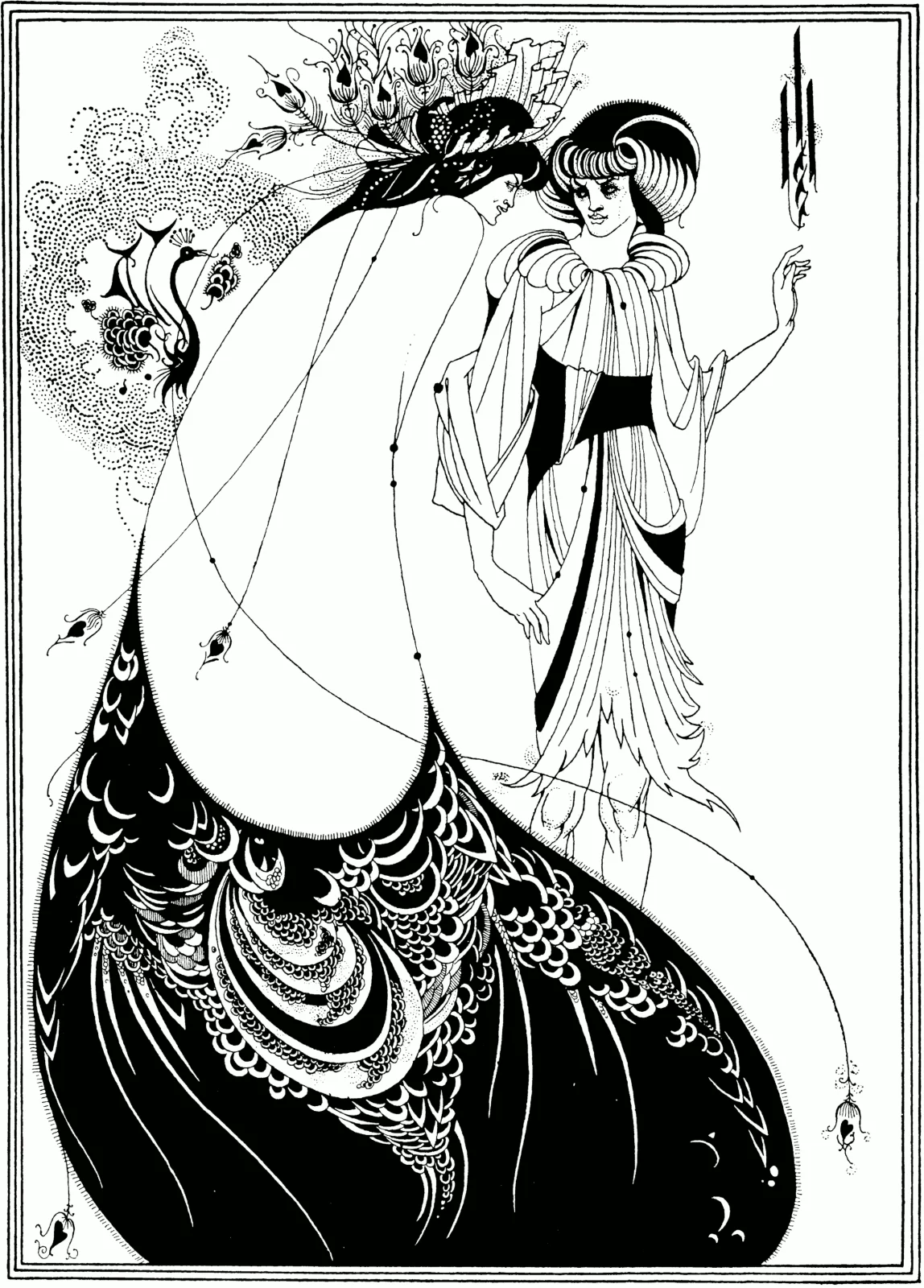
The Royal Ontario Museum describes the Salome drawings as a direct homage to the Japanese art Beardsley admired, citing flat black pattern, asymmetrical compositions and figures floating high on the picture plane against stylised backgrounds. The Peacock Skirt shows Salome from behind in a robe patterned with a stylised peacock and a headdress of peacock feathers, beside a male figure generally identified as the Young Syrian. The V&A's catalogue entry, citing Stephen Calloway's 1998 study of the artist, describes it as the plate that most clearly shows Beardsley's debt to Whistler's decorations in Leyland's house. Lane reissued the full set in 1907 as a portfolio of line block prints on Japanese vellum.
THE YELLOW BOOK AND BEARDSLEY'S DISMISSAL IN 1895

The Yellow Book was an illustrated quarterly of literature and art published in London by John Lane from 1894 to 1897 and edited by Henry Harland. Beardsley became its art editor in January 1894, and the first volume appeared in April. Contributors included Henry James, Edmund Gosse, Arnold Bennett, Charlotte Mew, Richard Le Gallienne and Walter Sickert, and the first volume carried Max Beerbohm's essay "A Defence of Cosmetics". His drawing La Dame aux Camélias appeared in the third volume, in October 1894. One critic wrote that "to most, Aubrey Beardsley is the Yellow Book", a remark quoted in the Tate's exhibition guide.
That identification proved costly. In April 1895 Wilde was charged with gross indecency, and he was convicted the following month. At his arrest he was seen carrying a yellow book; according to the Tate, it was a French novel rather than The Yellow Book, but because Beardsley had illustrated Salome, the public connected the author with the artist. Outraged crowds broke the windows of Lane's publishing house, and Lane gave way to the pressure and dismissed Beardsley from the magazine. In May, Beardsley and Mabel were forced to sell the house at 114 Cambridge Street, Pimlico, that they had bought in 1893.
THE SAVOY, LYSISTRATA AND LEONARD SMITHERS
In July 1895 Beardsley went to Dieppe, where he met the publisher Leonard Smithers and planned a new magazine. The Savoy launched in January 1896, with Beardsley as art editor and Arthur Symons in charge of its literary content. It ran for eight issues before it closed. W. H. Smith refused to display Beardsley's work, and W. B. Yeats said the magazine had waged "warfare on the British public". In the same year Beardsley illustrated Alexander Pope's 1712 mock epic The Rape of the Lock in a dense, decorative manner based on 18th-century French copper-plate engravings. The title page credits him with having "embroidered" the illustrations.
Beardsley also wrote. Britannica records his poems and the prose parody Under the Hill, published posthumously in 1903, with the unexpurgated original, The Story of Venus and Tannhäuser, following in 1907. In the summer of 1896 he began two explicit series for Smithers: eight designs for Aristophanes' Lysistrata and drawings for Juvenal's Sixth Satire. Smithers distributed them privately to subscribers. For these drawings Beardsley adopted a starkly linear style which, according to the Tate, drew on Japanese erotic prints and on Ancient Greek vase painting. Britannica describes the Lysistrata illustrations as openly licentious.
TUBERCULOSIS AND BEARDSLEY'S DEATH AT MENTON

Beardsley's health broke down in 1896. After travelling to Brussels with Smithers between March and May, he suffered a severe haemorrhage from which he never fully recovered, and Britannica describes him as an invalid from that year. He kept working: A Book of Fifty Drawings was published in January 1897, and between February and October 1897 he illustrated Théophile Gautier's novel Mademoiselle de Maupin for Smithers, using watercolour, which his friend Robert Ross suggested was less demanding for a sick man. In March 1897 Beardsley was received into the Roman Catholic Church.
In November 1897 he settled at Menton on his doctor's advice and began work on illustrations for Volpone. On 7 March 1898 he wrote to Smithers asking him to "destroy all copies of Lysistrata" and his other obscene drawings; Smithers ignored the request. Beardsley died at the Hôtel Cosmopolitain in Menton on 16 March 1898, aged 25, with his mother and sister present. His style returned in the 1960s: a major Beardsley exhibition at the V&A in 1966 drew a young audience, and his drawings influenced posters, record sleeves, underground magazines such as Oz and fashion of that decade.
THE AUBREY: A JAPANESE IZAKAYA NAMED AFTER BEARDSLEY
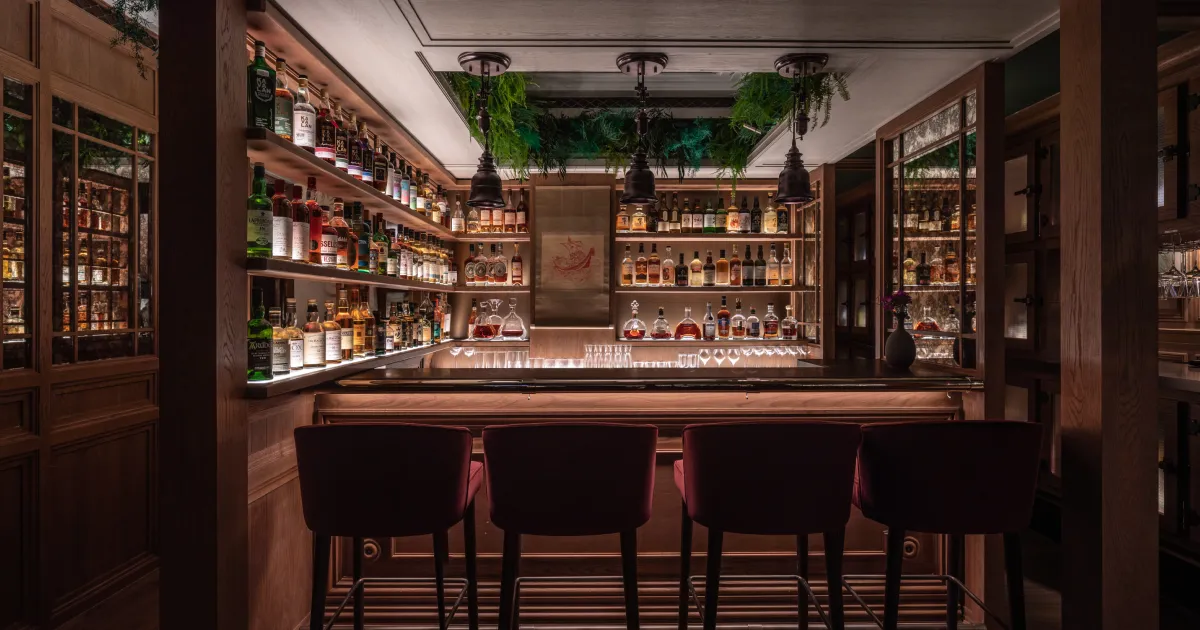
The Aubrey is a Japanese izakaya and bar on the top floor of Mandarin Oriental Hong Kong, designed by Silverfox Studios and completed in 2021. It is named after Aubrey Beardsley. Its concept is an eccentric English gentleman's manor in which a collector's obsession with all things Japanese shapes every element. The name links that concept to an English artist whose drawings were built in large part from Japanese sources: the ukiyo-e conventions, kakemono formats and porcelain patterns he absorbed after seeing the Peacock Room in 1891.
The design draws on Japonisme and on ukiyo-e motifs including Mount Fuji, the pagoda, torii gates and crashing waves. The rooms use dark timber panelling, gilded picture frames and gallery walls, and a curio lounge holds bespoke display cabinetry for objets d'art. Beardsley's interest in Japanese art began in a room of that kind: Whistler's Peacock Room, the London dining room that housed Leyland's collection of blue and white Kangxi porcelain.
SOURCES
- Britannica Aubrey Beardsley: English illustrator
- Britannica The Yellow Book: English periodical
- Tate Aubrey Beardsley: exhibition guide
- Victoria and Albert Museum The Peacock Skirt, Aubrey Beardsley
- Victoria and Albert Museum The Climax, Aubrey Beardsley
- Cooper Hewitt, Smithsonian Design Museum Aubrey Beardsley chapter heading for Le Morte D'Arthur
- Royal Ontario Museum The Art of Aubrey Beardsley
- Princeton University Library Aubrey Beardsley: A British Artist for the 1890s
- Historic England Number 31 and Attached Wall, Buckingham Road, Brighton
- Smithsonian National Museum of Asian Art The Peacock Room: The Room Travels