FROM MEDIEVAL SAKE SHOPS TO EDO'S SIMMERED-FOOD TAVERNS AND THE RED LANTERNS OF TODAY
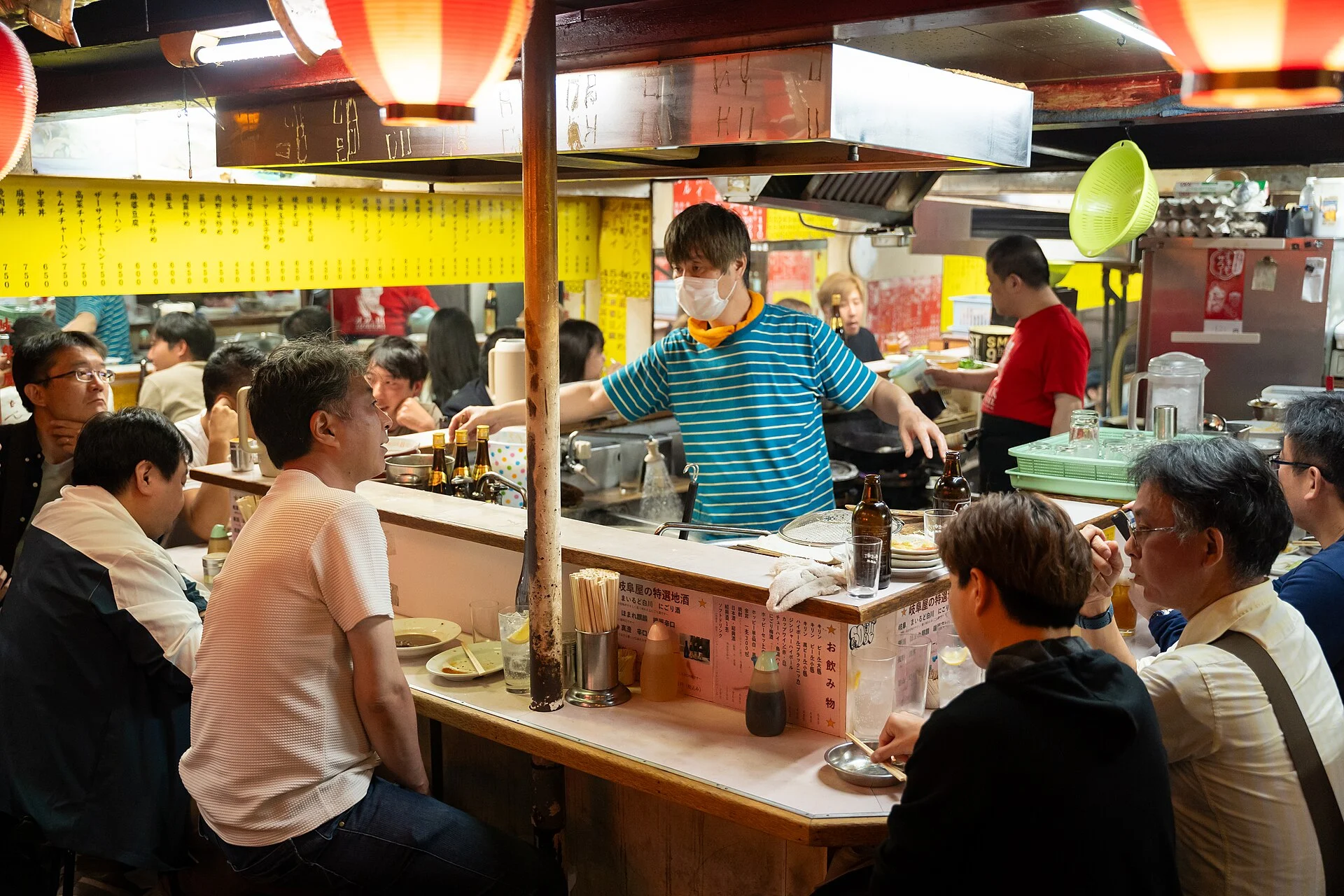
An izakaya is an informal Japanese tavern that serves sake, beer and other drinks with a long menu of small, inexpensive dishes. The word is written 居酒屋, literally stay, drink, place; the food historian Eric C. Rath glosses it as an establishment to sit and drink sake. The izakaya grew out of sake shops that let customers drink on the premises, and took its recognisable form in 18th-century Edo, now Tokyo, when shops selling sake merged with shops selling simmered food. Traditional izakaya are identified by a rope half-curtain over the entrance and a red paper lantern by the door, which give them the nicknames nawa noren and aka chochin. Today they range from small neighbourhood bars to large chains.
WHERE DID THE IZAKAYA COME FROM? MEDIEVAL SAKE SHOPS
Rath traces the izakaya's roots to the sakaya, shops that both brewed and sold sake from the 14th century. Medieval sakaya kept sake in ceramic pots of about 250 litres, buried in the ground to hold them steady. Because the pots could not be moved, customers came to the shop with their own containers to be filled. Kyoto had several hundred sakaya in the late medieval period, between about 1400 and 1600, and Rath suggests that competing owners plausibly offered free tastes or salty snacks such as pickles to keep customers drinking in the shop. Those customers stood: sit-down service took centuries to spread to some kinds of Japanese eatery.
Nipponia, a magazine published by Japan's Ministry of Foreign Affairs, says sake shops let customers taste different sakes and sold sake by volume, and that around the end of the 16th century they began serving simple meals, which it treats as the beginning of the izakaya. Rath dates the first written reference to a seated sake seller, izake, to the late 1600s. By then many sakaya had stopped brewing. A licensing requirement for brewers introduced in 1657 discouraged new brewers, and many shops in Edo turned to selling sake brought in from elsewhere.
WHY EDO NEEDED THE IZAKAYA: SAKE SUPPLY AND A CITY OF MEN
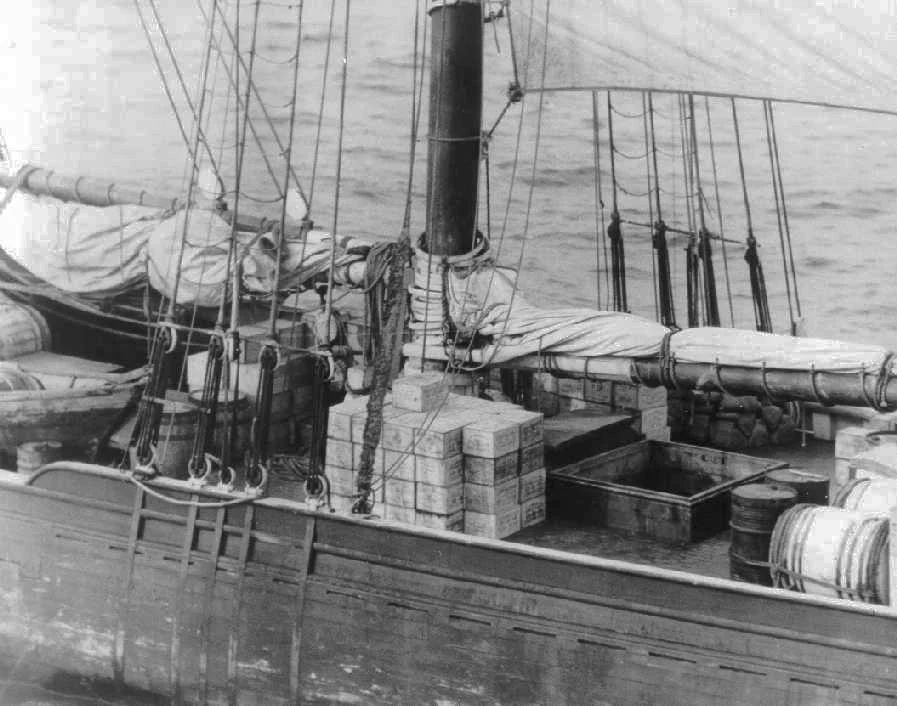
Edo drinkers considered sake from the Osaka and Kobe area the best, Rath notes, and brewers had by then moved from ceramic pots to wooden barrels for brewing, storage and shipping. Writing in Kikkoman's food culture journal The Japanese Table, Noritake Kanzaki explains that the Nada district of Hyogo Prefecture became the main producer of kudari-sake, sake shipped down to Edo. Breweries along the coast loaded it onto cargo ships called tarukaisen, and more than 800,000 barrels of 72 litres each reached Edo every year.
Demand came from the make-up of the city. Kanzaki puts Edo's population at about one million, with three or four men for every woman, and estimates that roughly half the population drank sake, at around 102 litres per person a year. Cheap sake and meals suited its many bachelors, and Rath adds that eating out was often cheaper and more convenient than cooking. Commoners lived in small homes where the kitchen was a narrow space just inside the entrance. Many cooked rice at home and bought side dishes from niuriya, shops selling simmered food. The izakaya joined these two trades, food and the sake shipped in from the west.
NIURI-SAKAYA: HOW THE FIRST IZAKAYA TOOK SHAPE IN EDO

Before the tavern, drinking out in Edo began at yatai, standing food stalls that sold soba noodles with side dishes such as dengaku, vegetables and tofu grilled with miso, and nishime, vegetables simmered in soy sauce and mirin. Kanzaki cites Mitamura Engyo (1870 to 1952), a pioneering researcher of Edo popular culture, who wrote that casual pubs like today's izakaya did not exist before the 18th century. In the early 18th century niuri-sakaya, sake and simmered-dish shops, appeared. They could be recognised by storefronts of shoji paper panels, they were thriving by the late 18th century, and Kanzaki describes them as the origin of the modern izakaya.
Rath gives a slightly later date. Around 1750, he writes, the seated sake shop and the simmered food shop merged into the niuri izakaya, the simmered-food seated sake shop, and the name was soon shortened to izakaya. The combination of cheap drink and cheap food proved popular: within seventy years Edo had 1,808 izakaya, the most common type of eating and drinking establishment in the city. According to Mitamura, proper restaurants also appeared by the middle of the 18th century.
WHAT WAS SERVED IN AN EDO IZAKAYA?

A drawing by Kuwagata Keisai, Kinsei Shokunin Zukushi Ekotoba, held by the Tokyo National Museum, shows people eating and drinking at a niuri-sakaya in early 19th-century Edo. An illustration in the 1814 book Hazakurahime uzuki monogatari shows an izakaya offering both takeaway and dine-in service. On one side, fish and an octopus hang above large platters of simmered food to attract passers-by. Inside, customers sit on benches with sake and side dishes. Rath reads the display of dishes as an early example of the food shown in Japanese restaurant windows today.
Warm sake, kanzake, became popular in these shops. It was heated in a vessel called a chirori and poured into small cups, which Kanzaki identifies as guinomi and Rath as ochoko. The usual accompaniments were nishime, kamaboko fish cake and tsukudani, small fish or shellfish simmered in soy sauce and other seasonings. Early izakaya did not sell sake by brand. They offered it in grades and prices, and customers ordered by saying how much they wanted and what they would pay. A 1977 story set in the period, Yami no Haguruma by the novelist Fujisawa Shuhei, describes a niuri-sakaya with a counter and stools holding only about fifteen people.
NAWA NOREN, RED LANTERNS AND SUGIDAMA: HOW AN IZAKAYA IS SIGNED
A noren is a cloth curtain hung at the entrance of a shop or restaurant. According to the Tokyo Metropolitan Government, noren are thought to date back to the Jomon period, when they protected households from harmful forces; they later became a means of promotion, shielding the entrance from dust, sun and wind and signalling that the business is open. The izakaya version, the nawa noren, is made of many strands of rope. Rath explains that it kept flies away from customers while letting in breezes and letting the smell of simmered food drift out to draw new customers.
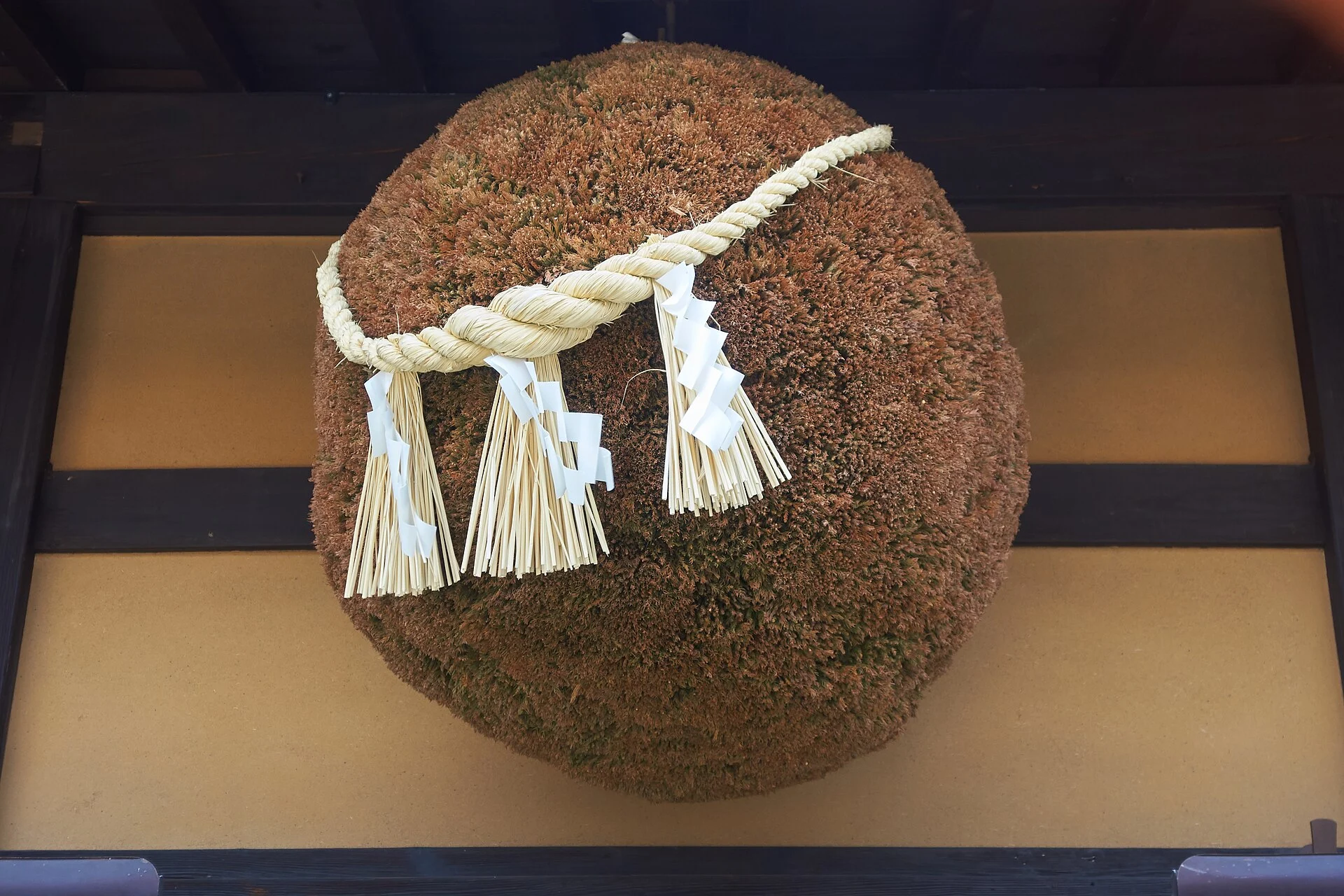
The red lantern, aka chochin, is built on a foldable bamboo frame covered in washi paper or vinyl, with the name of the business painted in black kanji or katakana. Its use outside izakaya is so widespread that the tavern itself is often called an aka chochin. A third sign, the sugidama, is a ball of tied cedar branches hung outside restaurants and breweries to show that local sake is served and that the new sake has aged enough to drink. A fresh sugidama is green and turns brown as it ages. The custom began at Mount Miwa in Nara Prefecture, where cedar was considered sacred, and in the Edo period cedar leaves were believed to stop sake from spoiling.
HOW THE IZAKAYA CHANGED AFTER 1868: BEER AND YOKOCHO ALLEYS
After the Meiji Restoration of 1868 and the opening of Japan to foreign trade, the Japan Creative Centre notes, izakaya began serving imported drinks such as beer and whisky. As prices fell, beer became one of the most popular orders, and a first round of beer is now a standard way to begin an evening at an izakaya. Sake today can be ordered hot as atsukan, warmed to body temperature as nurukan, or at room temperature or chilled as hiya, according to Aichi Prefecture's official tourism guide.
Many izakaya sit in yokocho, alleys off a main street, where the word also refers to the small pubs lined along them. Web Japan reports that Tokyo's historic yokocho began as makeshift market shacks in the postwar years. They include Omoide Yokocho in Shinjuku, Nonbei Yokocho in Shibuya and Harmonica Yokocho in Kichijoji, and their standard dishes from the start were motsuni, stewed entrails, and yakitori, grilled chicken skewers. New themed alleys have followed, including Ebisu Yokocho, opened in 2008 in a remodelled public market, and Shibuya Niku Yokocho, opened in 2009.
IZAKAYA CULTURE TODAY: STANDING BARS, KAKUUCHI AND OTOSHI
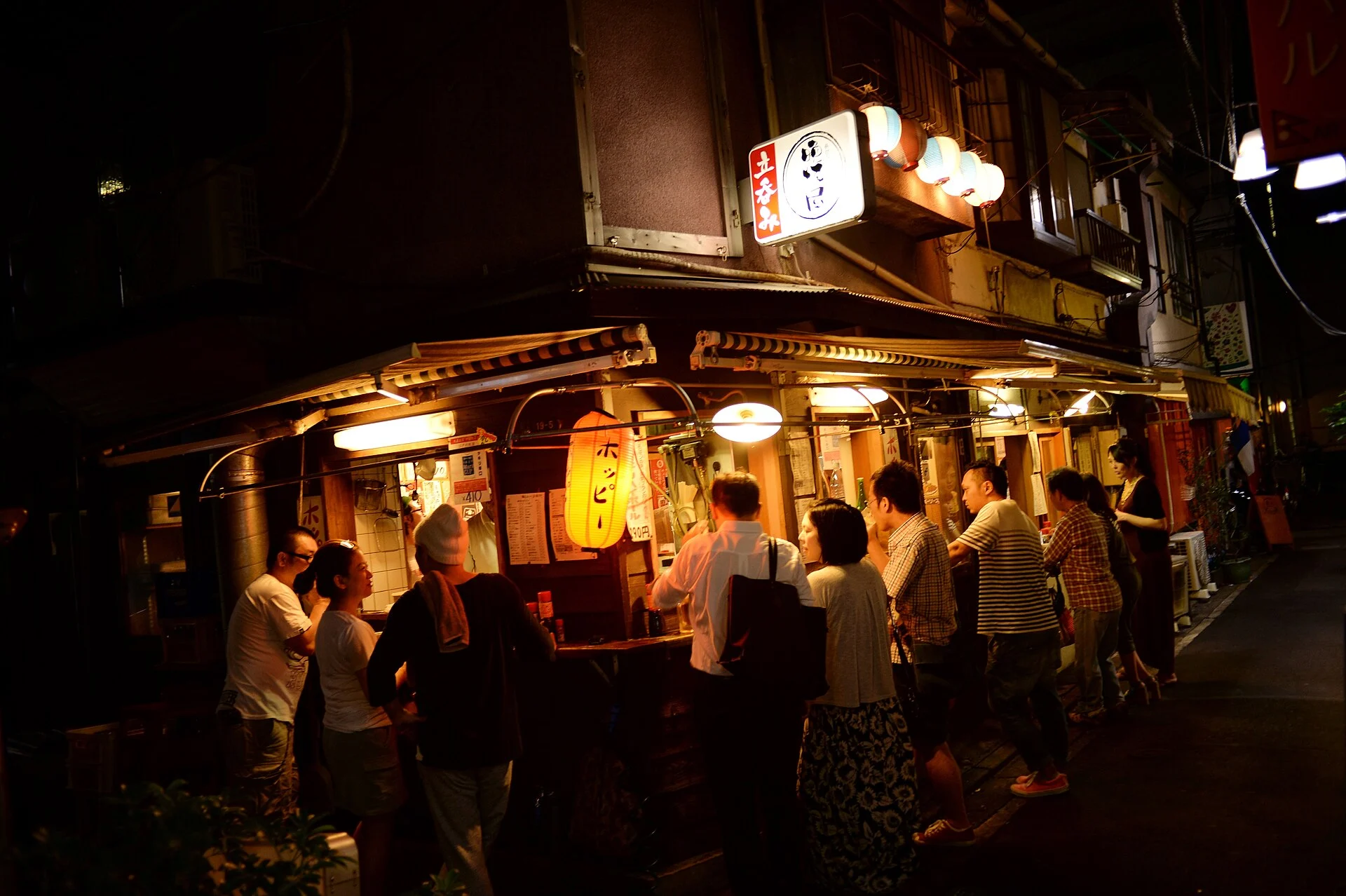
Standing to drink, as customers did in the medieval sakaya, has survived. Tachinomi means drinking while standing, and in 2005 the Japan Times reported a resurgence of standing bars in Tokyo. Its example was Akitaya, an izakaya in Hamamatsucho that had stood for about half a century, where customers stand at tables made from upturned beer crates. A related custom, kakuuchi, is drinking at a counter set up in the corner of a liquor shop. Fukuoka Prefecture's official tourism site says the term is believed to come from drinking sake from the square wooden masu cup that shops used to measure it from the barrel.
Kitakyushu is said to be where kakuuchi began, with industrial workers stopping at liquor shops after work, and the Kitakyushu Kaku-Uchi Culture Research Association counts at least 65 liquor stores in the city that still offer it. A 2015 study by Yuki Nakashima and Bart Dewancker of the University of Kitakyushu found that most of the city's kakuuchi stores were built between 1910 and 1970, that 57 per cent of them were still trading, and that 79 per cent had been renovated, mostly by changing their interiors. The same share, 79 per cent, had no successor to take over the business.
In a sit-down izakaya, some customs are particular to the format. Many serve otoshi, a small appetiser brought before anything is ordered, included in the cover charge and often not on the menu; guests can decline it. A wet hand towel, oshibori, is provided free. Menus usually change with the seasons, mixing yakitori, grilled fish, sashimi, edamame and tamagoyaki with onigiri, ramen and potato salad. Rath notes that the izakaya began to spread outside Japan from the 1980s, and that many still keep entrance curtains and serve simmered dishes popular centuries ago.
THE AUBREY: AN IZAKAYA IN AN ENGLISH COLLECTOR'S MANOR
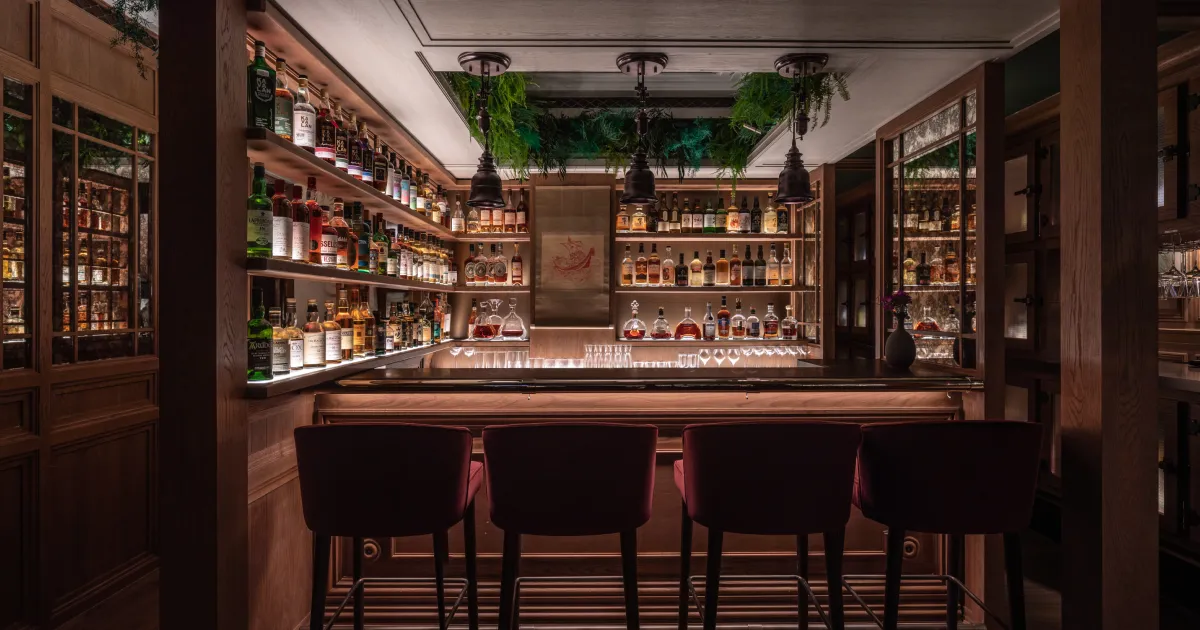
The Aubrey is a Japanese izakaya and bar on the top floor of Mandarin Oriental Hong Kong, completed by Silverfox Studios in 2021. It takes the format that developed in Edo's niuri-sakaya in the 18th century, drinks served alongside small shared dishes, and sets it within a concept from outside Japan: the manor of an eccentric English gentleman whose collecting is shaped by an obsession with Japan. The venue is named after Aubrey Beardsley. A curio lounge is fitted with bespoke display cabinetry.
The decoration draws on Japonisme and on ukiyo-e motifs: Mount Fuji, a pagoda, torii and crashing waves. These are the imagery of Japanese woodblock prints, the medium in which Utagawa Hiroshige depicted Edo's famous early 19th-century restaurants in the series Edo Komei Kaitei Zukushi, at the time when the niuri-sakaya and izakaya were multiplying across the city. At The Aubrey both, the izakaya format and the imagery of Edo's prints, are placed inside the rooms of an English collector's manor, among dark timber panelling, gilded frames and gallery walls.
SOURCES
- Saketimes Eric C. Rath, Drinking in Tradition: A Short History of Izakaya
- Kikkoman, The Japanese Table Noritake Kanzaki, Sake in Japanese Food Culture (No. 3), Vol. 29 No. 3, October 2015
- Nipponia, Web Japan Izakaya: Relax at a Japanese Tavern with Seasonal Sake and Food
- Japan Creative Centre, Embassy of Japan in Singapore Unwind at an Izakaya, JCC E-Magazine May 2024
- Tokyo Metropolitan Government Japanese Signage: TOKYO Signs Vol.2
- Web Japan Japan's Little Drinking Districts Offer a Taste of Nostalgia
- The Japan Times Standing firm for tradition
- Crossroad Fukuoka (Fukuoka Prefecture official tourism site) A Special Feature on enjoying the Kaku-Uchi culture at liquor stores
- International Journal of Building, Urban, Interior and Landscape Technology Nakashima and Dewancker, A Study on the Characteristics of the Kaku-uchi (liquor store) culture in Kitakyushu City, Japan (2015)
- Aichi Now (Aichi Prefecture official tourism site) A Guide to Enjoying an Izakaya, or Japanese Pub