EBONISED FURNITURE, NORWICH IRON AND BIRMINGHAM ENAMELS AFTER 1862
Anglo-Japanese style describes British furniture and decorative art of the 1860s and 1870s that adapted Japanese forms, motifs and techniques for the Victorian home. The Victoria and Albert Museum (V&A) links its rise to the 1862 International Exhibition in London, after which "the Japanese style exerted enormous influence on British design". Its leading designers were Edward William Godwin in London, Thomas Jeckyll in Norwich and Christopher Dresser, who in 1876 became the first European designer to visit Japan after the country opened to the West. Their designs were made by firms such as the cabinet maker William Watt and the Norwich ironworks Barnard, Bishop & Barnards, while Elkington & Co. of Birmingham produced enamels based on Japanese designs. The style formed the British furniture and design branch of a wider Japonism in European art.
WHERE DID ANGLO-JAPANESE STYLE BEGIN? THE 1862 EXHIBITION

The Japanese section of the 1862 International Exhibition in London consisted largely of objects organised by Rutherford Alcock, the British Minister in Japan, with the help of Captain F. Howard Vyse, the British Consul at Kanagawa. The V&A describes it as one of the most important showings of Japanese art abroad before Japan's official participation at the Paris Exposition Universelle of 1867. Johannis Tsoumas of the University of West Attica, writing in the Central Asian Journal of Art Studies in 2020, counts 623 objects, most of them from Alcock's private collection. They included woodblock prints, silk kimonos, ceremonial masks and porcelain, alongside everyday items such as straw raincoats, straw shoes and lanterns. Members of a Japanese mission attended the opening on 1 May 1862 as official guests and, Tsoumas records, judged the exhibits inferior to those of all the other countries.
Augustus Wollaston Franks of the British Museum contributed a catalogue of the Japanese section, and a small number of the exhibits entered the British Museum in 1862. Other material reached the London trade: according to the V&A, Japanese papers shown at the exhibition were sold afterwards, and London dealers were supplying them in the late 1860s. Dresser saw a large number of Japanese objects for the first time at the exhibition. The Metropolitan Museum of Art notes that he was one of a handful of critics to find merit in the works themselves, while others found them charmingly novel, and Tsoumas records that he bought pieces from Alcock's collection. Jeckyll's Norwich Gates, made by Barnard, Bishop & Barnards, were shown at the same exhibition and, according to the Bard Graduate Center in New York, launched the nineteenth-century British revival of wrought iron.
WHAT IS ANGLO-JAPANESE STYLE IN GODWIN'S FURNITURE?
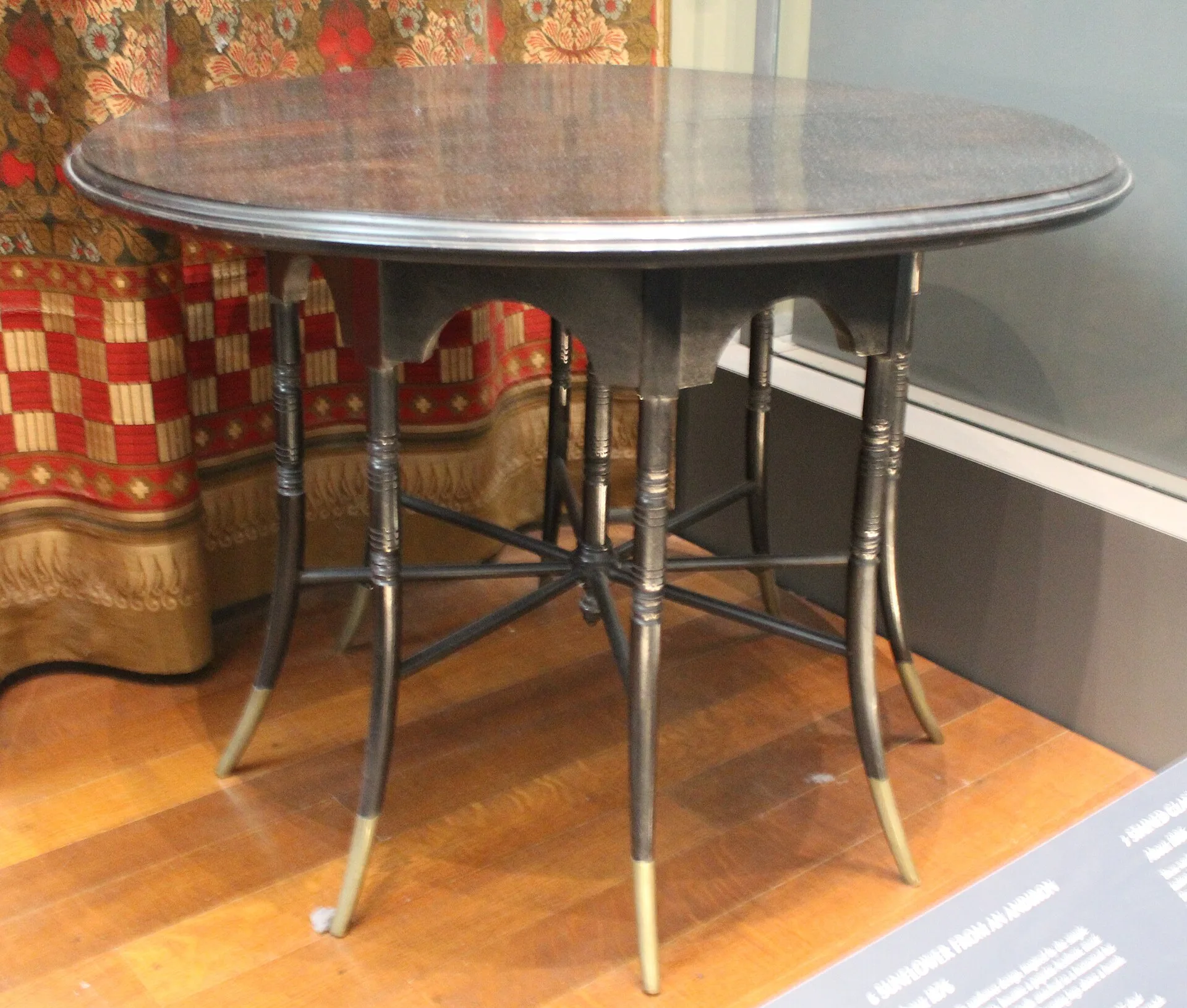
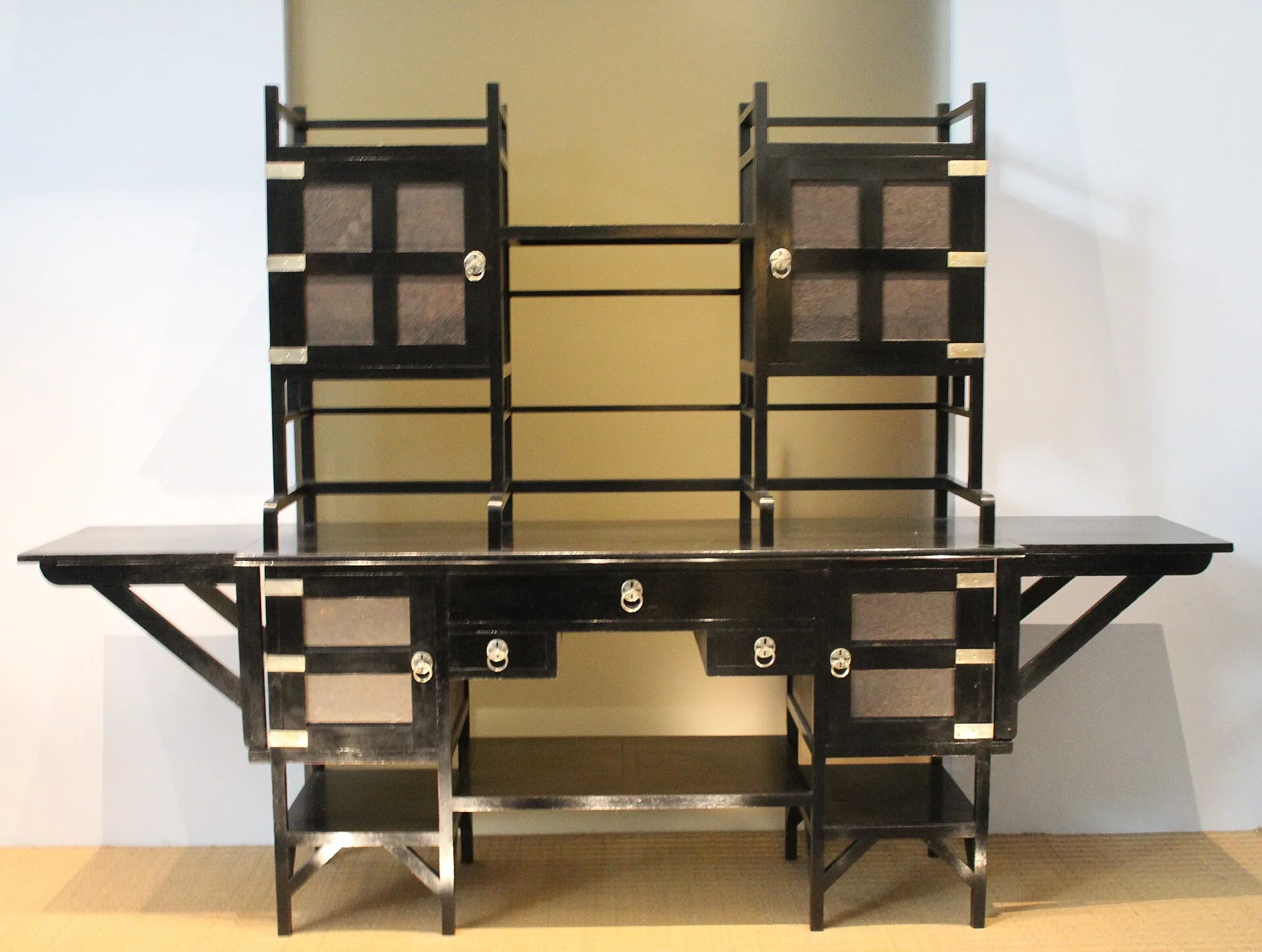
Godwin (1833 to 1886) designed his first ebonised sideboard in 1867 for the dining room of his London home. The V&A, which holds one example, attributes its geometric form and ebonised finish to his study of Japanese artistic principles, and quotes Godwin's aim of gaining effect "by the mere grouping of solid and void". The first version was made of deal, a cheap wood, and Godwin moved to mahogany because deal proved unstable. The V&A's sideboard, probably made by William Watt, has silver-plated handles and inset panels of embossed Japanese leather paper. At least ten versions were made between 1867 and 1888, differing in construction, decoration and number of legs, and unauthorised copies may also have circulated. Another example was made for the Red House at Wheathampstead, which Godwin shared with the actor Ellen Terry from 1868 to 1875.
Godwin began designing for Watt in the 1870s, drawing on Japanese lacquer. A watercolour in the V&A, dated 1872 to 1883, is inscribed "Anglo Japanese Designs by E.W. Godwin" and shows chairs, tables, a wall cabinet and a footstool in a Japanese-style interior, probably an exhibition stand or one of Watt's shop displays. The museum notes that Godwin combined Chinese and Japanese sources rather than copying Japanese examples. Watt published the designs in the trade catalogue Art Furniture in 1877, with the sideboard on plate 6. Godwin often used an inverted heart or "cloud" motif taken from a print of a Japanese hotel by Aimé Humbert. Liberty's later used the shape, and Heal & Son adopted it as a trademark in the 1890s.
Godwin applied the same approach to woven silk. Small Syringa, made in Spitalfields in about 1874, is a later and smaller version of his Syringa pattern, woven by the firm that Benjamin Warner founded in 1870 and which traded as Warner and Ramm from 1875 to 1882. The V&A states that Godwin "was the first to use Japanese motifs in furnishings" and finds the same Japanese simplicity of line and colour in the work of Dresser and B. J. Talbert. The museum suggests the smaller version was a commercially popular variation, and that the surviving length, woven in blue and brown, may be a trial kept as a colour reference.
THOMAS JECKYLL: NORWICH IRONWORK AND THE PEACOCK ROOM
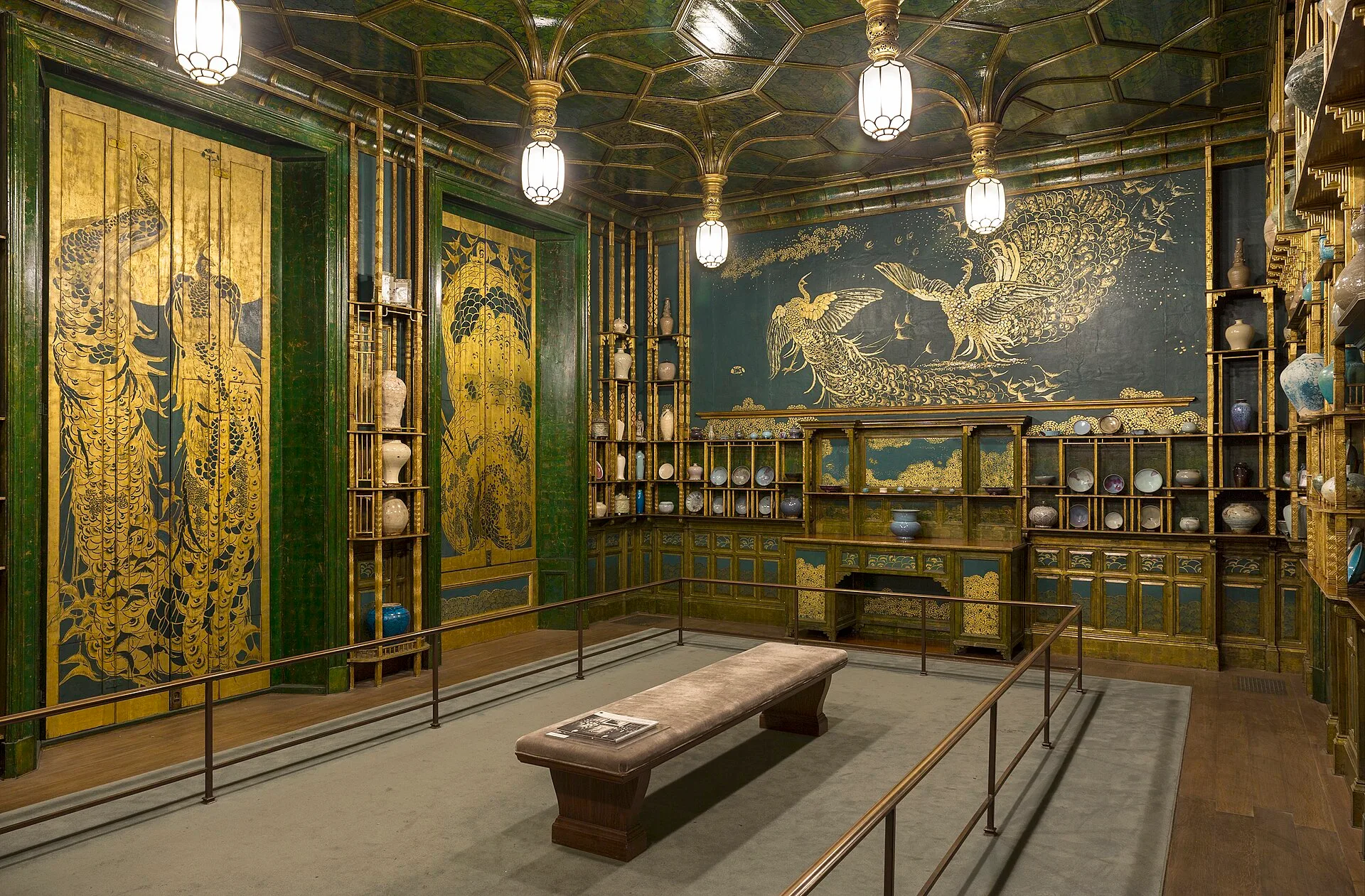
Jeckyll (1827 to 1881) began as a Gothic Revival architect in East Anglia, designing rectories, schools and church restorations, and later worked in Old English, Anglo-Japanese and Queen Anne manners. Barnard, Bishop & Barnards produced his exhibition pieces. After the Norwich Gates of 1862 came the Four Seasons Gates, shown in Paris in 1867 and in Vienna in 1873 and praised for their creative use of Asian principles and motifs, and a cast iron pavilion for the 1876 Centennial Exhibition in Philadelphia. The firm sold his stoves, fenders and other domestic metalwork in large numbers, which made the designs affordable for middle-class homes. The sunflower, a motif that appears on a pair of his andirons of 1876, became an emblem of the Aesthetic Movement largely through his consistent use of it.
At Heath Old Hall, decorated for Edward Green between 1865 and 1872, an ebonised overmantel holds six Japanese painted lacquer panels. At 1 Holland Park in London, for Alexander Ionides, he designed a wardrobe with Japanese lacquer inserts in 1870 to 1872 and an Anglo-Japanese billiard room. In 1876 he designed the dining room at 49 Prince's Gate for the shipowner Frederick Richards Leyland as a porcelain room to display Leyland's blue-and-white Chinese porcelain. James McNeill Whistler then painted over the room in blue and green with gold peacocks, and the Bard Graduate Center notes that Jeckyll's role in the design was completely overshadowed. Mental illness curtailed Jeckyll's career in 1876, and he spent his last five years in asylums in Norwich. The Peacock Room is now in the Freer Gallery of Art in Washington, DC.
CHRISTOPHER DRESSER'S JOURNEY TO JAPAN, 1876 TO 1877

Dresser was born in Glasgow in 1834 and studied from the age of 13 at the Government School of Design in London under the influence of design reformers including Henry Cole and Owen Jones. In 1856 he contributed a botanical plate to Jones's The Grammar of Ornament. The Metropolitan Museum of Art describes the arts and crafts of Japan as the most powerful influence on his work. His journey of 1876 to 1877 made him the first European designer to visit Japan after its opening to the West in 1854. On the way he received a commission in New York from Tiffany & Co. to acquire several thousand Japanese artefacts, and in Philadelphia he attended the Centennial Exhibition and lectured at the Pennsylvania Museum and School of Industrial Art.
According to the Met, the trip deepened his understanding of Japanese forms and turned his attention further towards material, form, surface and methods of manufacture. Dresser designed wallpapers, textiles and carpets for more than thirty firms in Britain, Ireland, France and the United States, and ceramics for at least seven companies, including Minton and Wedgwood. The Met's collection holds a Minton bottle of about 1862 and a Minton tile of about 1875 from his designs. It also holds a travelling tea set of about 1879 and a toast rack of 1881 made by Hukin & Heath, and a wave bowl of about 1880 attributed to him and made by the Linthorpe Pottery Works.
HOW WAS ANGLO-JAPANESE ENAMEL METALWORK MADE?

Japanese enamellers built the cells of a cloisonné vessel with wire and filled them with enamel. Elkington & Co. of Birmingham developed a range of enamelled wares based on Japanese designs and showed them at the Paris Exhibition of 1867 and the Philadelphia Centennial Exhibition of 1876. The firm did not use wire. It electroformed each vessel with the cavities for the enamel already formed in the metal, which the V&A describes as giving an effect similar to champlevé. A small vase in the museum, one of a pair made between 1870 and 1880 and marked with pattern number 339, is in gilt copper with cloisonné enamel, decorated with coloured flowers and insects whose technique and choice of motifs follow Japanese examples.
A second Elkington vase, made in 1876, was shown at the Philadelphia Centennial Exhibition and may have been made especially for it; the museum bought it there. The V&A records that Elkington was the only leading British silversmith to exhibit at Philadelphia, and that Japanese vases were collected and studied by British manufacturers in this period. Elkington made enamelled pieces only until about 1880 and then continued to import enamels from Japan, which the museum judges to have been more cost effective than producing them in Birmingham.
LIBERTY, DRESSER AND THE REGENT STREET TRADE
Arthur Lasenby Liberty was born in Chesham in 1843 and from 1862, the year of the exhibition, worked at the Great Shawl Emporium at 171 to 175 Regent Street, rising to head of the shop. His own shop at 218a Regent Street opened on 15 May 1875 as an "Oriental warehouse". By 1882 the firm had set up its studio and upholstery workshops at East India House, its original premises at No. 218, and in 1883 its furniture store moved to Chesham House at 142 to 144 Regent Street.
Dresser entered the trade at the same time. From 1879 to 1882 he imported Japanese art, with two of his sons acting as agents in Kobe, and in 1880 he opened the Art Furnishers' Alliance on New Bond Street, with Liberty's among its major shareholders. Financial problems and Dresser's declining health closed the Alliance in 1883. Its Thebes stool passed to Liberty's, which registered the design with the Patent Office in 1884. Liberty & Co. also sold Dresser's designs: a Clutha glass vase of about 1890, made by James Couper and Sons, is now in the Metropolitan Museum of Art.
THE AUBREY: AN ENGLISH COLLECTOR'S MANOR AT MANDARIN ORIENTAL HONG KONG
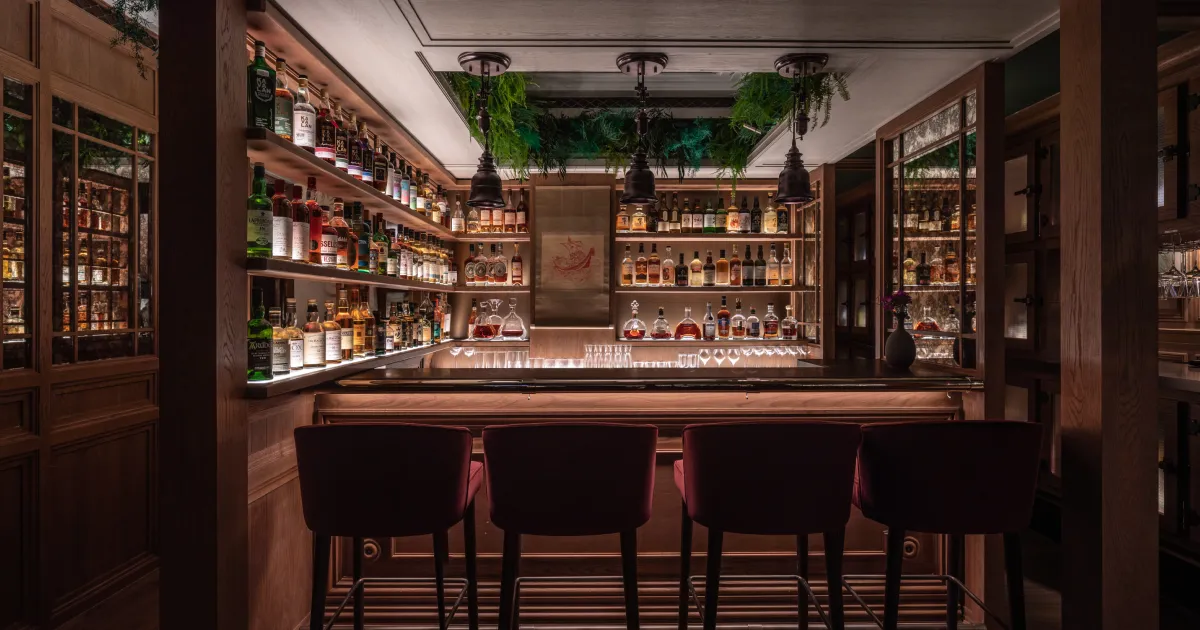
Silverfox Studios designed The Aubrey, the Japanese izakaya and bar on the top floor of Mandarin Oriental Hong Kong, completed in 2021. The concept is the manor of an eccentric English gentleman, shaped by a collector's obsession with Japan, and the venue is named after Aubrey Beardsley. The premise combines an English house with a collector's interest in Japan. In the 1860s and 1870s Godwin placed Japanese leather paper in an ebonised English sideboard, and Jeckyll set six Japanese lacquer panels into an overmantel for Heath Old Hall and lacquer inserts into a wardrobe for 1 Holland Park.
The interior draws on Japonisme and ukiyo-e motifs, among them Mount Fuji, a pagoda, a torii and crashing waves. These are set against dark timber panelling, gilded frames and gallery walls. A curio lounge is fitted with bespoke display cabinetry. Display was also the brief for the dining room that Jeckyll designed at 49 Prince's Gate in 1876, conceived as a porcelain room for Frederick Richards Leyland's blue-and-white Chinese porcelain, before Whistler painted over it in blue and green with gold peacocks.
SOURCES
- Victoria and Albert Museum Jardiniere, Japan, 1860 to 1862, shown at the 1862 International Exhibition
- Central Asian Journal of Art Studies Johannis Tsoumas, The Japanese Artifacts Display at the 1862 Great London Exposition: An Overview
- The Metropolitan Museum of Art Christopher Dresser (1834 to 1904)
- Victoria and Albert Museum Sideboard, Edward William Godwin
- Victoria and Albert Museum Design, Anglo Japanese Designs by E.W. Godwin
- Victoria and Albert Museum Small Syringa furnishing fabric, Edward William Godwin
- Bard Graduate Center Thomas Jeckyll: Architect and Designer
- Victoria and Albert Museum Vase, Elkington & Co., 1870 to 1880
- Victoria and Albert Museum Vase, Elkington & Co., 1876
- Furniture History Society, British and Irish Furniture Makers Online Liberty & Co. (1875 to 2024)