HOW IRON, GLASS AND HOT WATER BROUGHT TROPICAL PLANTS INTO BRITISH GARDENS

The Victorian glasshouse was an iron-and-glass building heated by hot water and used to keep tropical and subtropical plants alive through the British winter. Its parts came together over three decades. In 1816 the garden writer John Claudius Loudon developed a wrought-iron sash bar that could be bent in any direction. In 1829 Nathaniel Bagshaw Ward found a fern growing in a glass case, the origin of the Wardian case for shipping live plants. Joseph Paxton's coal-heated Great Conservatory at Chatsworth was completed in 1841, the glass excise was repealed in 1845, and the Palm House at the Royal Botanic Gardens, Kew, opened in 1848. Kew's Temperate House followed in 1863. In Singapore, the Botanic Gardens were established in 1859 and inscribed as a UNESCO World Heritage Site in 2015.
WHAT CAME BEFORE THE VICTORIAN GLASSHOUSE? ORANGERIES AND DEAD CARGO

A century before the iron glazing bar, the Orangery at Kensington Palace, in London's Kensington Gardens, was built in 1704 to 1705 for Anne, the younger sister of Queen Mary, who became queen when William III died. The Royal Parks, which manages Kensington Gardens, says the architect is thought to have been Nicholas Hawksmoor, then the clerk of works at the palace. The building had under-floor heating, and in the winter months it was used as a conservatory for delicate plants.
Getting plants to Britain alive was a second problem. Kew's archive records that until the early 19th century, plants sent back to England would often die on long sea voyages. An entry in Kew's Inwards book for 1793 notes three baskets of plants collected by Christopher Smith that arrived at Kew dead. Collectors sent countless plants to Kew from the 18th century onwards. One survivor, an Eastern Cape giant cycad, Encephalartos altensteinii, arrived at Kew in 1775 and is now one of the plants on display in the Palm House.
WHAT IS A WARDIAN CASE? NATHANIEL WARD'S GLASS BOX
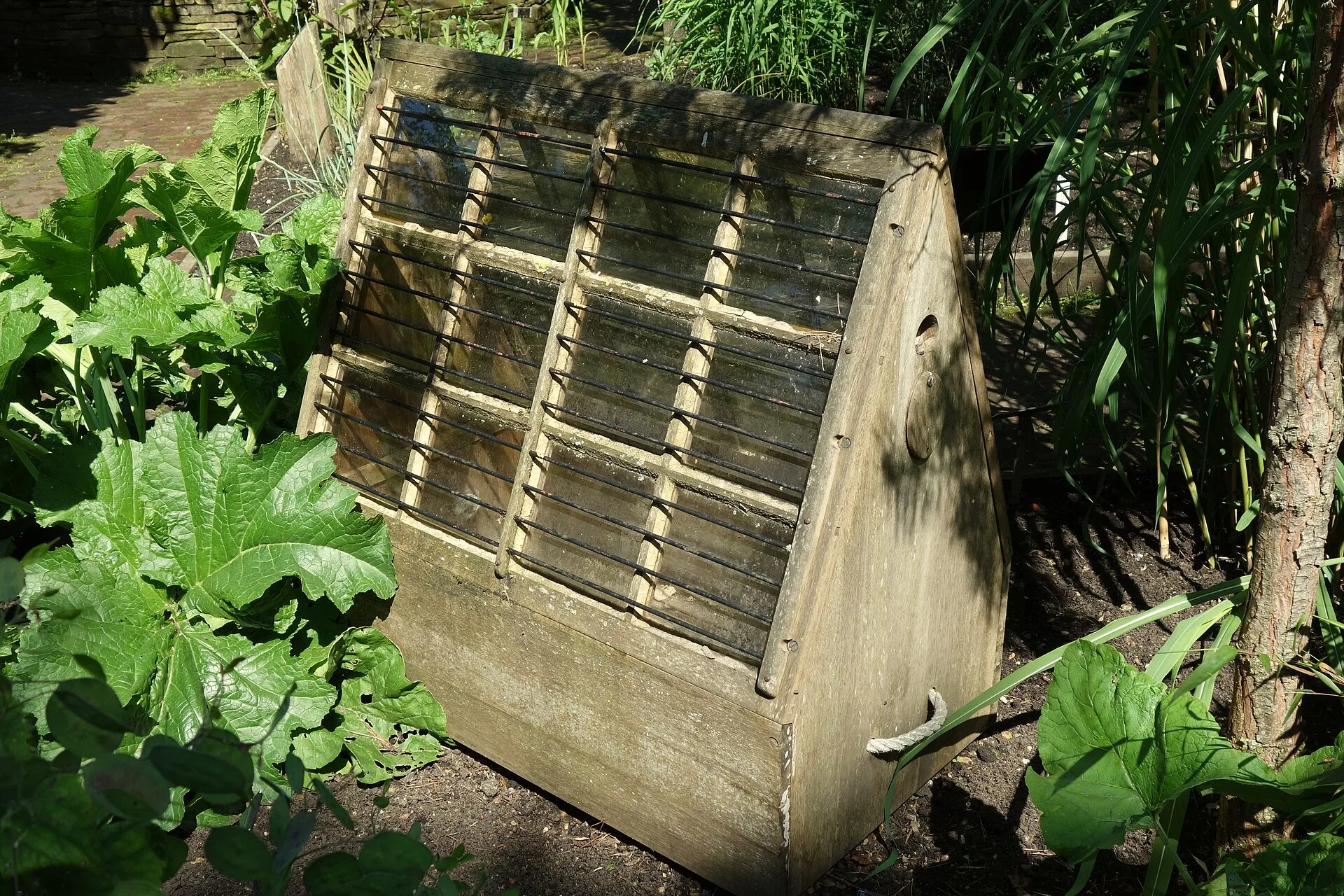
Nathaniel Bagshaw Ward was a medical doctor rather than a botanist. In 1829 his interest in botany led to the accidental discovery of a fern growing in a glass case that held a cocoon of moths. Realising that the conditions inside suited the growth and safe transport of plants, Ward experimented further. He published his findings in 1842 as On the Growth of Plants in Closely Glazed Cases. The cases could stand on deck, so the plants received sunlight, while the glass protected them from salt water and allowed condensed moisture to reach the plants. As the cases were developed further, they gained ventilation holes covered in perforated zinc to keep out rodents.
Kew's records include an 1841 letter from Joseph Hooker in the Bay of Islands, New Zealand, reporting that he had sent a large Ward's case of plants for Kew on board the ship Exporter. By 1847 the Wardian case was in regular use at Kew, with a standard case holding 28 plants. Kew was involved in introducing rubber and cinchona, the plant from which quinine is derived, from South America to British colonies in Asia. Henry Ridley, first Scientific Director of the Singapore Botanic Gardens from 1888 to 1911, sent Kew plants and seeds from his collecting expeditions in Malaysia. The last Wardian case used by Kew delivered plants from Fiji in 1962, by which time shipping plants by boat in this way had become expensive.
HOW DID THE IRON GLAZING BAR MAKE CURVED GLASSHOUSES POSSIBLE?
John Claudius Loudon, born in 1783 as the son of a Scottish farmer, developed a wrought-iron sash bar and half-bar in 1816 that could be bent in any direction without losing its strength. Loudon set out the argument in 1817 in A Comparative View of the Common and Curvilinear Modes of Roofing Hothouses. W. & D. Bailey acquired the rights to the flexible glazing bar in 1818 and used it to build a greenhouse for Lord St Vincent. Loudon completed his Encyclopaedia of Gardening in 1822, which went through nine editions, and in 1826 he founded The Gardener's Magazine, which ran for 19 years.
Glass itself was taxed. A 2026 UCL doctoral thesis by Robert Alexander Johnstone on the English glass industry from 1745 to 1860 describes how excise officers calculated duty by measuring raw materials at stages of production rather than by weighing the finished goods, and argues that this supervision shaped production methods and limited innovation. The industry it covers made tableware, bottles and sheet glass. The excise duty on glass was repealed in 1845. By then Paxton's Great Conservatory at Chatsworth, completed four years earlier, had already used nearly 70,000 square feet of glass, and the Palm House at Kew was a year into construction.
HOW WERE VICTORIAN GLASSHOUSES HEATED? THE GREAT CONSERVATORY AT CHATSWORTH
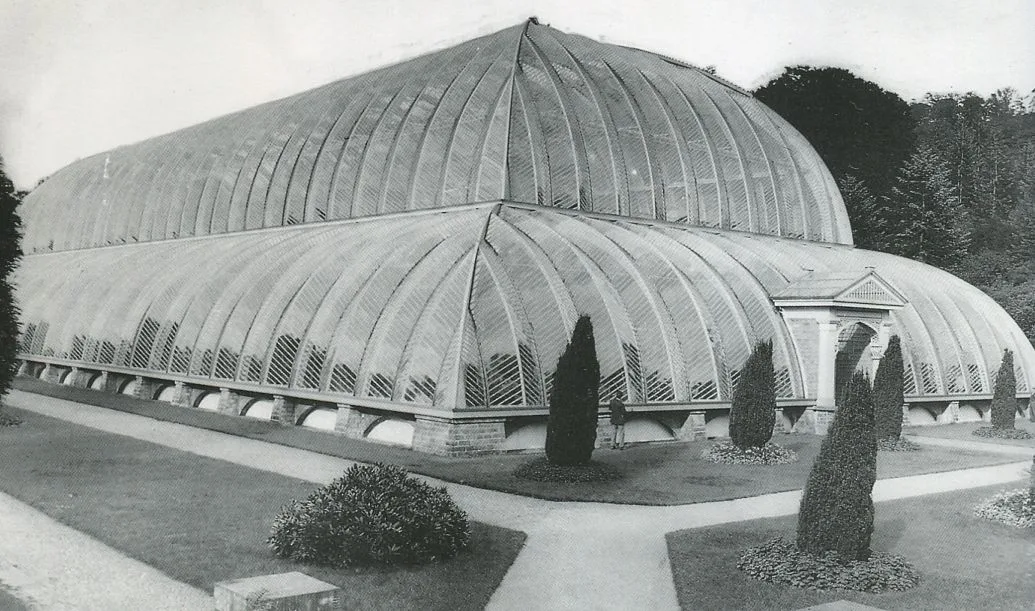
Joseph Paxton worked as a student gardener in the Horticultural Society's experimental gardens at Chiswick and was offered the post of head gardener at Chatsworth House in Derbyshire in 1826 by the 6th Duke of Devonshire. Parks and Gardens UK writes that Loudon's writing on hothouses must have influenced Paxton. At Chatsworth, Paxton designed greenhouses, a special glasshouse for a giant water lily, and the Great Conservatory, which the estate dates to 1841. It was nearly 100 metres long, over 60 feet high and covered more than an acre. Chatsworth records that it was visited by 50,000 people a year and was free to enter except on Sundays.
Eight coal-fired boilers supplied hot water to about seven miles of pipe running beneath the planting beds. The building burned around 300 tonnes of coal a year, delivered through underground tunnels, and workers kept the fires going continuously. The Cavendish banana, which first flowered at Chatsworth in 1835, was propagated by Paxton and planted throughout the conservatory; the Cavendish later replaced the dominant commercial banana after Panama disease destroyed it. Coal restrictions during the First World War stopped the heating and the tropical planting was lost. The structure was dismantled in 1920.
Paxton's water-lily house was built for Victoria amazonica, and Parks and Gardens UK records that the shape of the lily's leaves inspired the design. Its horizontal ridge-and-furrow roof formed the basis of his design for the Great Exhibition building of 1851 in Hyde Park, named the Crystal Palace. The exhibition building and its successors are covered in a separate article on world's fairs and the pavilion. Through the Chatsworth glasshouses Paxton developed his methods of combining glass, iron and wood.
WHO BUILT THE PALM HOUSE AT KEW?
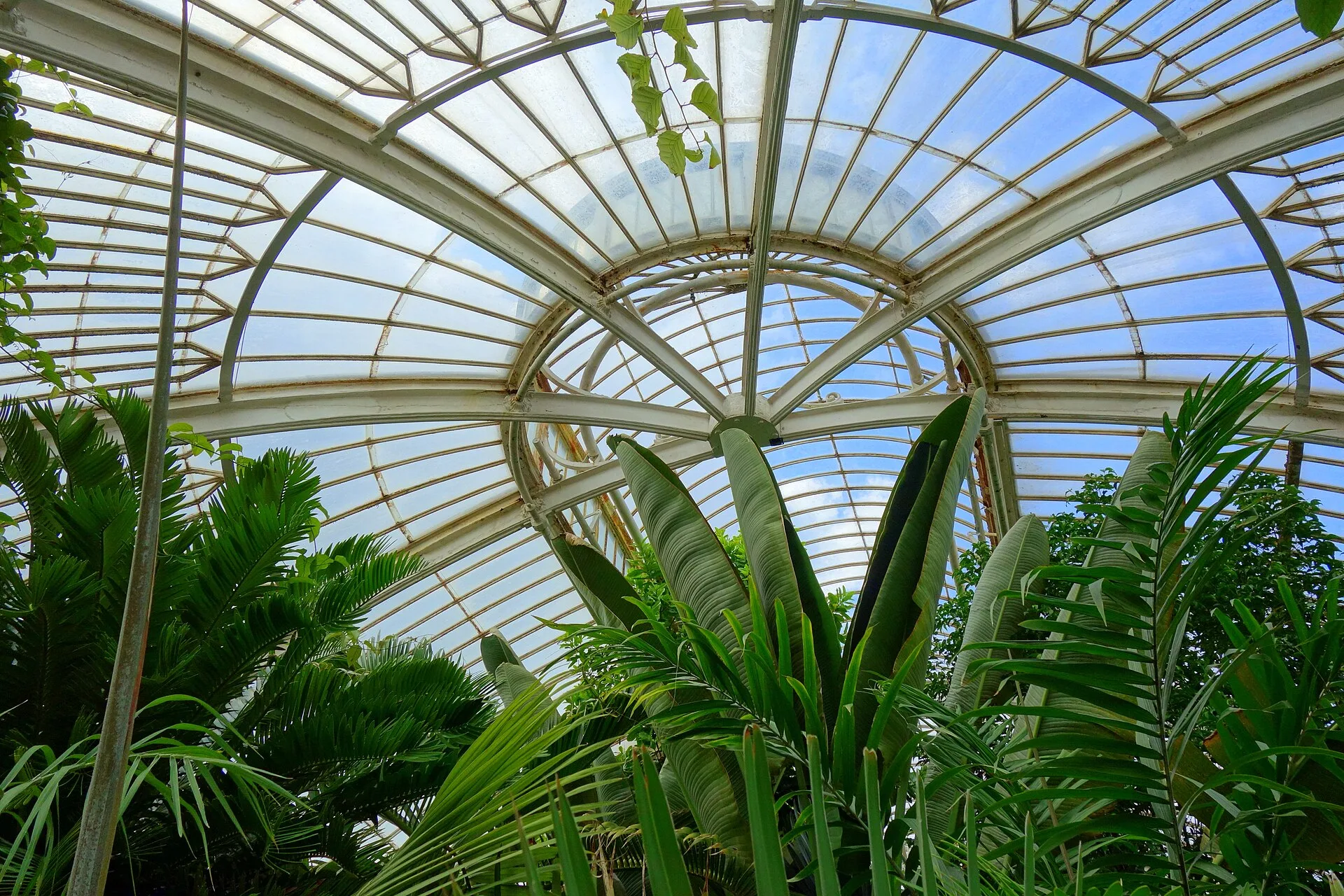
The Palm House at the Royal Botanic Gardens, Kew, was built between 1844 and 1848 by the architect Decimus Burton and the iron-maker Richard Turner. Kew states that it was built from iron and glass on an unprecedented scale, and that its builders borrowed techniques from the shipbuilding industry, which Kew suggests may explain why the building resembles the upturned hull of a ship. It first opened in 1848 and is listed at Grade I. Kew describes its original purpose as protecting and studying the tropical plants then being gathered, and the house still holds more than 1,000 species of tropical and subtropical plants, many of them endangered in the wild.
The tallest palms reach the top of the 19-metre roof. A winding staircase leads to an upper walkway, where ferns, climbers and understorey plants can be seen at canopy level. Carnivorous plants, bromeliads and orchids grow among the ground-floor planting. Other plants Kew highlights include the 1775 cycad, the Madagascar periwinkle used in treating several cancers, the jade vine, native only to the Philippines, and Clay's hibiscus, of which just over 100 remain in the wild. More than 175 years after its construction, the building shows severe deterioration. Kew has planned a renovation for 2027 and its horticulturists are moving plants out ahead of the conservation work.
WHAT IS THE LARGEST SURVIVING VICTORIAN GLASSHOUSE? KEW'S TEMPERATE HOUSE
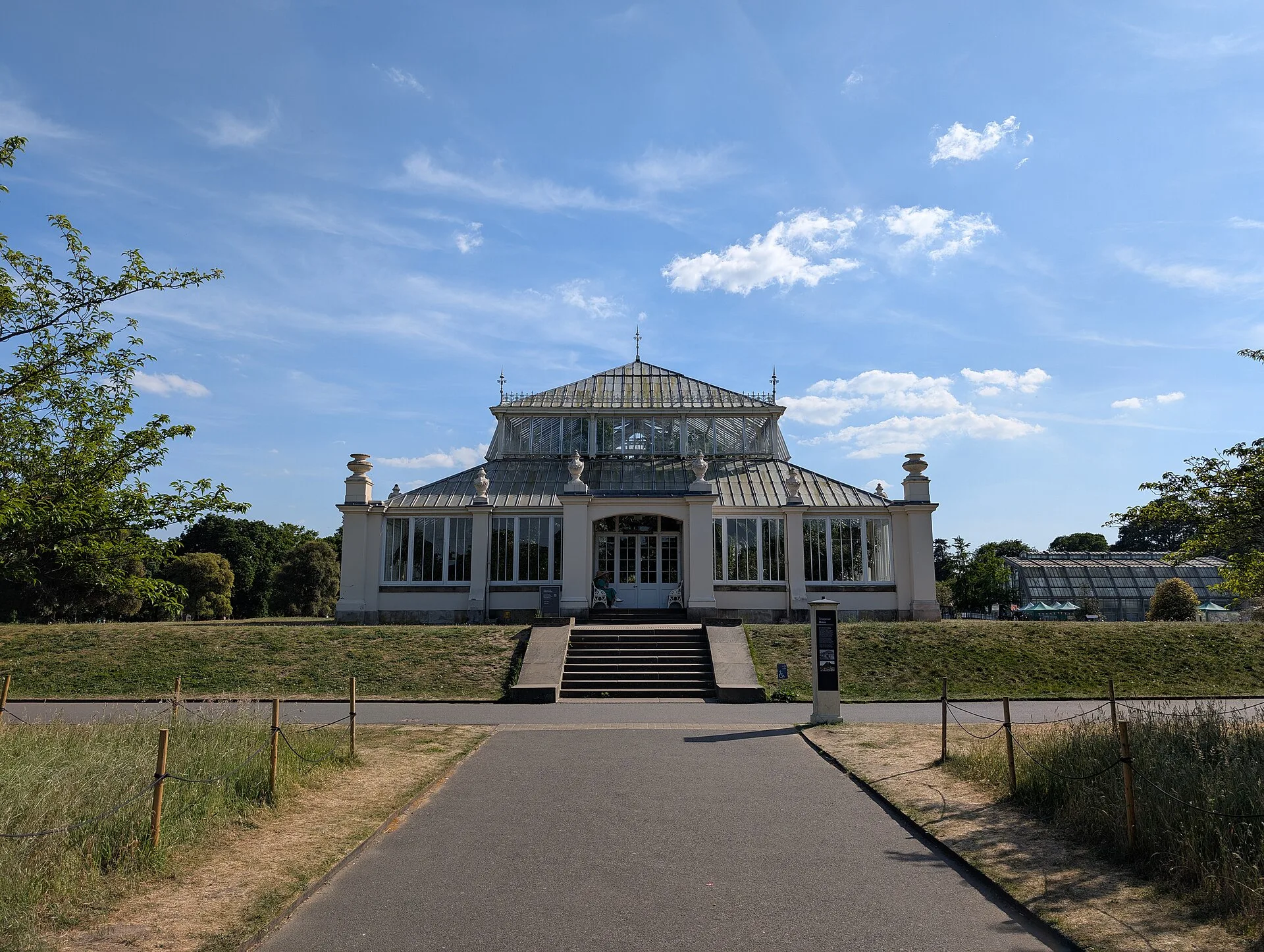
Decimus Burton also designed Kew's Temperate House, built for frost-tender plants. Construction ran from 1862 to 1899. The central block and two octagons opened in 1863 with the building only three-quarters complete, and the north and south ends were finished in 1899. The Grade I listed house covers 4,880 square metres, rises 19 metres at its highest point and has 15,000 panes of glass. Kew describes it as the world's largest surviving Victorian glasshouse and says it was once the largest glasshouse in the world. Before its most recent restoration it held around 1,000 species, and it reopened with 1,500 species and more than 10,000 individual plants.
The terracotta urns at each corner of the central building hide chimneys that once vented steam from the original heating, and restoration crews found the original underfloor heating in the south octagon. On cold winter days boilers and radiators now keep the plants above the 10°C they need to survive. The house was restored in the 1970s and again in the 2010s. The second project took five years, involved a team of 400 people, replaced the glass in 800 windows, and was completed in May 2018.
WHERE DID THE GLASSHOUSE GO NEXT? SINGAPORE'S BOTANIC GARDENS AND GARDENS BY THE BAY
The Singapore Botanic Gardens, established in 1859, cover 49 hectares in the centre of the city, with a buffer zone of 137 hectares. UNESCO describes them as an outstanding example of a British tropical botanic garden and inscribed them on the World Heritage List in 2015 under criteria (ii) and (iv). The Gardens have been a centre of plant research in Southeast Asia since 1875, and their work contributed to the development of plantation rubber. Protected buildings include Burkill Hall, Holttum Hall, Ridley Hall, a bandstand and the Swan Lake Gazebo, and the site has 44 heritage trees. Singapore's wider greening programme is covered in a separate article on Singapore's Garden City.
Where the Victorian glasshouse was heated, the Flower Dome at Gardens by the Bay is a cooled conservatory, holding plants from the world's cool-dry regions, from the Mediterranean to South African savannahs, at 23°C to 25°C. It is covered with 3,332 glass panels, and its roof is fitted with glass selected to admit light for the plants while minimising solar heat, so the conservatory can be cooled more efficiently. Its volume is equivalent to 75 Olympic-sized swimming pools, and Gardens by the Bay states that it holds the Guinness World Record for the largest glass greenhouse. The Cloud Forest is a separate attraction at Gardens by the Bay. The use of planting inside hotels is covered in a separate article on biophilic design.
EMBU AT MANDARIN ORIENTAL, SINGAPORE

Embu is the all-day dining restaurant on level 3 of Mandarin Oriental, Singapore. Silverfox Studios completed the project in September 2023, led by Susan Heng and Patrick Waring. The restaurant takes its name from the Tembusu, a tree with fragrant flowers and sturdy wood, covered in a separate article on the Tembusu tree. Its design themes come from Singapore's Garden City: canopy, botanical planting, pavilions and greenhouses. Curved louvred timber canopies and framing echo the perpendicular branching of the Tembusu.
The floors are Peranakan black-and-white porcelain tiles, and the interior uses open-weave rattan. In the Victorian glasshouse, curves were made in iron and glass: Loudon's wrought-iron sash bar of 1816 could be bent in any direction, his book of 1817 compared common and curvilinear modes of roofing hothouses, and between 1844 and 1848 Richard Turner built the Palm House at Kew in iron with techniques borrowed from shipbuilding. In Singapore, the Botanic Gardens date from 1859, and the cooled Flower Dome at Gardens by the Bay holds plants from the world's cool-dry regions under 3,332 glass panels.
SOURCES
- The Royal Parks The Orangery
- Royal Botanic Gardens, Kew The Wardian case: a history of plant transportation
- Parks and Gardens UK John Claudius Loudon
- UCL Discovery Transparency of Technology and Taxation: The development of the English Glass Industry between Culloden (1745) and post Crimea (1860)
- Chatsworth Chatsworth's Great Conservatory
- Parks and Gardens UK Joseph Paxton
- Royal Botanic Gardens, Kew Palm House
- Royal Botanic Gardens, Kew Secrets of the Temperate House
- UNESCO World Heritage Centre Singapore Botanic Gardens
- Gardens by the Bay Flower Dome