HOW A 1967 POLICY OF ROADSIDE PLANTING GREW INTO SINGAPORE’S CITY IN NATURE STRATEGY
Singapore's Garden City vision was set out by Prime Minister Lee Kuan Yew in May 1967, four years after a nationwide tree-planting campaign began with a single tree at Farrer Circus. The early programme concentrated on roadside trees and shrubs, and over the following decades Singapore greening expanded into laws protecting trees, an annual Tree Planting Day, planting on flyovers, a network of park connectors and gazetted nature reserves. The policy has been renamed twice: the Garden City became a City in a Garden in 2011, and under the Singapore Green Plan 2030 the aim is now a City in Nature. According to the National Library Board's journal BiblioAsia, more than 55,000 new trees had been planted by 1970, some 158,600 by 1974 and 1.4 million by June 2014. The OneMillionTrees movement run by the National Parks Board (NParks), launched in 2020, is adding one million more.
WHAT WAS SINGAPORE’S GARDEN CITY VISION?
Lee set out the vision in a speech at the Singapore Conference Hall in Trade Union House on 11 May 1967. The National Archives of Singapore records his aim as “a garden city beautiful with flowers and trees”, as tidy and free of litter as possible. Singapore had no official greening policy before then, according to BiblioAsia. Lee tied greenery to the economy as well as to daily life: a pleasant city would give Singapore a good reputation and draw visitors who stayed, which would support the hotel trade and create jobs at a time of unemployment. A 2012 BiblioAsia article by the National Library librarian Lim Tin Seng summarises the goals as a cleaner, greener city that would be more attractive to tourists and investors.
Lee returned to the subject in From Third World to First, his memoir of the years 1965 to 2000. CNBC reported that in it he described looking for a way to set Singapore apart from other Third World countries, and that he “settled for a clean and green Singapore”. In a 1968 address to Parliament he argued that an elected government could not keep some parts of the city clean and green while leaving the rest to deteriorate, so greenery could not be reserved for wealthier districts.
The phrase had an older meaning in town planning. Britannica defines the garden city as a planned residential community devised by the English planner Ebenezer Howard, who set out the idea in Tomorrow: A Peaceful Path to Social Reform in 1898. Howard proposed small towns of about 30,000 people on land held by a single company and surrounded by a protected rural belt. Letchworth in Hertfordshire, begun in 1903, was the first, followed by Welwyn Garden City in 1920. Singapore's programme was a different kind of project: a planting campaign applied to an existing city that was urbanising and industrialising quickly.
1963: THE FIRST TREE AND THE ROADSIDE PLANTING PROGRAMME
NParks dates the start of Singapore's greening to 16 June 1963, when Lee planted a Mempat tree at Farrer Circus to launch the nationwide tree-planting campaign. The National Archives notes that before this, trees had been planted by VIPs only occasionally, and that on 20 August 1963 Chor Yeok Eng, Parliamentary Secretary for National Development, planted a tree at Clementi Road. Once the Garden City vision was in place, the first phase was large-scale planting of roadside trees and shrubs by the Parks and Trees Unit of the Public Works Department. In December 1967 flowerbeds were being built along Collyer Quay.
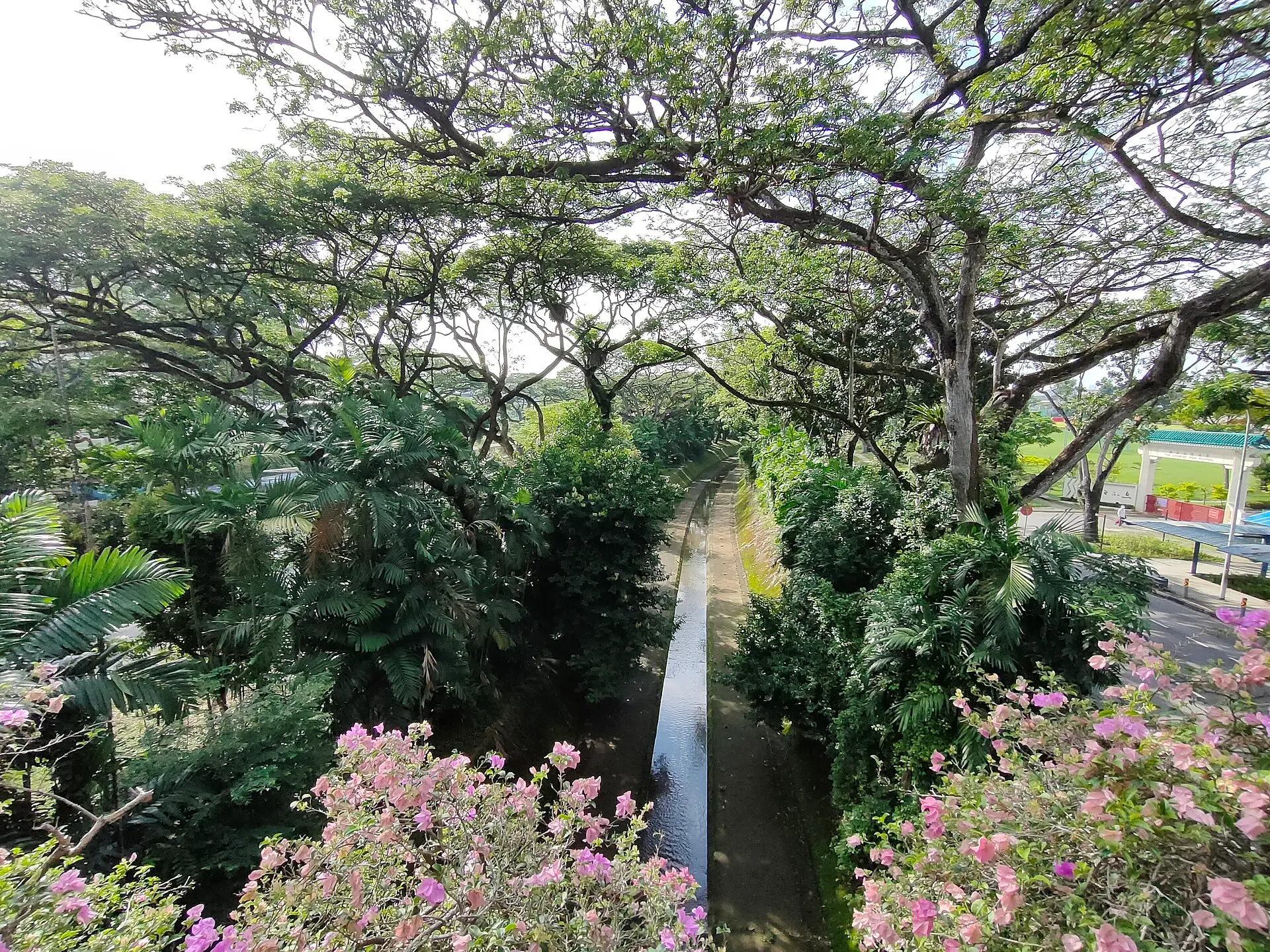
The planters chose fast-growing species with shady crowns. BiblioAsia lists angsana, rain tree, flame of the forest and frangipani among the trees, with bougainvillea, red ixora, bamboo orchid and Cassandra among the shrubs. Lim's 2012 article adds coral tree and pong-pong to the early list and records that yellow flame, red flame, tembusu and gardenia were added later. Several of these were already familiar on the island's streets: in the 1860s the Botanic Gardens and the Municipality had planted cotton trees, angsana, flame of the forest and rain trees along Orchard Road, Scotts Road, Anderson Road, Jalan Besar and Balestier Road.
As expressways and flyovers were built, the planting moved onto the concrete itself. NParks records that flyovers, overhead bridges and expressway viaducts were greened in the 1970s and 1980s. Lim describes creepers, palms and shrubs used to soften flyovers, overhead bridges, retaining walls and guardrails, with bougainvillea and cassia adding colour along roads and expressways. At a 2016 panel reported by CNBC, Chan Heng Chee, chairman of the Lee Kuan Yew Centre for Innovative Cities at the Singapore University of Technology and Design, said Lee had personally chosen a creeper for the flyovers, which became known as the Lee Kuan Yew creeper.
TREE PLANTING DAY, TREE LAWS AND THE GARDEN CITY ACTION COMMITTEE
Tree Planting Day became an annual event in 1971, and NParks dates the first one to 7 November that year. In the same year the Trees and Plants (Preservation and Improvement of Amenities) Act made it an offence to damage or remove trees in public places. Protection was followed by requirements on new development. The Parks and Trees Act of 1975 required planting space to be set aside in new major roads, open-air car parks and plazas, where Lim puts the share at about 30 to 40 per cent of plaza space. Also in 1975, the Parks and Recreation Department took over from the Public Works Department unit. NParks now administers the Parks and Trees Act of 2005.
Coordination between government agencies fell to the Garden City Action Committee. NParks gives its founding date as 1970 and Lim's 2012 article gives 1973; both describe it as the body that guided greening policy across agencies such as the Housing and Development Board (HDB) and JTC. CNBC reported Chan Heng Chee's account of a joke by former Prime Minister Goh Chok Tong, that Singapore's cabinet might have been the only one in the world to read the minutes of a Garden City Action Committee. The National Archives holds a 2008 oral history interview with James Koh, a former HDB chairman, on the committee's work, and records that HDB estates such as Marine Parade were being designed in 1976 with a clean and green environment in mind.
NATURE RESERVES AND THE PARK CONNECTOR NETWORK
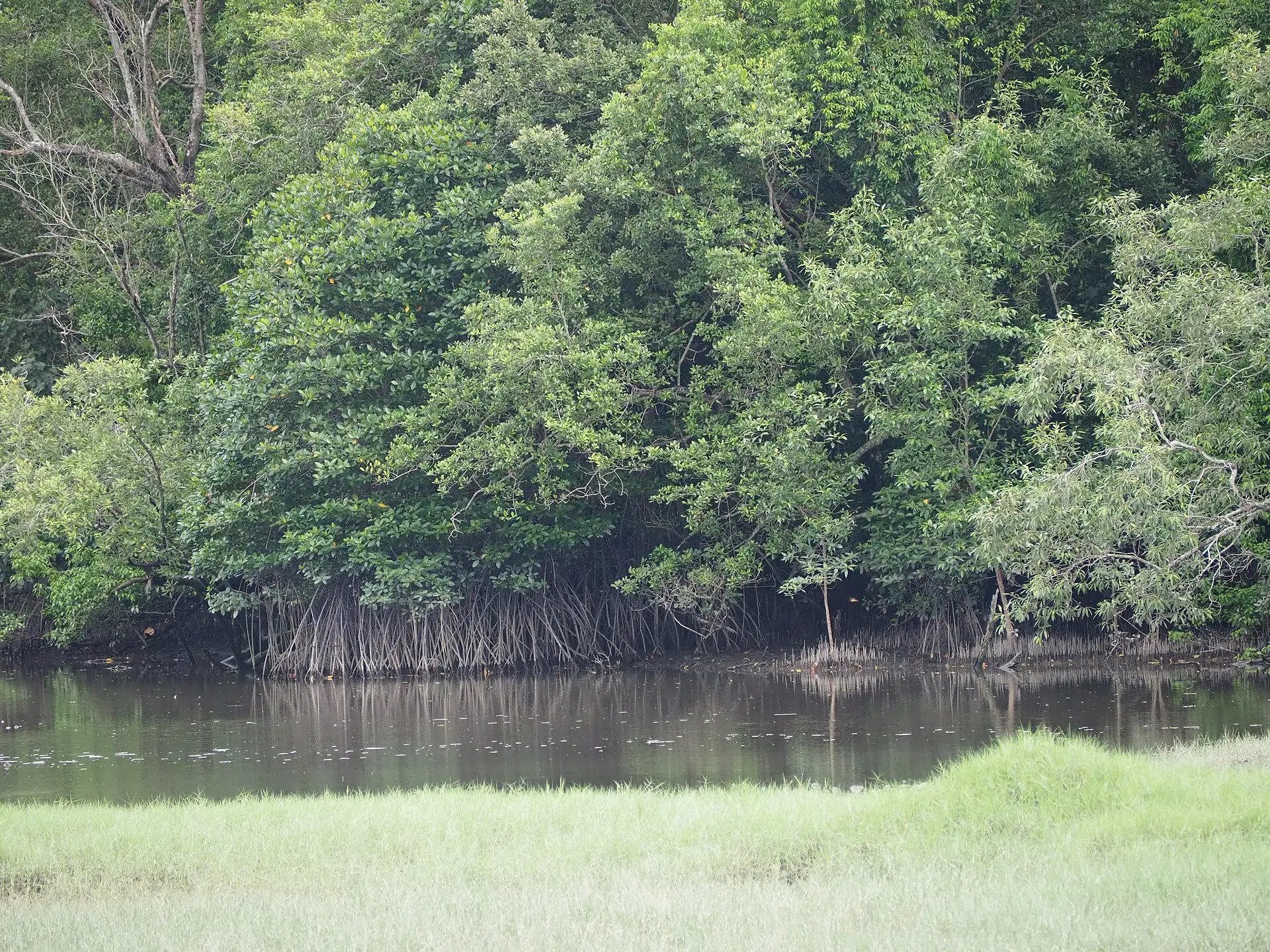
The National Parks Board was formed in 1990 to manage national parks, and in 1996 it took over the Parks and Recreation Department's roles, including roadside tree planting and park development. Bukit Timah and the Central Catchment area were gazetted as nature reserves in 1990. The Urban Redevelopment Authority's 1991 Concept Plan pledged to conserve 3,000 hectares of nature sites, and Singapore now has 24 nature sites, including four nature reserves. Sungei Buloh opened as a nature park in 1993, was gazetted as a nature reserve in 2002, the same year as Labrador, and became Singapore's first ASEAN Heritage Park in 2003. According to Lim, parks and green spaces grew from 879 hectares in the mid-1970s to 5,083 hectares by 2011.
The 1991 Concept Plan also proposed a Green and Blue Plan, which led to the Park Connector Network: routes linking parks and nature sites for walking and cycling. The first, a 7 km link from Bishan-Ang Mo Kio Park to Kallang Riverside Park, was completed in 1992. By the end of 2011 there were 41 connectors totalling 160 km, and BiblioAsia reported about 70 connectors covering more than 340 km in 2021. Residents were brought into the work through Community in Bloom, launched in 2005, which NParks says has created more than 1,800 community gardens and engaged over 45,000 gardening enthusiasts.
CITY IN A GARDEN: GARDENS BY THE BAY AND SKYRISE GREENERY
The City in a Garden concept was introduced in 2011. Prime Minister Lee Hsien Loong described it as connecting communities, places and spaces through parks, gardens, streetscapes and skyrise greenery, and Lim's 2012 article explains the shift as bringing greenery into homes and workplaces rather than only public spaces. Two building schemes began in 2009: the Urban Redevelopment Authority's LUSH programme, which encourages greenery on high-rise buildings, and NParks' Skyrise Greenery Incentive Scheme. BiblioAsia reported in 2021 that more than 550 commercial developments and over two-thirds of new residential projects had joined LUSH. HDB's Biophilic Town Framework followed in 2013, was piloted at Punggol Northshore in 2015 and was extended to all new housing projects in 2018.
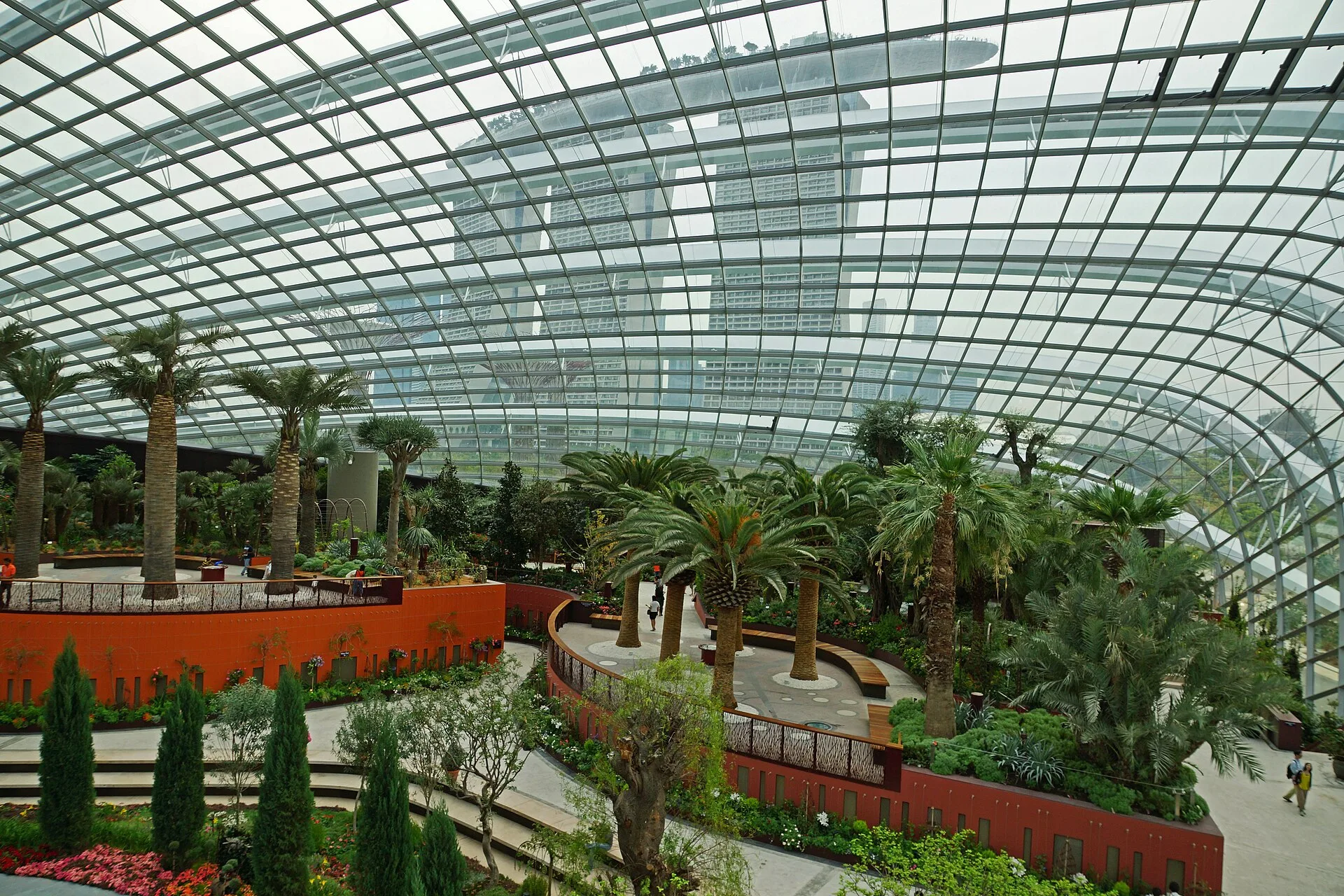
Gardens by the Bay was conceived in 2005 and completed in 2012 on 101 hectares in Marina Bay, with two glass conservatories and 18 Supertrees between 25 and 50 metres tall. Guinness World Records lists the Flower Dome as the largest glass greenhouse, covering 1.28 hectares under its glass roof. It was designed by Wilkinson Eyre and completed in June 2012, together with the slightly smaller Cloud Forest. In 2015 the Singapore Botanic Gardens became the country's first UNESCO World Heritage Site and the first tropical botanic garden on the list.
CITY IN NATURE AND THE SINGAPORE GREEN PLAN 2030
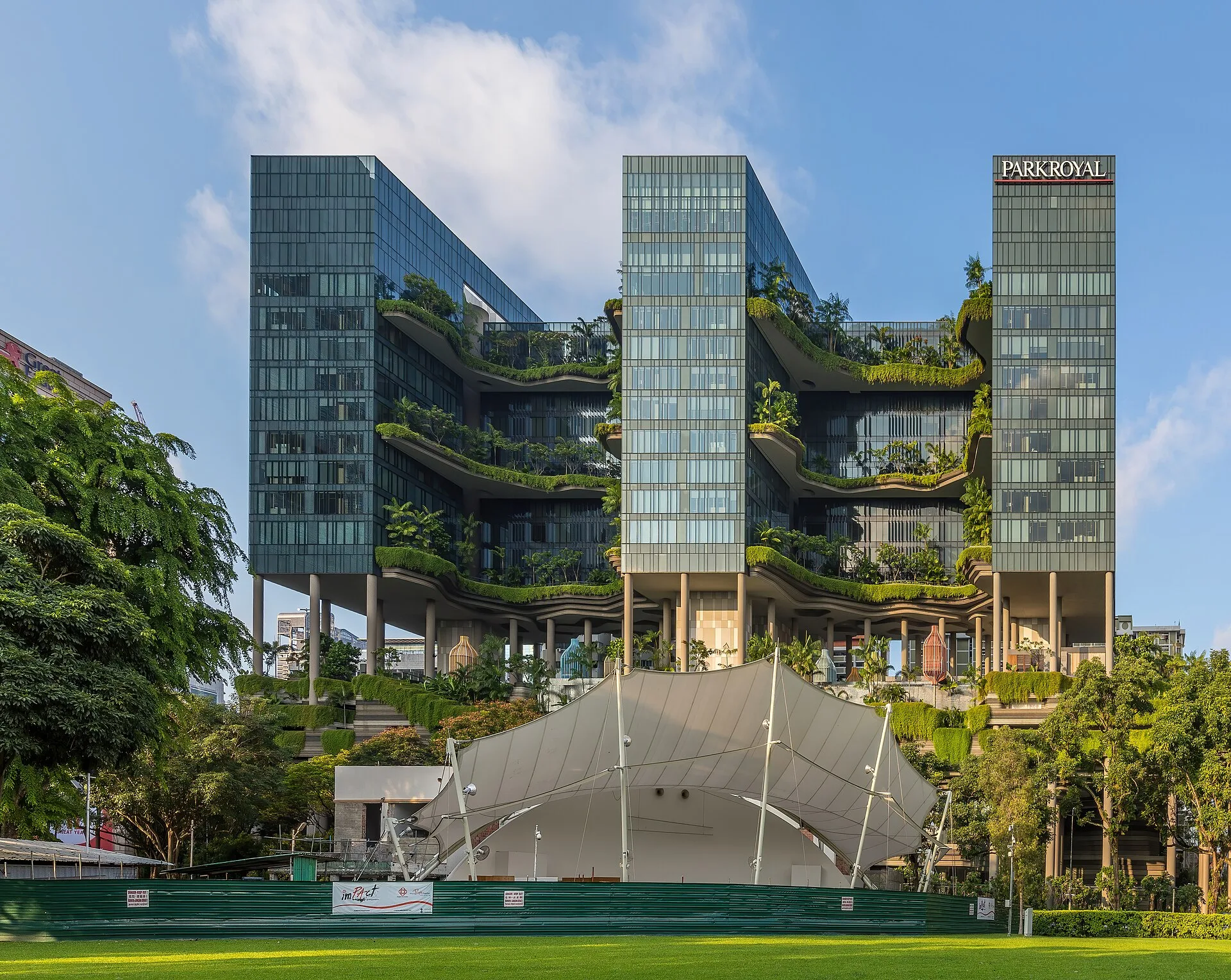
The City in Nature vision was announced in 2020 by Desmond Lee, then Second Minister for National Development. It is one of five pillars of the Singapore Green Plan 2030, launched on 10 February 2021, alongside Sustainable Living, Energy Reset, Green Economy and Resilient Future. NParks sets out five strategies under it: grow the Nature Park Networks, naturalise gardens and parks, restore nature into urban areas, connect green spaces, and improve veterinary care and animal management. The Central Nature Park Network, announced in 2017, was the first of these networks, and the Lornie Nature Corridor, introduced in 2020, was the first nature corridor.
By 2030 NParks aims to add 200 hectares of new nature parks, create 200 hectares of skyrise greenery, plant at least 170,000 more trees in industrial areas, build 300 km of Nature Ways and 500 km of park connectors, and place every household within a 10-minute walk of a park. It also plans to naturalise more than 300 hectares of gardens and parks by 2026 and to build 30 therapeutic gardens by 2030. Planting is carried out with the public through the OneMillionTrees movement, which began in March 2020. By April 2023 more than 500,000 trees had been planted with over 75,000 community members, and NParks expected to reach one million by the end of 2027, three years ahead of target. To mark 60 years since 1963, 60 native trees were planted at the Singapore Botanic Gardens.
THE GARDEN CITY AT EMBU, MANDARIN ORIENTAL, SINGAPORE

Embu is the all-day dining restaurant on Level 3 of Mandarin Oriental, Singapore, completed in September 2023 and designed by Silverfox Studios, with the project led by Susan Heng and Patrick Waring. Its name and design direction come from the Tembusu, a native Singaporean heritage tree known for its fragrant flowers and sturdy wood. The interior extends Singapore's Garden City vision around three themes: canopy, botanical planting, and pavilions and greenhouses. Curved, louvred timber canopies and stylised timber framing echo the Tembusu's perpendicular branching. The floors are laid with Peranakan black-and-white porcelain tiles, and open-weave rattan is used alongside the timber.
SOURCES
- BiblioAsia, National Library Board Singapore Of Parks, Trees and Gardens: The Greening of Singapore
- BiblioAsia, National Library Board Singapore From Botanic Gardens to Gardens by the Bay: Singapore's Experience in Becoming a Garden City
- National Archives of Singapore Garden City
- National Parks Board 60 Years of Greening Singapore
- National Parks Board City in Nature
- National Parks Board More than half a million trees planted with the community
- Ministry of Foreign Affairs Singapore Singapore Green Plan 2030
- CNBC Lee Kuan Yew was actually Singapore's chief gardener
- Britannica Garden city
- Guinness World Records Largest glass greenhouse