AN 1893 ORCHID HYBRID, ITS BREEDER AND SINGAPORE'S ORCHID GARDENS
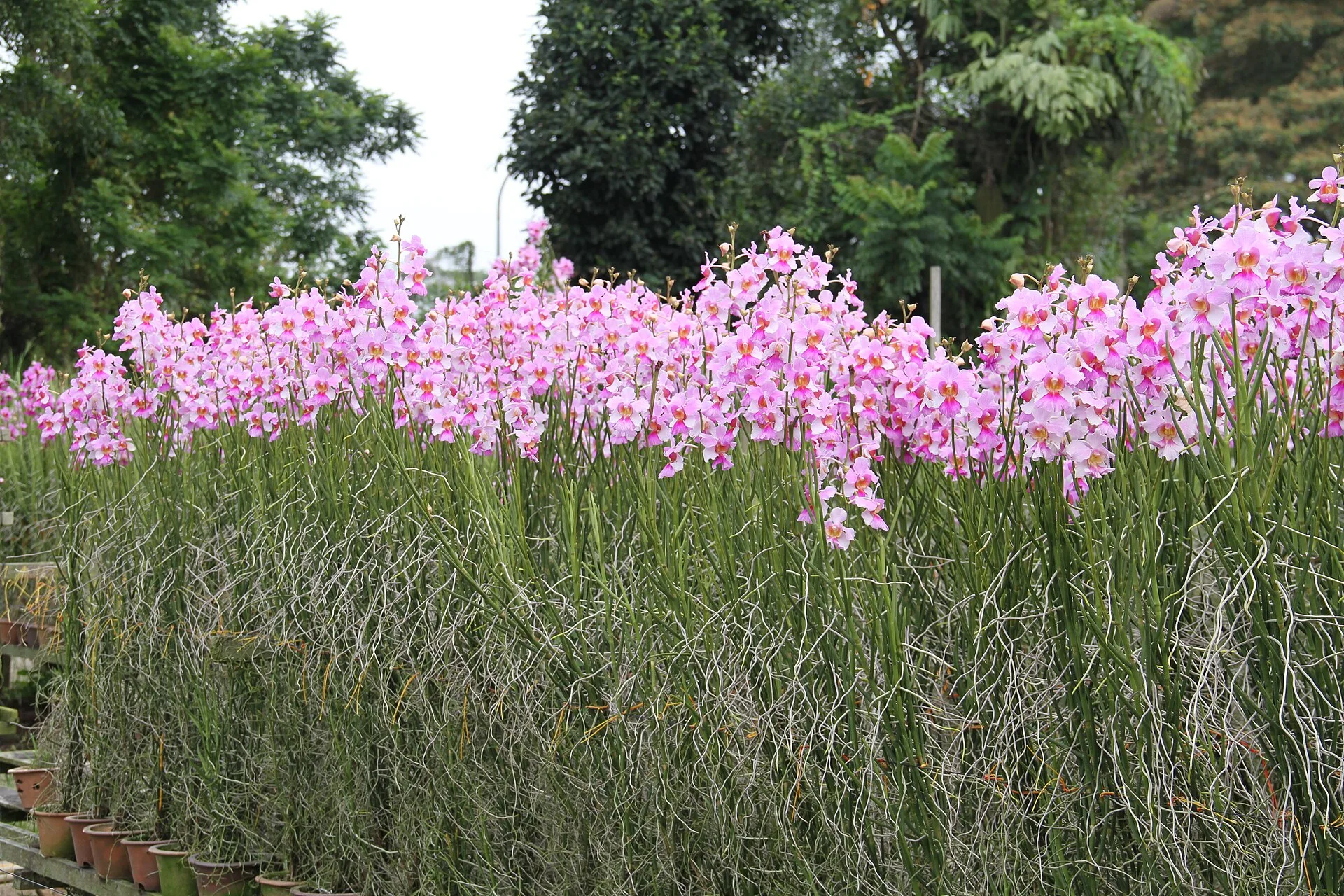
Vanda Miss Joaquim is an orchid hybrid of two species now placed in the genus Papilionanthe, P. teres and P. hookeriana. It was described in 1893 by Henry Nicholas Ridley, first Director of the Singapore Botanic Gardens, and named after Agnes Joaquim, in whose garden it arose. On 15 April 1981 it became Singapore's national flower, chosen from 40 flowers, 30 of them orchids. The National Parks Board (NParks) notes that Singapore is the only country with a hybrid as its national flower. Its history runs from an Armenian family in Tanjong Pagar to a London flower show in 1897, a century of argument over whether the cross was made by hand or by chance, and a breeding programme at the Gardens that has registered more than 650 orchid hybrids since 1932.
WHAT IS VANDA MISS JOAQUIM?
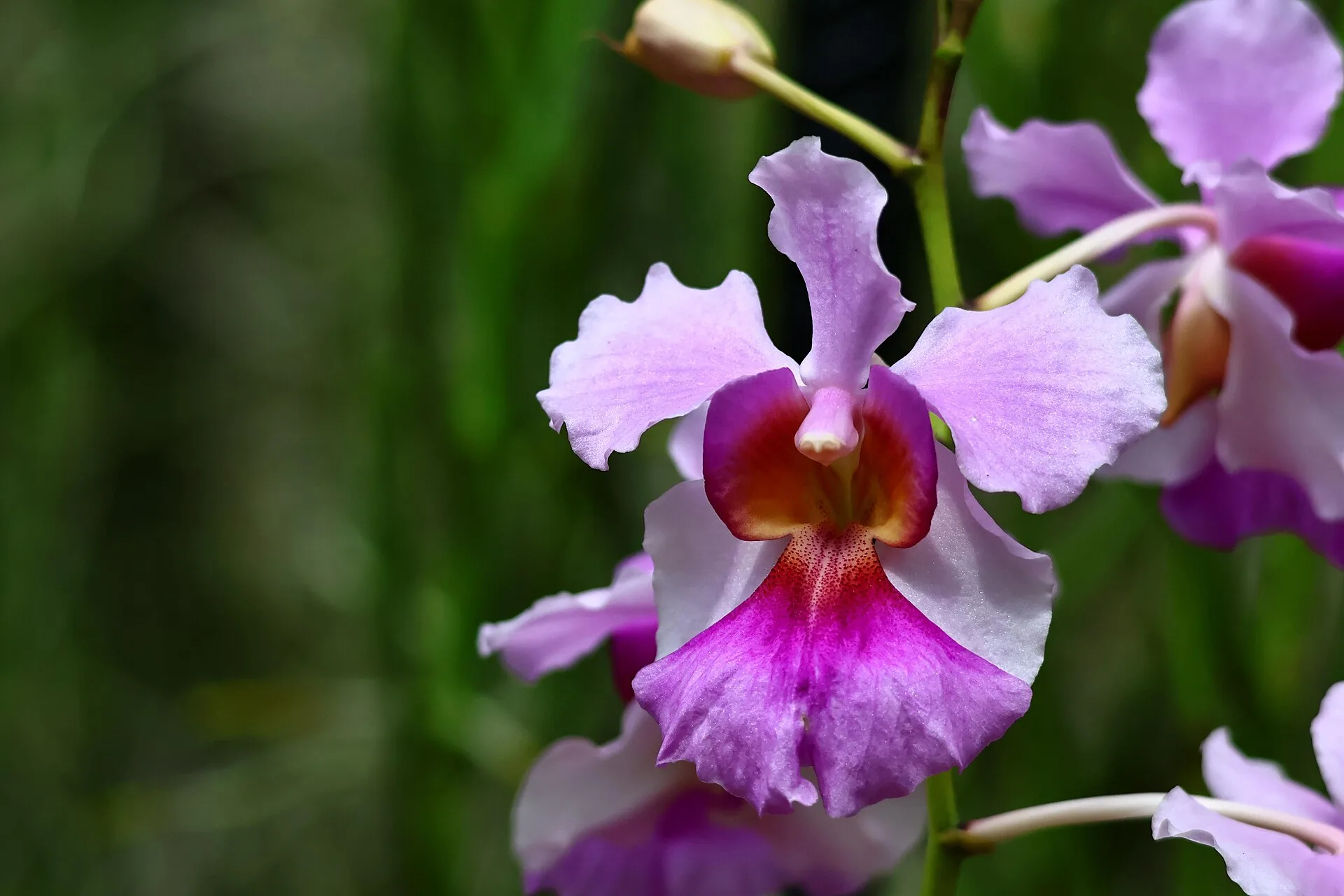
NParks describes each flower as about 5 cm across and 6 cm tall. The top sepal and the petals are light pink, the lower sepals are white, and the lip is a bright pinkish purple with an orange centre spotted in reddish purple. One inflorescence can carry up to 12 flowers. The plant forms dense clumps of slender, branching stems that are tied to posts for support, and it flowers only once its top has grown about 40 to 50 cm above the post. It needs an open, sunny position, humid moving air and heavy feeding, and in Singapore it blooms all year. Singapore Infopedia, the National Library Board's reference service, records that it was once a common plant in Malayan gardens.
The flower was first named in the genus Vanda, as a cross of Vanda teres and Vanda hookeriana. Both parents were later moved to Papilionanthe, so its scientific name is now Papilionanthe Miss Joaquim, while the common name has stayed in use. NParks lists it as the first registered plant hybrid from Singapore, and a 2011 study in the journal AoB Plants describes it as the first hybrid Vanda registered with the Royal Horticultural Society (RHS). The same study lists named varieties including 'Rose Marie', 'Douglas' and 'Singapore Botanic Gardens'. 'Agnes' is the name given retrospectively to the original plant, and it is this variety that holds the national title.
WHO WAS AGNES JOAQUIM?
Agnes Joaquim was born in Singapore on 7 April 1854, the eldest daughter and second of 11 children of Parsick Joaquim and his wife Urelia. Her father was an Armenian from Madras who arrived in Singapore around 1840 and in 1849 co-founded the firm Stephens & Joaquim with Simon Stephens; her mother was a Singapore-born Armenian and, according to Infopedia, also a keen gardener. The couple married on 17 February 1852, and Parsick died on 17 May 1872. In 1861 the family moved to a mansion overlooking Tanjong Pagar, which Parsick named Mt Narcis after his eldest son. The house was demolished in 1901 and its carriageway became Narcis Road.
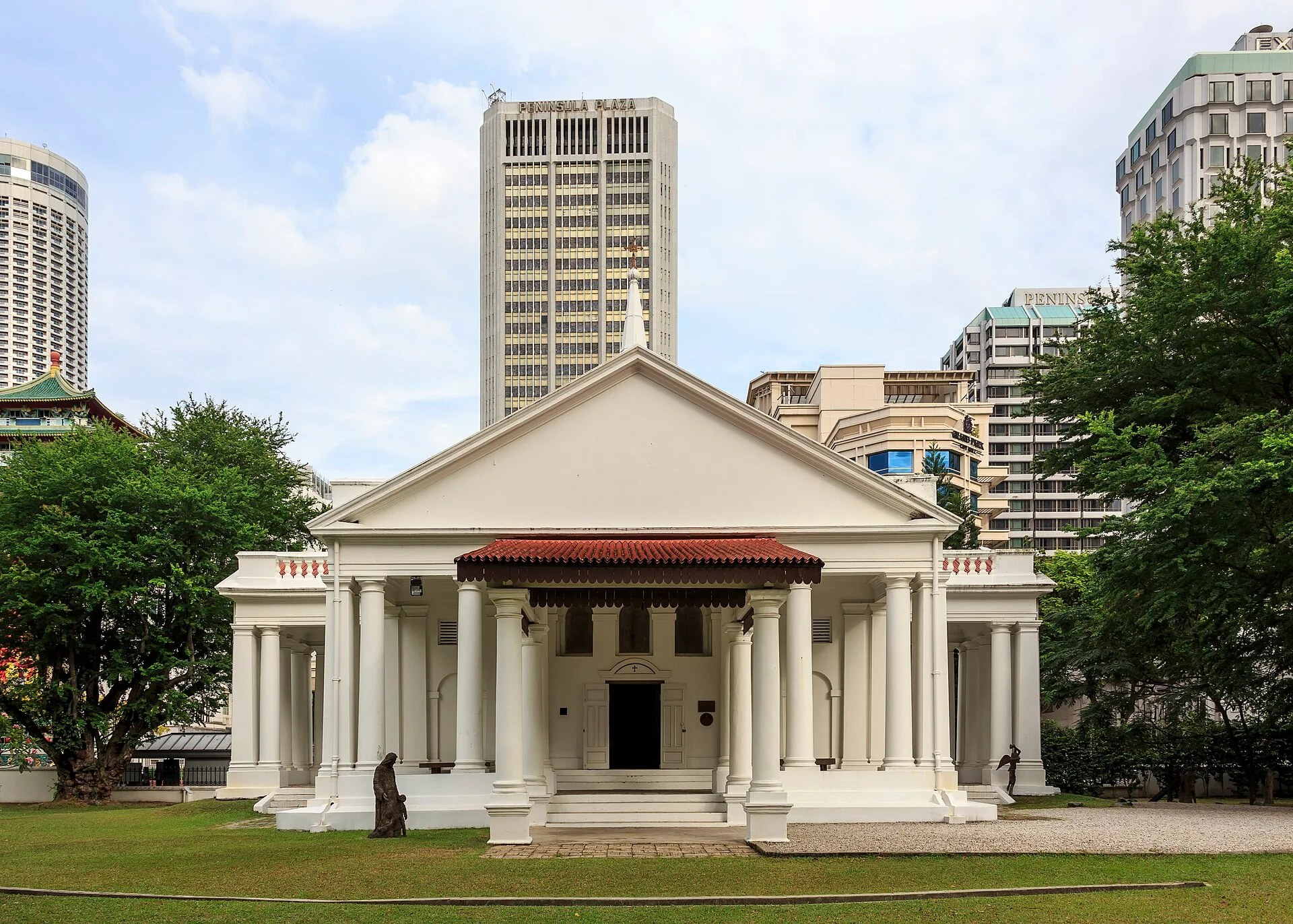
Agnes was a prize-winning gardener. Infopedia records that she won prizes at Singapore's annual Flower Show from 1881 to 1899, many of them first prizes, and dates the cross that produced her orchid to around 1890, in the family garden. At the April 1899 show the hybrid won first prize for the rarest orchid. Agnes died on 2 July 1899, aged 45, about three months later. Her tombstone was moved from the Bukit Timah cemetery to the grounds of the Armenian Church on Hill Street, where it carries the line "Let her own works praise her." In 2015 she was inducted into the Singapore Women's Hall of Fame.
RIDLEY'S 1893 DESCRIPTION AND THE 1897 LONDON AWARD
In 1893 Agnes, or possibly her brother Joe, showed the plant to Ridley, who directed the Botanic Gardens from 1888 to 1911. Ridley had it sketched, kept a herbarium specimen labelled "Vanda Agnes Joaquim" and described it in The Gardeners' Chronicle of 24 June 1893. He wrote that Miss Joaquim had "succeeded in crossing Vanda Hookeriana, Rchb. f., and V. teres", added that "no record was kept as to which was used as the male", and judged the offspring "quite intermediate between the two species". In an 1894 paper for the Linnean Society, published in 1896, he repeated the account and called the plant "V. x Miss Joaquim". Ridley lived to 100 and, according to a 2018 article in the National Library's journal BiblioAsia, never changed his version.
Ridley sent cuttings to Sir Trevor Lawrence, President of the RHS, who grew them at Burford Lodge in Dorking, England. The orchid flowered in Europe for the first time in 1897 and was shown at the Royal Horticultural Show in London in June that year, its first public showing, where it won a First Class Certificate for Lawrence as owner. The Gardeners' Chronicle reported that the plant came from a cross made "some years ago by Miss Joaquim at Singapore."
WAS VANDA MISS JOAQUIM BRED OR A NATURAL HYBRID?
The case that Agnes made the cross by hand rests first on Ridley's two published accounts and on herbarium sheets from April 1893 that, according to Infopedia, describe the plant as an artificial hybrid. BiblioAsia authors Nadia Wright, Linda Locke and Harold Johnson list later botanists who accepted it: Isaac Henry Burkill, Ridley's successor, who recorded Joaquim as the creator after checking the herbarium; Richard Holttum, Director from 1925, who called it "her orchid" in 1928; Robert Rolfe, editor of The Orchid Review; and Sander's Complete List of Orchid Hybrids. Wright published on the question in 2000, 2003 and 2004, and with Johnson in 2008. They note that information on orchid seed germination was readily available in books and horticultural journals of the period.
The natural hybrid case began with Humphrey Morrison Burkill, Director from 1957 to 1969, who at the 1963 World Orchid Conference called the plant a "delightful accident of nature". In 1981 a nephew, Basil Johannes, said Agnes had "found the flower one morning" in the garden, and Teoh Eng Soon's 1982 book A Joy Forever added that it was found in a clump of bamboo. Hew, Yam and Arditti, authors of Biology of Vanda Miss Joaquim (2002), argued for chance pollination and called Ridley's account "likely to be more allegorical than factual". Wright and her co-authors reply that Johannes was born in 1893, moved to Singapore in 1901 and was about six when Agnes died.
DNA settled one part of the record. In 2011 the botanists G. S.-W. Khew and T. F. Chia sequenced two chloroplast genes, rbcL and matK, which pass down the maternal line, using fresh plants and the 1893 herbarium specimens. They identified V. teres var. andersonii as the seed parent and, by exclusion, V. hookeriana as the pollen parent, the reverse of the RHS record. The question of intent was settled administratively: after Agnes's great-grandniece Linda Locke asked agencies to review the sources in March 2016, NParks and the National Heritage Board recognised Agnes as the breeder on 7 September 2016.
HOW VANDA MISS JOAQUIM BECAME SINGAPORE'S NATIONAL FLOWER
The hybrid spread first to Malaysia and then to Hawaii. Infopedia records that Isaac Burkill sent 28 cuttings to Hawaii in 1920, where the flower became popular for leis. Orchid exporting from Singapore began in the 1930s, and according to BiblioAsia librarian Ang Seow Leng, Vanda Miss Joaquim was the first orchid exported on a large scale. Breeders also used it as a parent: by the end of the 20th century more than 440 hybrids had been derived from it.
The national flower was chosen by a committee drawn from the Ministry of Culture, the Parks and Recreation Department, the Singapore Tourist Promotion Board, the Singapore Institute of Standards and Industrial Research and the Orchid Society of Southeast Asia. Of the 40 candidates, 30 were orchids. Infopedia records that the 'Agnes' variety was picked for its vivid colour and its "resilience and year-round blooming quality", and it was launched on 15 April 1981. The first National Flower Week ran from 20 to 27 July 1981.
The flower then entered national design. It formed the reverse of the one-cent coin in the 1985 Floral series and appeared in the 2003 Garden City stamp series. In 1992 the Singapore Dress Development Committee narrowed its orchid motifs to five, and in 1994 Vanda Miss Joaquim became the theme of the Singapore dress collection. The Singapore Institute of Standards and Industrial Research had developed a technique for preserving orchids in 24K gold in 1976, the basis of the Risis gold orchids. Vanda Miss Joaquim Park, Vanda Drive and Vanda Crescent are named after the flower.
ORCHID BREEDING AT THE SINGAPORE BOTANIC GARDENS
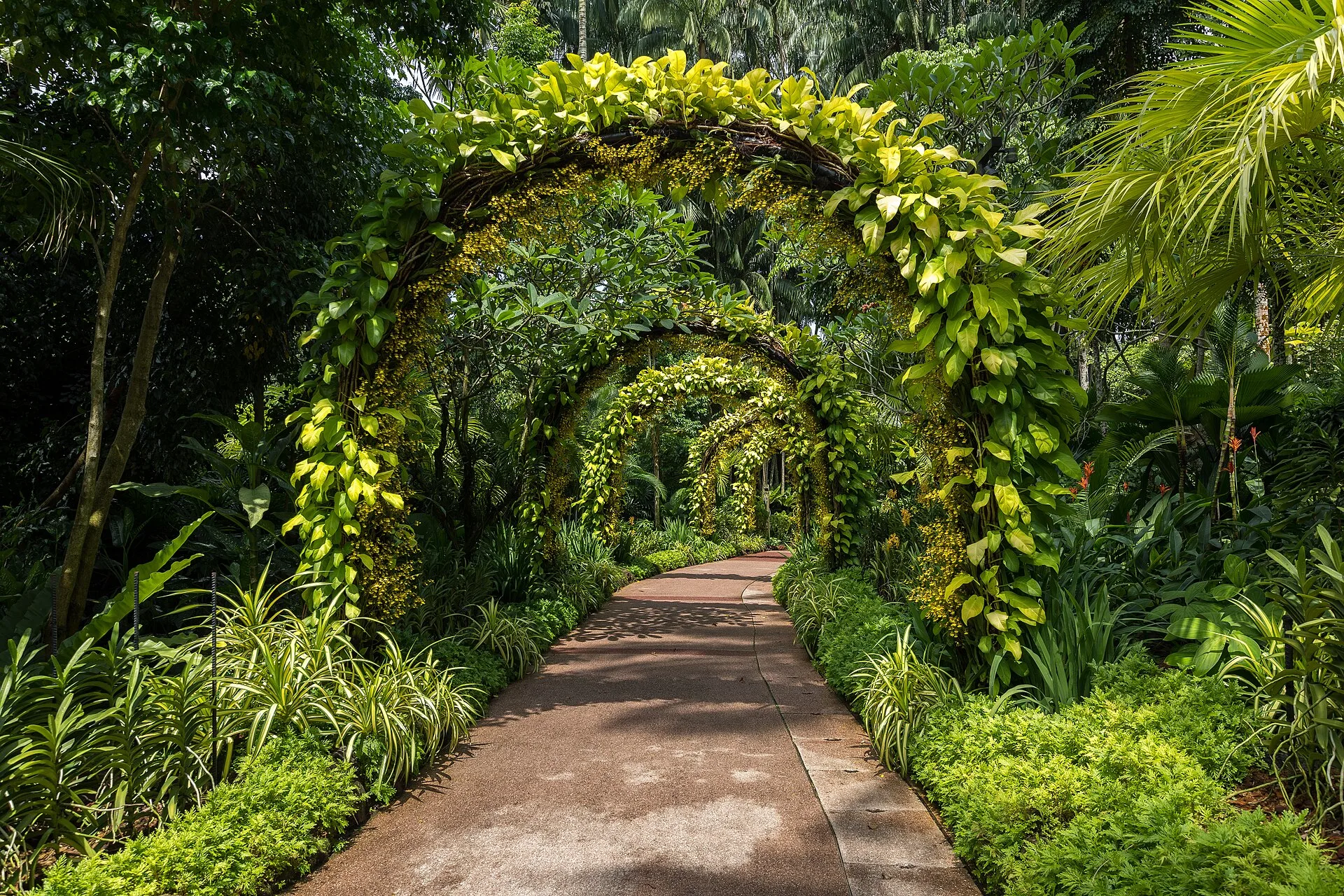
Orchids were first cultivated at the Gardens in the mid-1870s by Superintendent H. J. Murton, and Ridley's collecting programme from 1888 led to an Orchid House in 1899. Holttum, who joined the Gardens in 1922, started the Orchid Hybridisation Programme in 1928. A 2024 paper in the Gardens' Bulletin Singapore credits him with introducing Knudson's asymbiotic method, which lets orchid seed germinate without symbiotic fungi. The first hybrid, Spathoglottis Primrose (S. aurea x S. plicata), flowered in 1931, and Holttum registered 28 hybrids during his tenure. Papilionanda Tan Chay Yan, bred by lawyer Tan Hoon Siang from seed sown at the Gardens in 1949, won an RHS First Class Certificate at the 1954 Chelsea Flower Show.
The National Orchid Garden opened on 20 October 1995 after three years of construction at a cost of S$5 million. It covers 3 ha, against the 1 ha of the Orchid Enclosure it replaced, and displays more than 60,000 orchids drawn from over 150,000 plants; by 2010 the collection held more than 1,000 species and more than 2,000 hybrids. Its displays are arranged in four seasonal colour schemes, from spring yellows, creams and golds to winter whites. The Cool House, a 600 m² glasshouse opened in 2004 after a S$4.1 million upgrade, recreates a tropical montane climate of 15 to 29°C for more than 450 orchid species.
The Gardens also name hybrids after visiting guests. The first of these VIP orchids, Aranthera Anne Black, was named in 1956 after Lady Anne Black. Months before a visit the Gardens receive a profile of the guest, shortlist suitable unnamed hybrids and take advice on colours to prefer or avoid; each chosen orchid is registered with the RHS and the guest receives a certificate listing its parentage. Named orchids are not sold. Examples include Dendrobium Elizabeth, for Queen Elizabeth II, who toured the Gardens in 1972, and an orchid for singer Stefanie Sun in 2006, the first for a Singaporean celebrity. More than 200 such orchids grow in the National Orchid Garden.
EMBU AT MANDARIN ORIENTAL, SINGAPORE

Silverfox Studios designed Embu, the all-day dining restaurant on level 3 of Mandarin Oriental, Singapore. The project was completed in September 2023 and led by Susan Heng and Patrick Waring. Where Singapore's national flower is a hybrid named after the woman in whose garden it arose, Embu takes its name from a tree: the Tembusu, known for its fragrant flowers and sturdy wood. The design themes come from Singapore's identity as a Garden City: canopy, botanical planting, pavilions and greenhouses.
Inside the restaurant, curved, louvred timber canopies and framing echo the perpendicular branching of the Tembusu. Underfoot are Peranakan black-and-white porcelain floor tiles, and the material palette includes open-weave rattan. Orchid houses and glasshouses run through the history of the Singapore Botanic Gardens told above, from the Orchid House that followed Ridley's collecting programme in 1899 to the 600 m² Cool House of 2004, which recreates a montane climate for more than 450 orchid species in the National Orchid Garden.
SOURCES
- BiblioAsia, National Library Board Singapore Blooming Lies: The Vanda Miss Joaquim Story (Nadia Wright, Linda Locke and Harold Johnson)
- Singapore Infopedia, National Library Board Vanda Miss Joaquim
- Singapore Infopedia, National Library Board Agnes Joaquim
- National Parks Board Vanda Miss Joaquim: Our National Flower
- AoB Plants, Oxford University Press Parentage determination of Vanda Miss Joaquim (Orchidaceae) through two chloroplast genes rbcL and matK (Khew and Chia, 2011)
- BiblioAsia, National Library Board Singapore More Than Just a Flower: The Orchid's Manifold Faces (Ang Seow Leng)
- Singapore Botanic Gardens Orchid Hybridisation Programme
- Gardens' Bulletin Singapore Rediscovering and conserving orchids in a tropical city-state (Er, Tan, Neo and Ang, 2024)
- Singapore Infopedia, National Library Board National Orchid Garden
- BiblioAsia, National Library Board Singapore Flower Power: Singapore's Orchid Diplomacy (Rebecca Tan)