MASKED DANCE DRAMA FROM THE MUROMACHI PERIOD TO TODAY
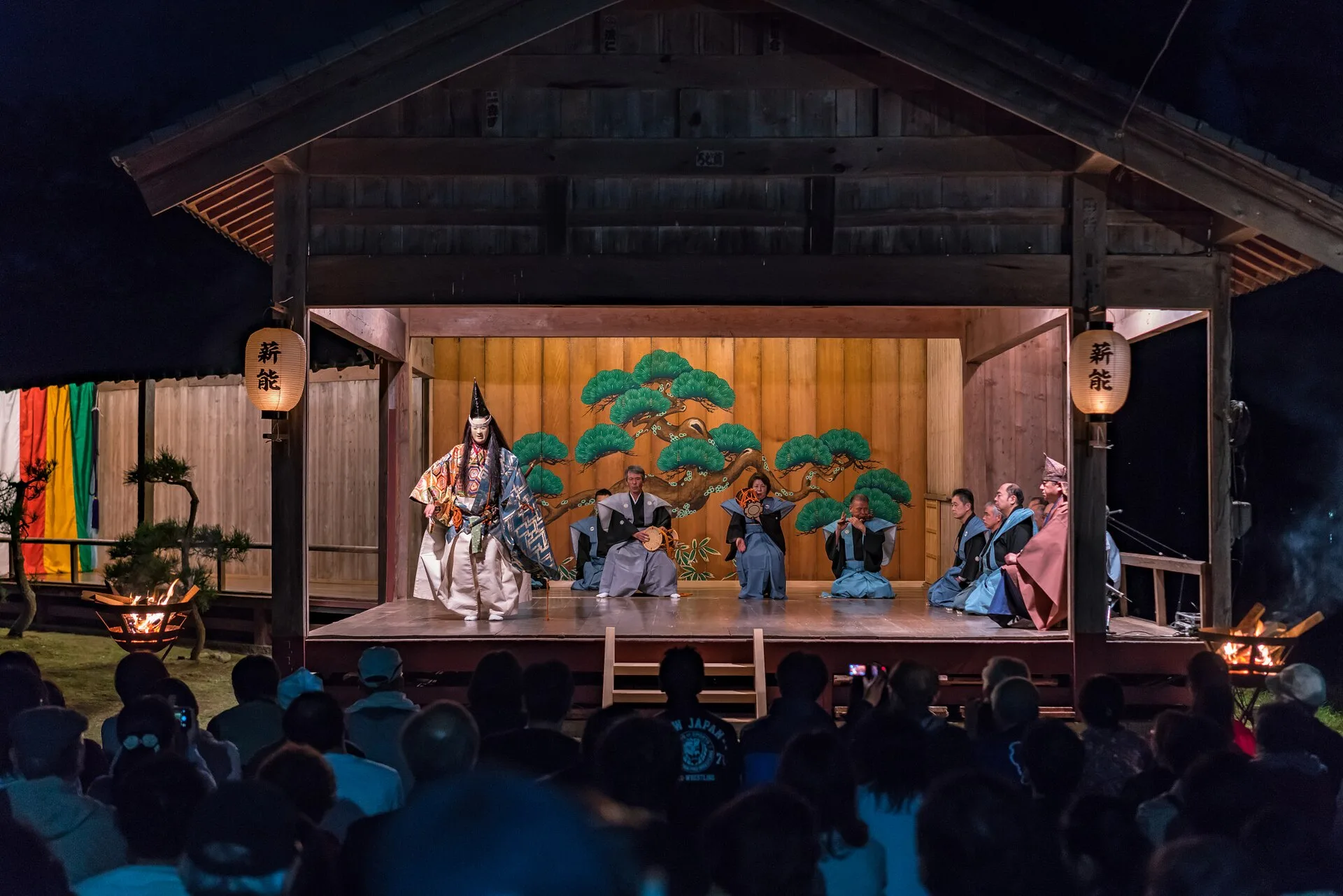
Noh theatre is a masked dance drama that took its present form in 14th-century Japan under the actor and playwright Kan'ami and his son Zeami. With kyogen, a comic form played on the same stage, it makes up nogaku, which UNESCO inscribed on its Representative List of the Intangible Cultural Heritage of Humanity in 2008. A noh play combines a chanting chorus, an ensemble of flute and drums, and the stylised movement of a principal actor who usually wears a mask carved from Japanese cypress. The form has a performance history of more than 600 years and is kept up today by five schools of principal actors: Kanze, Komparu, Hosho, Kongo and Kita.
WHAT IS NOH THEATRE AND WHERE DID IT COME FROM
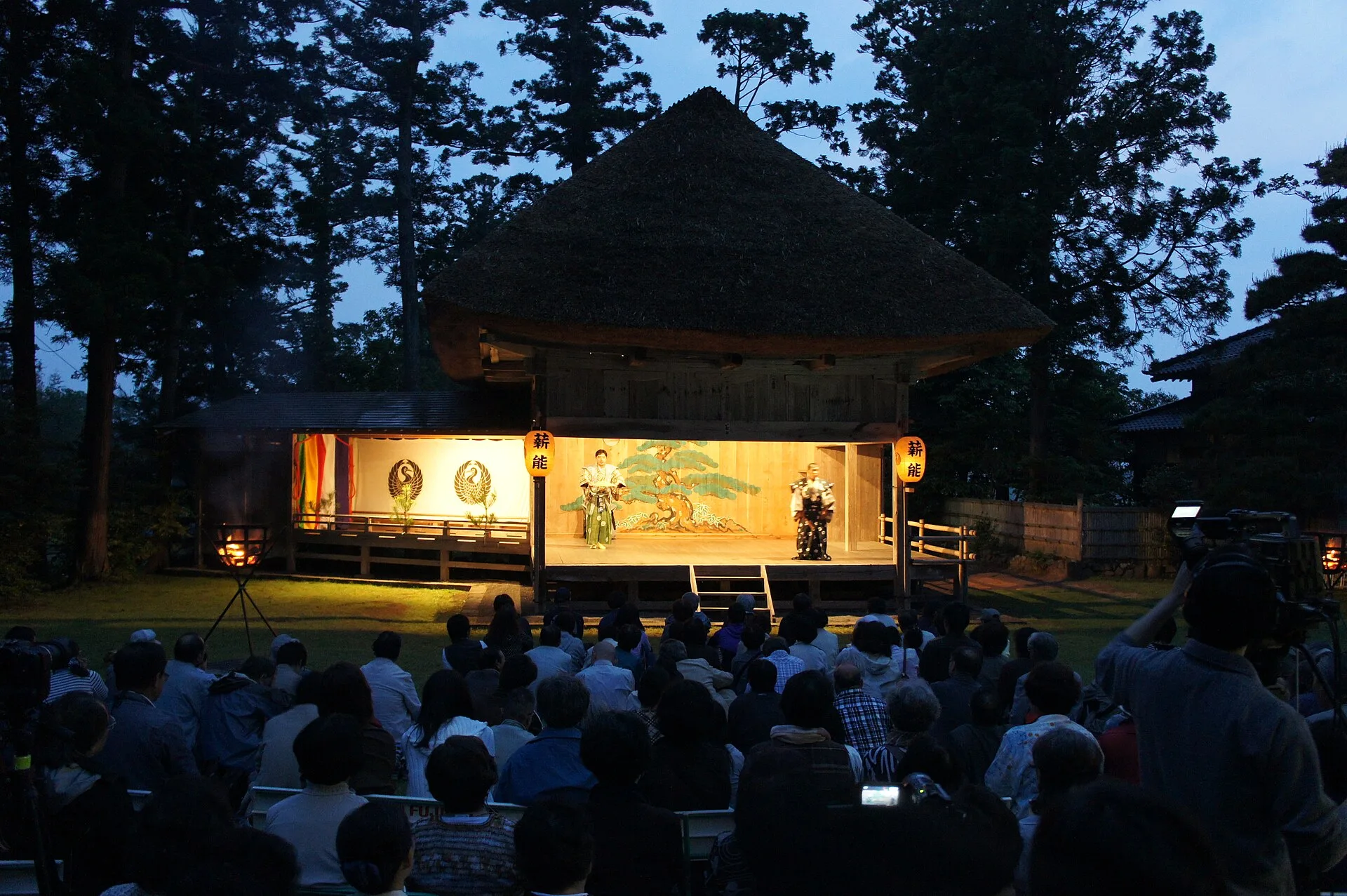
The word noh comes from a term meaning skill or talent, according to the Japan National Tourism Organization. UNESCO traces nogaku to the 8th century, when sangaku was transmitted from China to Japan. Sangaku was a mixed entertainment of acrobatics, song, dance and comic sketches, and over the following centuries it absorbed other Japanese performing arts. The Japanese Architecture and Art Net Users System (JAANUS), a dictionary of Japanese art terms, describes noh and its masks as growing out of local festival customs and being refined under the daimyo class.
In the 14th century the troupes that developed noh performed sarugaku. Britannica records that early sarugaku reportedly included tricks, acrobatics and slapstick skits, and that by Kan'ami's time it had developed into plays with dialogue, acrobatics and dance. A second source was dengaku, the music and dance of rustic harvest celebrations. The resulting form was called sarugaku no nou, now shortened to noh. Kan'ami was the first to bring kusemai, a popular song and dance with a strong irregular beat, into drama, and Britannica names kusemai and dengaku as the two main sources of noh.
KAN'AMI, ZEAMI AND THE PATRONAGE OF ASHIKAGA YOSHIMITSU
Kan'ami was born in 1333 in Iga Province. He organised a sarugaku troupe in Obata, then moved it to Yamato, where it became the Yuzaki company. That company developed into the Kanze school of noh. Kan'ami was an actor, playwright and musician, and the plays attributed to him include Komachi, Eguchi, Ji'nen koji and Matsukaze, the last later adapted by his son. In 1374 the shogun Ashikaga Yoshimitsu attended one of Kan'ami's performances in Kyoto and became his patron, which gave the troupe the means to refine the form and write new plays.
Zeami, born in 1363, performed before Yoshimitsu in 1374 and was favoured by the shogun from then on. He took over the Kanze school after Kan'ami died in 1384 and became a Zen monk in 1422. Britannica credits Zeami with about 90 of the roughly 230 plays in the present noh repertoire, including most of the best known. The Metropolitan Museum of Art notes that noh's status rose under Yoshimitsu and that the art became closely linked with the samurai class.
That link continued through the Edo period (1615 to 1868), when the Tokugawa shogunate officially sponsored noh. Daimyo were expected to learn noh chanting and dancing, high-ranking samurai supported troupes, built stages and published libretti. The Japan National Tourism Organization notes that noh flourished in this period, declined early in the Meiji period (1868 to 1912) and has since revived. In 1957 Japan designated nogaku an Important Intangible Cultural Property, which gives legal protection to the tradition and to its most accomplished performers.
ZEAMI'S FUSHIKADEN AND THE MEANING OF YUGEN
Zeami also wrote the theory of the form. His principal treatise, the Fushi kaden, also known as the Kaden sho, was written between 1400 and 1418 as a manual for his pupils. In it he held that an actor had to master three roles: the warrior, the woman and the old person. An essay by Tom Hare on Stanford University's noh project records that Zeami's earlier typology, in the late 14th century, was broader, including gods, demons, priests and the deranged, before he settled on the three modes.
The treatises also set out the idea of yugen. Britannica names two main elements in his writing, monomane, the imitation of things, and yugen, the symbolic aspect and spiritual core of noh, and quotes him as writing that "the essence of yugen is true beauty and gentleness." The Government of Japan's Highlighting Japan magazine describes yugen as a subtle and profound beauty that is hard to put into words, and as a central aim of noh performance today. Hare places the play Hashitomi, which builds to a jonomai dance at its climax, within the aesthetics of the early to mid 15th century, yugen among them.
THE NOH STAGE: HASHIGAKARI, PILLARS AND THE MIRROR ROOM

UNESCO describes the noh stage as projecting into the audience and connected by a walkway to a backstage area. JAANUS gives the standard main stage as three bays, or 5.7 m, square. Each corner post has a name: the shitebashira at the rear left for the principal actor, the metsukebashira at the front left as a guide post, the wakibashira at the front right for the supporting actor, and the fuebashira at the rear right for the flute. The posts serve as landmarks for actors whose vision is limited by their masks. The chorus sits on an extension along the right side, and the musicians sit at the rear of the stage on the atoza.
The walkway, the hashigakari, runs diagonally from the rear left of the stage to the kagami no ma, or mirror room, and lets actors enter slowly. Its length is not fixed, and three small pines set in white gravel mark its edge. The back wall carries a painted pine, the subject of a separate article on the pine tree in Japanese culture. Stages were built only of cypress polished with the tree's own oil, with two jars under the atoza and three under the hashigakari to help control sound. The oldest surviving stage, at Nishi Honganji in Kyoto, dates from 1581. Stages were originally outdoor structures and moved inside purpose-built halls, nohgakudo, from the mid to late 19th century.
NOH MASKS, COSTUMES AND MUSIC
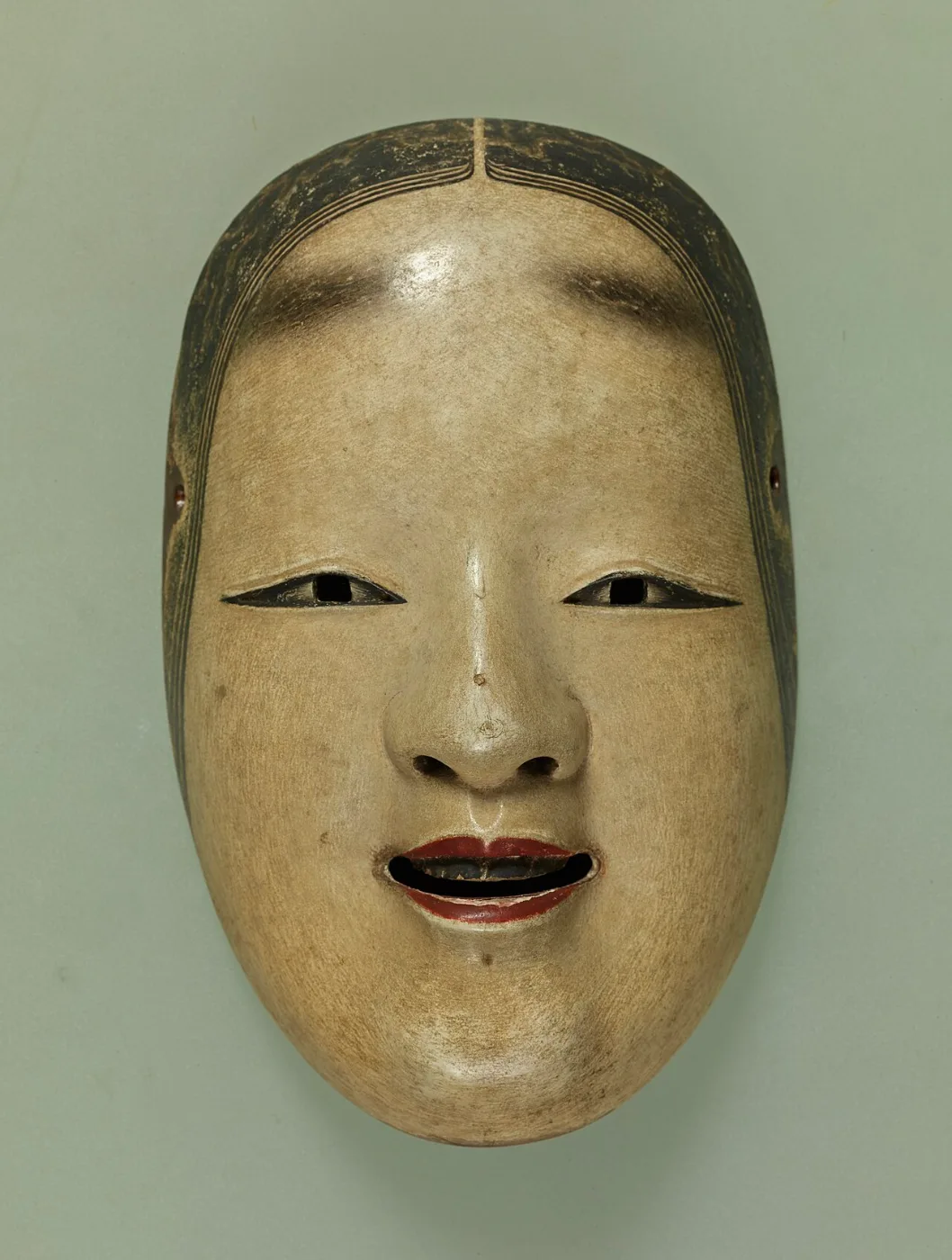
Noh masks are worn by the principal actor, the shite, and his companion, the tsure. They are small and sit in front of the face, with a wig covering the rest of the head. According to JAANUS, the earliest are the okina masks for the ritual play Okina, which predate Kan'ami and Zeami. Demon-god masks were probably the next to develop, and other types cover old men, women, men and vengeful spirits; women's masks were carved from the late 14th century so that mature male actors could play female roles. Books of the 16th century classified about 125 mask styles, and the count today is close to 200. Some roles are played unmasked.
A mask is carved from an unblemished block of Japanese cypress, hinoki, working the front and back alternately. Carvers build in asymmetry, such as one eye looking up and the other down, so that the expression can change on stage; Highlighting Japan notes that the shite tilts his face to shift light and shadow across the mask. The surface is built up from layers of gofun, a powdered white pigment, mixed with animal glue, then painted with flesh tones, black ink for the hairline and brows, and vermilion for the mouth.
The costumes use silk, metallic thread and gold and silver leaf, worked by weaving and embroidery. The Metropolitan Museum of Art calls the karaori, a brocaded robe usually worn as the outer garment for women's roles, the quintessential noh costume; nuihaku combines embroidery with metal leaf, and maiginu dance robes and mizugoromo jackets were made specifically for the noh stage in the 15th century. The music comes from the hayashi, an ensemble of fue bamboo flute, kotsuzumi small hand drum, otsuzumi hip drum and taiko stick drum, with the jiutai chorus chanting the story and setting.
THE FIVE CATEGORIES OF NOH PLAYS AND KYOGEN
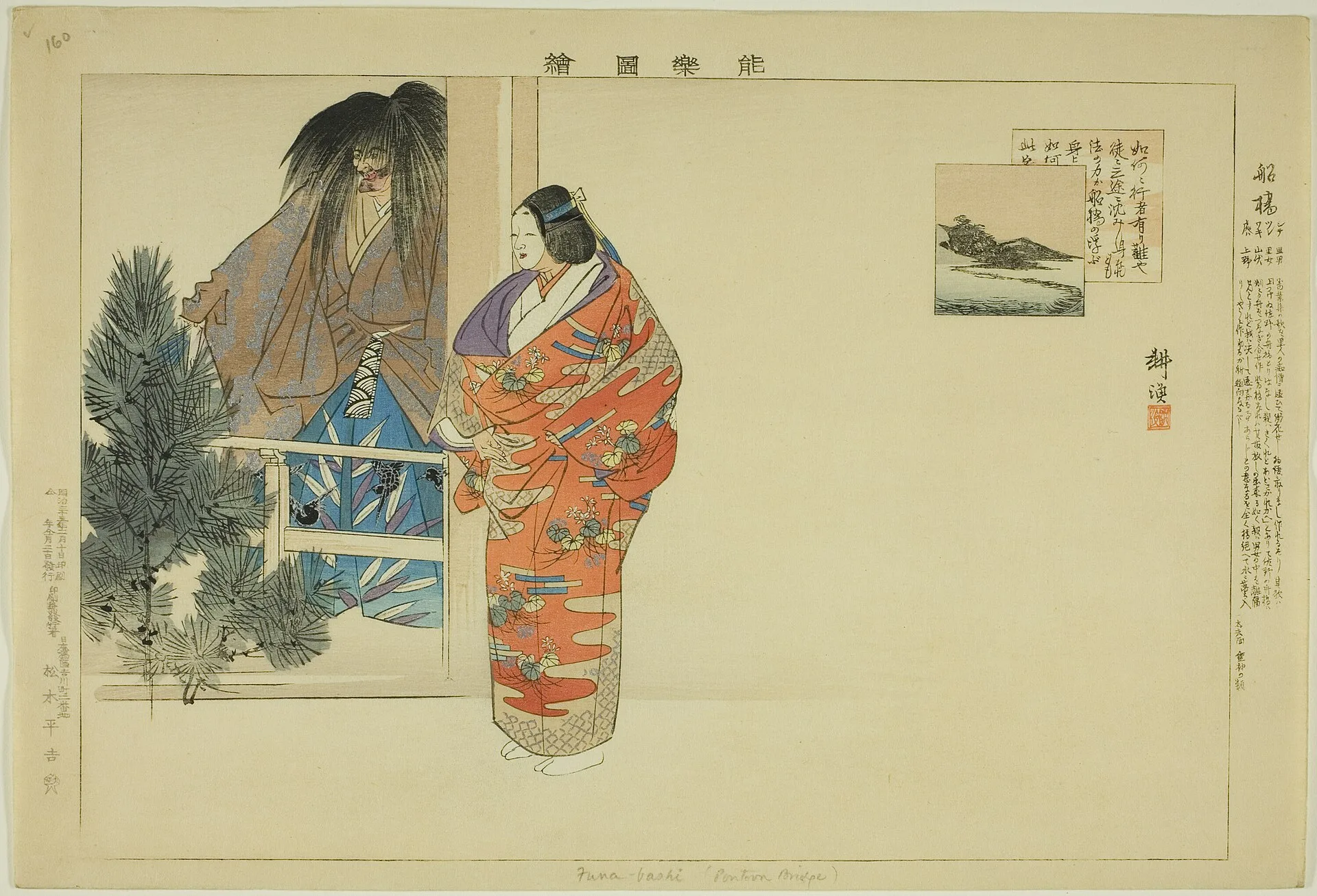
Noh plays are grouped into five categories, the goban-date system, numbered in the order troupes used for a formal full-day programme: god plays, warrior plays, wig plays, miscellaneous plays and demon plays. Hare notes that the system was in use by the 17th century if not earlier. The Japan National Tourism Organization describes a full-day programme as opening with the ritual piece Okina-Sanbaso, followed by a play from each category with a kyogen performance between each play. The shite is the central character in every category, and the waki is a supporting role that highlights the shite's acting; in Hashitomi, Hare notes, the waki speaks first and sets up the action.
Kyogen shares noh's roots in sangaku. UNESCO describes it as relying less on masks and growing out of the humorous plays of sangaku, which shows in its comic dialogue. Its texts use an older form of Japanese and depict ordinary people of the 12th to 16th centuries. Highlighting Japan notes that kyogen plays turn on everyday life and on human foolishness and weakness, and that the form has two schools, Okura and Izumi. Kyogen actors also appear inside noh plays: in the play Kokaji, as Hare describes it, a kyogen actor enters as a minor local deity and retells the plot.
HOW NOH THEATRE DIFFERS FROM KABUKI
Noh is the older of the two forms by more than two centuries. It took its present shape in the 14th century under shogunal patronage and was tied to the samurai class, while kabuki began in Kyoto in the early 17th century and, as UNESCO notes, was especially popular with townspeople. The Japan National Tourism Organization calls noh the more serious form. Noh's principal actor wears a carved mask, while kabuki actors wear kesho, the make-up that gives the form its visual signature. Noh plays draw on classical literature and supernatural heroes; kabuki plots, covered in our history of kabuki, deal with historical events and moral conflicts in personal relationships.
The stages differ as well. On the noh stage, actors enter along the diagonal hashigakari, and the fixed corner posts guide them when masked. The kabuki stage has revolving sections and trapdoors for entrances and exits, and its signature feature is the hanamichi, a footbridge that extends into the audience. In 2008 kabuki, nogaku and the puppet theatre bunraku became the first Japanese performing arts inscribed on the UNESCO list. Nogaku is now staged regularly at the National Noh Theatre in Tokyo, founded in 1983, which also runs courses to train actors for its leading roles.
NETSU: A KABUKI THEATRE CONCEPT AROUND A ROBATA GRILL

Netsu, a Japanese robata restaurant by chef Ross Shonhan at Mandarin Oriental Jumeira, Dubai, was completed in 2019 with kabuki, not noh, as its design concept. The double-height room is planned as a kabuki theatre, with the robata grill as the central stage and guests watching from several levels, and an upper bar and DJ lounge above. A raised walkway from the back kitchen recalls the hanamichi, the kabuki footbridge into the audience, rather than the diagonal hashigakari of the noh stage described above.
The theatre references continue on the surfaces. Graphics in the style of 1950s kabuki posters are applied to the columns and a wall, and outside, horizontal recessed lighting references the tiered seating of a theatre. UNESCO describes kabuki as the most popular traditional style of Japanese drama today, and inscribed it on its Representative List in 2008, the same year as nogaku. The cooking format at the centre of the room, robata, is covered in a separate article on how Japan's hearthside grill became a restaurant.
SOURCES
- UNESCO Nogaku theatre
- UNESCO Kabuki theatre
- Britannica Kan'ami
- Britannica Zeami
- The Metropolitan Museum of Art Nō Costume
- JAANUS (Japanese Architecture and Art Net Users System) Noubutai
- JAANUS (Japanese Architecture and Art Net Users System) Noumen
- Stanford University Why Hashitomi and Kokaji?
- Highlighting Japan, Government of Japan An Introduction to Nohgaku Appreciation: From the National Noh Theatre to the World
- Japan National Tourism Organization Theater in Japan