SOUTH BEACH, ITS 1930S HOTELS AND THE PRESERVATIONISTS WHO LISTED THEM

Miami Art Deco is concentrated in South Beach, at the southern end of Miami Beach, in a district built largely in the 1930s and 1940s. On 14 May 1979 the area was listed on the US National Register of Historic Places as the Miami Beach Architectural District, and the City of Miami Beach records it as the first district composed primarily of 20th-century architecture to receive that listing. The Miami Design Preservation League (MDPL) describes the stretch of Ocean Drive between 5th and 15th Streets as the most concentrated strip of Art Deco architecture in the world. Its hotels were designed by a small group of local architects, among them Henry Hohauser, L. Murray Dixon and Anton Skislewicz, and from the late 1970s many of their facades were repainted in a pastel palette devised by the designer Leonard Horowitz.
HOW DID MIAMI BEACH BECOME A RESORT CITY?
According to Britannica, the site of Miami Beach was a mangrove swamp until 1912. John S. Collins, Carl Fisher, and John and James Lummus pioneered real estate development there. A bridge was built across the bay, followed in 1920 by a causeway, and dredging later added land to the island. The city was incorporated in 1915 as Ocean Beach and took the name Miami Beach the following year. Its growth was held back by the collapse of the Florida land boom and then the Great Depression, and Britannica credits the numerous Art Deco buildings that went up by the mid-1930s with helping to revive the city.
MDPL traces the style to the Exposition Internationale des Arts Décoratifs held in Paris in 1925, the subject of our article on the 1925 Paris Exposition and the birth of Art Deco. In the late 1920s the classical "Skyscraper Style" rose in large American cities. Miami Beach kept building through the Depression, and its boom coincided with Streamline Moderne, which MDPL calls Art Deco's "sleeker, more sober second act". The Society of Architectural Historians notes that Ocean Drive was planned for hotels and apartments close to the water, aimed at middle-class tourists.
WHAT ARE THE FEATURES OF MIAMI ART DECO?
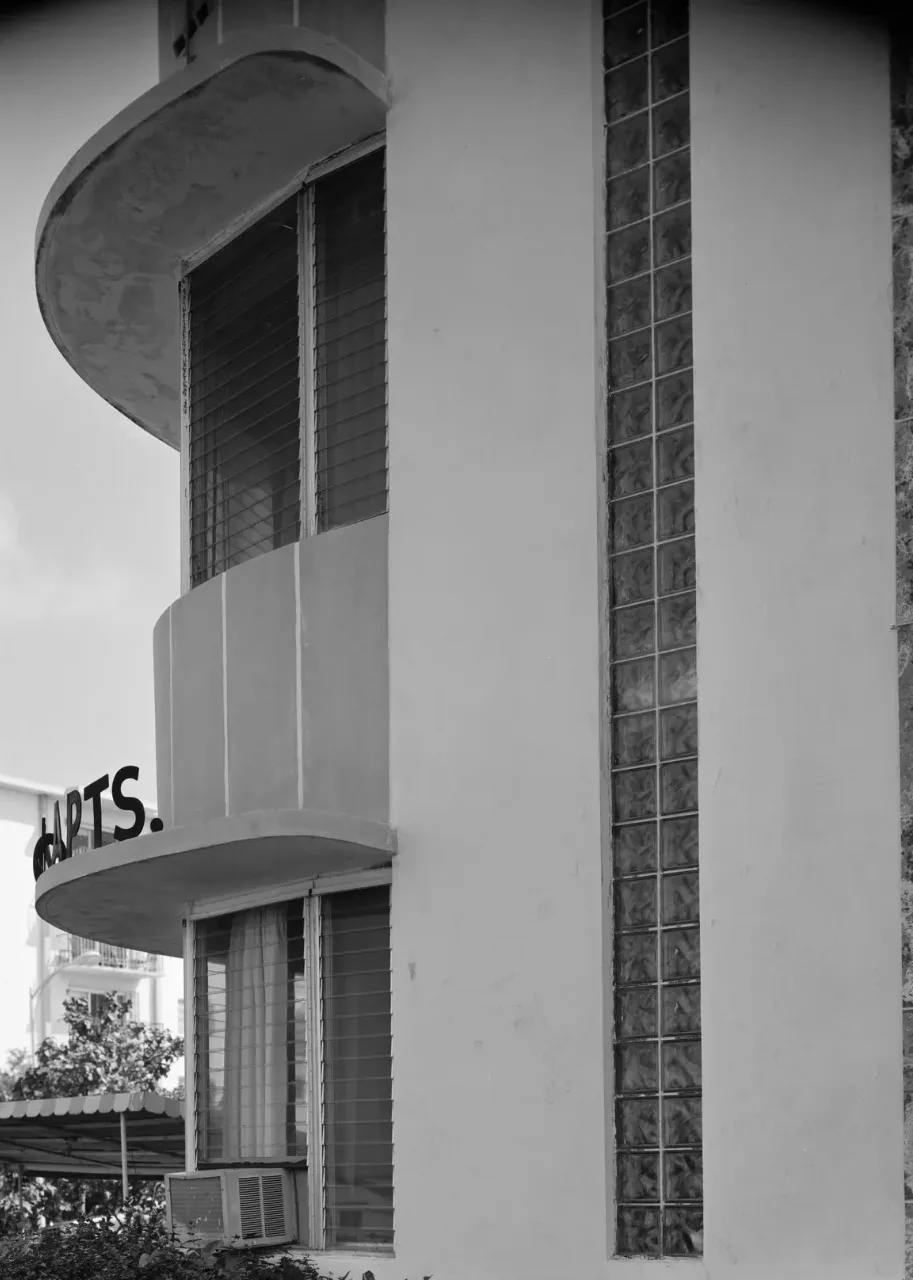
MDPL's guide to identifying Miami Art Deco starts with symmetry, which it calls the anchor of the style. On that symmetrical base sit eyebrow awnings shading horizontal strips of windows, round porthole windows borrowed from ocean liner design, ziggurat rooflines that step upwards like stylised pyramids, and curved corners. Facades carry decorative sculptural panels and vertical relief details, glass block is used to catch the light, and neon glows inside and out after dark. The league also advises counting details in threes, since the style favours a trio of elements.
MDPL describes Tropical Deco as a local invention that layers relief ornament of flora, fauna and ocean liner motifs onto Art Deco forms, with pelicans, palms and waves among its subjects. The National Park Service adds that the wide variation of Mediterranean and Moorish influences in the district produced a vernacular version of Deco particular to South Beach. Neon, whose history is told in our article on neon signs and Georges Claude, served a practical purpose: PBS's American Experience notes that neon signs helped the hotels announce themselves to travellers, and singles out the cobalt blue neon of the Breakwater on Ocean Drive.
HENRY HOHAUSER, L. MURRAY DIXON AND THE COLONY HOTEL
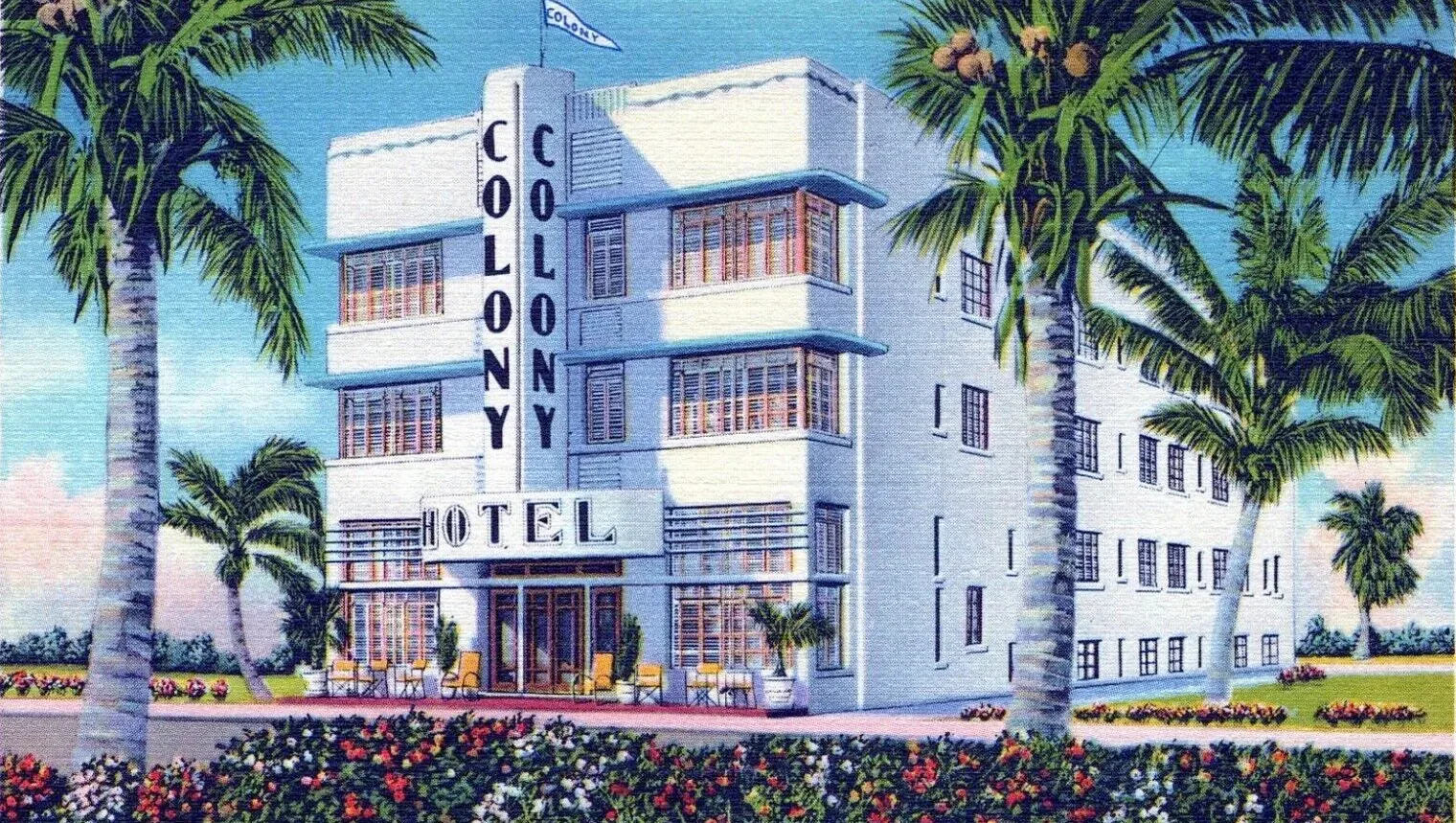
PBS's American Experience names Henry Hohauser and L. Murray Dixon as the principal architects of South Beach Deco. It also names Anton Skislewicz, Roy F. France, Igor B. Polevitsky, Albert Anis and the firm McKay & Gibbs. The Society of Architectural Historians, in its SAH Archipedia entry on the Colony Hotel, describes Hohauser as one of the earliest proponents of streamlined architecture on Miami Beach. The entry adds that other architects quickly adopted the features he used, which helped produce one of the largest and most consistent districts of modern buildings from the period in the United States.
Plans for Hohauser's Colony Hotel on Ocean Drive were completed in July 1935, and SAH Archipedia considers it the first streamlined building on the street. The client was the Colony Hotel Corporation. The original plans provided 50 rooms, each with a private bathroom, a telephone and a radio, along with a rooftop solarium, a wine-red lobby with a fireplace and a writing balcony for guests. A fireproof basement held recreation rooms, a card room and locker rooms with bathing facilities, which the entry notes was unusual for Miami Beach. Outside, Hohauser used steel corner windows and a neon marquee in the shape of an inverted "T" carrying the hotel's name.
THE ART DECO HOTELS OF OCEAN DRIVE AND SOUTH BEACH
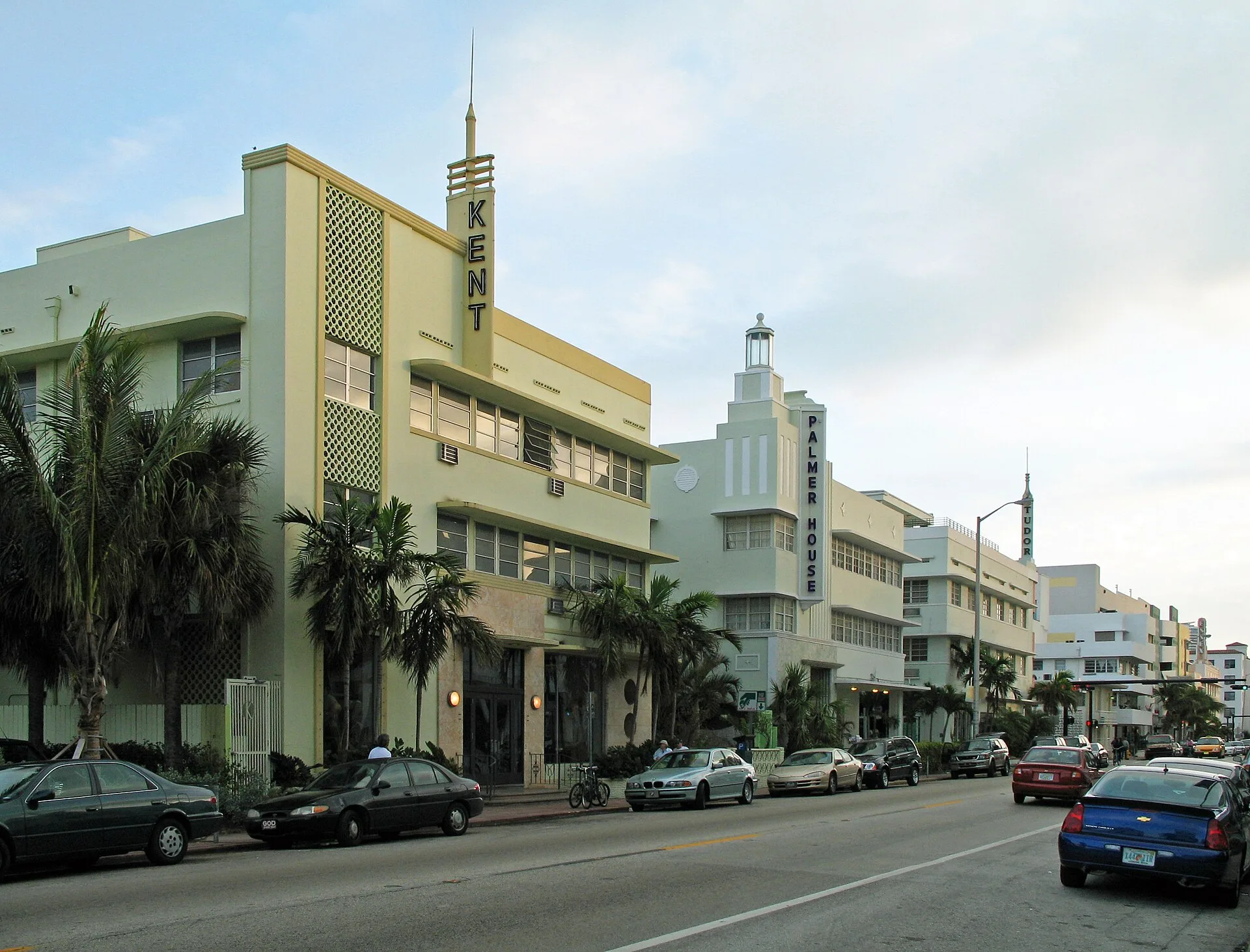
MDPL treats the Colony, at 736 Ocean Drive, as a textbook example of the style, with its symmetrical facade, eyebrow awnings, vertical fin and neon sign. Further north, the Carlyle at 1250 Ocean Drive is defined by three vertical columns and curved corners. The Breakwater, designed by Anton Skislewicz, dates from 1939. The National Park Service names the Breakwater, Beacon, Colony, Carlyle, Essex House, Leslie, Marlin, Park Central, Raleigh and Webster as examples of the South Beach hotels saved from demolition along the oceanfront.
PBS's American Experience dates a further set of South Beach hotels. Hohauser designed the Essex House Hotel in 1938, with porthole windows and a neon tower resembling a smokestack, followed by the Collins Park Hotel and the Century Hotel in 1939. Dixon's Senator Hotel also dates from 1939. Roy F. France designed the Cavalier Hotel in 1936, and Albert Anis designed the Tyler Hotel in 1940, with its streamlined prows. Building continued through the next decade and beyond: McKay & Gibbs designed the Surfcomber in 1948 with squared eyebrows, and Igor B. Polevitsky designed the Shelborne in 1954.
BARBARA CAPITMAN, MDPL AND THE 1979 HISTORIC DISTRICT
According to PBS, Barbara Capitman and Leonard Horowitz came across the overlooked buildings of South Miami Beach in the mid-1970s. MDPL records that Horowitz and Capitman founded the Miami Design Preservation League in 1976 with eight other individuals, and that more than 400 design professionals attended its first public meeting. MDPL describes Capitman as a leading voice for the district's Deco buildings, and the National Park Service identifies her as the league's founder and the leader of the campaign for a National Register listing.
The campaign sought National Register designation for an area of about one square mile, and the listing followed in May 1979. The National Register record names it the Miami Beach Architectural District, roughly bounded by the Atlantic Ocean, Alton Road and the Collins Canal, with periods of significance from 1900 to 1949. The National Park Service calls it the nation's first urban 20th-century historic district. Listing did not save every building: the Boulevard Hotel was demolished in April 1980, and Henry Hohauser's New Yorker hotel was torn down in 1981. MDPL now counts ten local historic districts in the city, four of which, Espanola Way, Collins and Washington Avenues, Museum, and Flamingo Park, together form the nationally recognised Art Deco District.
LEONARD HOROWITZ AND THE MIAMI ART DECO PASTEL PALETTE

The National Park Service records that South Beach's buildings were originally painted mostly white, with small touches of jade green, ochre or coral. MDPL describes Horowitz as an award-winning industrial designer who graduated from the New York Institute of Technology and moved to South Florida in the 1970s after a holiday in Miami Beach; he lived at 1211 Pennsylvania Avenue, in a building by Henry Hohauser. In the late 1970s he devised a pastel palette to bring out architectural details that had been painted over in white and beige. The colours listed by the National Park Service include pastel yellow, pink, sky blue, purple and green, along with peach, mauve, aqua, seafoam green and sunrise orange.
The first building painted in his colours was Friedman's Bakery, at the corner of 7th Street and Washington Avenue, in cotton candy pink, periwinkle blue, buttercream and mint green. In 1982 the bakery appeared on the cover of Progressive Architecture magazine, photographed by Steven Brooke. Horowitz died on 5 May 1989, and on 10 March 1990 a ceremony named 11th Street after him. The City of Miami Beach credits the developer Tony Goldman, who owned the Park Central Hotel, with helping turn South Beach into a cultural and commercial centre in the late 1980s and early 1990s, as developers revived hotels that had been in decline.
AFTER ART DECO: MIMO ON COLLINS AVENUE

MDPL dates the next local style, Miami Modern or MiMo, to the 1950s, when International Style architecture was adapted to a Florida setting. Clean lines, open forms and an interest in technology replaced the hand-crafted ornament of the 1930s. Metal louvres and sculptural sun shades took the place of the Art Deco eyebrow, and facades gained tiled mosaic walls, catwalks, asymmetrical kidney and amoeba curves, concrete screens with cheese-hole cutouts, and anodised aluminium in gold and copper. Garden Style apartments wrapped open-air walkways around a central courtyard.
The best-known example is the Fontainebleau Hotel at 4441 Collins Avenue, designed by Morris Lapidus in 1954, which MDPL notes for its curved facade, bow-tie lobby floor and "staircase to nowhere". MDPL also cites the former Ankara Motel on Indian Creek, now The Creek South Beach, as a textbook example of MiMo at residential scale. The MiMo Historic District runs along Collins Avenue between 50th and 63rd Streets in North Beach, and the North Beach Resort Historic District is the newest addition to the city's local historic districts.
FROM MIAMI TO MARINA BAY: YARDBIRD SOUTHERN TABLE & BAR

Yardbird Southern Table & Bar was founded by John Kunkel of 50 Eggs Hospitality Group, and its original restaurant opened in Miami in 2011. That opening came 32 years after the Miami Beach Architectural District was added to the National Register of Historic Places, and 76 years after the plans for Henry Hohauser's Colony Hotel on Ocean Drive were completed. Yardbird's Singapore restaurant, at Marina Bay Sands, opened in July 2017. It is the only Yardbird location outside the United States.
The interior of the Singapore restaurant follows a concept called the "Barnhouse", assembled from reclaimed barn doors, white walls, reclaimed wood and metal. The signature dish on the menu is fried chicken that is brined for 27 hours and served with a Vermont cheddar waffle and watermelon; the origins of the dish are traced in our article on Southern fried chicken. The bar centres on bourbon, and the rules that define the spirit are set out in our article on what makes bourbon bourbon.
SOURCES
- National Park Service, NPGallery Miami Beach Architectural District (National Register of Historic Places record 79000667)
- City of Miami Beach This Month in Miami Beach: The Business of Preservation Begins
- National Park Service Color Pallets Saving Buildings from Demolition
- PBS, American Experience Miami Beach Deco
- Britannica Miami Beach
- Society of Architectural Historians, SAH Archipedia Colony Hotel
- Miami Design Preservation League Miami Design Styles
- Miami Design Preservation League Art Deco Style
- Miami Design Preservation League Miami Modern (MiMo)
- Miami Design Preservation League Leonard Horowitz: The King of Art Deco (1988)