MUSEUMS, GALLERIES, A LIBRARY AND A SYNAGOGUE IN SOUTH MUMBAI

Kala Ghoda is the heritage art district of South Mumbai, named after an equestrian statue that was removed from its site in 1965. The district holds the Chhatrapati Shivaji Maharaj Vastu Sangrahalaya, which opened to the public in 1922, the Jehangir Art Gallery, established in 1952, the David Sassoon Library, erected between 1867 and 1870, and the Keneseth Eliyahoo Synagogue, built in 1884. The museum is part of the Victorian Gothic and Art Deco Ensembles of Mumbai, inscribed on the UNESCO World Heritage List in 2018. Since 1999 the neighbourhood has also given its name to the Kala Ghoda Arts Festival, a free annual event held around the gallery, the museum and Horniman Circle.
WHAT DOES KALA GHODA MEAN?
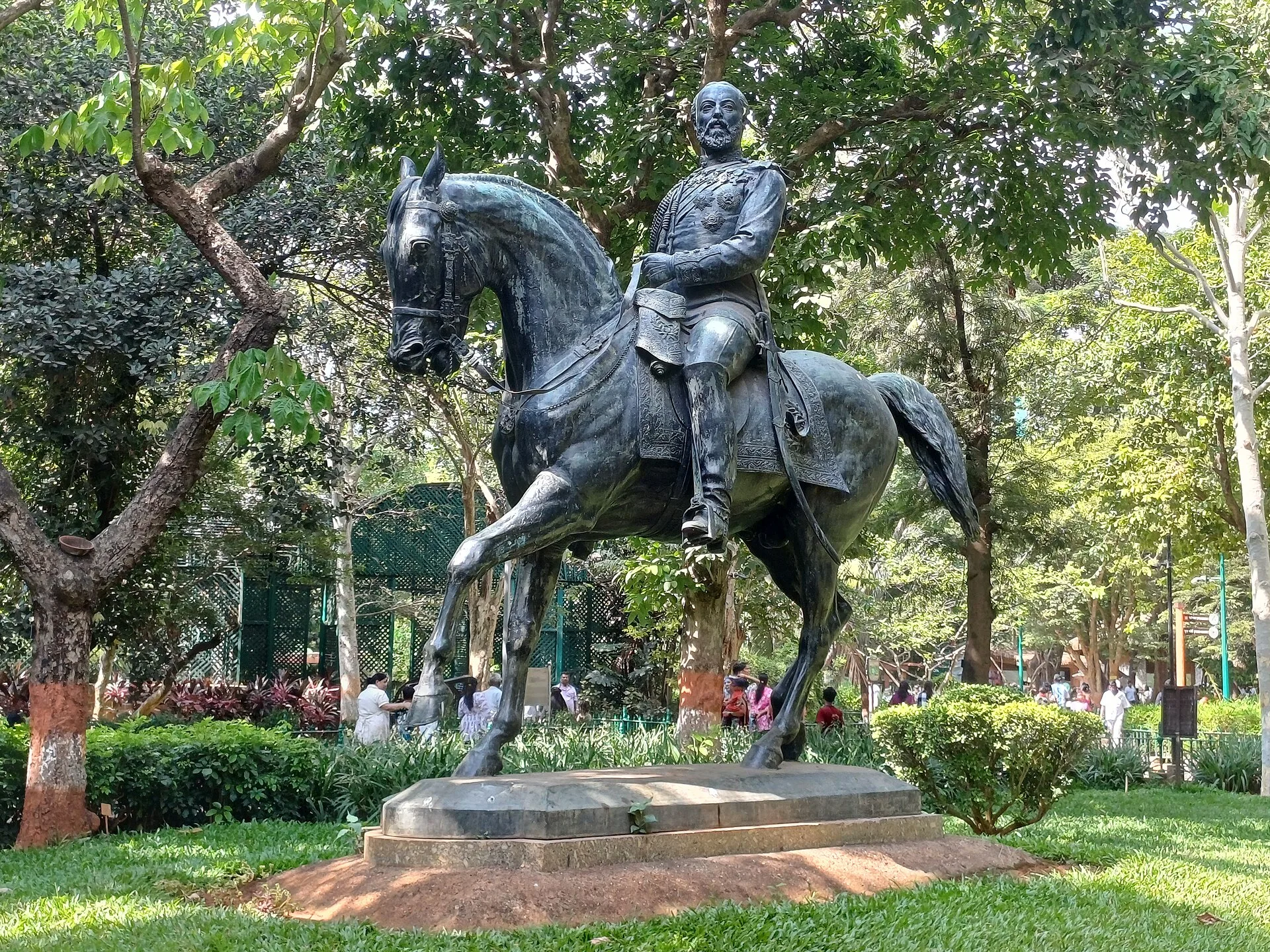
Kala ghoda means black horse. The district is named after an equestrian statue of King Edward VII, who reigned from 1901 to 1910, which once stood in the precinct near the present-day Fort area of Mumbai. The Free Press Journal describes the figure as a bronze statue with a polished black finish. In August 1965 the statue was taken down from its plinth and moved to Jijamata Udyan in Byculla, the city's zoo and garden, also known as Veermata Jijabai Bhosale Udyan. The plinth was separated from the horse and is displayed at the Bhau Daji Lad Museum, according to a digital exhibition on the garden published by the Jio Institute. The neighbourhood kept the name after the statue had gone.
In 2017 the Kala Ghoda Association commissioned a new sculpture for the district, a riderless black horse titled The Spirit of Kala Ghoda. The Association describes itself as a group of citizens, artists, architects and conservationists working to revive and preserve the art district and to draw attention to its historic buildings, museums and cultural institutions. It is also the body that started the Kala Ghoda Arts Festival in 1999. The original Edward VII figure remains at Byculla, and the 2017 sculpture stands in the district that still carries its name.
KALA GHODA AND THE VICTORIAN GOTHIC ENSEMBLE OF MUMBAI
In 2018, at its 42nd session in Manama, the UNESCO World Heritage Committee inscribed the Victorian Gothic and Art Deco Ensembles of Mumbai on the World Heritage List under criteria (ii) and (iv). The property is organised around the Oval Maidan, an open space with an ensemble of Victorian Gothic buildings on its eastern side and an ensemble of Art Deco buildings on its western side. The Committee named the Rajabai Clock Tower as the visual high point of the Victorian group and asked that its dominance of the skyline be maintained. The property and its buffer zone fall within two heritage precincts, the Fort Precinct and the Marine Drive Precinct.
The Art Deco half, on the western side of the Oval Maidan, is covered in how Mumbai built its Art Deco seafront. The Committee asked for the revitalisation of one of its buildings, the Eros Cinema, which no longer functions as a cinema. On the Victorian side, the Chhatrapati Shivaji Maharaj Vastu Sangrahalaya lists itself as part of the 2018 inscription. The decision also recommended urgent conservation of the former Watson's Hotel, known at present as Esplanade Mansions, a Grade IIA heritage building in the Fort area.
ESPLANADE MANSION: HOW WATSON'S HOTEL WAS BUILT IN IRON

Watson's Esplanade Hotel was commissioned by John Hudson Watson, who had started in Bombay as a silk mercer and clothier with a drapery business. It stood on the Esplanade in the Fort area, where the Esplanade met Rope Walk Row. In a 2002 paper in the journal Construction History, Jonathan Clarke shows that the engineer and architect Rowland Mason Ordish (1824 to 1886) designed the building, correcting earlier accounts that credited Watson himself. The ironwork was prefabricated by the Phoenix Foundry Company of Derby, England. The 1865 design specified cast-iron columns and wrought-iron riveted girders under a wrought-iron double roof, with the ornamental parts in cast iron.
On-site assembly of the frame began in 1867. James Douglas, in Bombay and Western India (1893), recorded a traveller's impression of the skeleton that year as "something like a huge birdcage". Shipping every piece of ironwork from England slowed the work, and some components were later cast or fabricated locally in Bombay. The hotel opened on Saturday 4 February 1871 as the Esplanade Hotel, with shops and a restaurant on the ground floor, a dining saloon on the first floor and 130 bedrooms and apartments on three upper storeys. Clarke describes it as the first multi-storey habitable building in the world, on present knowledge, in which all loads are carried on an iron frame. Renamed Esplanade Mansions, it now houses many businesses and tenants.
THE DAVID SASSOON LIBRARY AND THE KENESETH ELIYAHOO SYNAGOGUE
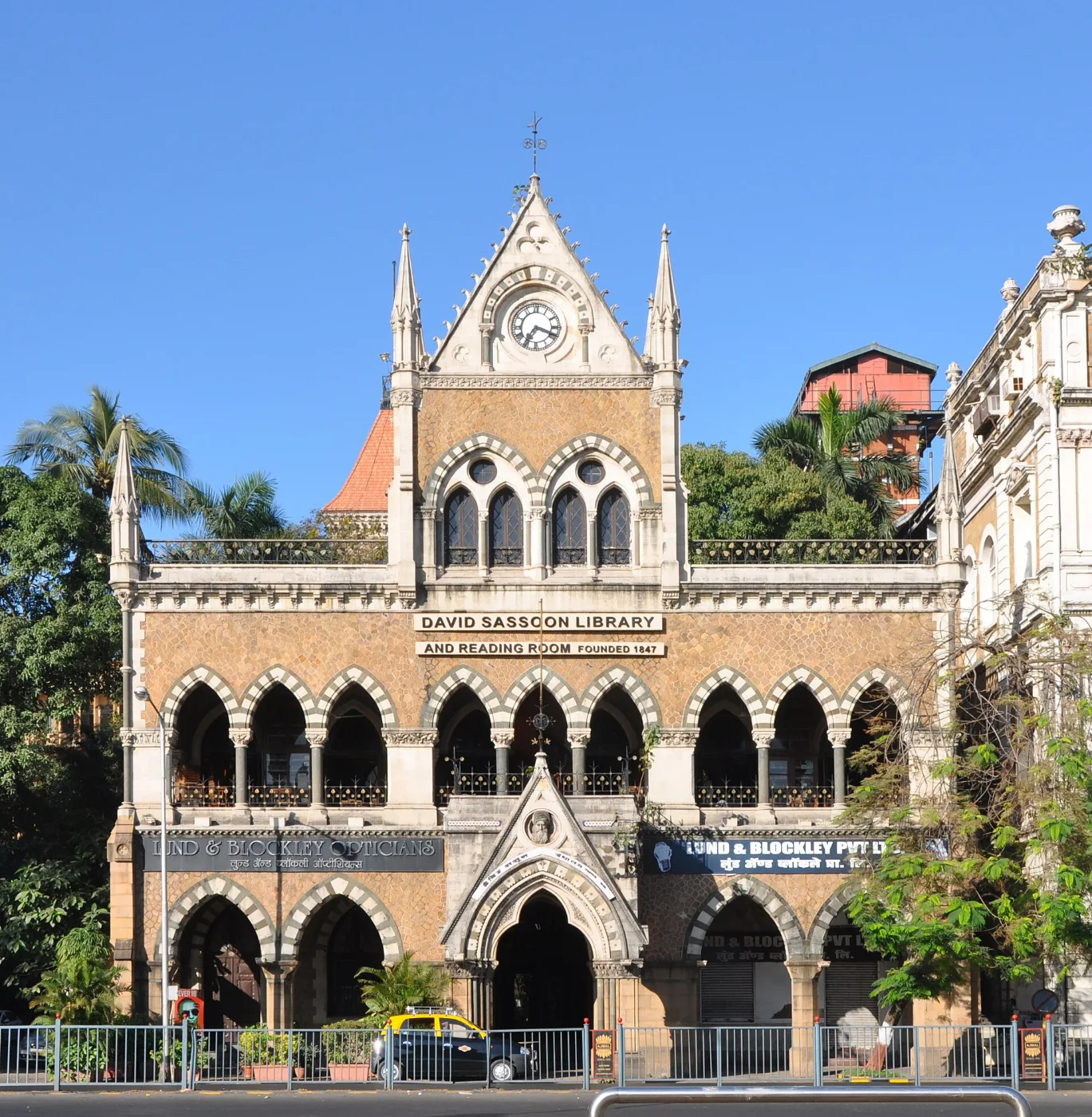
The David Sassoon Library and Reading Room was erected between 1867 and 1870 at a cost of Rs 1.25 lakh, with funds from the Baghdadi Jewish philanthropist David Sassoon, the public and the government. It was built to house the Bombay Mechanics Institution, founded in 1847, which was reconstituted as the Sassoon Mechanics Institute in 1873 and took the name David Sassoon Library around 1923. Its original pitched roof was demolished in the 1960s and replaced with a reinforced concrete structure. A Grade I heritage building, it was restored over 16 months from January 2022 at a cost of Rs 4 crore, funded chiefly by JSW and ICICI, and handed back in June 2023.
The Keneseth Eliyahoo Synagogue was constructed in 1884 to designs by Gostling and Morris, a British architectural firm based in Bombay, and paid for by the Sassoon family. The World Monuments Fund describes it as the second-oldest Sephardic synagogue in Mumbai, built in a classical revival style with Victorian stained glass windows, teakwood furnishings and a staircase from Burma, and Minton tile floors imported from Stoke-on-Trent. The Kala Ghoda Association writes that "an entire Jewish ecosystem once flourished in this area", with the synagogue at its centre, and lists the David Sassoon Library among the Sassoon family's endowments in the district.
Water infiltration had damaged the synagogue's roof, ceiling and wall surfaces. The World Monuments Fund funded a conservation plan in 2010, and a new phase of work ran from 2017 to January 2019, covering structural and roof repairs, the recovery of decorative finishes and the restoration of the nineteenth-century stained glass. The restoration architect was Abha Narain Lambah. The inauguration of the restored building coincided with the Kala Ghoda Arts Festival in February 2019, and in October 2019 the project received an Award of Merit at the UNESCO Asia-Pacific Awards for Cultural Heritage Conservation.
THE CHHATRAPATI SHIVAJI MAHARAJ VASTU SANGRAHALAYA
Prominent citizens of Bombay resolved at a meeting in the Town Hall to mark the visit of the Prince of Wales, later King George V, with a public museum, and the Prince laid the foundation stone on 11 November 1905. A Board of Trustees was constituted by an Act in 1909, and in the same year the Scottish architect George Wittet, known for the Indo-Saracenic style, was selected through an open competition. The building was completed in 1914, handed to the Trustees in 1920 and formally opened to the public as the Prince of Wales Museum on 10 January 1922.
The dome is modelled on the Gol Gumbaz of Bijapur and the finial is copied from the Taj at Agra, and the building is set in a garden that retains its original plan. An extension wing, whose foundation stone was laid in 1933, opened in 1938. The building was declared a Grade I heritage building in 1990, was renamed Chhatrapati Shivaji Maharaj Vastu Sangrahalaya in 2001, and received a UNESCO Asia-Pacific award for the conservation of the building in 2010. The collection now numbers about 70,000 artefacts, including sculpture, bronzes, Indian miniature paintings and European paintings, with separate numismatics and natural history sections.
THE JEHANGIR ART GALLERY AND RHYTHM HOUSE
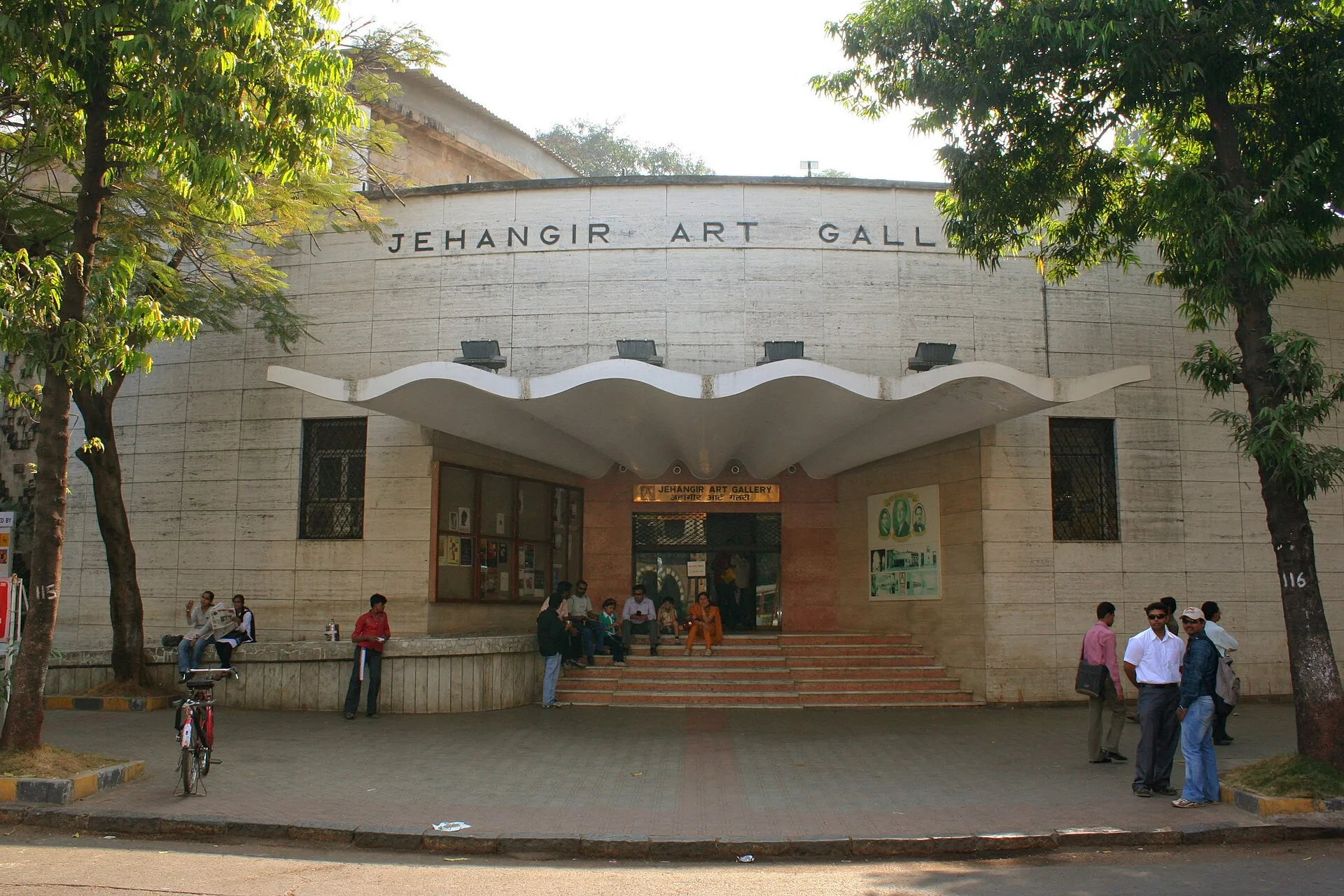
The Jehangir Art Gallery was established in Kala Ghoda in 1952 with donations from Sir Cowasji Jehangir, 2nd Baronet, and was inaugurated on 21 January 1952. Sir Cowasji gave the money in memory of his late son, Jehangir. The building, designed by Durga Bajpai, stands beside the museum in the Fort area at 161 Kala Ghoda and contains seven spaces in all: an auditorium hall, four exhibition galleries, the Hirji Jehangir Gallery and a terrace gallery for photography and visual art.
The gallery hosts more than 300 shows a year across painting, sculpture, printmaking, craft, ceramics, photography and weaving, alongside lectures, workshops and discussions. Artists who have exhibited there include M.F. Husain, S.H. Raza, Akbar Padamsee, Ram Kumar, Anjolie Ela Menon and K.K. Hebbar. Its annual Monsoon Art Show is held for emerging artists. The gallery is run by its committee, chaired by Adi H. Jehangir, and is one of the three landmarks, with the museum and Horniman Circle, around which the Kala Ghoda Arts Festival is organised.
Rhythm House, a music shop that opened in the 1940s, was another Kala Ghoda institution. Scroll describes its blue facade, with the name lettered across it, as a landmark of the area, and calls the shop one of the institutions that made Kala Ghoda a hub of art and culture. It sold vinyl records, then cassettes and then CDs, was known for its knowledgeable staff, and counted big names from the Indian film industry among its patrons. With its last clearance sales over, Rhythm House closed on 1 March 2016, ahead of its scheduled closing date of 7 March.
WHAT IS THE KALA GHODA ARTS FESTIVAL?

The Kala Ghoda Arts Festival was first held in 1999, initiated by the Kala Ghoda Association. It began as a modest art and heritage event and has since expanded to take in theatre, dance, music, literature, film screenings, workshops, food stalls and street performances alongside the visual arts. Each edition turns the area around the Jehangir Art Gallery, the Chhatrapati Shivaji Maharaj Vastu Sangrahalaya and Horniman Circle into a pedestrian-friendly hub for nine days, and the festival remains free and open to all.
The Free Press Journal reports that the festival is widely recognised as Asia's largest multidisciplinary street art festival and that the open-air event draws thousands of visitors each day. The 26th edition ran from Saturday 31 January to Sunday 8 February 2026, and its official prelude was the Kala Gala, held at the Taj Mahal Palace, Mumbai. The February 2019 edition coincided with the inauguration of the restored Keneseth Eliyahoo Synagogue, according to the Kala Ghoda Association, which runs the festival and commissioned The Spirit of Kala Ghoda in 2017.
TRIDENT, NARIMAN POINT ON MARINE DRIVE

The 2018 UNESCO decision places the Mumbai property and its buffer zone within two heritage precincts, the Fort Precinct and the Marine Drive Precinct, and sets the Art Deco ensemble on the western side of the Oval Maidan and the Victorian Gothic ensemble on its eastern side. Trident, Nariman Point stands on Marine Drive in South Mumbai, facing the Arabian Sea. The hotel is a 35-storey tower that opened on 7 April 1973 as the Oberoi-Sheraton and was renamed Trident in 2008 under The Oberoi Group.
Silverfox Studios refurbished the interiors of the hotel's arrival reception, lobby lounge, Ness Bar, ballroom and event spaces under a "Luxury Lifestyle" concept, completing the work in 2025. Ness Bar is on level L1, with views over Marine Drive and the sea. The Oberoi-Sheraton's opening in 1973 came 102 years after Watson's Esplanade Hotel opened on the Esplanade in 1871, with shops and a restaurant on its ground floor, a first-floor dining saloon and 130 bedrooms and apartments, and 51 years after the museum at Kala Ghoda opened to the public in 1922.
SOURCES
- UNESCO World Heritage Centre Decision 42 COM 8B.19: Victorian Gothic and Art Deco Ensembles of Mumbai (India)
- Jio Institute Equestrian statue of King Edward VII
- Free Press Journal The Story Behind Kala Ghoda: Why The Black Horse Defines Mumbai's Art Festival?
- Construction History (Jonathan Clarke) Like a huge birdcage exhaled from the earth: Watson's Esplanade Hotel, Mumbai (1867-71), and its place in structural history
- Free Press Journal Mumbai News: David Sassoon Library and Reading Room at Kala Ghoda restored and handed over in grand ceremony
- World Monuments Fund Keneseth Eliyahoo Synagogue
- Kala Ghoda Association Keneseth Eliyahoo Synagogue, Kala Ghoda
- Chhatrapati Shivaji Maharaj Vastu Sangrahalaya History
- Jehangir Art Gallery About
- Scroll After 61 years, Mumbai's own music store Rhythm House says goodbye with this bittersweet video